A flash LLM model from a Western lab now costs between $0.10 and $0.75 per million input tokens, and its Eastern rival between $0.15 and $0.30. On output the gap widens: $0.50 to $3.75 against $0.28 to $1.20. Those are public list prices checked on 17 November 2026, before caching, batch discounts or off-peak windows. The cheaper token is not automatically the cheaper agent: the benchmark and the billing tier decide that.
This article compares the flash or small tier that Western and Eastern labs sell today — Google’s Gemini 3.8 Flash, OpenAI’s GPT-5.6 Luna and GPT-5 mini, Anthropic’s Claude Haiku 5.5, and on the Eastern side DeepSeek V4.1 Flash, Z.ai’s GLM-5.3-Flash, Alibaba’s Qwen3.8-Flash, Moonshot’s Kimi K2.7, Xiaomi’s MiMo-V2.6-Flash and MiniMax’s M3.1 Flash. Every number below is traced to a named vendor page or a named benchmark paper, with the date it was checked.
Last updated: 17 November 2026. Prices are public list rates, standard tier, in US dollars because that is how the vendors publish them. A ringgit column is shown at the spot rate of 1 dollar to 4.0942 ringgit, taken from the open exchange-rate API on 17 November 2026. No tax, batch, cache-write or enterprise discount is included.
What the flash tier of an LLM model actually is
Flash is a price and latency position, not a quality rank. Vendors use the word for the fast, inexpensive entry in a model family — the one meant for high-volume calls, routing, extraction and the many steps of an agent loop. It sits below the flagship reasoning model, and it is the tier most Malaysian teams will actually call hundreds of times a day.
The distinction matters for a bill. An agent is a loop: read a file, plan, edit, run a test, read the error, edit again. Each step is a separate call that resends the context. The bill is driven by input tokens multiplied by the number of steps, not by the short answer at the end. A cheaper flash tier with a higher failure rate can cost more than a dearer one that finishes in fewer turns.
The four places to compare are the same for every vendor: the input price, the output price, the cached-input price, and the conditions attached — peak windows, introductory rates, long-context surcharges and whether the rate card is the domestic one or the international one.
Western flash models: the prices Google, OpenAI and Anthropic publish
Google’s Gemini API pricing page lists Gemini 3.8 Flash at $0.75 per million input tokens and $3.75 per million output tokens through 31 December 2026, then $1.50 and $7.50 from 1 January 2027. That is an introductory rate with a stated end date, not a permanent price. Batch runs are billed at half those figures and context caching at $0.075 per million tokens during the introductory period.
Google also sells a smaller Gemini 3.1 Flash-Lite at $0.25 input and $1.50 output per million tokens, and Gemini 3.5 Flash-Lite at $0.30 and $2.50. The two Flash-Lite tiers have no published end date on the pricing page checked for this article.
OpenAI’s pricing page lists GPT-5.6 Luna at $0.20 input, $0.02 cached input and $1.20 output per million tokens for prompts of 272,000 tokens or fewer. Above that threshold the rate is $0.40, $0.04 and $1.80. GPT-5 mini is $0.25, $0.025 and $2.00; GPT-5 nano is $0.05, $0.005 and $0.40. Batch is half the standard rate; Fast mode is roughly double. A separate flagship promotion on GPT-5.6 Sol runs to 30 November 2026 — that is a different model and should not be read as a flash-tier price.
Anthropic’s pricing page lists Claude Haiku 5.5 at $0.10 input and $0.50 output per million tokens for prompts up to 100,000 tokens, with cache reads at $0.01. Above 100,000 tokens the same model bills at $0.50 and $2.50. The older Claude Haiku 4.5 is $1 and $5. The announced rise on Sonnet 5 from $2/$10 to $3/$15 was cancelled and is not active — a reminder to check the live vendor page rather than an old announcement.
| Western flash model | Input / 1M | Output / 1M | Approx RM in / out | Condition to note |
|---|---|---|---|---|
| Claude Haiku 5.5 (Anthropic) | $0.10 | $0.50 | RM0.41 / RM2.05 | Up to 100K-token prompts; higher above |
| GPT-5 nano (OpenAI) | $0.05 | $0.40 | RM0.20 / RM1.64 | $0.005 cached input |
| GPT-5.6 Luna (OpenAI) | $0.20 | $1.20 | RM0.82 / RM4.91 | Up to 272K tokens; doubles above |
| GPT-5 mini (OpenAI) | $0.25 | $2.00 | RM1.02 / RM8.19 | $0.025 cached input |
| Gemini 3.1 Flash-Lite (Google) | $0.25 | $1.50 | RM1.02 / RM6.14 | No stated end date |
| Gemini 3.5 Flash-Lite (Google) | $0.30 | $2.50 | RM1.23 / RM10.24 | No stated end date |
| Gemini 3.8 Flash (Google) | $0.75 | $3.75 | RM3.07 / RM15.35 | Introductory; rises to $1.50/$7.50 on 1 Jan 2027 |
Public list prices for the standard tier, read from the vendors’ own pricing pages on 17 November 2026. Ringgit figures use the 1 dollar = 4.0942 ringgit spot rate from the same date and are indicative only. Source: OpenAI, Anthropic and Google pricing documentation.
Eastern flash models: DeepSeek, Z.ai, Alibaba, Moonshot, Xiaomi and MiniMax
DeepSeek’s API documentation names the current model deepseek-flash, served by DeepSeek-V4.1-Flash-1017. The older names deepseek-v4-flash and deepseek-v4-flash-vision-exp are still accepted but the underlying models have been retired and the requests are billed at the Flash price. Its rate card is the only one in this comparison with a peak and off-peak split: cache-miss input is $0.30 at peak and $0.15 off-peak, output is $1.20 at peak and $0.60 off-peak. Peak hours are 01:00–04:00 and 06:00–10:00 UTC, Monday to Friday, excluding Chinese public holidays. Cache-hit input is $0.006 at peak and $0.003 off-peak.
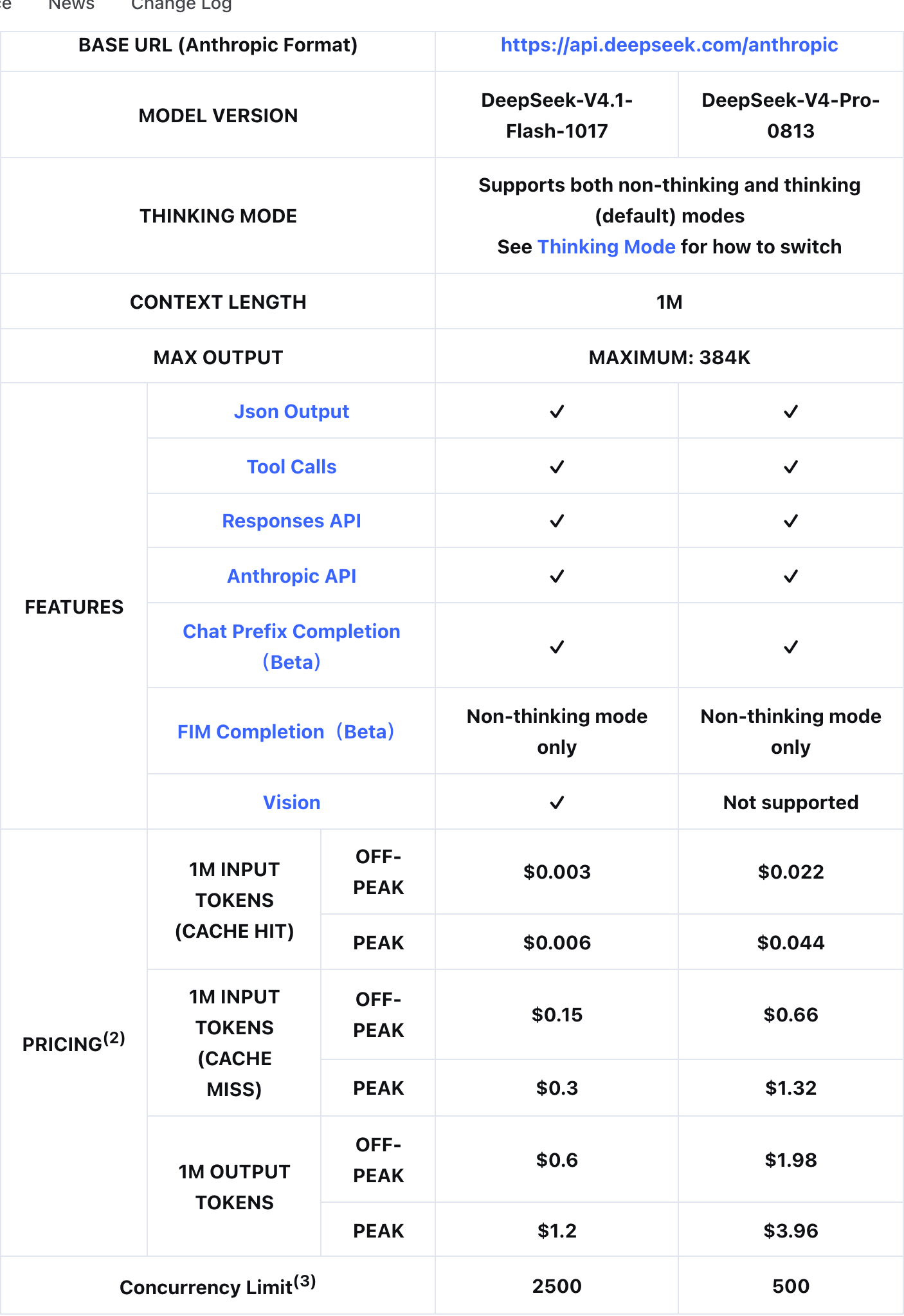
Source: DeepSeek, Models & Pricing (pricing table, deepseek-flash column), api-docs.deepseek.com/quick_start/pricing, captured 17 November 2026.
Z.ai’s international pricing page lists GLM-5.3-Flash at $0.15 input, $0.03 cached input and $0.50 output per million tokens. This is the international dollar rate card. Zhipu’s domestic rate card is priced in yuan and is a different product at a different price — a Malaysian buyer pays the international card. GLM-5.3-FlashX is $0.37 and $1.25.
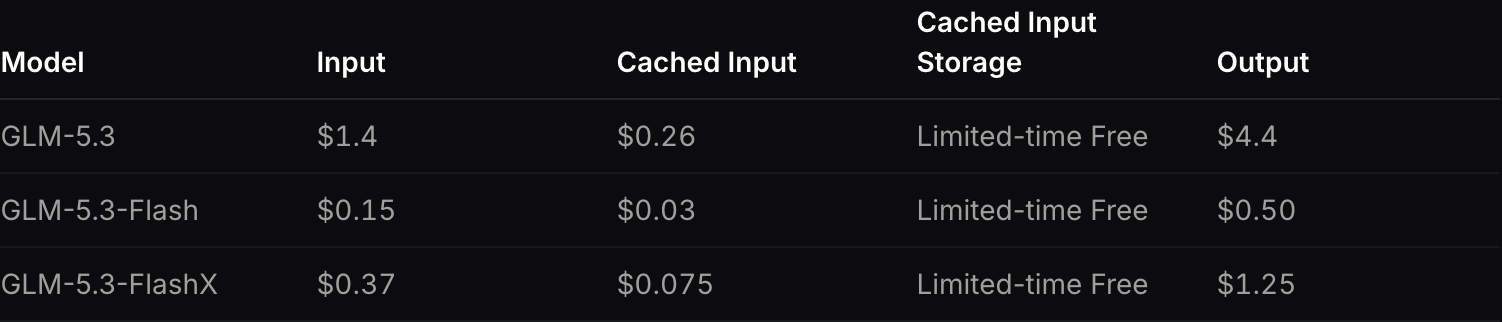
Source: Zhipu’s international developer documentation, Pricing — Latest Models (GLM-5.3-Flash row), docs.z.ai/guides/overview/pricing, captured 17 November 2026.
MiniMax’s own international rate card lists M3.1-Flash at $0.15 input and $0.60 output per million tokens, with prompt-cache reads at $0.015. That is the standard service tier; the priority tier is 1.5 times the standard rate and is switched on with service_tier: priority. The card lists no context-length tier for M3.1-Flash, unlike the flagship M3, which splits its price at a 512,000-token input boundary. The card is published in dollars, so it is the rate a buyer outside China actually pays.
Alibaba’s Model Studio lists qwen3.8-flash as its cost-priority, one-million-token-context model, with thinking mode, tool calling and structured output. Alibaba’s public documentation did not expose the per-token rate in the page checked, so no Qwen price is asserted as a verified figure here. An independent compilation placed Qwen3.8-Flash at $0.15 input and $0.47 output, but that is a secondary report and is labelled as such.
Moonshot’s international Kimi platform does not currently list a flash tier; its cheapest general model is kimi-k2.7-code at $0.95 input and $4.00 output per million tokens, with $0.19 cached input. Moonshot states that K2-series models stop being available to new users from 31 October 2026 and are planned for retirement by the end of December 2026. Kimi K3, the flagship, is $3 and $15. Xiaomi’s MiMo-V2.6-Flash appears in independent compilations at $0.14 input and $0.28 output per million tokens; no first-party international rate card was confirmed for this article.

Source: Moonshot AI, Model Inference Pricing — K2 Series, platform.kimi.ai/docs/pricing/chat, captured 17 November 2026.
| Eastern model | Input / 1M | Output / 1M | Approx RM in / out | Source status |
|---|---|---|---|---|
| Xiaomi MiMo-V2.6-Flash | $0.14 | $0.28 | RM0.57 / RM1.15 | Independent compilation; no first-party card confirmed |
| GLM-5.3-Flash (Z.ai) | $0.15 | $0.50 | RM0.61 / RM2.05 | International vendor rate card, verified |
| MiniMax M3.1 Flash | $0.15 | $0.60 | RM0.61 / RM2.46 | Vendor rate card, verified; Priority tier 1.5×, cache read $0.015 |
| Qwen3.8-Flash (Alibaba) | $0.15 | $0.47 | RM0.61 / RM1.92 | Secondary report; vendor rate not exposed publicly |
| DeepSeek V4.1 Flash, off-peak | $0.15 | $0.60 | RM0.61 / RM2.46 | Vendor rate card, verified; off-peak only |
| DeepSeek V4.1 Flash, peak | $0.30 | $1.20 | RM1.23 / RM4.91 | Vendor rate card, verified; weekday peak hours |
| Kimi K2.7-code (Moonshot) | $0.95 | $4.00 | RM3.89 / RM16.38 | Vendor rate card, verified; retirement planned |
Ringgit figures use the 1 dollar = 4.0942 ringgit spot rate of 17 November 2026 and are indicative only. Rows marked secondary or independent are not first-party vendor rates and should not be treated as quotable list prices. Source: DeepSeek, Z.ai, MiniMax and Moonshot pricing pages; ModelTrends and Yotta Labs compilations for Xiaomi and Alibaba.
Three traps in every flash price comparison
Peak, off-peak and list are different numbers. DeepSeek alone in this set bills by time of day. The same token costs twice as much at 07:00 UTC on a Tuesday as it does on a Saturday. A comparison built on DeepSeek’s off-peak rate and Google’s full introductory rate is not like-for-like. Budget at the peak rate if the workload cannot be scheduled.
Introductory and list prices are different numbers. Gemini 3.8 Flash is $0.75/$3.75 only through 31 December 2026. From 1 January 2027 the same model is $1.50/$7.50. A cost model that uses today’s figure for a 2027 budget understates the bill by half. A flagship promotion on GPT-5.6 Sol ends 30 November 2026; it is not a flash-tier rate.
Domestic and international rate cards are different products. Zhipu publishes a yuan-denominated domestic card and a dollar-denominated international card. GLM-5.3-Flash is $0.15/$0.50 on the international card a Malaysian developer pays. Quoting the domestic yuan price understates the cost. A separate trap is the retired name: DeepSeek’s old deepseek-v4-flash label still accepts requests, but they are served by V4.1-Flash and billed at the Flash price.
What the performance benchmarks actually show
Price is only half the comparison. The third-party ExpertCrowd-SWE paper, submitted on 9 November 2026, ran 100 expert-authored software tasks across 87 open-source projects and 11 languages, five attempts each, on seven frontier agents. It reported Claude Opus 5.5 at 67.3%, GPT-6 Astra at 63.7%, Claude Fable 5.1 at 46.5%, Gemini 3.8 Flash at 40.0%, Qwen 3.8 Max at 33.5%, DeepSeek V4.1 Flash at 32.5% and Grok 4.6 at 32.2%.
The paper’s own conclusion is narrower than the ranking. It groups the seven into four statistical tiers: the top pair is not statistically separated, and the bottom three are not separated from one another. Gemini 3.8 Flash sits alone in the third tier. The authors also found that step count was a poor predictor of success — GPT-6 Astra used a median of 33 steps per run against 160 for Opus and 166 for Gemini 3.8 Flash, yet scored higher than both on average. Their phrase is worth repeating: effort is not capability.
Vendor-reported numbers tell a different story, because the harnesses and the benchmark versions differ. DeepSeek’s own V4.1 Flash card reports 77.0 on DeepSWE v1.1 and 35.4 on Agents’ Last Exam. Z.ai reports GLM-5.3-Flash at 63.4 on DeepSWE v1.1 and 26.3 on Agents’ Last Exam. MiniMax reports M3.1 Flash at 73.7 on DeepSWE v1.1 and 29.6 on Agents’ Last Exam. Qwen reports Qwen3.8-Flash-Next at 58.7 on DeepSWE v1.1 and 24.3 on Agents’ Last Exam. Google’s model card reports Gemini 3.8 Flash at 73.7% on DeepSWE v1.1 and 89.4% on Terminal-Bench 2.1, but a separate compilation records 71.0 for the same model on DeepSWE v1 rather than v1.1 — the two suites are not directly comparable.
These figures should not be averaged into a single winner. One benchmark asks a model to turn requirements into a repository, another runs longer software-engineering workflows, and a third targets agentic problem solving. Tools, harnesses and attempt budgets differ. A lead on one is evidence for that task, not proof of a universal result.
| Model | DeepSWE v1.1 | Agents’ Last Exam | ExpertCrowd-SWE | Reported by |
|---|---|---|---|---|
| Gemini 3.8 Flash | 73.7% (vendor card) | not published | 40.0% | Google; independent paper |
| DeepSeek V4.1 Flash | 77.0 | 35.4 | 32.5% | DeepSeek; independent paper |
| GLM-5.3-Flash | 63.4 | 26.3 | not reported | Z.ai |
| MiniMax M3.1 Flash | 73.7 | 29.6 | not reported | MiniMax |
| Qwen3.8-Flash-Next | 58.7 | 24.3 | not reported | Alibaba |
Values are as reported by each vendor or by the named paper, on different harnesses and settings. Blank cells mean the figure was not published by that source — not a score of zero. Source: vendor model cards compiled by Latent Space and Local AI Zone; AGI Tracker, ExpertCrowd-SWE, 9 November 2026.
Speed and context: the other half of flash performance
Flash models compete on throughput as much as on price. An independent compilation measured DeepSeek V4.1 Flash at about 214 output tokens per second. MiniMax reports more than 200 tokens per second for M3.1 Flash with a median above 170, and Z.ai describes GLM-5.3-Flash as using hybrid sparse and linear attention to keep long contexts accurate. These are different measurement setups and are not a like-for-like speed ranking.
Context length is easier to compare because the vendors publish it. DeepSeek V4.1 Flash, GLM-5.3-Flash, Qwen3.8-Flash and Gemini 3.8 Flash all advertise a one-million-token context. Claude Haiku 5.5 changes price at 100,000 tokens and GPT-5.6 Luna at 272,000 — for those two, context is a billing boundary, not just a capability. MiniMax M3.1 Flash is reported at one million tokens and Kimi K3 at 1,048,576 tokens.
What a flash model costs for a real agent workload
Take a workload of ten million input tokens and two million output tokens in a month — roughly what a small team’s coding or document agent can consume. Using standard list rates with no cache or batch discount, DeepSeek V4.1 Flash at off-peak rates comes to about $2.70 for that month, and at peak rates about $5.40. Gemini 3.8 Flash at its introductory rate comes to about $15.00, and at the 2027 list rate about $30.00. Claude Haiku 5.5 on short prompts comes to about $2.00.
In ringgit at the same 4.0942 rate, that is approximately RM11 off-peak and RM22 at peak for DeepSeek, RM61 introductory and RM123 at the 2027 rate for Gemini 3.8 Flash, and RM8 for Claude Haiku 5.5. The spread between the cheapest and dearest flash option on this one workload is more than seven times — before a single failed task is retried.
That is why the benchmark matters to the bill. If the cheaper model needs more turns to finish the same ticket, the saved token rate is spent on repeated context. The ExpertCrowd-SWE result that step count and score barely correlate cuts both ways: paying for more steps is not a quality guarantee, and paying for fewer steps is not a saving if the task fails.
Which flash model fits which job
- High-volume, cost-led work with schedulable batch windows: DeepSeek V4.1 Flash at off-peak rates, provided the peak-hour surcharge is acceptable when work cannot wait.
- Agentic coding where published benchmark performance leads: DeepSeek V4.1 Flash and Gemini 3.8 Flash both carry strong reported coding results, at very different prices and with different benchmark caveats.
- Short-prompt, high-volume calls on a Western API: Claude Haiku 5.5 at $0.10/$0.50 for prompts under 100,000 tokens is the lowest published rate in this set.
- Long-context document and multimodal work: the one-million-token models — Gemini 3.8 Flash, GLM-5.3-Flash, MiniMax M3.1 Flash, Qwen3.8-Flash and DeepSeek V4.1 Flash — avoid the surcharge boundaries that apply to Haiku 5.5 and GPT-5.6 Luna.
- Teams planning a 2027 budget: recalculate any Gemini 3.8 Flash line at $1.50/$7.50, and treat the current $0.75/$3.75 as a dated introductory rate.
What could not be confirmed
- Alibaba’s per-token rate for Qwen3.8-Flash. The public Model Studio page confirmed the model and its capabilities but did not expose a per-token price. The $0.15/$0.47 figure is a secondary compilation and is labelled as such.
- A first-party international rate card for Xiaomi MiMo-V2.6-Flash. The $0.14/$0.28 figure comes from independent compilations.
- A current Kimi flash tier. Moonshot’s international pricing page lists K2 and K3 series, not a flash model. The K2 series has a stated retirement plan.
- Independent reproduction of vendor benchmark numbers. Every DeepSWE and Agents’ Last Exam figure here is the vendor’s own report. Only ExpertCrowd-SWE is a separate paper, and it uses its own task set and harness.
- Malaysian search demand for these exact phrases. `flash llm models`, `llm price comparison 2026`, `gemini flash vs deepseek` and `cheapest llm api 2026` returned no data in the MY keyword database on 17 November 2026. `llm model` recorded 320 searches a month at difficulty 90, `large language model` 660 at 98, `agentic ai` 3,200 at 100 and `deepseek` 450,000 at 100. No data is not zero.
Frequently asked questions
Which flash LLM model is cheapest right now?
On published input price, GPT-5 nano is $0.05 per million tokens and Claude Haiku 5.5 is $0.10 for short prompts. Among models with one-million-token context, GLM-5.3-Flash, MiniMax M3.1 Flash, Qwen3.8-Flash and DeepSeek V4.1 Flash off-peak start at $0.15. The cheapest input token is not the cheapest completed task — output price, cache hits and retries change the total.
Is DeepSeek V4.1 Flash cheaper than Gemini 3.8 Flash?
On list rates, yes: $0.15/$0.60 off-peak against $0.75/$3.75 introductory, or $0.30/$1.20 at DeepSeek peak against $1.50/$7.50 for Gemini from 1 January 2027. On the independent ExpertCrowd-SWE paper, Gemini 3.8 Flash scored 40.0% and DeepSeek V4.1 Flash 32.5%, so the price gap comes with a reported capability gap on that task set.
What does DeepSeek peak and off-peak mean in Malaysia?
Peak hours are 01:00–04:00 and 06:00–10:00 UTC on weekdays, excluding Chinese public holidays. Malaysian time is UTC+8, so that is 09:00–12:00 and 14:00–18:00 Malaysian time on weekdays. All other hours, including weekends, bill at half the peak rate.
Are the Chinese model prices the ones a Malaysian company pays?
Only if the international dollar rate card is used. Zhipu, Alibaba, Moonshot and Xiaomi publish domestic yuan rates as well. The yuan card is a different product at a different price, and accessing it may require a mainland account and payment method. This article quotes the international rates where a vendor publishes them.
Do cached inputs matter for agent cost?
Yes. An agent resends the same system prompt and tool definitions at every step, so a cache hit can cover much of the input. Claude Haiku 5.5 charges $0.01 per million cached input tokens, GPT-5.6 Luna $0.02, DeepSeek V4.1 Flash $0.003 off-peak, MiniMax M3.1 Flash $0.015 and GLM-5.3-Flash $0.03. The cache only matches when the beginning of the prompt stays identical.
Sources
- OpenAI, API Pricing, standard, batch and Fast-mode tables, read 17 November 2026 — developers.openai.com/api/docs/pricing
- Anthropic, Claude API Pricing, Haiku and batch tables, read 17 November 2026 — platform.claude.com/docs/en/about-claude/pricing
- Google, Gemini API Pricing, Flash and Flash-Lite tables, read 17 November 2026 — ai.google.dev/gemini-api/docs/pricing
- DeepSeek, Models & Pricing, read 17 November 2026 — api-docs.deepseek.com/quick_start/pricing
- Z.ai, Pricing — Latest Models, international rate card, read 17 November 2026 — docs.z.ai/guides/overview/pricing
- Moonshot AI, Model Inference Pricing, read 17 November 2026 — platform.kimi.ai/docs/pricing/chat
- MiniMax, Pricing Overview, international rate card, standard tier, read 17 November 2026 — platform.minimax.io/docs/guides/pricing-paygo
- Alibaba Cloud, Text Generation and Visual Understanding and Models, read 17 November 2026 — alibabacloud.com/help/en/model-studio/text-generation-model
- AGI Tracker, ExpertCrowd-SWE: a tie at the top and what five runs reveal, 9 November 2026 — agitracker.io/blog/expertcrowd-swe-repeated-runs
- Forkast, ExpertCrowd-SWE finds four coding-agent tiers, but top pair remains unresolved, 9 November 2026 — forkast.news/expertcrowd-swe-finds-four-coding-agent-tiers-but-top-pair-remains-unresolved
- Yotta Labs, Best Chinese LLMs and AI Models in 2026 (model and rate compilation), read 17 November 2026 — yottalabs.ai/post/best-chinese-llm-models-2026-deepseek-qwen-glm-kimi-compared
- ModelTrends, How to choose an AI model in October 2026 (rate compilation), read 17 November 2026 — modeltrends.ai/traditional-chinese/指南/how-to-choose-an-ai-model-october-2026
- Open Exchange Rates API, US-dollar spot rates, read 17 November 2026 — open.er-api.com — latest US-dollar rates
- SE Ranking, DATA_getKeywordsMetrics, source MY, measured 17 November 2026 — internal SEO record, see meta.json
demandblock
BD Media is the editorial desk of Big Domain. This article records published vendor prices and reported benchmark results as at 17 November 2026. It is not procurement advice. No secondary rate is presented as a verified list price, and no vendor-reported benchmark is presented as independently reproduced.