Budget 2027 Malaysia was tabled in the Dewan Rakyat on Friday 9 October 2026 at 3.35pm, half an hour earlier than the usual 4pm slot, with total spending of RM459.8 billion — 3.6% above the revised 2026 allocation and 19.8% of gross domestic product. It was tabled by Prime Minister Datuk Seri Anwar Ibrahim, who is also Finance Minister. It is the fifth MADANI budget and the second under the 13th Malaysia Plan, and it carries the theme “Malaysia MADANI: Menggapai di Langit, Mengakar di Bumi” (Reaching to the Sky, Rooted in the Earth).
This page is our running record of Budget 2027 Malaysia. It now carries the tabled measures themselves, the fiscal architecture underneath them, and what Malaysian business asked for before the speech. It is updated through the debate and the committee stage, and every figure carries its source and date.
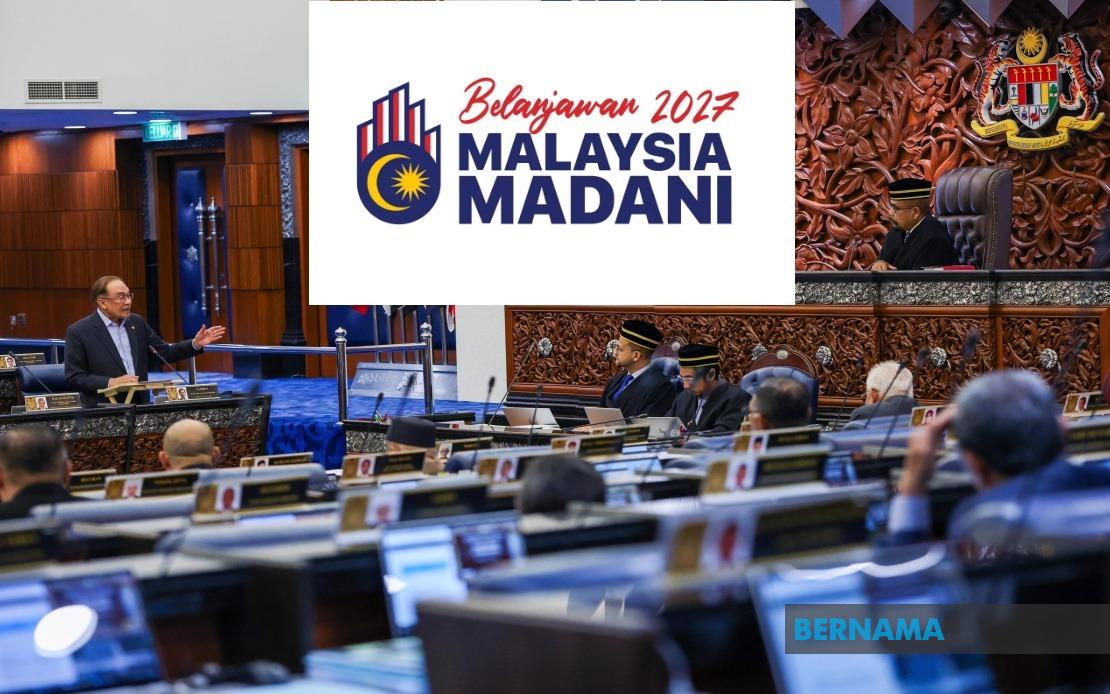
Photo: Bernama. Prime Minister Datuk Seri Anwar Ibrahim at the Dewan Rakyat despatch box, where the national budget is tabled. Image published by Bernama with its Budget 2027 report, 9 October 2026.
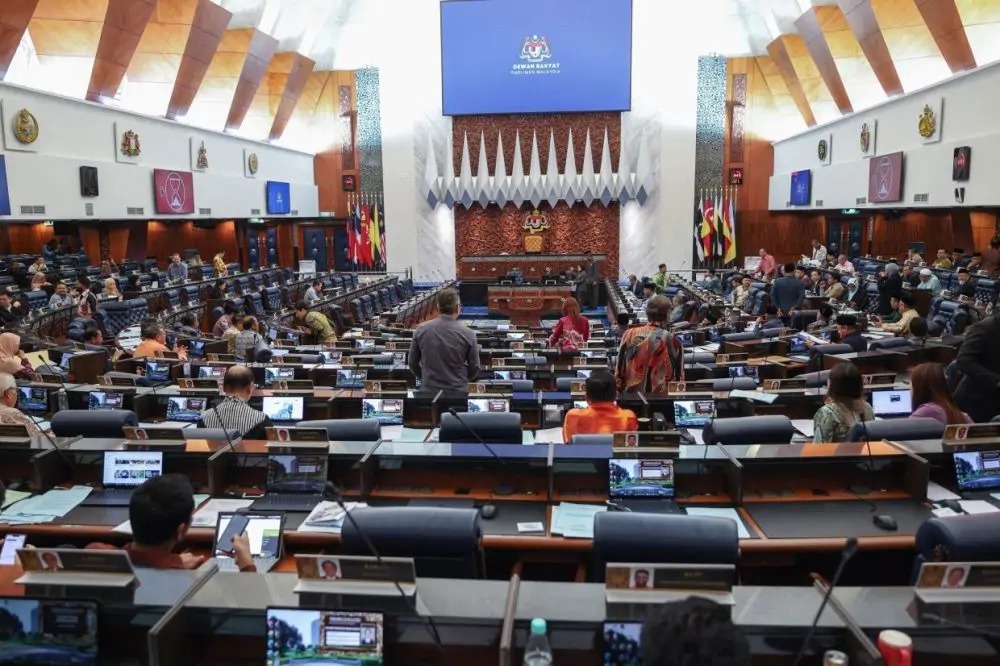
Photo: The Star. The Dewan Rakyat chamber, where Budget 2027 is tabled on 9 October 2026. Read 9 October 2026 at https://www.thestar.com.my/news/nation/2026/10/09/budget-2027-to-be-tabled-in-parliament-today
How to read this page. Two kinds of number appear below and they are labelled differently on purpose. “Tabled” figures are read from the Budget 2027 speech and Ministry of Finance documents. “Expected” figures are the published forecasts or requests of named bodies (economists, associations, unions) and are not government commitments. If a figure is later clarified or corrected, we update it here and date the change. We do not publish a number we have not read at source.
Budget 2027 Malaysia: what is confirmed
| Item | Detail | Source |
|---|---|---|
| Tabled | 9 October 2026, 3.35pm, Dewan Rakyat | Bernama, 9 Oct 2026 |
| Tabled by | PM Datuk Seri Anwar Ibrahim, also Finance Minister | Bernama; The Star, 9 Oct 2026 |
| Theme | “Malaysia MADANI: Menggapai di Langit, Mengakar di Bumi” | Ministry of Finance, Pre-Budget Statement 2027 |
| Which budget | 5th MADANI budget; 2nd under the 13th Malaysia Plan | Bernama, 9 Oct 2026 |
| Three pillars | Raising the growth ceiling · raising the floor of living standards · governance reform | MOF Pre-Budget Statement, 18 Aug 2026 |
| Growth backdrop | H1 2026 actual 5.7%; 2026 full year seen at the upper end of 4.8–5.3%; 2027 forecast 4.2–5.2% | MoF, Economic Outlook 2027; Bernama, 9 Oct 2026 |
| Budget portal | belanjawan.mof.gov.my, opened 18 August 2026 for public submissions | Ministry of Finance |
The tabled measures
These are read from the speech and the Ministry of Finance documents released with it. They are the measures themselves, not forecasts.
| Area | Measure | Effective |
|---|---|---|
| Individual income tax | Individual tax relief raised from RM9,000 to RM12,000 — the first review since 2010 | YA 2027 |
| Individual income tax | Rate cut by one percentage point: 18% on RM70,001–RM100,000; 24% on RM100,001–RM150,000 | YA 2027 |
| Individual income tax | Rate raised to 30% on chargeable income above RM1 million | YA 2027 |
| Individual income tax | Net effect: up to RM1,600 more disposable income for about 5 million taxpayers | YA 2027 |
| Tax relief scope | Expanded to postnatal care; all care expenses for parents and grandparents; sports shoes; all fields of study and children’s tuition; AI subscriptions; vaccination costs; pet adoption from registered centres | YA 2027 |
| Minimum wage | Raised from RM1,700 to RM2,000 a month, covering more than 4 million workers | June 2027 |
| Minimum wage — exemption | MSMEs with annual sales below RM50 million are exempt from the new minimum wage | June 2027 |
| Wage floor | New RM2,500 monthly baseline for semi-skilled workers and graduates | 2027 |
| Living wage | GLIC and GLC living-wage benchmark raised from RM3,100 to RM3,400 — about 230,000 workers | 2027 |
| Wage tax deduction | Non-MSME companies may only deduct wage expenses if wages are paid through bank accounts, on channels permitted under the Employment Act 1955 — aimed at employers of undocumented foreign workers | 2027 |
| Cash transfers | STR and SARA allocation raised from RM15 billion to RM16 billion; all STR recipients now eligible for SARA up to RM150 a month (RM1,800 a year) | 2027 |
| Cash transfers | Malaysians aged 18 and above who are not STR recipients get SARA MADANI RM100 twice — before Aidilfitri, and around the 70th National Day | 2027 |
| SARA network | SARA usable for wet and fresh produce at 216 farmers’ markets / tamu under FAMA; 15,000 participating outlets including 6,800 small grocery shops | 2027 |
| Gig workers | Government and Grab co-fund a RM160 million package: e-hailing net income up to +RM227 a month, p-hailing up to +RM100 a month, for about 600,000 workers | from 2027 |
| Gig workers | PERKESO matching 35%, rising to 50% if platform companies also contribute; 70% matching for more than 200,000 self-employed people across 17 sectors; EPF matching up to RM600 a year / RM6,000 lifetime | 2027 |
| Gig workers | BSN and Agrobank provide RM270 million to finance business start-ups and first homes; p-hailing to be regulated under APAD and LPKP | 2027 |
| Retirement protection | PERKESO tax relief extended to Lindung Kendiri mandatory contributions; up to RM150 extra relief for voluntary Lindung 24 Jam and Lindung Kendiri | YA 2027 |
| Cost of living | Jualan RAHMAH MADANI and Jualan Agro MADANI raised from RM630 million to RM750 million; 35,000 sales events (30,000 RAHMAH, 5,000 Agro, with Agro prices up to 30% lower) | 2027 |
| Rural supply | RM250 million to distribute essential goods to rural and remote areas, covering six new locations including Penampang (Sabah) and Pusa (Sarawak) | 2027 |
Source: Budget 2027 speech and the Ministry of Finance’s Fiscal Outlook and Federal Government Revenue Estimates 2027, tabled 9 October 2026, as reported by Bernama, The Star, Sinar Daily, The Vibes and the New Straits Times the same day. Read 9 October 2026.
The fiscal architecture
| Item | 2027 | Comparison |
|---|---|---|
| Total expenditure | RM459.8 billion | +3.6% on the revised 2026 allocation; 19.8% of GDP |
| 2026 allocation, revised | RM444.1 billion | revised up from RM419.2 billion |
| Operating expenditure | RM376.8 billion (81.9%) | RM363.1 billion in 2026 |
| Development expenditure | RM83 billion | RM81 billion in 2026; at least 3% of GDP as required by Act 850 |
| Education, Health, Defence | RM138.85 billion (30.2%) | — |
| Social sector | RM161.6 billion (35.1%) | largest share of expenditure |
| Subsidies and social assistance | RM72.7 billion (19.3% of OE) | down 2.3%; RM74.47 billion in 2026, RM55.27 billion in 2025 |
| Debt service charges | RM61 billion (16.2% of OE) | up 6.5%; 98.4% domestic |
| Emoluments | RM111.6 billion (29.6% of OE) | up 2.9% |
| Revenue | RM380.8 billion | up 4.7% |
| Petronas dividend | RM32 billion | RM27 billion estimated for 2026 |
| Fiscal deficit | 3.3% of GDP | 3.6% in 2026 and 3.7% in 2025; on the path to 3.0% |
| Inflation | 1.8–2.8% | 2026 revised to 1.5–2.5% |
Source: Ministry of Finance, Fiscal Outlook and Federal Government Revenue Estimates 2027 and Economic Outlook 2027, released 9 October 2026; reported by Bernama. Deficit revision for 2026 reported by Reuters, 9 October 2026.
Two figures that get mis-quoted, so we state them precisely. Budget 2027 is +3.6% higher than the revised 2026 allocation of RM444.1 billion — not 10% higher than the original RM419.2 billion. And the 2026 fiscal deficit target was revised up from 3.5% to 3.6% of GDP, largely on the fuel subsidy bill, before falling to 3.3% in 2027.
The arithmetic is the check. RM459.8 billion is +3.6% over RM444.1 billion; over RM441.1 billion it would be +4.2%, which is not the figure the Ministry of Finance published. The components agree: 2026 operating expenditure of RM363.1 billion plus development expenditure of RM81 billion is RM444.1 billion — the same total, reached two ways. One wire report carried RM441.1 billion; the ministry’s own numbers and The Edge’s reading of the Fiscal Outlook do not support it. We use RM444.1 billion.
SME and co-operative financing, line by line
The agency-level allocations were published in the Ministry of Finance’s Anggaran Perbelanjaan Persekutuan 2027, released with the speech. These are the development allocations for the bodies that deliver SME and co-operative financing. They sit inside the KUSKOP ministry total, so they should be read as parts of it rather than additions to it.
| Body | 2027 development allocation | Notes |
|---|---|---|
| KUSKOP (the ministry, all agencies) | RM753.2 million | 2026 revised: RM707.4 million. Operating: RM275,248,500 |
| SME Corp Malaysia | RM137.0 million | Of which Program Peningkatan dan Pembangunan PKS RM112.0m; Dana Pembangunan dan Pembiayaan PKS RM22.0m; Pembangunan Perusahaan Mikro RM3.0m. Operating: RM42,756,400 |
| TEKUN Nasional | RM550.0 million | 2026 revised: RM530.0 million. Operating grant: RM3.0 million |
| INSKEN (National Entrepreneurship Institute) | RM9.4 million | Operating: RM12,000,900 |
| Suruhanjaya Koperasi Malaysia (SKM) | RM10.5 million | Co-operative development. Operating: RM91.0 million |
Source: Ministry of Finance, Anggaran Perbelanjaan Persekutuan 2027 (Federal Expenditure Estimates 2027), B.26 / P.26, published 9 October 2026. Read 9 October 2026 at https://belanjawan.mof.gov.my/pdf/belanjawan2027/perbelanjaan/Anggaran_Perbelanjaan_Persekutuan_2027.pdf
What happens next in Parliament
The Supply Bill 2027 was moved for its second reading at 3.35pm on 9 October. Under the Dewan Rakyat calendar the policy-stage debate runs for eight days from Monday 12 October, ministerial winding-up sessions are scheduled for 26–29 October, and the committee stage runs from 2 to 26 November before the Bill is put to the House. Budget estimates can change during the committee stage, so figures on this page are dated.
Source: Bernama, “PM Anwar Tables 2027 Budget, Drives MADANI Agenda”, 9 October 2026.
The ten focus areas named in advance
The Ministry of Finance published ten focus areas in its Pre-Budget Statement on 18 August 2026, saying they would be refined with public feedback before the tabling. They remain the clearest statement of the government’s own priorities.
| # | Focus area | What it covers |
|---|---|---|
| 1 | Social justice and development for all | Closing development gaps including Sabah, Sarawak and rural areas; empowering MSMEs, cooperatives, youth, women and vulnerable communities |
| 2 | Protecting people from cost-of-living pressure | Continuing subsidy and social-assistance reform; household costs across food, housing, transport, health, education and childcare |
| 3 | Strengthening social protection | Reviewing EPF and PERKESO coverage, including gig and informal workers, and preparing for aged-nation status by 2030 |
| 4 | Education, health and basic services | TVET, STEM, digital and AI skills; reducing congestion in health facilities; widening access to basic services |
| 5 | Spending that delivers best value | Outcome-oriented expenditure; reducing leakage; ensuring programmes reach the people they are meant for |
| 6 | Governance and delivery | Expanding GovTech, digital identity and data integration; cutting bureaucratic friction |
| 7 | Worker welfare and dignified wages | Reskilling, AI skills, productivity growth and raising women’s participation in the labour force |
| 8 | Local entrepreneurs and “Made by Malaysia” | Helping local firms grow and compete in ASEAN and global markets; commercialising Malaysian technology and IP |
| 9 | High-value investment and jobs | Semiconductors, AI, digital, energy transition, pharmaceuticals, logistics and aerospace |
| 10 | Energy, food, climate and cyber security | Clean energy, agrifood, disaster preparedness and protection against cyber threats |
Source: Ministry of Finance, Budget 2027 Pre-Budget Statement, 18 August 2026. Read 9 October 2026 at https://www.astroawani.com/berita-bisnes/belanjawan-2027-dibentang-9-oktober-kerajaan-garis-10-tumpuan-utama
What Malaysian business asked for
The submissions are on the record and they point in one direction: less emphasis on the size of an allocation, more on whether it changes anything.
The Ministry of Entrepreneur and Cooperatives Development (KUSKOP) said on 8 October that its priorities for Budget 2027 are more funding and resources for SMEs, lower costs of doing business, and better efficiency in how government assistance is delivered. Its minister, Steven Sim Chee Keong, also flagged a revised SME definition, movement on corporate tax thresholds, and stronger protection against late payment, while noting the details would have to wait for the tabling.
The SME Association of Malaysia (SMEAM) put six proposals on the table on 2 October, with the central demand that assistance be judged on demonstrated outcomes (productivity, competitiveness, business performance) rather than eligibility on paper.
SAMENTA sent the Ministry of Finance 15 proposals, with copies to KUSKOP and MITI. Its national president, Datuk William Ng, named zero-collateral export credit refinancing as the association’s first priority, followed by a review of the 2% dividend tax and a double tax deduction for SMEs moving from contract manufacturing to their own brands. The submission also asks for at least 30% of government and GLC procurement to be reserved for domestic SMEs through competitive bidding, and for a productivity-linked wage system in place of a flat minimum-wage floor.
The Malaysian Trades Union Congress (MTUC) has called for the minimum wage to rise to RM3,100 from the current RM1,700, arguing that government-linked companies should demonstrate the higher floor before the private sector is pressed to follow. Six GLICs adopted a RM3,100 living wage for permanent employees from May 2025, and the Prime Minister has said 34 GLCs and GLICs have adopted it. The tabled increase is to RM2,000 in June 2027, with the GLIC and GLC benchmark moving to RM3,400.
What economists expected, and how it compares
A pre-budget note from TA Securities listed nine measures it considered likely: an increase of about RM100 each in the STR and SARA cash-transfer programmes; a minimum wage rise of RM100 to RM200, taking it to RM1,800 to RM1,900; enhanced tax relief aimed at the M40 rather than new broad-based taxes; an extension of the full stamp-duty exemption for first homes; wider housing-finance support; extensions to solar and battery-storage incentives; a carbon-pricing roadmap; continued infrastructure spending; and incentives for the automotive and EV ecosystem.
The STR and SARA increase and the M40 tax relief landed, and both came in above the forecast. The minimum wage rose by RM300 rather than the RM100–RM200 modelled. The remaining items on that list — stamp duty and housing finance, solar and battery storage, carbon pricing, and EV incentives — are not confirmed by the documents we have read. The government has repeatedly said it does not intend to reintroduce GST and will instead continue to refine the SST regime.
Live updates
Newest first. Each entry carries its source and the time we read it.
- 9 Oct 2026, 16:35 — the tabled budget Budget 2027 commits RM459.8 billion, with the deficit falling to 3.3% of GDP. The 2026 allocation was revised up to RM444.1 billion and the 2026 deficit target revised from 3.5% to 3.6%, largely on the fuel subsidy bill. Operating expenditure takes RM376.8 billion (81.9%) and development expenditure RM83 billion. Education, Health and Defence together receive RM138.85 billion, or 30.2% of the total. Revenue is projected at RM380.8 billion, up 4.7%, including a RM32 billion Petronas dividend. Source: Ministry of Finance, Fiscal Outlook and Federal Government Revenue Estimates 2027, released 9 October 2026; Bernama, 9 October 2026.
- 9 Oct 2026, 16:35 — wages The minimum wage rises from RM1,700 to RM2,000 a month from June 2027, and MSMEs below RM50 million in annual sales are exempt. More than four million workers are covered by the increase. The budget also introduces a RM2,500 monthly baseline for semi-skilled workers and graduates, and raises the GLIC and GLC living-wage benchmark from RM3,100 to RM3,400, affecting about 230,000 workers. Employee compensation is only 33.9% of GDP, which the Prime Minister gave as the reason for moving. Source: Budget 2027 speech, 9 October 2026; Sinar Daily, Media Selangor, The Vibes and SAYS, all 9 October 2026.
- 9 Oct 2026, 16:35 — tax Individual tax relief goes from RM9,000 to RM12,000 and selected rates come down. The rate falls to 18% on chargeable income of RM70,001 to RM100,000 and to 24% on RM100,001 to RM150,000, while income above RM1 million is taxed at 30%. The government puts the combined effect at up to RM1,600 of extra disposable income for about five million taxpayers. Relief has also been widened to AI subscriptions, postnatal care, all care expenses for parents and grandparents, children’s tuition, vaccination and pet adoption from registered centres. Source: Budget 2027 speech, 9 October 2026; Bernama and The Star, 9 October 2026.
- 9 Oct 2026, 16:35 — households and gig workers STR and SARA rise to RM16 billion, and gig workers get a RM160 million package. All STR recipients can now draw SARA of up to RM150 a month, and Malaysians aged 18 and over who are not on STR receive SARA MADANI of RM100 on two occasions. SARA can be used for wet and fresh produce at 216 farmers’ markets and tamu. For the roughly 600,000 e-hailing and p-hailing workers, the government and Grab will co-fund a RM160 million package; PERKESO matching is set at 35%, rising to 50% where platforms also contribute. Source: Bernama and Sinar Daily, 9 October 2026.
- 9 Oct 2026, before the speech Budget 2027 is tabled at 3.30pm. The Dewan Rakyat sitting was scheduled half an hour earlier than the usual 4pm slot. The measures above replace the pre-tabling position this entry previously carried. Source: Bernama and The Star, 9 October 2026.
Related coverage
- Budget 2027 SME Wishlist: SAMENTA’s 15 Asks: the association’s submission to the Ministry of Finance
- Budget 2027 Malaysia: SMEs Want Outcomes, Not Allocations: the SME Association of Malaysia’s submission
- Budget 2027 SST: What Malaysia’s Tax Experts Want Changed
- Labuan Service Tax: SMEs Seek Section 48 Relief
- Malaysia Minimum Wage: What Budget 2027 Signals for SMEs
Sources
Sources
Ministry of Finance: Budget 2027 speech; Economic Outlook 2027; Fiscal Outlook and Federal Government Revenue Estimates 2027; Pre-Budget Statement, 18 August 2026; and the Budget portal at belanjawan.mof.gov.my.
Bernama, 9 October 2026: “PM Anwar Tables 2027 Budget, Drives MADANI Agenda” (tabling time and parliamentary calendar); “Budget 2027: Growth That Pays Off For Malaysians” (RM459.8 billion, sector shares); “Budget 2027 Estimated At RM459.8 Bln, Up 3.6 Pct Year-on-year” (fiscal architecture); individual tax relief; STR and SARA; growth and revenue outlook; “Budget 2027: KUSKOP Seeks More Funding, Lower Business Costs For SMEs”, 8 October 2026; and the tabling date first announced 27 July 2026.
Corroboration
The Star, 9 October 2026: income tax rates by band; the Prime Minister’s tabling remarks; market reaction.
Sinar Daily, 9 October 2026: minimum wage to RM2,000 from June 2027; the RM160 million gig-worker package.
The Edge Malaysia, 9 October 2026: subsidy and social assistance path, RM72.73 billion.
Reuters, 9 October 2026: 2026 deficit target revised to 3.6%.
New Straits Times, 9 October 2026: pre-tabling expectations and the wage position.
The Vibes and Media Selangor, 9 October 2026: the RM50 million MSME exemption and the RM2,500 graduate baseline.
Astro Awani, 18 August 2026: Ministry of Finance Pre-Budget Statement coverage.
The Edge Malaysia, 2 October 2026: SMEAM Budget 2027 submission.
Oriental Daily, 10 September 2026: Budget 2027 preview, TA Securities note.
Open items, and one correction we are carrying. (1) No Budget 2027 measure on the 2% dividend tax was found in the speech or the ministry documents released with it, even though SAMENTA asked for a review. We searched for it and found nothing; that is a finding of absence from the documents we could read, not proof the budget ignored it. (2) No new SST scope or rate change is reported; the RM73.3 billion revenue line reflects the expansion already in force. (3) Solar, battery-storage and EV incentives, and a carbon-pricing roadmap, were not found in the released documents. (4) Housing measures are not Budget 2027. The RM672 million affordable-homes allocation, the SJKP guarantee doubling to RM20 billion and the first-home stamp-duty exemption running to 31 December 2027 are Budget 2026 measures, tabled on 10 October 2025. They are not new and should not be presented as new. (5) The full speech text and the tax annexes were not yet published at source when we checked — the portal carried the speech as a cover page and the fiscal/tax documents returned errors. Tax-side detail is therefore reported from the press and will be re-checked against the speech. (6) Development expenditure appears as both RM83 billion and RM85 billion. RM83 billion is the Fiscal Outlook headline; RM85 billion is the certified expenditure estimate, which includes loans and contingency. Both are from the ministry; we use the RM83 billion headline and note the difference rather than silently swapping one for the other.
This article is maintained as a live record of Budget 2027 and is updated as measures are tabled and published. It is produced by the BD Media desk. Last reviewed 9 October 2026, 16:50 (tabled measures added; SME and co-operative financing added; 2026 comparison base corrected to RM444.1 billion; prior-year coverage removed).