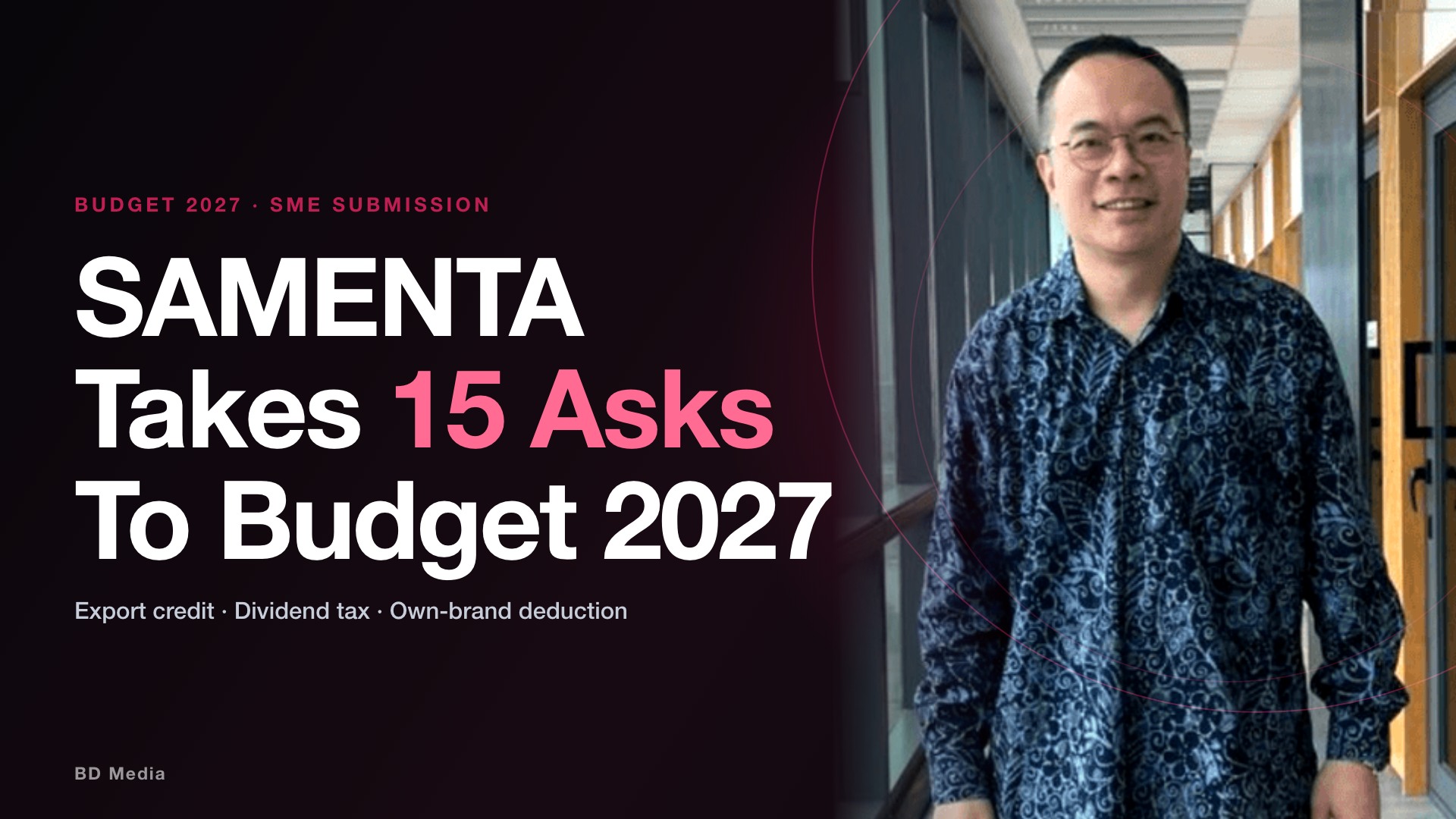
The Budget 2027 SME wishlist SAMENTA put to the Ministry of Finance runs to 15 proposals, and its president says the three that matter most would cost the government almost nothing. In an interview with BFM 89.9 aired on 9 October 2026, hours before the budget was tabled, Datuk William Ng, National President of the Small and Medium Enterprises Association of Malaysia (SAMENTA), named zero-collateral export credit refinancing as the association’s first priority, followed by a review of the 2% dividend tax and a double tax deduction for SMEs shifting from contract manufacturing to their own brands.
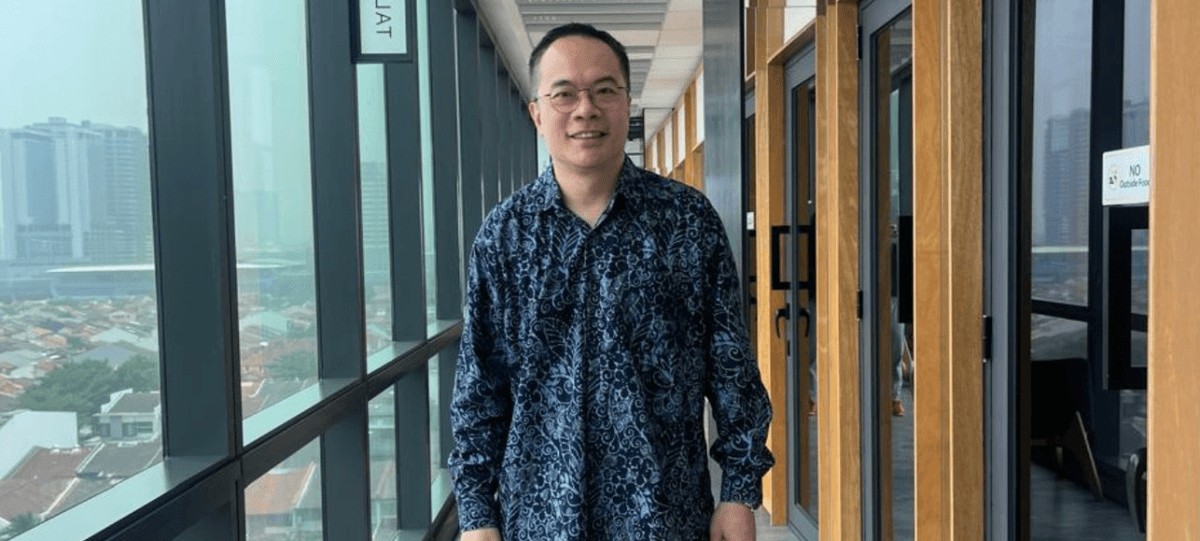
Photo: BFM 89.9. Datuk William Ng, National President of SAMENTA, in BFM’s studio building. Ng set out the association’s 15 Budget 2027 proposals on Enterprise Explores at 12.00pm on 9 October 2026.
The 15 proposals went to the Ministry of Finance, with copies to the Ministry of Entrepreneur Development and Co-operatives and to MITI. They are aimed, Ng said, at “the small and medium rather than the micro enterprises” — the firms he argues are capable of moving up the value chain.
Budget 2027 SME reality check: an economy growing in two directions
Malaysia’s headline growth is not in dispute: 5.2% in 2025 and 5.6% in the first half of 2026, according to the Ministry of Finance. Ng began with the distance between that number and the shop floor.
“If you ask any SME, you will hear that nobody feels excitement or the buoyancy that these numbers are supposed to represent,” he said. “What you will hear instead is the same complaint that we hear since COVID — that margin has shrunk substantially. Even as revenue increases, we’re not able to catch up with the rising costs of doing business.”
Datuk William Ng, National President of SAMENTA, on BFM 89.9’s Enterprise Explores, 9 October 2026.
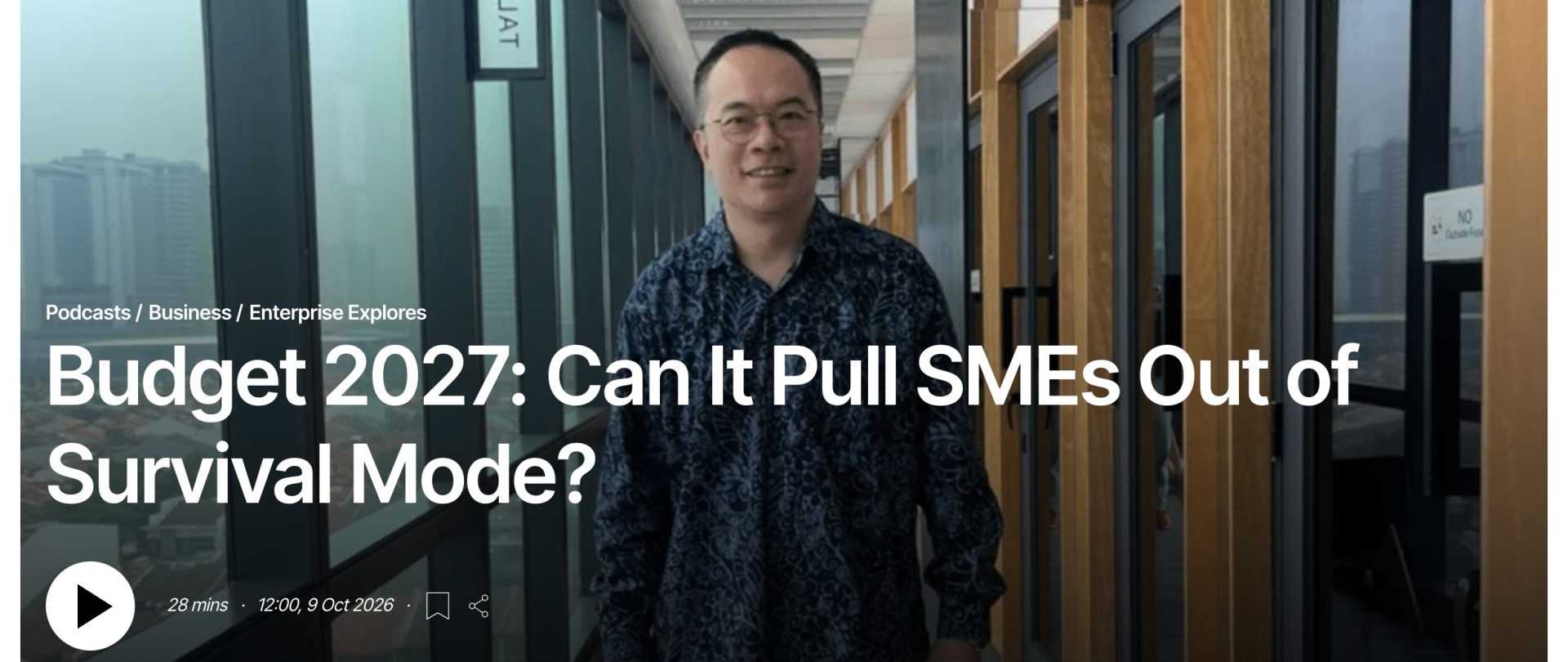
Source: BFM 89.9. The episode page for “Budget 2027: Can It Pull SMEs Out of Survival Mode?”, Enterprise Explores, showing the broadcast time of 12.00pm on 9 October 2026. Read on 9 October 2026. Every quotation in this article is taken from that broadcast.
He treats much of that as structural rather than cyclical. Malaysian manufacturers of furniture, footwear and household plastics largely stopped production from the early 2000s, because it was far cheaper to make — or simply buy — the same goods in China. Many SMEs responded by wrapping their own brand around imported products. The suppliers they bought from are now selling into the Malaysian market directly.
“Our domestic supply chain is thoroughly disrupted… we are now sitting ducks, and there’s really nothing that we can do to compete with the Chinese players,” he said. On the industry Malaysia gave up, his verdict was blunter: “We kill our own industry way too early.”
What that produces, he argues, is a K-shaped economy — multinationals, semiconductors and data centres on one arm, and traditional SMEs in retail, trading, light manufacturing and construction on the other.
The money is there. The access is not.
Ng was careful to separate availability from access. “There’s no shortage of liquidity in our banking system,” he said, adding that bankers call him regularly asking to be introduced to SMEs to lend to. The constraint, in his account, is the credit mechanism itself.
“Our credit mechanisms are still stuck in the 1980s. Our banks are still evaluating SMEs like pawn shops — where’s your factory land title, where’s your director’s personal guarantee.”
Datuk William Ng, National President of SAMENTA, on BFM 89.9’s Enterprise Explores, 9 October 2026.
Malaysia has been a services-led economy since the 1990s. Service businesses have no factory to pledge, so Ng wants a faster shift to cash-flow and intellectual-property-based lending. The second constraint is commercial: a relationship manager carries the same paperwork for a RM5 million facility as for a RM50,000 one, so the incentive runs to the larger borrower. His concern is that funds earmarked for smaller SMEs end up with established businesses instead.
The scale of the guarantee system is not the problem. Budget 2026 raised government guarantees under Syarikat Jaminan Pembiayaan Perniagaan to RM30 billion, from RM20 billion (New Straits Times, 10 October 2025), alongside RM2.5 billion in micro-loans. A further RM5 billion guarantee allocation followed in April 2026 to cushion the energy and logistics disruption (Bernama, April 2026), with coverage lifted from 70% to 80% and the guarantee tenure extended from seven years to ten. SAMENTA has argued that the higher coverage should be made permanent rather than allowed to lapse.
The three asks
1. Export credit that discounts the order, not the balance sheet. This is the proposal Ng returns to most often. An SME that wins an export contract typically pays its supplier first, waits out shipping, then waits on the buyer’s payment terms — a cycle he puts at five to seven months. “Many SMEs have no choice but to decline large orders, because if you’re not careful, you can actually kill your business during the months when you’re waiting for the money,” he said. SAMENTA wants a government-backed facility that discounts a validated overseas purchase order directly, instead of requiring collateral or a director’s personal guarantee. The argument for the taxpayer is that the guarantee transfers delivery and payment risk off the bank’s books, which is what makes the bank say yes.
2. A review of the 2% dividend tax. Ng contends that SMEs are caught by accident in a measure aimed at larger companies and corporate investors. “Dividend in SMEs is actually channelled back to business owners. In fact, that could be their only income for the whole year. And most of it is actually reinjected into the operations as working capital,” he said. His wider concern is repatriation — he argues that taxing income brought back into the country discourages owners from returning profits to the business, and that some of that money now simply stays overseas.
3. From contract manufacturing to own brands. SAMENTA has asked for a double tax deduction on SMEs’ operational and marketing expenditure against verified, year-on-year incremental export revenue, for companies carrying a Malaysian-registered brand. The intent is to move more SMEs from making other companies’ products to owning the brand and the intellectual property, which Ng says is what builds long-term equity and pricing power. Automation and digitalisation came up as a related ask — a double tax deduction and a possible tax voucher, which he describes as the measure with the most direct line to productivity.
E-invoicing: the threshold moved, but late
SAMENTA was among the first associations to argue publicly for deferring e-invoicing or exempting micro and small traders — a stance that drew accusations of helping businesses evade tax. Ng rejects that, saying the association supports the regime both for correct taxation and for the digitalisation it forces, and that what it wanted was a system simple enough to use on day one. “Make it as easy as scanning a QR code, very much like how we do with Touch ’n Go,” he said.
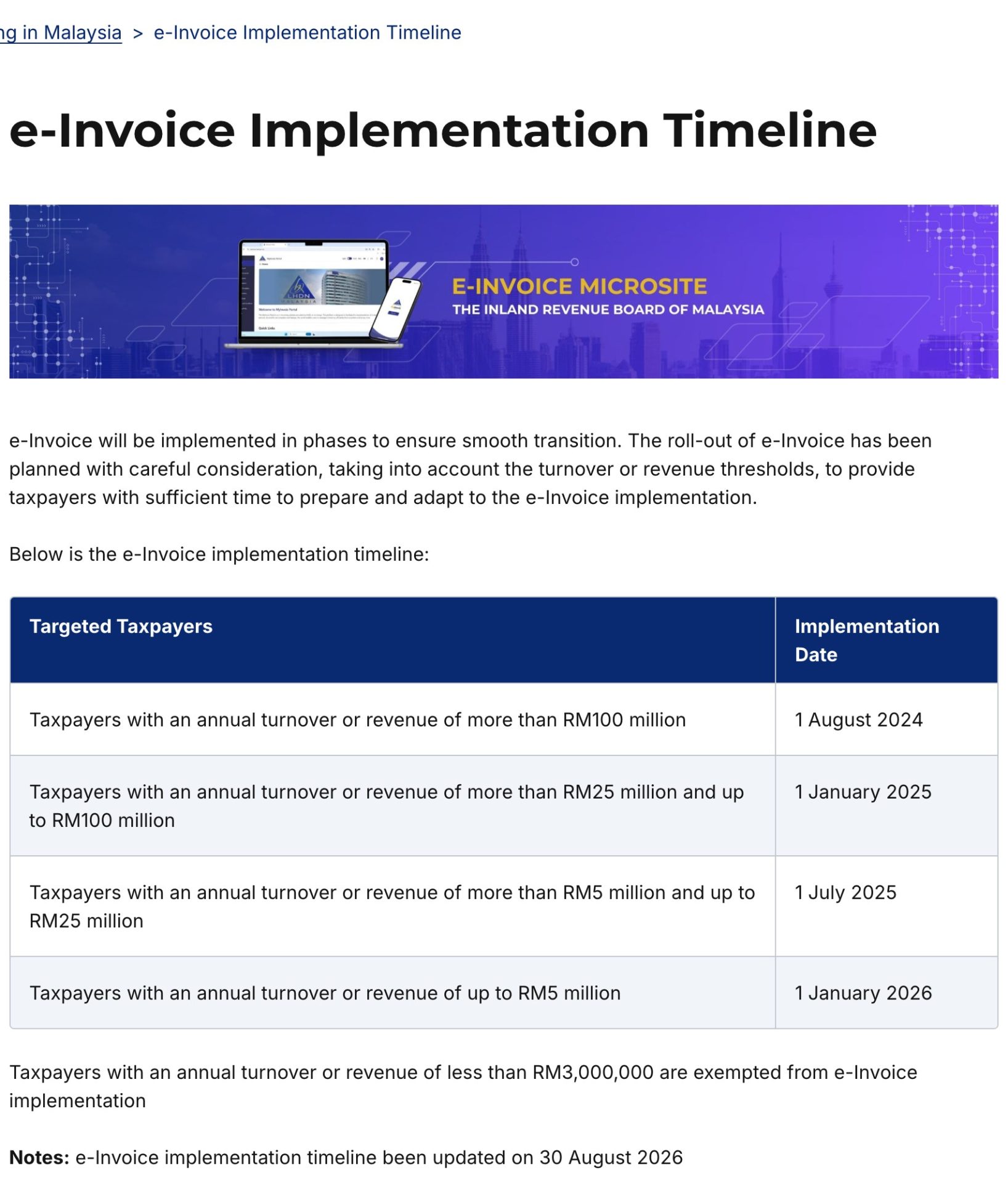
Source: Inland Revenue Board of Malaysia. The e-invoice implementation timeline, updated 30 August 2026, showing the phase-in thresholds and the exemption for taxpayers below RM3,000,000. Read on 9 October 2026.
The government has since moved further than the association first asked. The Inland Revenue Board raised the exemption threshold from RM1 million to RM3 million in annual turnover or revenue, effective 1 September 2026, after the Prime Minister announced the change at the 2026 National Day address. The IRB says more than 1.1 million businesses are now exempt. Ng’s response was that it is welcome but late: SMEs sit inside larger supply chains, and bigger buyers often require e-invoices regardless of the exemption, so many affected businesses had already invested to comply.
Minimum wage: pay for output, not just a floor
On the prospect of a further increase to the RM1,700 minimum wage, Ng said nobody — SMEs included — wants workers to stay on low pay. His objection is to how a flat floor behaves once it lands: raise the bottom of the ladder and the whole ladder shifts, because a supervisor will not keep working for barely more than the production worker beneath them.
SAMENTA’s preferred model is a productivity-linked wage system, in which pay rises with output while the government supports the productivity side through training and automation. Ng points to Australia, where hotel housekeeping is commonly paid per room rather than per hour, so pay moves with occupancy. He says Malaysian labour law, much of it colonial-era, does not currently provide for that, and that introducing it needs planning well ahead rather than a Labour Day announcement.
If the government proceeds regardless, SAMENTA has asked for the increase to be tiered — by region, and between larger companies and SMEs. Ng notes that the Klang Valley, Johor Bahru and Penang already pay at or above the level under discussion, while smaller towns with a lower cost of living and thinner business volumes are a different case. He points out that Thailand sets its minimum wage by province rather than nationally.
Procurement: reserve 30%, then make them compete
SAMENTA has called for at least 30% of government and GLC procurement to go to domestic SMEs. Ng says the current share is far below that, because public procurement is dominated by large conglomerates with the volume, scale and delivery reach to win on price.
“It is less about giving the SMEs the tongkat. It’s more about evening the playing field.”
Datuk William Ng, National President of SAMENTA, on BFM 89.9’s Enterprise Explores, 9 October 2026.
The mechanism he proposes is a reserved 30% awarded through transparent competitive bidding, so that SMEs compete against each other rather than being handed contracts. He argues that also makes the firms which depend on government work more resilient. Today there are rules favouring Malaysian products and vendors, but Ng says there is no set minimum for SME participation.
What SMEs want most is to be left alone to trade
Asked what else is on the list, Ng put the emphasis somewhere other than incentives. “What SMEs really want are policy certainty, less bureaucracy and no unnecessary compliance burden,” he said, adding that governments should stop simply declaring public holidays.
His regulatory ask is procedural: good regulatory practice and a regulatory impact assessment at federal, state and municipal level before any new requirement is introduced, with the affected sectors engaged early. He credits the federal government with real engagement with associations like SAMENTA, but says state and municipal authorities still introduce new rules and fees with no notice, and then hold businesses responsible for not complying.
Where this sits in the Budget 2027 cluster
Budget 2027 — themed “Reaching to the Sky, Rooted in the Earth” — was tabled in the Dewan Rakyat on 9 October 2026. Our Budget 2027 Malaysia hub tracks the measures as they are announced. SAMENTA’s submission is one of several association wish lists in front of the Ministry of Finance: the tax profession’s SST wish list and SMEAM’s outcomes-first proposals cover adjacent ground, and the Labuan service tax question turns on the same service-sector exposure Ng describes.
Sources
Sources
BFM 89.9: “Budget 2027: Can It Pull SMEs Out of Survival Mode?”, Enterprise Explores, broadcast 12.00pm, 9 October 2026, with Datuk William Ng, National President of SAMENTA. Every quotation in this article is taken from that broadcast; the audio was transcribed and each quotation checked against the transcript.
Corroboration
Inland Revenue Board of Malaysia: e-Invoice implementation timeline, updated 30 August 2026; exemption for taxpayers with annual turnover or revenue below RM3,000,000, and more than 1.1 million businesses exempt.
The Edge Malaysia / Bernama: MSMEs with annual revenue below RM3 mil exempt from e-invoicing, 30 August 2026.
New Straits Times: 2026 Budget: SMEs to get RM50bil in loans, RM2.5bil in microloans next year, 10 October 2025.
Bernama: RM5bil SJPP guarantee facility with coverage raised to 80%, April 2026.
New Straits Times: Malaysia GDP accelerates as economy defies global headwinds, August 2026 (5.2% for 2025; 5.6% for the first half of 2026).
The Star: Channel at least 30% of govt, GLC procurements to local SMEs, 31 May 2026 (SAMENTA’s 30% procurement position).