E-Invoice Malaysia rules may change, but nothing has taken effect yet. A tax administration Bill tabled in Parliament on 16 November 2026 proposes that e-commerce platforms operating in or outside Malaysia issue self-billed invoices for goods sold and services provided through their platforms. The same Bill proposes that a tax notice count as delivered when a system generates a delivery report. It has had its first reading only.
The Bill is the Measures for the Collection, Administration and Enforcement of Tax Bill 2026, tabled by Deputy Finance Minister Liew Chin Tong. The Star reported that it amends seven laws and that, if passed, the amendments come into force on 1 January 2027. The Edge reported the same first reading and a second reading in the current parliamentary sitting. Both reports are dated November 2026 and both describe a proposal, not a law in force.
That distinction drives everything below. Platform sellers can usefully check their invoicing and notice-handling processes now. Nobody should treat the Bill’s provisions as current obligations until it is passed and the conditions are published.
Last updated: 23 November 2026. This article reports a Bill at first-reading stage, the provisions described in named Malaysian reporting, and the limits of what that reporting establishes. It is not tax advice.
What does the E-Invoice Malaysia Bill tabled on 16 November propose?
The Bill is an administration and enforcement measure, not a rate-cutting measure. According to The Star, it seeks to strengthen and modernise Malaysia’s tax administration and enforcement system by amending the Income Tax Act 1967, Real Property Gains Tax Act 1976, Stamp Act 1949, Labuan Business Activity Tax Act 1990, Petroleum (Income Tax) Act 1967, Customs Act 1967 and Excise Act 1976.
Three parts matter most to a seller. First, the proposed self-billed invoice duty for e-commerce platforms, whether located in Malaysia or abroad. Second, an electronic delivery definition under which a notice is treated as served when a designated system generates a report confirming delivery. Third, new penalty provisions attached to information exchange and Labuan record-keeping.
RegFollower, a tax practice publication, summarised the same Bill on 16 November and identified the invoicing change as an amendment to section 82C(6)(b) of the Income Tax Act 1967, effective 1 January 2027. That section reference comes from a secondary summary. The Bill text itself was not read for this article, so the substance is reported and the reference is attributed rather than asserted from the statute.
Status: tabled for a first reading on 16 November. The Star reported that Liew said the second and third readings would be tabled during the current Dewan Rakyat meeting. No vote had taken place at the time of writing.
What does a self-billed invoice mean for a platform seller?
A self-billed invoice is an invoice issued by the buyer rather than the seller. In the platform scenario described in the Bill, the platform provider would issue the invoice for goods sold or services performed by other parties through that platform. The condition attaching to that duty is that it is subject to conditions imposed by the Director General of Inland Revenue.
The Edge reported that the invoicing provisions would apply to platform providers “whether in Malaysia or outside Malaysia”, and that the provisions concern self-billed invoices issued by platforms for goods sold or services provided by other parties. The Star used the same formulation: e-commerce platforms operating in or outside Malaysia may be required to issue self-billed invoices for goods sold or services provided by other parties through their platforms.
For a seller, the practical question is not whether a platform can issue such a document. It is how the platform’s invoice will match the seller’s own records, and what the conditions set by the Director General will require. Those conditions had not been published at the time of writing. Any operational detail about format, timing or thresholds would therefore be speculation.
The existing rollout provides background for why this matters. Our earlier record of Malaysia’s e-invoice rollout numbers describes the scale of the regime this proposal would extend. The proposal does not, on the reporting available, rewrite every existing e-invoice obligation at once.
Does it apply if I sell on Shopee, Lazada, TikTok Shop or my own site?
The reporting names platform providers, not individual merchants. The Star and The Edge both describe an obligation on the platform to issue self-billed invoices for third-party sales. Neither report says that every seller on a platform must issue a self-billed invoice for their own sales.
Three situations should be separated. A merchant selling through a large marketplace is not obviously the party being described by the invoicing amendment. A merchant operating an own-site store without a third-party platform is further still from the reported wording. A business that itself operates a marketplace where other parties sell is closest to the described obligation.
That separation is provisional. The Bill text dictates the actual scope, and the conditions to be set by the Director General may affect how the duty reaches different business models. Until the text and conditions are available, the answer supported by the reporting is that marketplace sellers should expect platform-level changes to invoicing data, but should not assume a new personal filing duty from the first-reading report alone.
The deemed-delivery proposal is broader than the invoicing clause and is not limited to platforms. Any taxpayer receiving a notice under the covered tax laws could be affected by the new service definition, which is why the point deserves a separate section below.
What changes on 1 January 2027, and what does not?
The Star reported that, if passed, the amendments come into force on 1 January 2027. The Edge was slightly more precise: most amendments are proposed to take effect on 1 January 2027, with selected provisions starting later. The difference matters. A single blanket effective date is not what the more detailed report describes.
| Item | Reported timing | What is not yet settled |
|---|---|---|
| Most amendments | Proposed for 1 January 2027, conditional on passage | Whether the Bill passes unchanged |
| Stamp Act general exemptions | Electronic submission from 1 July 2027 | Prescribed return and verification process |
| Instalment and petroleum estimate changes | From year of assessment 2028 | Operational forms and guidance |
| Platform self-billing conditions | Not published in the reporting reviewed | What the Director General will prescribe |
Timing reported by The Star, 16 November 2026 and The Edge, 16–17 November 2026. Source: The Star and The Edge Malaysia; all dates are proposed and conditional on the Bill passing.
What does not change on 1 January 2027 is the existing e-invoice timetable and any exemption a business already qualifies for. The proposed platform rule sits alongside those obligations. The RM3 million e-invoice exemption remains a separate test under the existing framework, and nothing in the first-reading report says it is being replaced.
The Budget 2027 hub gives the wider fiscal setting in which the Bill was tabled. It should not be read as authority for treating the Bill’s dates as final.
Why can a tax notice count as delivered before it is opened?
The Edge reported a proposed definition of electronic delivery under several tax laws. A notice would be deemed served when a report confirming delivery is generated by the designated information processing system determined by the Director General. The trigger is the generation of the report, not the recipient opening the message.
This is a change in the legal moment of service. Under an open-and-read model, the recipient’s action completes delivery. Under the proposed model, a system event completes it. The practical consequence is that an unopened notification can still start a clock, provided the designated system generated the required report.
For a business, the response is operational rather than technical. A mailbox that nobody monitors is no longer a safe place for tax correspondence. Access to the designated system, internal forwarding rules, and a record of who reviews notices become part of basic tax hygiene. The proposal does not, on the reporting available, change how a taxpayer contests a notice or what the response deadline is.
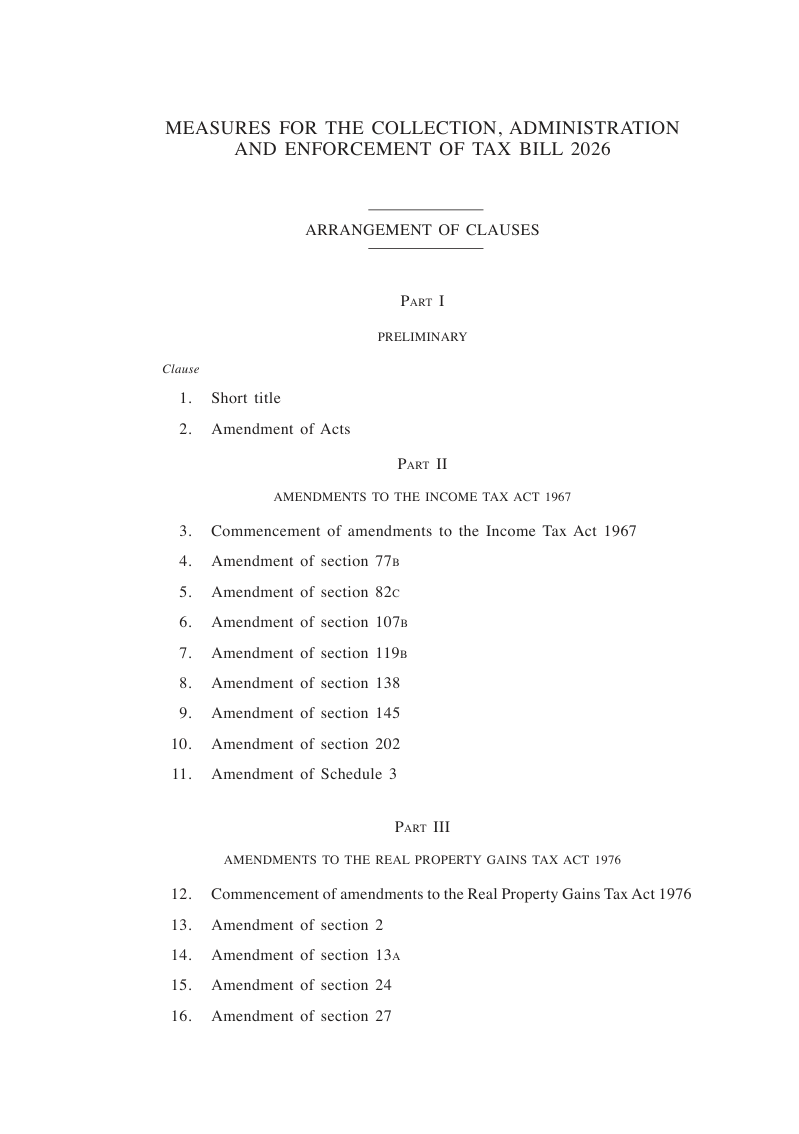
The Bill as tabled on 16 November 2026, first page. Source: Measures for the Collection, Administration and Enforcement of Tax Bill 2026, Parliament upload, read 23 November 2026.
Why are overseas platforms in scope but the local-office clause absent?
The Edge reported that the amendments specify invoicing provisions for e-commerce platform providers “whether in Malaysia or outside Malaysia”. That wording is the reason the proposal has drawn attention beyond domestic platforms.
The same report supplies the context. Domestic Trade and Cost of Living Minister Armizan Mohd Ali told Parliament on 28 October that foreign e-commerce platforms would be required to issue e-invoices, and the report says related vendors establishing offices in Malaysia were also part of his remarks. The Edge then notes the important gap: the invoicing clauses in the Bill do not stipulate a local-office requirement.
Those two statements are not the same thing. A ministerial remark about vendors setting up offices is not a clause in the Bill as reported. A proposed duty that reaches platforms outside Malaysia without a local-office condition raises its own compliance questions, but the article should not invent an answer. The Bill text and any guidance from the Inland Revenue Board would have to settle it.
What penalties are proposed, and which are not e-invoice fines?
The Edge reported two penalty sets, and they belong to different problems. Neither is described in the reporting reviewed as a fine for failing to issue a self-billed invoice.
- Automatic exchange of information and country-by-country reporting. Under a proposed new subsection of the Income Tax Act, failure to provide the automatic exchange of information or to furnish a country-by-country report could draw a fine between RM20,000 and RM100,000.
- Labuan law offences. An amendment to the Labuan Business Activity Tax Act would criminalise obstruction of officers, refusal to produce records, failure to provide reasonable assistance and refusal to answer lawful questions. The reported range is a fine of RM20,000 to RM1 million, imprisonment of up to two years, or both.
These figures come from The Edge’s report of the Bill. The Bill’s own penalty provisions were not read for this article. Any description of how the ranges apply, who is charged, and whether compounding or remission is available would need the statute rather than a news summary.
The Star described a related but separate provision: a proposed subsection under section 119B of the Income Tax Act 1967 empowering the Director General to impose a penalty, where no prosecution is instituted, for failure to comply with rules on automatic exchange of information and country-by-country reporting. That is an enforcement mechanism for information rules, not an e-invoice penalty.
How does this differ from the Finance Bill SME band and the separate e-commerce bill?
Three pieces of legislation are being discussed together, and they are not the same. Keeping them apart is the most useful thing this article can do for a seller trying to plan.
| Instrument | Subject | Status reported |
|---|---|---|
| Tax administration and enforcement Bill 2026 | Self-billed platform invoices, deemed electronic delivery, information-exchange and Labuan penalties | First reading 16 November 2026 |
| Finance Bill 2026 | Proposed 14 per cent SME company tax band and related rate changes | First reading 16 November 2026 |
| Foreign e-commerce bill planned for 2027 | Consumer protection, marketplace responsibilities and dispute resolution | Planned for the first sitting in 2027 |
Three separate legislative items. Source: The Star, 16 November 2026; The Edge, 16–17 November 2026; BD Media’s Finance Bill coverage.
The Bill on this page is about collecting and enforcing tax. It does not propose the SME company tax band covered in the separate Finance Bill 14% SME tax band, even though both were tabled on the same date and both were reported in the same news cycle. A business reads them for different reasons: one changes how tax administration works, the other changes a proposed rate.
The third item, the foreign e-commerce bill planned for the first parliamentary sitting in 2027, is further away again. The Edge says it would address consumer protection, marketplace responsibilities and dispute resolution. Nothing in the reporting suggests it is the same text as the tax administration Bill.
What we could not confirm
- The Bill has not passed. It had a first reading on 16 November. The second and third readings, the final text and the final commencement dates were not settled at the time of writing.
- The Director General’s conditions. The self-billed invoice duty is subject to conditions to be prescribed. No condition set was found in the reporting reviewed.
- Exact scope by seller type. The reports describe a platform-level duty. Whether every marketplace seller, or only platform operators, faces a new obligation requires the Bill text.
- Penalty scope. The RM20,000 to RM100,000 and RM20,000 to RM1 million ranges are taken from The Edge’s account. The penalty ranges were verified directly in the Bill text: clause 7 and the new section 23d in clause 39.
- Section references. The 82C(6)(b) amendment (clause 5) and the section 119B penalty (clause 7) were both verified in the Bill text.
- LHDN’s published FAQ. The official e-invoice FAQ is linked in Sources as the authority’s entry point, but the file could not be opened in this session. No claim in the article rests on it.
- Search demand for narrower phrases. `self billed invoice malaysia` and `tax notice mytax` returned no data in the MY database on 23 November 2026. No data is not zero.
What should sellers check before the second reading?
Four checks are possible without predicting the Bill’s outcome. Review whether the business operates a marketplace or merely sells through one, because the reported duty is framed around the platform provider. Confirm that tax correspondence sent to a company email address reaches a monitored inbox and that someone is accountable for reading it. Keep platform invoices and internal sales records reconciled so that a future self-billed document can be matched. And track the Bill’s second reading rather than relying on commentary about its first.
Two things are not worth doing. Buying a workflow built around an unpublished condition set is premature, and treating any of the reported penalties as an e-invoice fine would misstate what the reporting says.
The relevant official entry point for the existing regime is LHDN’s e-invoice material; the link is listed in Sources. The next reliable update will come from the Bill’s later readings and from any conditions the Director General publishes after passage.

Compliance checks start with the paperwork a business already keeps. Photo: “Legal Contract & Signature – Warm Tones”, Blogtrepreneur, Wikimedia Commons, CC BY 2.0. Provisions discussed are proposals in the Bill at first reading.
Sources
- The Star, New tax Bill proposes self-billed invoices for e-commerce platforms, says Liew, Ragananthini Vethasalam and Divya Theresa Ravi, 16 November 2026 (Bill name, seven amended laws, first reading, platform self-billing, electronic notice delivery, section 119B penalty mechanism, second and third readings) — thestar.com.my, 16 November 2026
- The Edge Malaysia, Govt tables bill to include overseas platforms in invoicing rules, widen tax enforcement, Luqman Amin, 16–17 November 2026 (overseas platform wording, deemed service trigger, penalty ranges, 1 January and 1 July 2027 dates, YA2028, separate 2027 e-commerce bill, absent local-office clause) — theedgemarkets.com/node/825943
- RegFollower, Malaysia tables Finance Bill 2026, proposes 30% REIT withholding tax, 18 November 2026 (summary identifying section 82C(6)(b), the Director General’s conditions, and the proposed 1 January 2027 date) — regfollower.com, 18 November 2026
- LHDN, e-Invoice General FAQs (official entry point for the existing e-invoice regime; file could not be opened in this session and no claim in the article rests on it) — hasil.gov.my, e-Invoice general FAQs
- SE Ranking, DATA_getKeywordsMetrics, source MY, measured 23 November 2026 (`e-invoice malaysia` 880 / difficulty 36; two narrower candidates no data) — internal SEO record, see meta.json
demandblock
BD Media is the editorial desk of Big Domain. This article reports a Bill at first-reading stage and is not tax or legal advice. The proposed measures are not in force. Readers should verify the final text and any published conditions before changing a filing process.