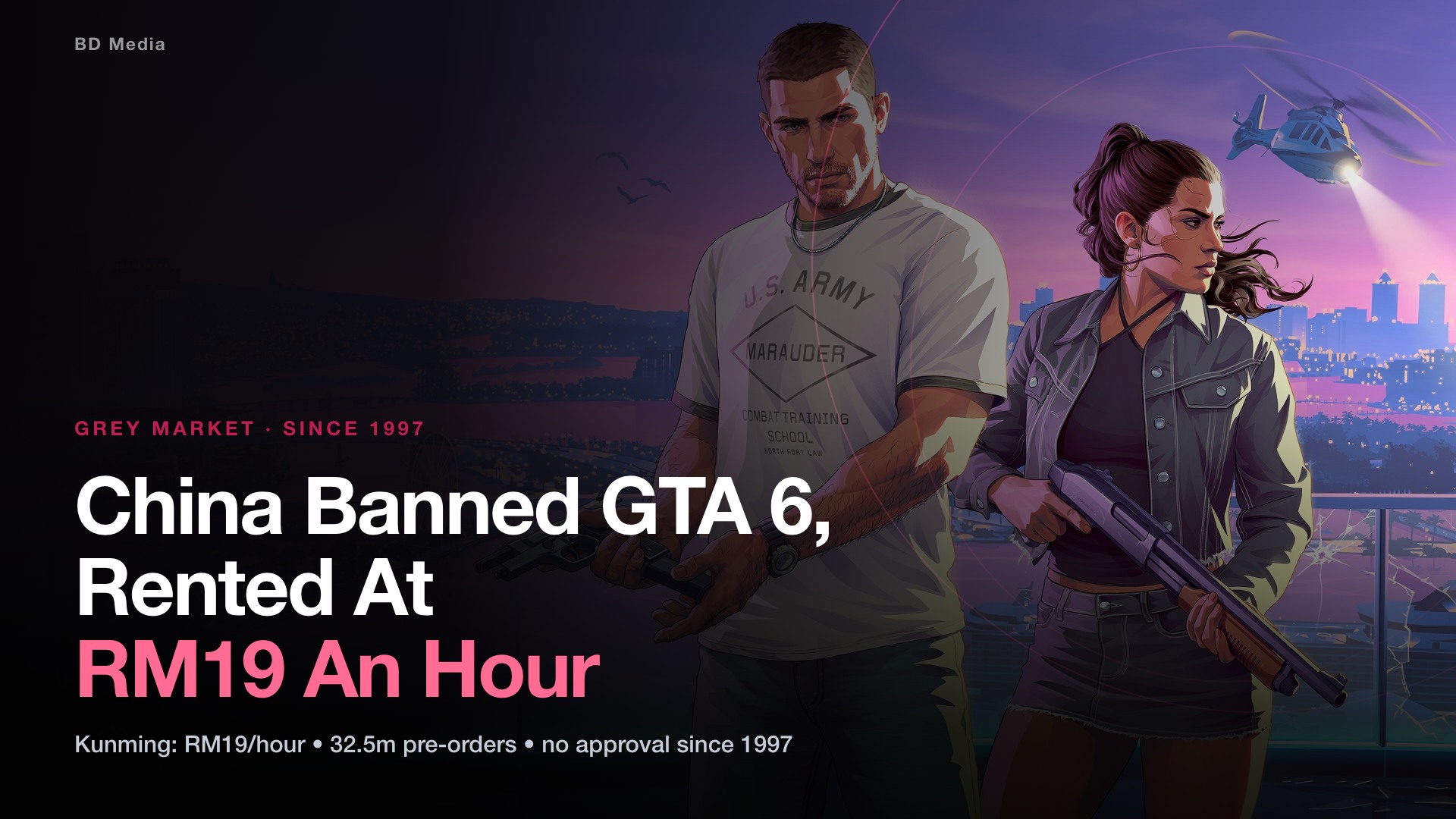
The GTA 6 China ban did not stop the launch. It moved the till. Grand Theft Auto VI sold RM15.6 billion worth of copies in its first 24 hours, and Take-Two Interactive reported the figure in dollars, 3.79 billion of them. At RM4.11 to the dollar that makes a video game the biggest entertainment opening on record. Bigger than any film. Bigger than the highest-grossing movie of all time has managed across its entire run.
In those same 24 hours, a shopper walking through a technology mall in Kunming, in south-west China, would have found nothing. No poster, no demo unit, no shelf. Not one screen in the city’s central business district carried an advertisement. The GTA 6 China ban is why an entire country is missing from the week’s biggest commercial event, and it has held, in one form or another, since before most of the people playing the game were born.
Both things are true at once. The gap between them is a better business story than the record.
What the GTA 6 China ban left out of the numbers
Two sets of figures are doing the work here, and they come from different kinds of witness. Take-Two’s release is a company estimate, filed with the US Securities and Exchange Commission the morning after launch. The network numbers come from an internet exchange that was watching the pipes.
| Measure | Figure | Source |
|---|---|---|
| Day-one retail sales, worldwide | RM15.6 billion | Take-Two 8-K, 20 Nov 2026 |
| Units sold before launch | 32.5 million | Take-Two 8-K |
| Previous day-one record (GTA V, 2013) | about RM3.3 billion | Reuters, 20 Nov 2026 |
| Lifetime box office, Avengers: Endgame | RM12.1 billion | Rentrak, via Reuters |
| Metacritic score | 99 | Take-Two 8-K |
| Peak traffic across DE-CIX exchanges | 33.03 terabits per second | DE-CIX, 19 Nov 2026 |
| Download size, PS5 | about 210 GB | DE-CIX |
None of those numbers includes China, in the sense that matters. A grey-imported console bought abroad and a foreign store account do not appear in anyone’s retail tracker. They do not appear in the 32.5 million pre-orders either.
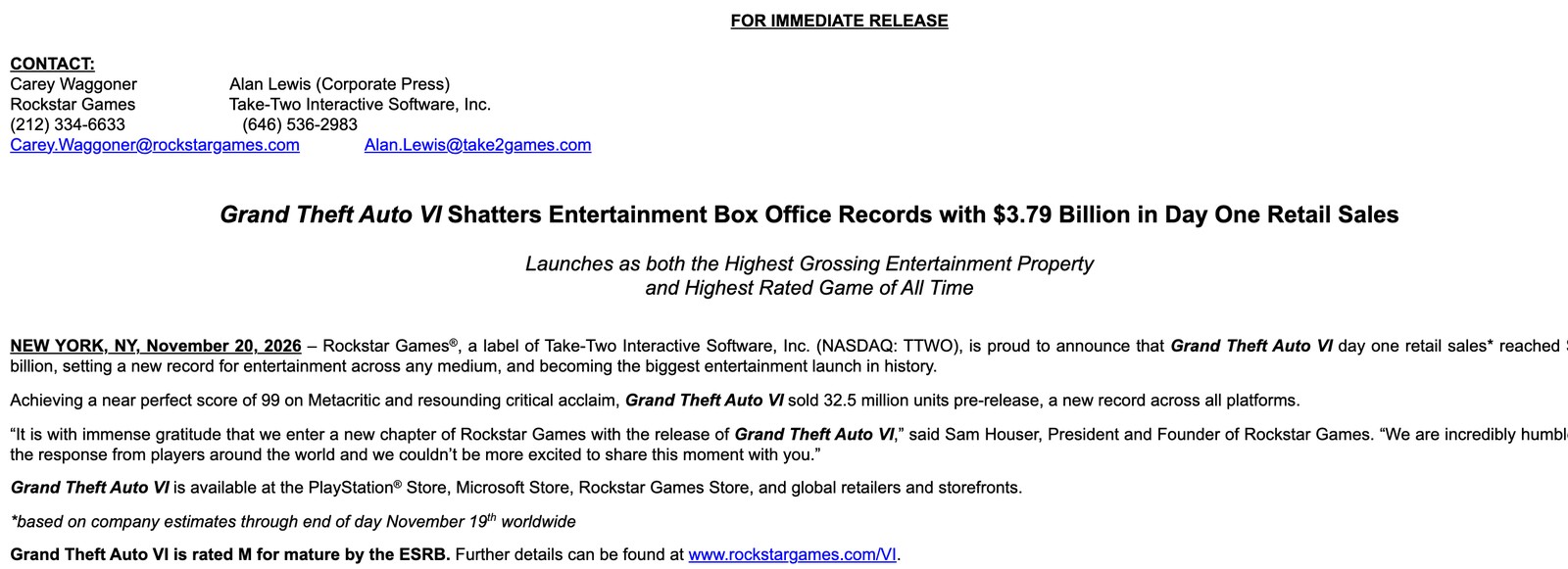
The launch-morning release, exhibit 99.1 of Take-Two’s 8-K filing. Day one is a company estimate through the end of 19 November. Source: US Securities and Exchange Commission, 20 November 2026.
Twenty-nine years without an approval
The first Grand Theft Auto shipped in 1997. No game in the series has ever been approved for sale in mainland China. That is not a boycott of one title. It is the output of an approvals machine that has been running, with modifications, for a quarter of a century.
In June 2000 the State Council’s general office circulated a notice on cleaning up electronic gaming venues, known by its number, 44. It stopped the production and sale of game machines for the domestic market outright. The stated concern was youth addiction. Chinese state media of that period were calling video games electronic heroin.
The ban was lifted in stages. On 6 January 2014 the State Council suspended the 2000 notice inside the Shanghai free trade zone, allowing foreign firms to make and sell consoles there provided the content passed a cultural review. A 2015 culture ministry notice extended the arrangement nationwide. In 2016 the original 2000 document was formally declared invalid.
What survived all of that is the part that actually decides whether a game can be sold. Every title needs approval from the National Press and Publication Administration, and approval brings an ISBN. No ISBN, no lawful publication. China also has no enforceable 18-plus rating, only advisory labels at 8, 12 and 16, so anything approved has to suit a general audience that includes children. A game whose core loop is committing crimes for money does not fit that standard.
Enforcement, in practice, lands on platforms and broadcasters rather than on players. The report that prompted this piece records a livestreaming prohibition sitting alongside the retail one, and notes in the same breath that the game’s own publisher runs an account on a Chinese short-video platform.
Where the demand went instead
The clearest field report from launch day comes from the creator Ina Yu, who spent 19 November in Kunming and published a 21-minute account two days later. Three details are worth taking seriously.
The first is the console cafe. A PlayStation 5 cafe in one of the city’s residential towers was fully booked from ten in the morning until ten at night, and stayed booked roughly ten days out. Entry was 33 yuan an hour, about RM19. Access came through a Hong Kong PlayStation Store account, and the game arrived with Simplified Chinese subtitles. One customer had taken a single room for twelve hours straight.
The second is the download. At roughly 210 GB, the shop estimated up to eighteen hours on launch-day servers and told her Sony’s infrastructure had slowed under the load. DE-CIX measured the same pressure from the network side, which is why a download became a service rather than a click.
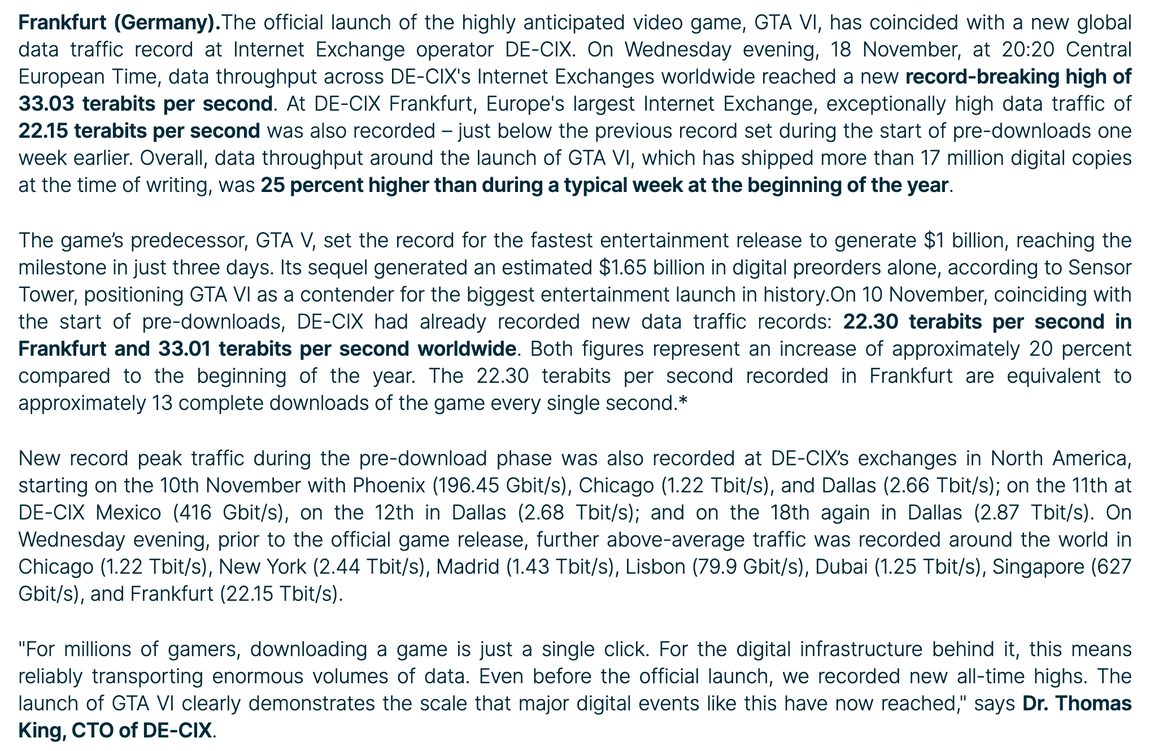
33.03 terabits per second across DE-CIX’s exchanges on the eve of launch, with a file of roughly 210 GB behind it. At 50 Mbps that one download takes more than nine hours. Source: DE-CIX press release, 19 November 2026.
The third is the shop. At a neighbourhood games store she watched staff explain what comes with the console, set the machine up, run the download on the premises, and hand over something that works when the buyer gets home. A PS5 was sold during the few minutes she was standing there. The same visit turned up a GTA VI-themed go-kart track on a 1,500-metre circuit an hour outside the city centre, and it was the only public promotion of the game she saw all day. Per visit, the track was doing what no billboard in China is allowed to do.
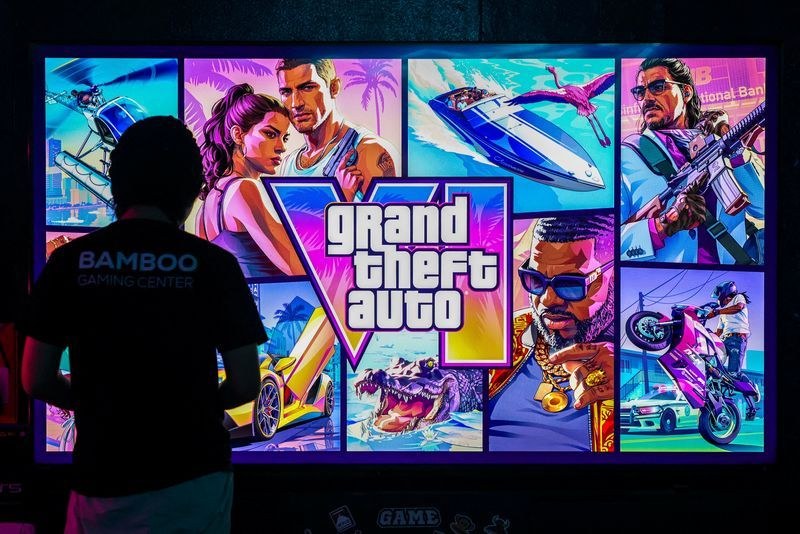
A staff member prepares the game at a gaming centre in Bangkok on launch day. Rented access, not a retail box, was the shape the launch took across much of Asia. Source: Reuters, photograph by Athit Perawongmetha, 19 November 2026.
One caution before drawing conclusions. This is one creator, one city, one day. It is reporting, not a market study, and nothing in it should be read as a national figure.
The pattern: sell the access, not the licence
Strip the specifics away and three things are happening. All three will be familiar to anyone who has run a business inside a regulated market.
Rent the hardware, not the software. A console is a RM2,500 outlay for the sake of one game. At 33 yuan an hour it becomes an operating cost with a queue behind it. The cafe does not need the customer to own anything.
Sell the setup. The eighteen-hour download is not an inconvenience to be apologised for. It is the moat. A shop that can hand over a working machine has sold something the customer could technically have done alone and would rather not.
Let the friction build the community. Because the process was too convoluted to self-serve, the shops became the place where fans gathered to watch and argue and compare notes. The difficulty produced the venue.
What it means for a Malaysian SME
Malaysia has no equivalent of the game ban, and the point is not that it should. The point is the shape of the response. Every compliance regime creates the same openings, because a rule never removes the demand for a thing. It removes the easy path to it.
Look at what has happened around e-invoicing, halal certification, import licensing and sales tax classification in this market. In each case the rule arrived, the deadline moved closer, and the businesses that grew were rarely the ones that argued hardest against it. They were the ones that made the last mile survivable: the ones who could take a mess of paperwork and hand back something that works.
That is the console cafe’s business, translated. The margin is not in the product. The product was never allowed. The margin is in the hour of access and the setup that follows it.
There is a line here worth naming, because the same story can be misread. The Chinese shops in this account operate in a space that is tolerated rather than permitted, and the risk sits with them. Copying the arbitrage while skipping the service layer gets a Malaysian business the liability and none of the moat.
The part that is not settled
There is no PC version yet. Analysts expect a PC release and an online mode during 2027, and the online mode is where the money actually lives. TD Cowen named Take-Two one of its best ideas for 2027, and its analyst Doug Creutz was explicit about why recurring revenue matters more than the unit count.
For China, that is the harder problem. A single-player game can be carried in on a console and a foreign account. A live service with servers, accounts and an economy is a different kind of object, and the approval arithmetic does not change because the revenue model did.
Which leaves the record where it started. RM15.6 billion in a day, from a market that officially does not exist, in a country that cannot buy it. The launch was the easy part.
About BD Media
BD Media is the editorial desk of Big Domain, covering technology, compliance and the business of doing business in Malaysia. This article contains no paid placement.
Sources
Take-Two Interactive, Grand Theft Auto VI Shatters Entertainment Box Office Records with 3.79 Billion in Day One Retail Sales, exhibit 99.1, Form 8-K, 20 November 2026. sec.gov
Reuters, GTA VI shatters records with 3.8 billion in first-day sales, 20 November 2026. thestar.com.my
DE-CIX, GTA VI: Global Data Traffic Hits Record-Breaking High, 19 November 2026. de-cix.net
Rockstar Games, Grand Theft Auto VI product page, release date 19 November 2026, PlayStation 5 and Xbox Series X|S. rockstargames.com
Ina Yu, I Investigated China’s GTA 6 Black Market, published 21 November 2026. youtube.com Launch-day reporting from Kunming; console cafe rates and bookings, Hong Kong store access, download times, the go-kart venue and the games shop. The 2011 Ministry of Culture ruling on 39 titles, the livestreaming prohibition and the publisher’s short-video account are that report’s account.
State Council of the People’s Republic of China, Decision on temporarily adjusting administrative approvals and special access measures within the China (Shanghai) Free Trade Zone, 6 January 2014. gov.cn
Ministry of Culture and Tourism, drafting note on the administration of game and amusement equipment, 2019. mct.gov.cn Records the 2015 nationwide extension and the 2016 invalidation of the 2000 document.
Last updated: 24 November 2026. Currency conversions at RM4.11 to the dollar, 23 November 2026.