
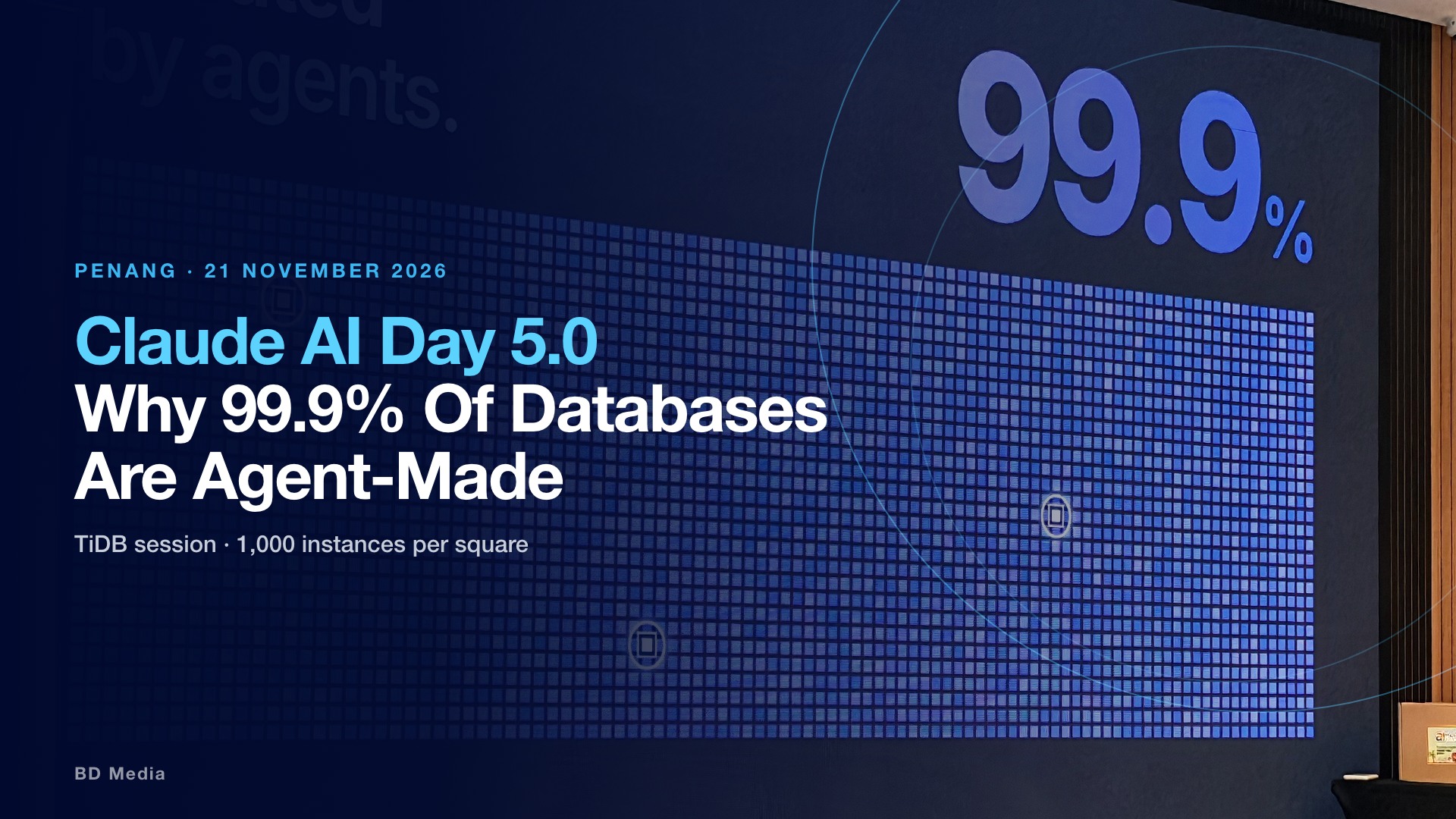
Claude AI Day 5.0 opened in Penang on 21 November 2026 with a number that had nothing to do with model quality. Kenneth Lee, an AI product manager at TiDB, told the room his company had counted its own database instances six months earlier and found tens of thousands. The count had since reached three million.
Of the databases created in those six months, he said, 99.9 per cent were created by agents rather than by people. On the slide behind him, every square represented 1,000 database instances; the blue covered the grid and three small white squares did not.
The point of the talk was not that Claude is good. Lee said plainly that Claude is probably the best model on the market. The point was the sentence he built the session around: the model is one part, and once the model problem is solved, keeping state is the hard part. That is the claim worth testing, because it decides whether an SME’s first agent becomes a system or an expensive demo.
Last updated: 21 November 2026. Sources: the session as delivered at Claude AI Day 5.0, Peninsula College Georgetown, Batu Kawan, photographed slides reproduced below, the Agmo Group event record, and SAMENTA Northern Region’s programme announcement. The figures are the speaker’s own and have not been independently audited.
Claude AI Day 5.0: the number that framed the session
Lee’s session was titled Beyond the Model: The Infrastructure Powering the Agent Era, and it was the only slot on the programme aimed at people who would have to operate an agent rather than buy one. On his own opening slide, TiDB is described as open source since 2015, with 40,000-plus GitHub stars, 1,200-plus contributors, 5,000-plus customers and 60 per cent of them on the managed cloud service. The vendor also lists Gartner, DB Tech Showcase and Forrester recognition on that slide, which is the company’s own marketing and is repeated here as such.
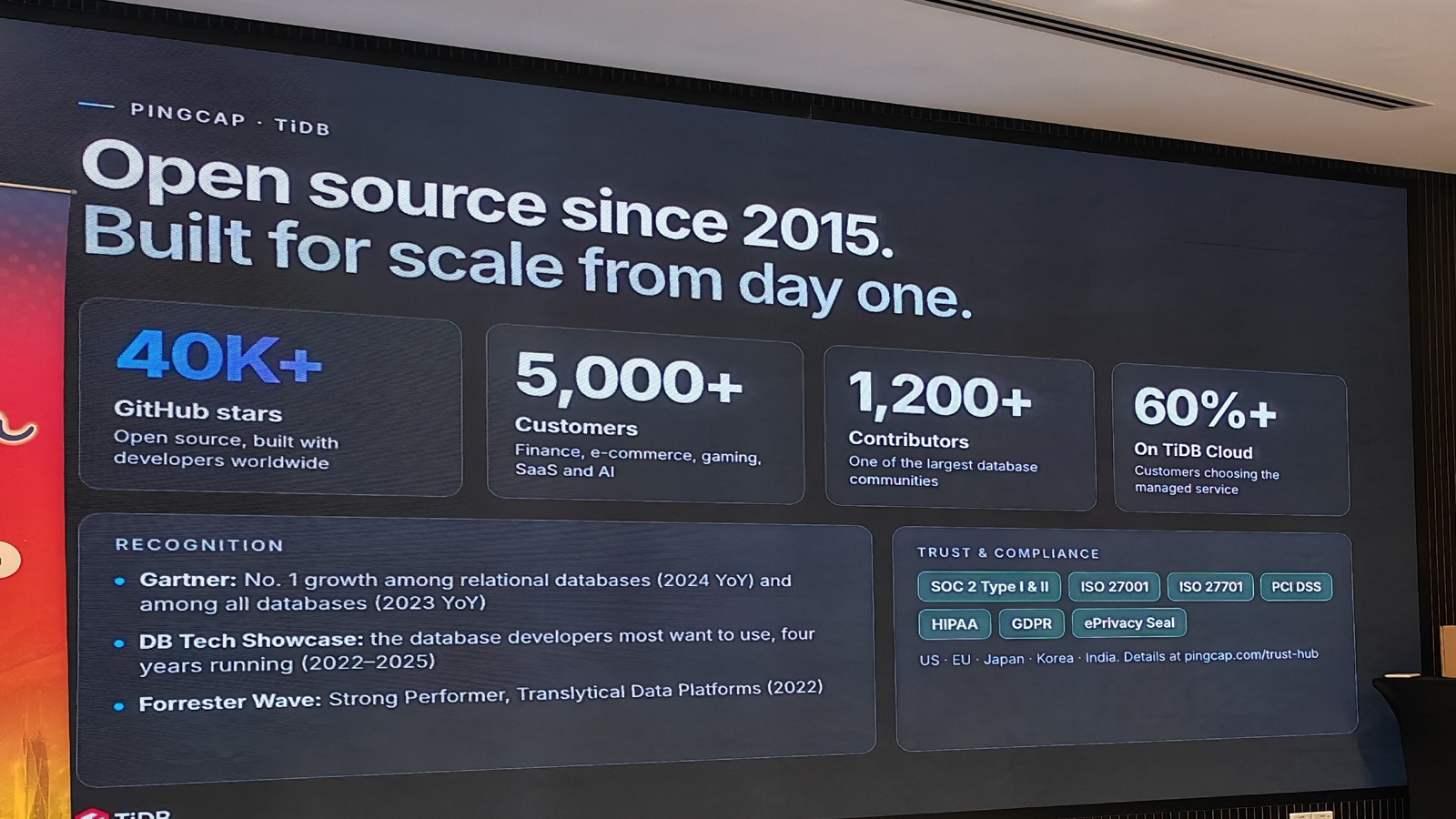
Source: the opening slide presented by Kenneth Lee of TiDB at Claude AI Day 5.0, photographed at Peninsula College Georgetown, Batu Kawan, on 21 November 2026. The figures and the recognition list are the vendor’s own.
The growth he described is a side effect of how agent products are built today. Instead of sharing one database, an agent workflow commonly provisions a fresh instance for each run, so that a bad run cannot damage anything else. That is a sensible safety choice with an awkward bill attached: thousands of small databases, each one mostly idle, each one expected to stay reachable so the work can be resumed.
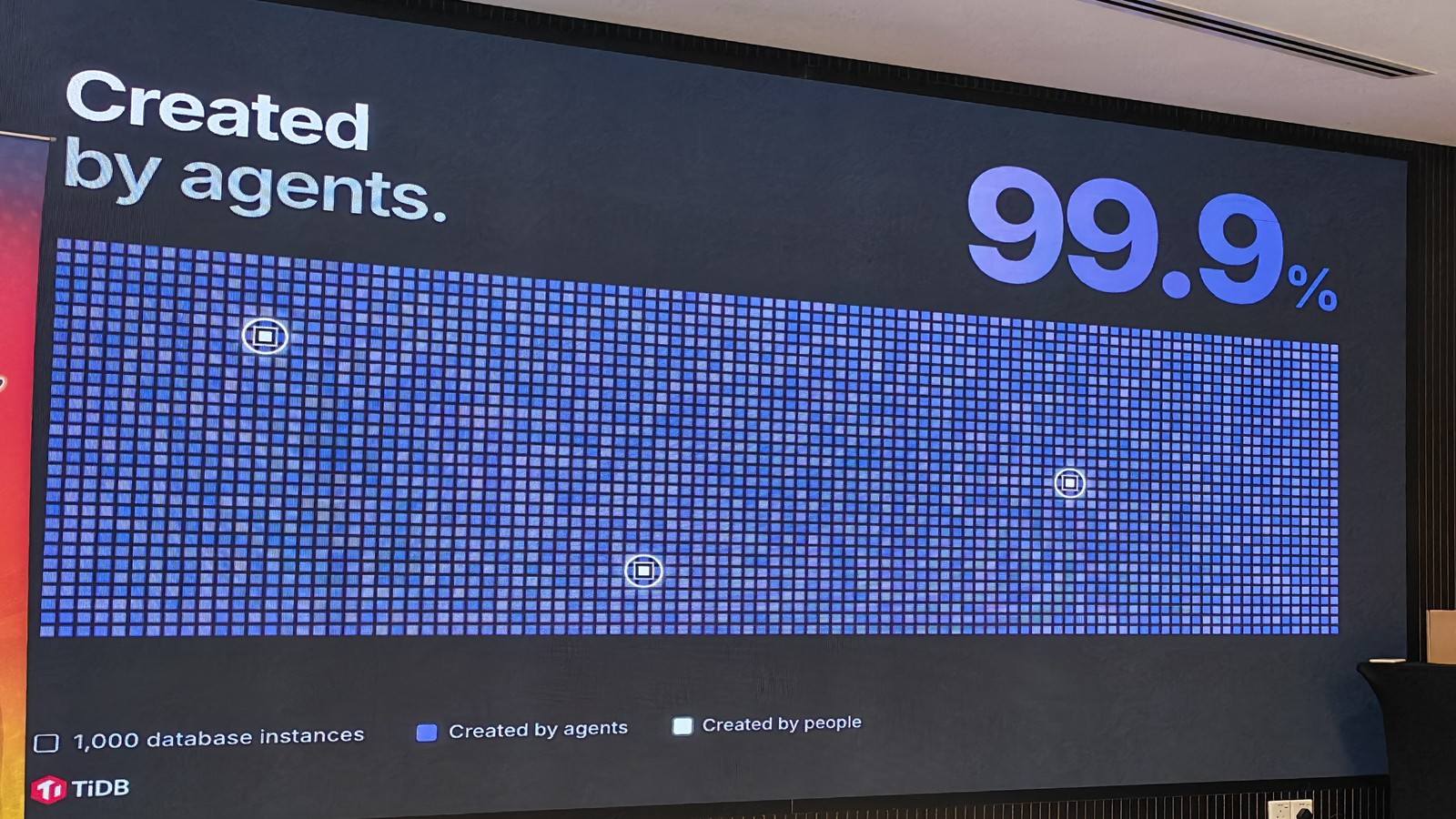
Source: the slide presented by Kenneth Lee of TiDB at Claude AI Day 5.0, photographed at Peninsula College Georgetown, Batu Kawan, on 21 November 2026. The legend on the slide states that each square represents 1,000 database instances.
Why state is the part that breaks
An agent rarely finishes on its first attempt. It tries, reads the result, and tries again, sometimes ten times, sometimes fifty. Lee’s framing was that the model is the brain and everything else is the room it works in: the runtime and sandbox where the work physically happens, the files it produces, the permissions it holds, the traces that record what it did, and the versions that let a team return to a run that worked.
The failure mode is mundane. If a thirty-minute operation dies at minute twenty-nine because a laptop closed, a system without checkpoints restarts from zero and spends the tokens again. That is not a model failure. It is an infrastructure choice made before the first prompt.
Lee listed what an agent actually has to store: who is allowed to do what, what ran, the files, the application data, and the memory used for training. In most organisations those live in different systems, and connecting them is where the friction appears.
The three bottlenecks he named for production
The talk closed with three constraints that appear once an agent deployment leaves a demo and enters a company.
| Bottleneck | What it looks like in practice |
|---|---|
| Database count | One instance per run multiplies with every prompt. Usage is uneven, some databases are prompted monthly and some daily, and no forecast survives contact with real traffic. |
| Work must survive | Checkpointing lets a run resume instead of restarting. Branching lets a team test three approaches and compare, which requires each version’s files and context to stay separate. |
| Workspace boundaries | Users, tasks and whole teams need different access to the same files. Storage also has to expand on request rather than being provisioned years ahead. |
Source: the session as delivered, 21 November 2026. The bottlenecks are the speaker’s characterisation of what his customers hit in production.
His phrase for the last cost is the one worth keeping. Files that agents write accumulate, they are rarely deleted, and each one is slow to reach in isolation. He called it death by a thousand small reads: three seconds a file is nothing until an agent needs thousands of them.
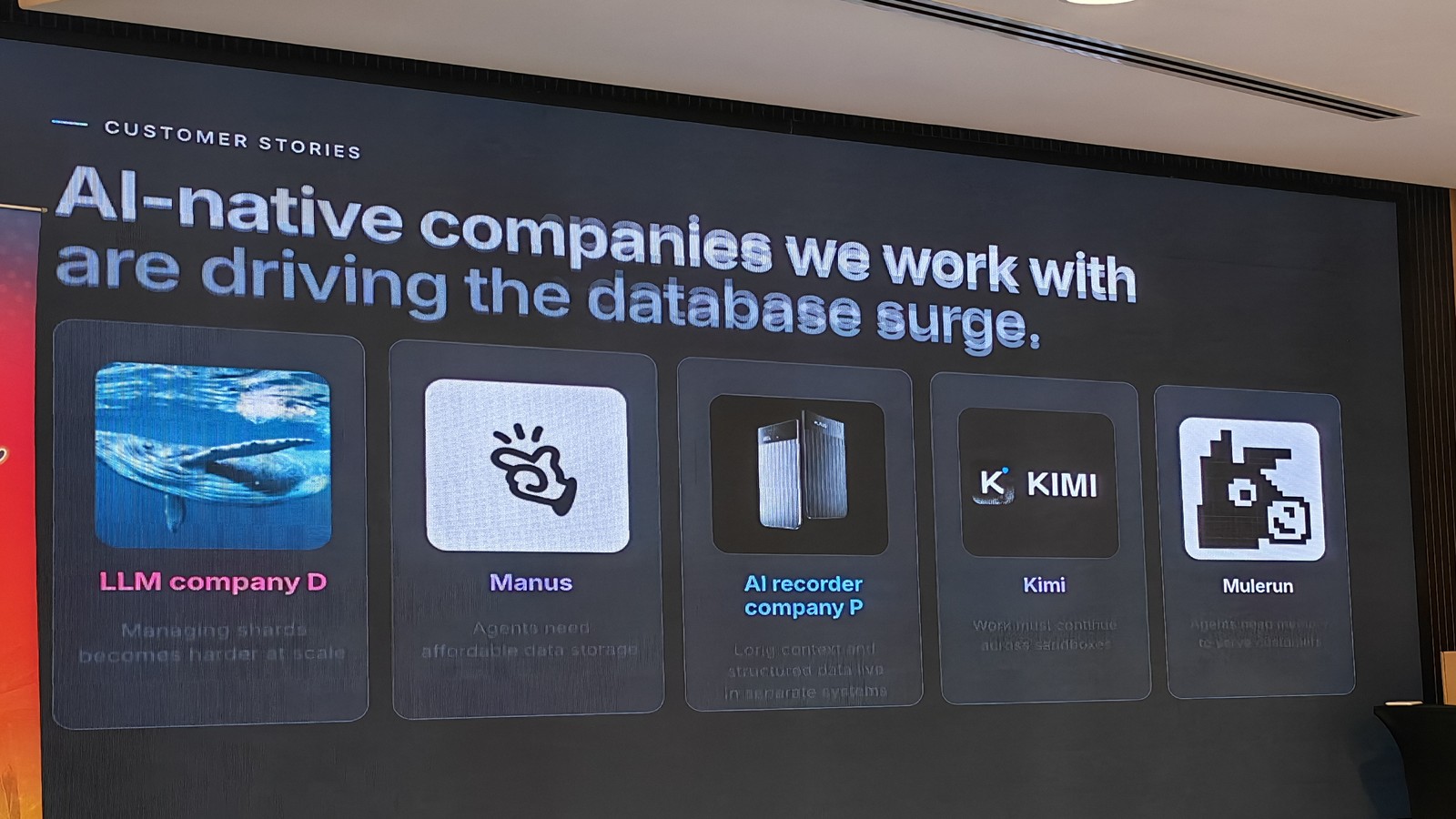
Source: the slide presented by Kenneth Lee of TiDB at Claude AI Day 5.0, photographed on 21 November 2026. The tiles name AI-native companies the vendor counts as customers.
What this means for a Malaysian team running its first agent
Almost none of this is visible in a demonstration, which is precisely why it matters to a company deciding where to spend. A pilot that answers questions well proves the model works. It says nothing about whether the work survives a crash, whether a second team can share the output without seeing the first team’s files, or what happens to the bill when a hundred runs each leave a database behind.
Three questions follow directly from Lee’s session, and a Malaysian buyer can ask them of any vendor without needing to be technical.
First: when a run fails at minute twenty-nine, what has to happen next? If the answer is a restart, the vendor is selling a demonstration. Second: if two departments use the same agent, how are their files kept apart? If the answer is trust, the deployment cannot pass an audit. Third: who can read the record of what the agent did last Tuesday, and for how long is it kept? An agent whose actions cannot be reconstructed is a liability with a subscription attached.
Where this sits in the day
The infrastructure session ran second on the programme, after the chief executive’s own account of running more than 40 AI staff and before the live demonstration of a business request turned into an approved action. That order was deliberate: the room had just been shown what an agent can produce, and Lee was there to say what that production costs to keep.
For a fuller account of the event, including the attendance overrun, the durian supply chain case and the free national AI subscription most of the room had not claimed, see Claude AI Day 5.0 Penang: 268 Sign-Ups, 118 Seats Short.
Sources
- Agmo Group, Claude AI Day Comes to Penang for the First Time, 21 November 2026 — session and speaker line.
- SAMENTA Northern Region, Claude AI Day 5.0 programme announcement, 10 November 2026 — the session title and its stated scope.
- Session recording of Claude AI Day 5.0, 21 November 2026 — the quotes reproduced above, checked against the photographed slides before publication.
- Event slides captured by BD Media at Peninsula College Georgetown, Batu Kawan, on 21 November 2026 — the 99.9 per cent figure and the customer tiles reproduced above.
Note on figures: the six-month database growth and the 99.9 per cent share are the speaker’s own company figures, presented on his slide. BD Media has not independently verified them and reports them as claims made from the stage.