
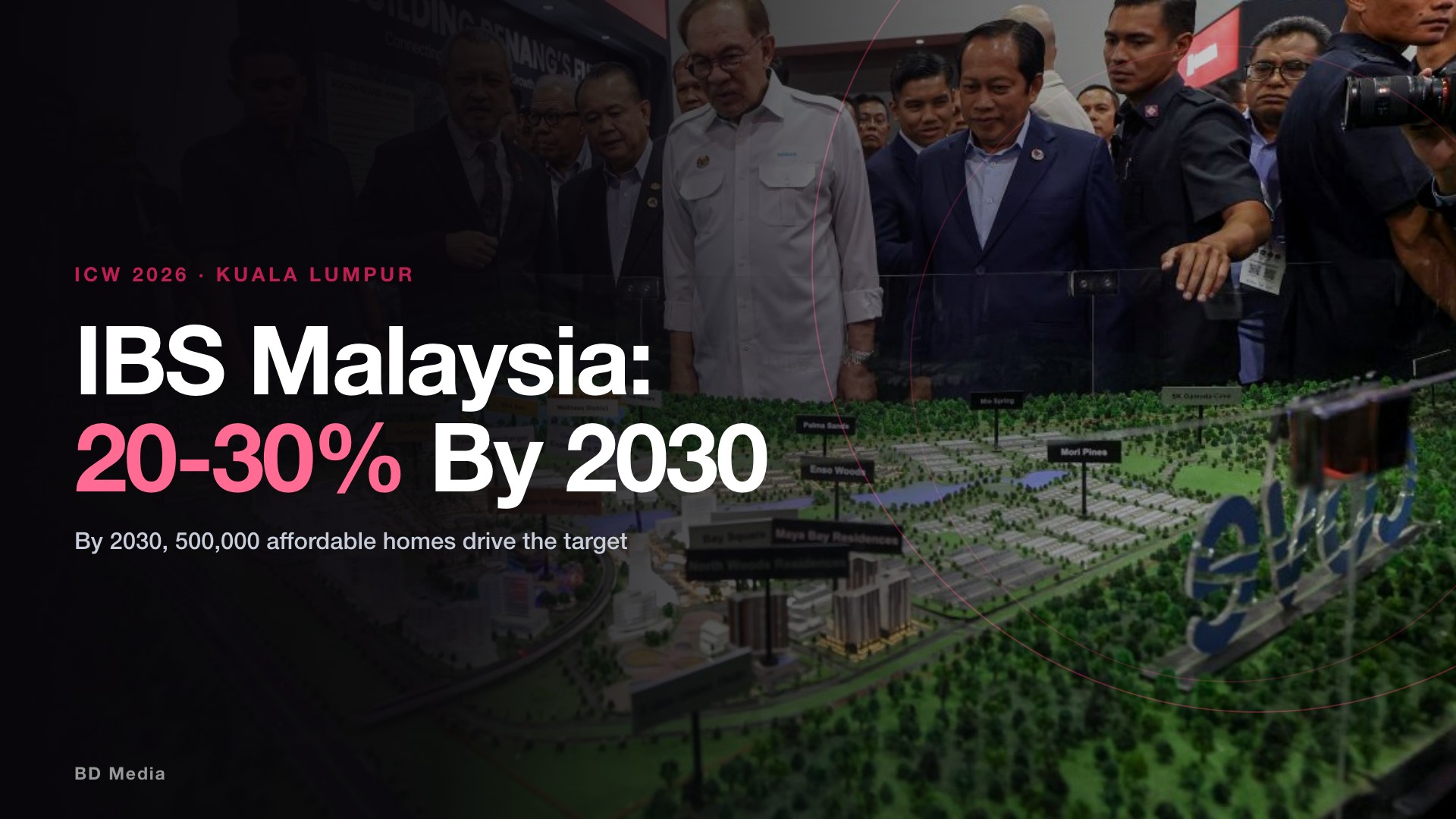
IBS Malaysia has a new number to hit: 20 to 30 per cent adoption of IBS, modular construction and BIM by 2030, Works Minister Datuk Seri Alexander Nanta Linggi said on 10 November 2026, opening International Construction Week at the Malaysia International Trade and Exhibition Centre. It is the first hard figure attached to the Modular Construction Roadmap 2026-2030, and for a small contractor it is the signal that matters: the government has to specify the method in its own tenders to get there.
That is the point at which a small contractor either has a way to bid or does not.
IBS Malaysia: what the 20-30% target actually counts
The three things in the target are not the same thing. IBS is an industrialised building method with a formal scoring regime. Modular construction means volumetric units built off site. BIM is a digital model, not a construction method at all. A target that groups them gives a ministry room to move, and it means the number will be reported against whichever of the three is easiest to count.
| Element | What was said on 10 November | What it means for a contractor |
|---|---|---|
| The target | 20 to 30 per cent adoption of IBS, modular construction and BIM by 2030 | Public tenders will increasingly specify one of the three |
| The instrument | Modular Construction Roadmap 2026-2030 | The document was not published with the speech |
| The demand driver | School construction under the 13MP | Repeatable building types suit off-site manufacture |
| The sector’s size | Four per cent of GDP | Nanta’s point: most building materials are counted under manufacturing |
Source: Bernama, “Govt Targets 30 Percent IBS, Modular Construction Adoption By 2030 – Nanta”, 10 November 2026, captured the same day.
Nanta’s own framing of the four per cent figure is worth keeping, because it is the argument the industry makes whenever construction’s contribution is described as small: “The figure (four percent) is quite normal globally. However, the construction sector encompasses a wider scope as many building materials are classified under the manufacturing sector.”
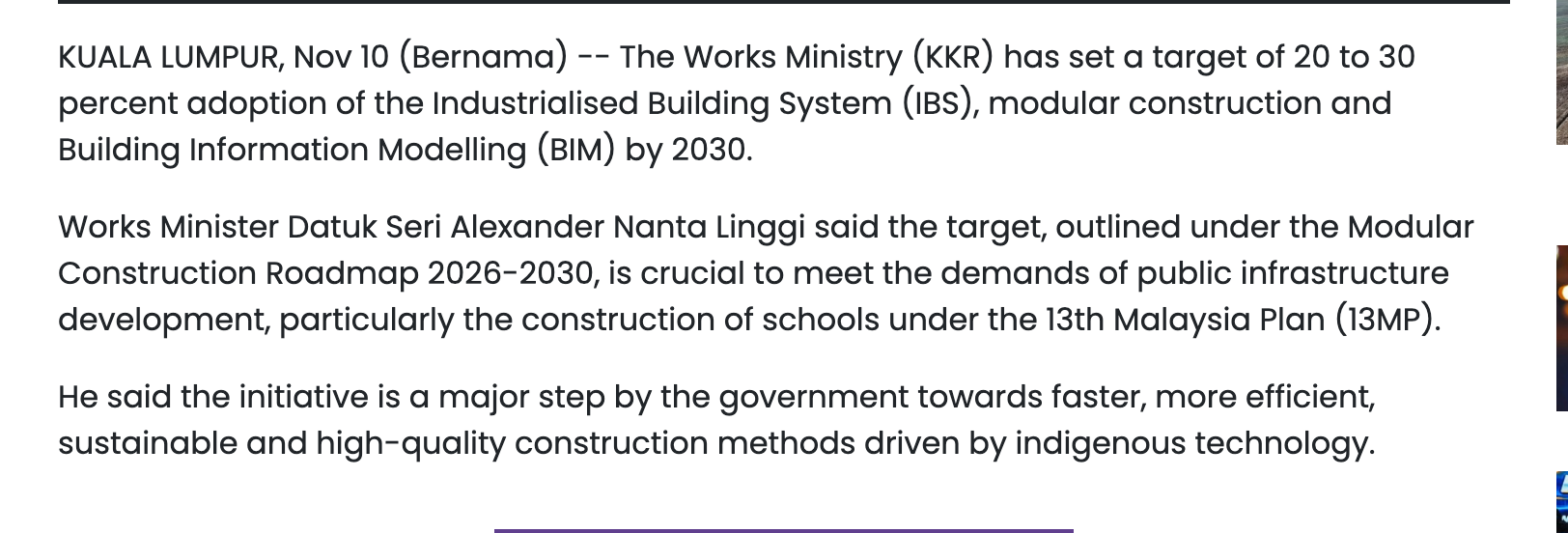
Source: Bernama, “Govt Targets 30 Percent IBS, Modular Construction Adoption By 2030 – Nanta”, datelined Kuala Lumpur, 10 November 2026, captured 10 November 2026.
The number behind the target: 500,000 homes
Speaking at the same opening, the Prime Minister put a volume on the pipeline. Anwar Ibrahim said the 13th Malaysia Plan sets a target of delivering 500,000 affordable homes by 2030, as part of an aspiration of one million homes between 2026 and 2035.
Half a million homes in five years is the reason a modular target exists. A school or a house is a repeating design; a hospital or a bridge is not. Modular construction earns its case on repetition, and repetition is what an affordable-housing programme produces.
“We want Malaysia to be a country that does not simply import and consume technology.”
Datuk Seri Anwar Ibrahim, Prime Minister, opening International Construction Week and BuildXpo Malaysia 2026, as reported by The Star, 10 November 2026The Prime Minister’s version of the policy is about where the value sits. Malaysia should move from importing construction technology to developing, manufacturing and eventually exporting it, he said, naming modular construction and three-dimensional concrete printing as the areas where the Works Ministry and CIDB are exploring domestic capability.
He also addressed the part of the industry that this piece is about: “We must ensure that our local contractors, particularly small and medium-sized enterprises, are not left behind in this transformation.”
What the announcement does not include
Three things a contractor would need in order to plan against this target are absent from the coverage reviewed for this piece.
The roadmap document. The Modular Construction Roadmap 2026-2030 was named in the speech. It was not published alongside it, so the targets, the phasing and the definition of “adoption” are not available to read.
Any incentive or funding line. No grant, no financing scheme and no procurement preference was announced. A target is not a programme. Without a specified method appearing in tender documents, a 20 to 30 per cent adoption goal has no mechanism behind it.
An SME route. The Prime Minister said small and medium contractors must not be left behind and must get access to knowledge, training, technology and commercial opportunity. That is a statement of intent. It does not name a scheme, an eligibility test or a date.
Read the target as a tender signal, not a subsidy. The realistic way a 2030 adoption target reaches a G1 to G4 contractor is through the specification in a public project: a school designed as volumetric modules, tendered with an IBS score requirement. The contractor that can read that specification and price it is the one that benefits. The contractor waiting for a grant will wait past 2030.
What a small contractor can do while the show is on
ICW and BuildXpo Malaysia 2026 run at MITEC until 12 November, with about 20,000 participants and more than 200 international exhibitors, co-located with Glasstech Asia and Fenestration Asia. That is two working days from the date of this piece.
- Walk the floor with one question. Ask each modular exhibitor who installs their units in Malaysia, and whether that installer is a contractor or an in-house crew. The answer tells you whether a subcontracting route exists for a company your size.
- Ask CIDB what the IBS score actually requires of you. The scoring regime is what a tender will be judged against. If nobody in the company can calculate a score for a proposed design, that is the gap to close before the next school tender, not after.
- Write down the two project types you could repeat. Modular work rewards a contractor who can build the same unit twenty times. Name the two building types your company already repeats, and take those to a manufacturer rather than the whole portfolio.
What this does not change
The labour picture. Nanta told reporters that the supply of Indonesian workers had seen no significant disruption, that it was “perhaps a little bit too early” to judge the effect of recent sentiment, and that Putrajaya is monitoring Jakarta’s policy. A modular programme is partly an argument about reducing site labour, and that argument gets weaker when labour is available and cheap.
Geopolitics is the other exposure he named: tensions in Europe and the Middle East feeding into logistics chains and fuel costs. For a contractor, that lands on the price of steel, cement and transport, and it lands before any 2030 target does.

Source: Bernama, “Construction Sector Must Develop Next Generation Of Leaders – Nanta”, datelined Kuala Lumpur, 10 November 2026, captured 10 November 2026.
Last updated: 10 November 2026 — Bernama’s two reports from the ICW opening and The Star’s reports of the Prime Minister’s speech were opened for this edition. The roadmap document itself could not be read because it was not published with the announcement.
Sources
- Bernama, Govt Targets 30 Percent IBS, Modular Construction Adoption By 2030 – Nanta, 10 November 2026 — the 20 to 30 per cent target, the Modular Construction Roadmap 2026-2030, the 13MP school programme, the four per cent GDP figure and the minister’s quotes — bernama.com
- Bernama, Construction Sector Must Develop Next Generation Of Leaders – Nanta, 10 November 2026 — the minister’s remarks on skills and youth, the 28th edition of ICW, and the exhibitor and delegate profile — bernama.com
- The Star, M’sia must develop, export own construction tech, says PM, 10 November 2026 — “We want Malaysia to be a country that does not simply import and consume technology” and “We must ensure that our local contractors, particularly small and medium-sized enterprises, are not left behind in this transformation” — thestar.com.my
- The Star, Malaysia targets 500,000 affordable homes by 2030, says Anwar, 10 November 2026 — the 500,000 home target under the 13MP and the one million homes aspiration for 2026 to 2035 — thestar.com.my
BD Media is the editorial desk of Big Domain. This article reports what was said at the ICW and BuildXpo Malaysia 2026 opening on 10 November 2026. Programme targets, tender requirements and IBS scoring are set by the Works Ministry and CIDB; Big Domain does not provide construction, procurement or compliance advice for any specific project.