
Google has published the answer, in its own documentation, to the question a growing number of Malaysian SMEs are being invoiced for: there is no special file, no special markup and no special optimisation that gets a page into AI Overviews or AI Mode. The requirements are the ones that have applied to search all along — the page must be indexed, eligible to show a snippet, and must meet Google’s existing technical requirements.
The wording is unambiguous. Google’s Search Central documentation, AI features and your website, states: “There are no additional requirements to appear in AI Overviews or AI Mode, nor other special optimizations necessary.” The page was last updated on 31 December 2025.

Google’s own statement of the eligibility bar for AI Overviews and AI Mode. Source: Google Search Central, “AI features and your website” (last updated 31 December 2025). Screenshot: BD Media.
What Google AI Overviews actually require
The full eligibility test, verbatim: “To be eligible to be shown as a supporting link in AI Overviews or AI Mode, a page must be indexed and eligible to be shown in Google Search with a snippet, fulfilling the Search technical requirements. There are no additional technical requirements.”
Read those three sentences together and the commercial point is blunt. The deliverable being sold to small businesses as “AI optimisation” does not appear anywhere in Google’s own statement of its requirements.
Google follows that with a warning that matters more than most vendors will tell you: “Just because a page meets all requirements, best practices, and complies with the policies, doesn’t mean that Google will crawl, index, or serve its content. Indexing and serving isn’t guaranteed.”
The same page closes the door on the product being sold around this topic: “You don’t need to create new machine readable files, AI text files, or markup to appear in these features. There’s also no special schema.org structured data that you need to add.”
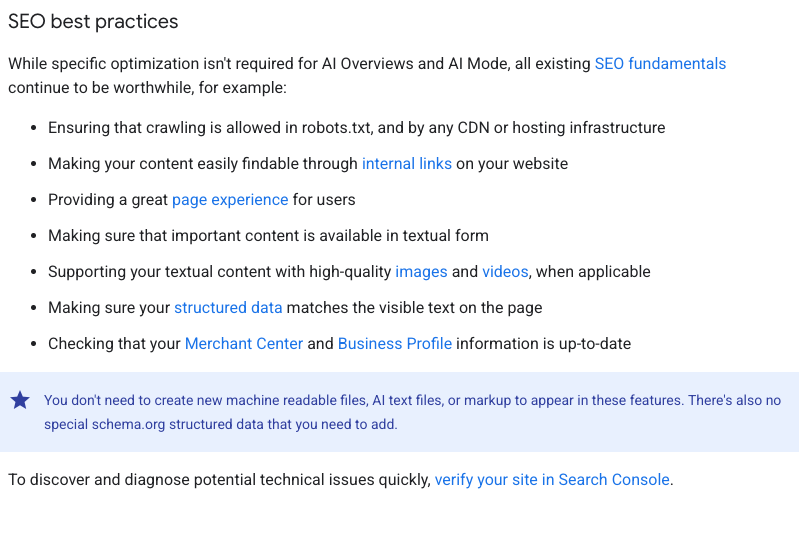
The fundamentals Google says still apply, and the line stating that no new machine-readable file, AI text file or markup is needed. Source: Google Search Central, “AI features and your website”. Screenshot: BD Media.
The checklist Google names, and nothing else
Google does list work that helps — framed as existing SEO fundamentals rather than an AI playbook. There are seven items, and every one of them predates AI Overviews. In our reading this is the most useful part of the page for a small business: nothing on the list is new, and nothing on the list is optional.
| What Google names | What it means in practice |
|---|---|
| Crawling allowed in robots.txt, and by any CDN or hosting infrastructure | A firewall, WAF rule or CDN setting that blocks Googlebot undoes everything else |
| Content findable through internal links | A page no other page links to is a page the crawler may never reach |
| A great page experience | Core Web Vitals and the basics of a page that works |
| Important content available in textual form | Text inside images or JavaScript-only rendering is not reliably readable |
| High-quality images and videos supporting the text | Supporting material, not a replacement for it |
| Structured data matches the visible text on the page | Markup describing something the page does not say is a mismatch, not a boost |
| Merchant Centre and Business Profile kept up to date | The two Google surfaces that feed commercial answers directly |
The seven fundamentals listed in Google’s AI features documentation, verbatim in substance. Source: Google Search Central, “AI features and your website”.
How the answer is assembled — and why depth matters
The mechanism Google describes explains why thin pages keep underperforming inside AI answers. “Both AI Overviews and AI Mode may use a ‘query fan-out’ technique,” the documentation states, “issuing multiple related searches across subtopics and data sources.” A page that answers one narrow question competes in one of those sub-searches. A page that covers a topic across the questions a buyer actually asks competes in several at once.
Google also tempers expectations on frequency: “AI Overviews are only shown when our systems determine that it is additive to classic Search, and as such, often don’t trigger.” An SME should not expect an AI answer on every query in its market, and a vendor promising guaranteed AI Overview placement is promising something Google’s own documentation says nobody can guarantee.
Scale is why this matters commercially even for a business that never thinks about it. Alphabet reported at its Q2 2025 earnings update that AI Overviews had reached two billion monthly users across more than 200 countries and 40 languages — a figure compiled from Alphabet’s own earnings disclosures.
Measuring it, and controlling it
Two practical points from the same page, both of which a Malaysian SME can act on this week.
The traffic is visible. “Sites appearing in AI features (such as AI Overviews and AI Mode) are included in the overall search traffic in Search Console,” Google states, reported within the Performance report’s “Web” search type — not a separate AI report. And Google’s own observation on quality: “when people click from search results pages with AI Overviews, these clicks are higher quality (meaning, users are more likely to spend more time on the site).”
The control exists, and it is blunt. robots.txt directives for Googlebot govern crawling; nosnippet, data-nosnippet, max-snippet and noindex limit what a page contributes to Search; Google-Extended governs AI training and grounding in other Google systems. There is no per-query switch. Opting out of snippets opts a page out of the AI answer too — which is the trade-off, stated plainly.
What we would actually do. If an agency or a tool is selling you an “AI visibility file”, a special AI schema package or guaranteed AI Overview placement, ask them to point to the line in Google’s documentation that requires it. It does not exist. Then ask what they will actually change — the answer should be a subset of the seven fundamentals above, plus content that answers real questions in depth. If that is what they were going to do anyway, the work is probably worth buying. Just not under the AI label.
Sources
- Google Search Central documentation, “AI features and your website”, last updated 31 December 2025 — source of every quoted passage above, the seven-item fundamentals list, the query fan-out description, the Search Console reporting statement and the content-control options
- SQ Magazine, “Google Usage & Search Statistics 2026” — compilation of Alphabet’s own earnings disclosures, including the Q2 2025 figure of two billion monthly AI Overviews users across more than 200 countries and 40 languages
- Search Engine Journal, “Google’s Official Advice On Optimizing For AI Overviews & AI Mode” — independent editorial read of the same documentation, used as a cross-check on our interpretation