On 1 September 2026 the e-Invoice exemption floor moved from RM1 million to RM3 million. LHDN says that takes more than 1.1 million traders out of the regime. For Malaysian small business it is the largest single piece of relief from this system so far.
It is also narrower than the headline reads. The exemption is granted to a taxpayer and then withdrawn again if that taxpayer sits inside a group. A Sdn Bhd turning over RM2 million is exempt. A Sdn Bhd turning over RM2 million whose shareholder is a company turning over RM4 million is not. Nothing about the smaller company changed. Only the people standing behind it did.
The e-Invoice exemption below RM3 million applies to every taxpayer category
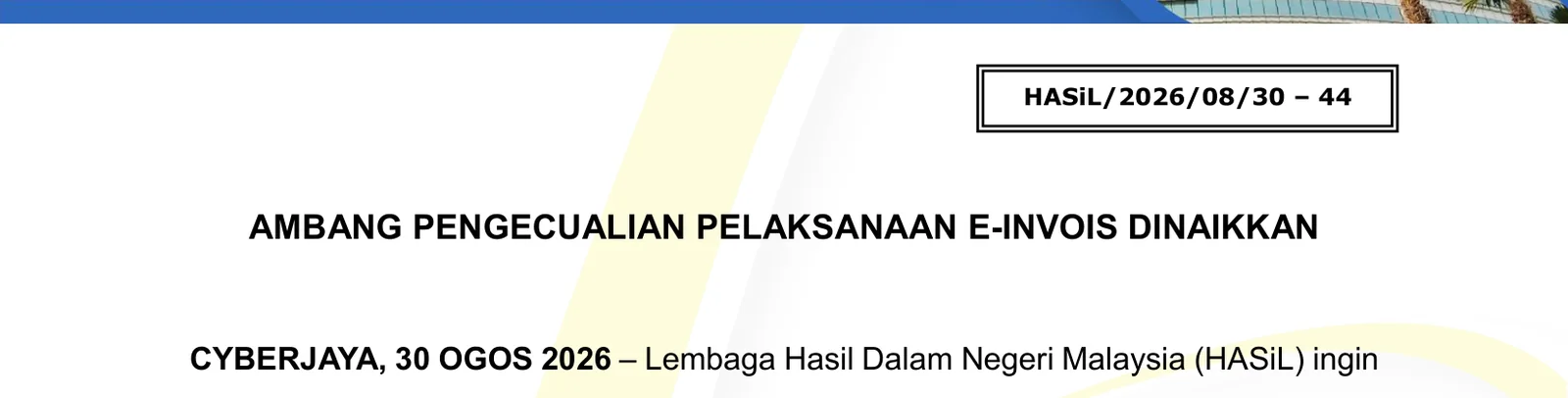
LHDN announced the change in a media release dated 30 August 2026, issued the same day the Prime Minister announced it. The regulator’s own sentence:
“Selaras dengan pengumuman oleh YAB Perdana Menteri dalam Majlis Amanat Perdana Hari Kebangsaan 2026 pada hari ini, Kerajaan telah bersetuju untuk menaikkan nilai ambang pelaksanaan e-Invois daripada RM1 juta kepada RM3 juta, berkuat kuasa mulai 1 September 2026. Dengan kenaikan nilai ambang tersebut, PMKS dengan pendapatan atau jualan tahunan kurang daripada RM3 juta tidak diwajibkan untuk melaksanakan e-Invois.”
In English: the government agreed to raise the e-Invoice implementation threshold from RM1 million to RM3 million with effect from 1 September 2026, and MSMEs with annual income or revenue below RM3 million are not required to implement e-Invoice.
The same release puts a number on the reach:
“Pengumuman ini turut memberi manfaat kepada keseluruhan lebih 1.1 juta peniaga yang mendapat pengecualian.”
LHDN’s implementation timeline page carries the rule in English, with its own revision note underneath:
“Taxpayers with an annual turnover or revenue of less than RM3,000,000 are exempted from e-Invoice implementation”
“Notes: e-Invoice implementation timeline been updated on 30 August 2026”
Read the sentence, not the row above it. The phase table still lists “up to RM5 million — 1 January 2026”. LHDN added an exemption line rather than redrawing the table, and both now sit on the same page.
The group test: when the exemption does not apply
The General Guideline, version 4.8, published 30 August 2026, opens the exemption to every category of taxpayer. Individuals, partnerships, companies, cooperatives. Then it takes three of them back. From section 1.6.10, page 18:
“Walau bagaimanapun, pengecualian tersebut tidak terpakai kepada:”
“(a) pembayar cukai yang mempunyai pemegang saham bukan individu (atau yang setara) dengan pendapatan atau jualan tahunan sekurang-kurangnya RM3,000,000; atau”
“(b) pembayar cukai yang merupakan subsidiari kepada syarikat induk yang mempunyai pendapatan atau jualan tahunan sekurang-kurangnya RM3,000,000; atau”
“(c) pembayar cukai yang mempunyai syarikat berkaitan / usaha sama dengan pendapatan atau jualan tahunan sekurang-kurangnya RM3,000,000.”
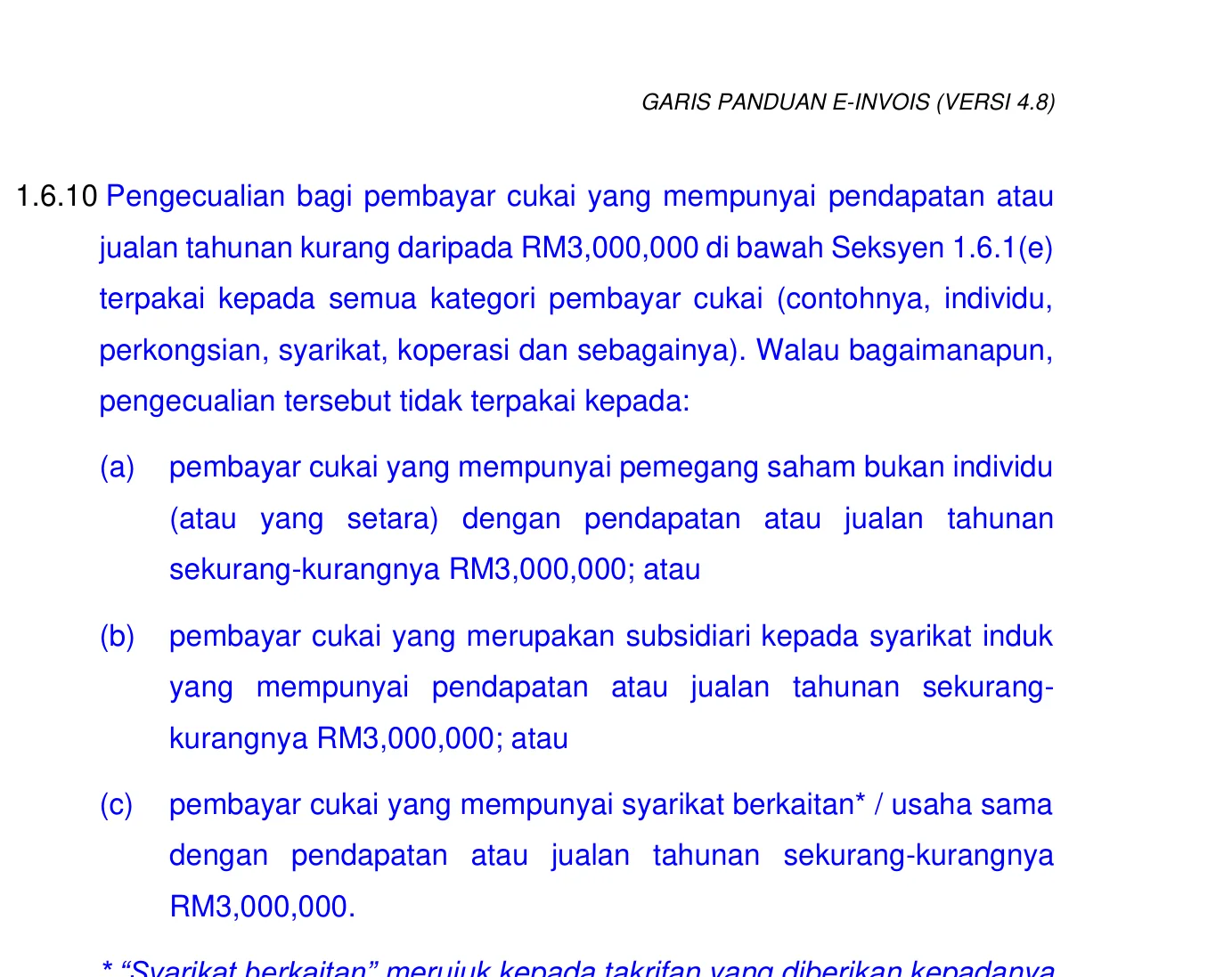
Three tests, and failing any one of them fails the exemption. A non-individual shareholder at RM3 million or more. A holding company at RM3 million or more. A related company or joint venture at RM3 million or more. The guideline takes the meaning of “related company” from the Investment Promotion Act 1986.
The reverse direction is written down too. The exemption protects the listed persons themselves and stops there. A company owned by them is still on the hook:
“Mana-mana entiti (contohnya, syarikat, perkongsian liabiliti terhad dan lain-lain) yang dimiliki oleh individu atau pihak yang dinyatakan di atas adalah masih perlu melaksanakan e-Invois, mengikut garis masa pelaksanaan yang ditetapkan.”
Which year LHDN looks at
The determination rests on the audited financial statements or the tax return for 2022, whichever applies. Once your position is fixed, your implementation date is fixed with it. Later changes in turnover do not move it.
New companies follow a different clock. A business that began operating between 2023 and 2025 with annual income or revenue of at least RM3 million was due on 1 July 2026. A business starting in 2026 or later is due on 1 July 2026 or on its first day of operations. If its first-year turnover is below RM3 million, its implementation date begins on 1 January of the second year after the year it crosses RM3 million.
Which of these four is your company?
| Your situation | e-Invoice status |
|---|---|
| Annual income or revenue below RM3 million, and no non-individual shareholder, holding company, related company or joint venture at RM3 million or above | Exempt. No obligation to issue e-Invoice, including self-billed e-Invoice. LHDN states that ordinary receipts remain acceptable as proof of expense. |
| Below RM3 million, but a shareholder, holding company, related company or joint venture is at RM3 million or above | In scope. You implement on your group’s implementation date. Your own small turnover does not save you. |
| RM3 million to RM5 million | In scope. Implementation date applies, and the interim relaxation for this phase runs to 31 December 2027. |
| Above RM5 million | In scope. Implementation for this phase is complete and its interim relaxation period has ended. |
How to test your group in 20 minutes
- Write down your own annual income or revenue, taken from the audited financial statements or the tax return for 2022.
- Pull your shareholder register. Mark every shareholder that is not a natural person. A Sdn Bhd, a Bhd, an LLP, a trustee body, a foreign company.
- For each of those, find its annual income or revenue. RM3 million or more on any one of them ends your exemption.
- Check upwards. If you are a subsidiary and your holding company is at RM3 million or more, the exemption does not apply to you.
- Check sideways. List related companies and joint ventures. “Related company” follows the Investment Promotion Act 1986 definition. RM3 million or more on any of them has the same effect.
- If all five checks come back clear, you are exempt. Diarise a re-check anyway. The floor has already moved once, and no part of this test depends on your own books alone.
Two different things end on 31 December 2027
The interim relaxation for the phase covering taxpayers up to RM5 million runs until 31 December 2027. That comes from Table 16.1 of the Specific Guideline, version 4.9, published 7 September 2026, which sets the relaxation period for each implementation phase. Its final row covers taxpayers with annual income or revenue up to RM5 million, whose implementation dates are 1 January 2026 and 1 July 2026, and gives the relaxation period as “Sehingga 31 Disember 2027”.
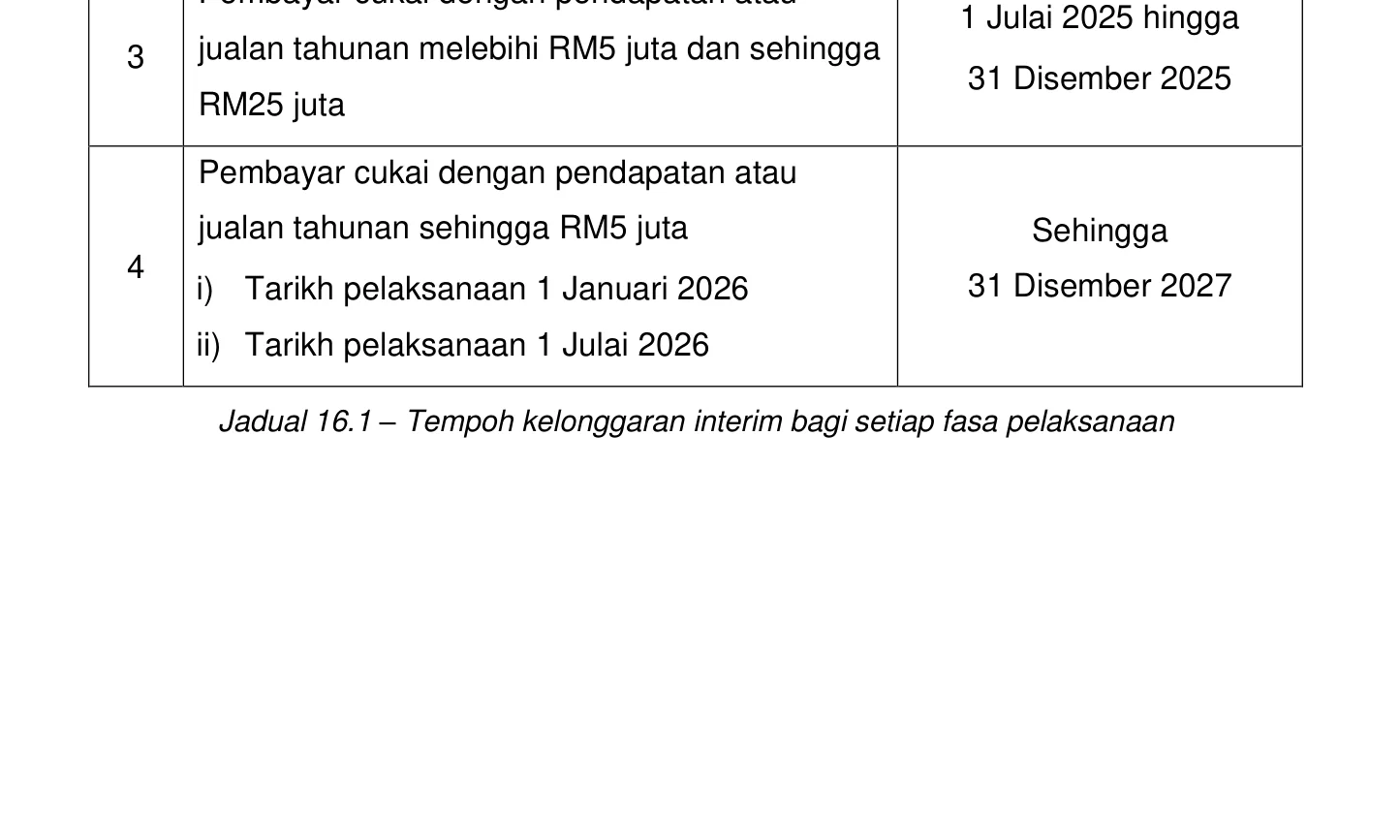
Inside that window the same guideline lets a taxpayer issue consolidated e-Invoices for all activities and transactions, issue consolidated self-billed e-Invoices, put free-text detail into the product or service description field, and skip per-transaction e-Invoices even where a buyer asks for one, provided the consolidation rules are met. LHDN also states that it will not take prosecution action under the Income Tax Act 1967 for non-compliance during the interim relaxation, on the same condition.
There is a separate programme that ends on exactly the same date, and it is not the relaxation period. The e-Invoice Special Voluntary Disclosure Programme, Program Khas Pengakuan Sukarela or PKPS, runs from 7 July 2026 to 31 December 2027. It covers taxpayers who never submitted, who submitted wrongly, and those already notified of a compliance review. Two instruments, one date. Do not read one as proof of the other.
One thing we could not confirm: an enforcement start date of 1 January 2028. The Specific Guideline states that the interim relaxation runs until 31 December 2027 and goes no further than that. Several third-party summaries say enforcement begins the following day. We did not find that sentence in the guideline, so we are not asserting it.
If you have been told the floor is RM1 million
Plenty of Malaysian guides still say RM1 million, and the error is understandable, because that was correct until the end of August 2026. One of them is ours. An earlier Big Domain guide, published in January 2026, carries a table row reading “Below RM1 million — Micro businesses — Exempted”. A business turning over RM2 million was told that it had to implement. It does not, unless the group test catches it.
That page has not been corrected, and correcting it is a separate decision. What matters to a reader today is the sentence LHDN is publishing now, and the four cases above.
About BD Media
BD Media is the publishing desk of Big Domain, a Malaysian technology company. We write about the compliance, payments and infrastructure decisions that land on small and mid-sized Malaysian businesses, and we try to source every number to the regulator that published it rather than to the summary that repeated it. Where we could not open a document, we say so in the piece.
Sources
- LHDN (Inland Revenue Board of Malaysia) — Media Release, “Ambang Pengecualian Pelaksanaan e-Invois Dinaikkan”, reference HASiL/2026/08/30 – 44, dated 30 August 2026. Opened 17 September 2026. https://www.hasil.gov.my/en/butiran-media/?item=a2VueWF0YWFuX21lZGlhfDIxMg== — the release PDF is linked from that page.
- LHDN — Garis Masa Pelaksanaan e-Invois (e-Invoice Implementation Timeline), page last updated 30/08/2026. Opened 17 September 2026. https://www.hasil.gov.my/en/e-invois/pelaksanaan-e-invois-di-malaysia/garis-masa-pelaksanaan-e-invois/
- LHDN — Garis Panduan e-Invois, Versi 4.8, diterbitkan 30 Ogos 2026. Opened 17 September 2026. https://www.hasil.gov.my/e-invois/rujukan-pelaksanaan-e-invois/garis-panduan — the exemption and group-test text is on page 18; the year-of-determination and new-business rules run from page 14 to page 15; the entities-owned-by-exempt-persons rule is on page 16.
- LHDN — Garis Panduan Spesifik e-Invois, Versi 4.9, diterbitkan 7 September 2026. Opened 17 September 2026. Same guideline index URL as above — Table 16.1 and the interim-relaxation treatment are on pages 139 to 140; the voluntary disclosure programme is on page 141.
- Big Domain (our own archive) — earlier guide, published January 2026, read 17 September 2026 to confirm the RM1 million row it still carries. Referenced, not edited.
What could not be checked. We did not find, in either guideline, a stated enforcement start date of 1 January 2028, and we have not asserted one. We also did not open the guideline’s appendices or the Investment Promotion Act 1986 itself; the definition of “related company” is described here only as the guideline describes it.