Almost everything published about the haze this month is a health story or a news story. Both have their place. Neither tells a business owner what to do on a Tuesday morning when three of the crew are outside, two riders are on the road and the reading is climbing.
This is the operator’s version. It sets out the official index bands, what each band changes for outdoor work, delivery and a booked event, and the sequence to make the call in. It is deliberately not a medical article. The medical guidance is published by the Ministry of Health and it is good. We are not going to paraphrase it into operational language and pretend it is ours.
The IPU bands, from the document that defines them
The scale is set out in Jerebu: Panduan Kesihatan Untuk Anda, a Ministry of Health publication produced with the ministry’s Occupational and Environmental Health Unit and hosted by the Department of Environment. Its own publisher line reads “Diterbitkan oleh Bahagian Pendidikan Kesihatan dengan Kerjasama Unit Kesihatan Pekerja dan Alam Sekitar Kementerian Kesihatan Malaysia”. So this is a health ministry document, not an environment department one. The page it sits on is the Department of Environment’s.
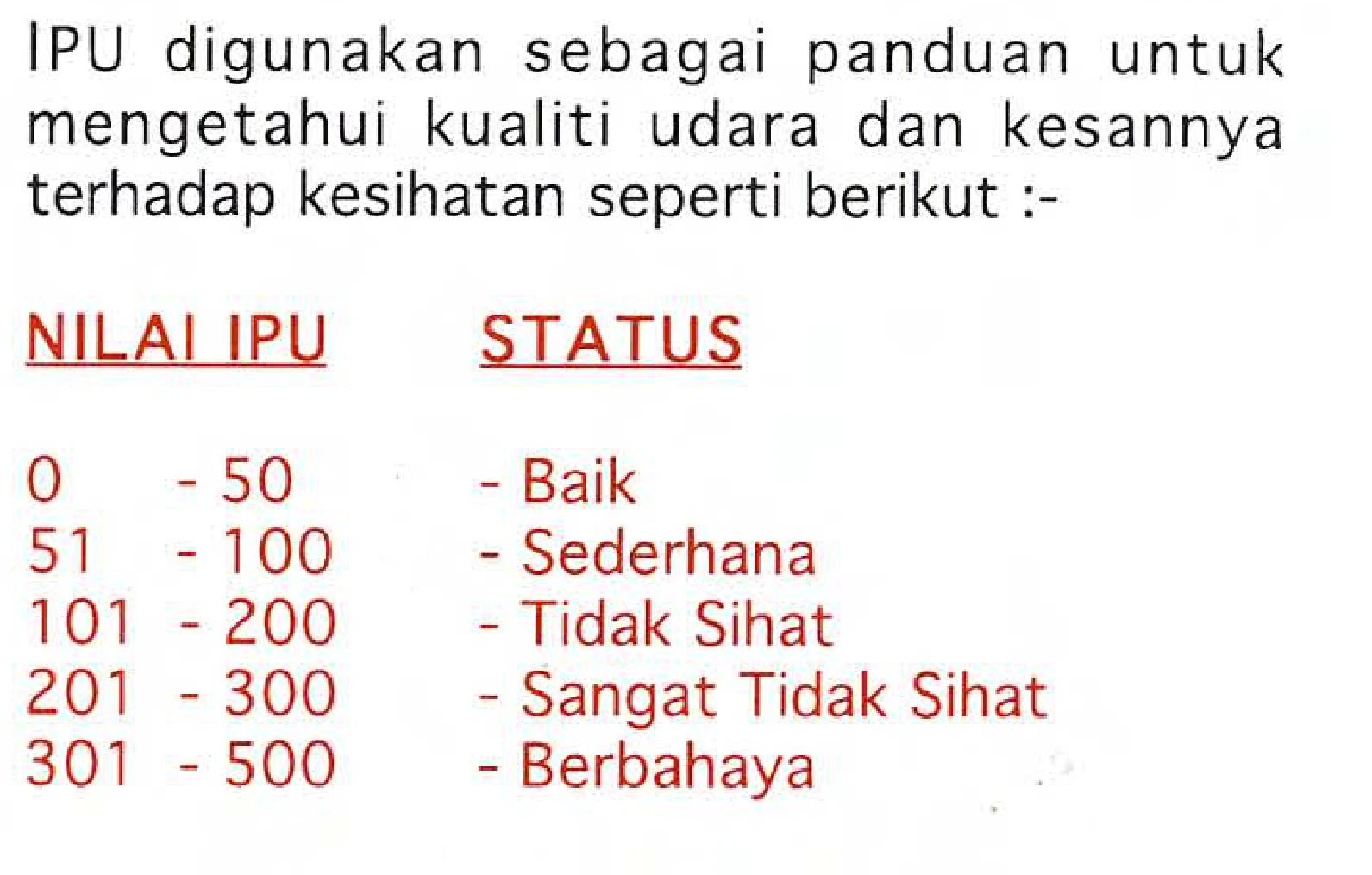
Two things about how we read it. The file is image-only, with no text layer, so it cannot be copied from or searched by a normal reader. We extracted the embedded page images and read them visually. That is reproducible: download the PDF, render the two pages, and the table above is what you will see.
| IPU / API value | Official status | What the ministry’s leaflet advises |
|---|---|---|
| 0 – 50 | Baik Good | Normal conditions. No adjustment indicated. |
| 51 – 100 | Sederhana Moderate | Normal under the scale. The leaflet’s specific advice begins above 100, which it defines as unhealthy air: “Perokok dinasihatkan supaya tidak merokok apabila keadaan udara tidak sihat ( iaitu IPU yang melebihi 100)”. |
| 101 – 200 | Tidak Sihat Unhealthy | The leaflet advises reducing outdoor sporting activity, staying inside a building or home as far as possible, and wearing a face mask outside. Its mask line names motorcyclists and people who work outside buildings specifically. Outdoor workers also appear on the document’s own high-risk list. |
| 201 – 300 | Sangat Tidak Sihat Very unhealthy | Minimise outdoor activity, keep windows closed where you can, use air conditioning if available, drink water. The document’s leave advice attaches at the band above this one, and only for high-risk individuals. |
| 301 – 500 | Berbahaya Hazardous | The leaflet advises that high-risk groups take leave away from the haze area if the haze continues at the hazardous level where they are: “Mereka yang berisiko tinggi dinasihatkan mengambil cuti di luar kawasan yang berjerebu sekiranya keadaan jerebu berterusan pada tahap berbahaya di kawasan mereka.” |
Columns 1 and 2 are the official scale, reproduced exactly. Column 3 condenses that document’s own advice. The scale is also set out on the Department of Environment’s Air Pollutant Index page, which adds that the categories follow the action criteria in the National Haze Action Plan.
Who the Ministry of Health says is at risk
This is the part that turns a health notice into a business problem. The leaflet sets out the groups it considers at higher risk, and the fifth item on that list is people who work outdoors. That is the ministry’s own words, not our reading of them.
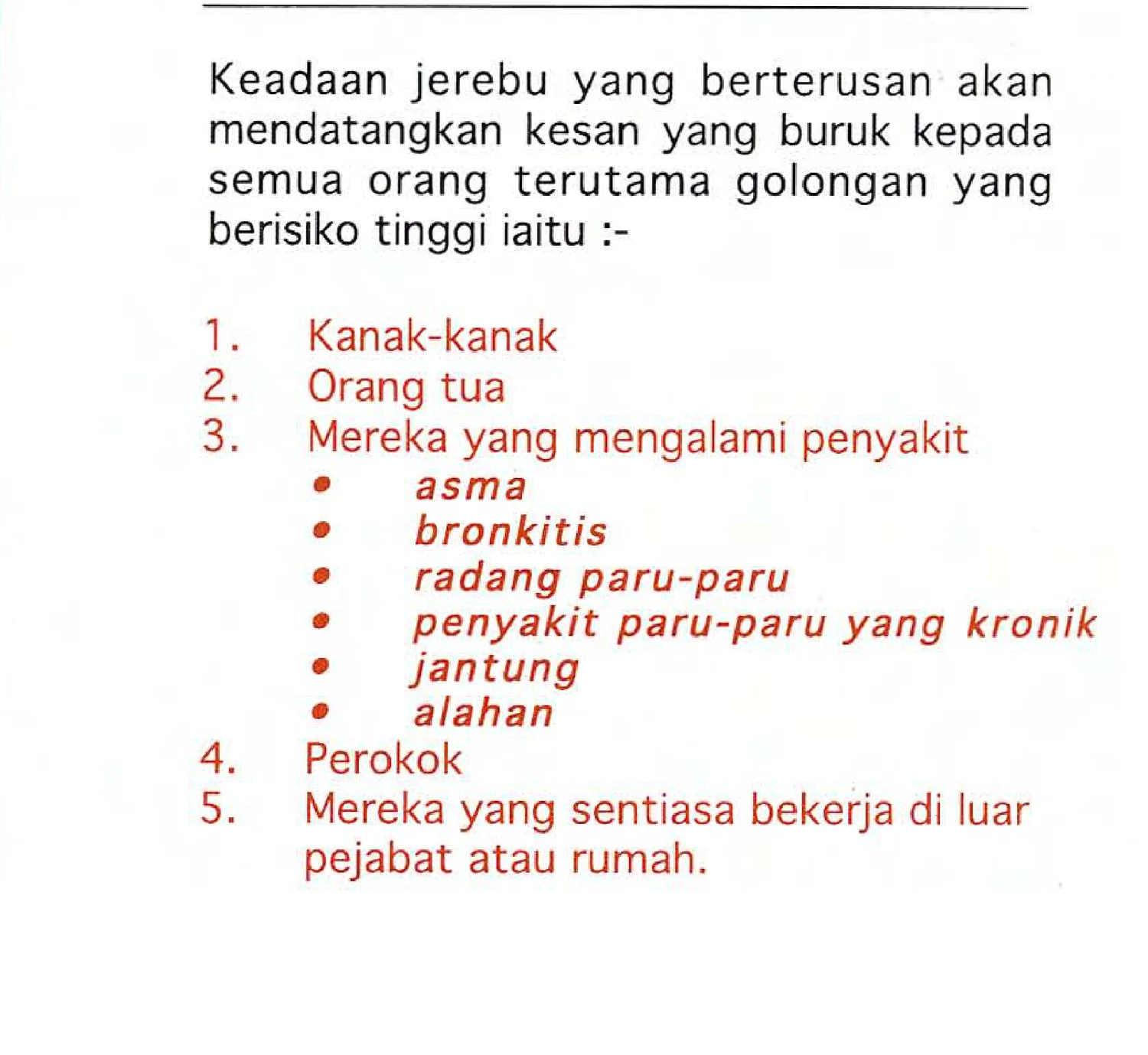
Item 5 reads “Mereka yang sentiasa bekerja di luar pejabat atau rumah”, which is those who are always working outside the office or the home. Your site crew and your riders are in that sentence. The mask advice points the same way, naming motorcyclists and people who work outside buildings. A rider on an open bike is precisely who this guidance was written for.
The leave advice is narrower than it first looks. It is addressed to high-risk individuals, it attaches at the hazardous band, and it is advice rather than an entitlement. An employer can reasonably act on it anyway. Calling it a legal right would be wrong, and we are not going to.
What is binding, and for whom
The thresholds with legal force that we could verify apply to schools. The Education Ministry has said outdoor activities are suspended above an API of 100 and schools close above 200, under the National Haze Action Plan. Sarawak’s state education department put the same two thresholds in a written statement in September and added a third: above 500, teachers and school staff are not required to report for duty.
| API reading | Education-sector action, as stated by the ministry and state departments |
|---|---|
| Above 100 | All outdoor activities involving students are halted. |
| Above 200 | Schools in the affected area or district close immediately. |
| Above 500 | Teachers and school staff are not required to report for duty. |
Read that table for what it is. It is a school rule. There is no equivalent published rule for a construction site, a warehouse yard or a delivery fleet, and we could not find one. We looked. No statutory obligation on a private employer that is triggered by a specific IPU band was verified in the preparation of this article. A general duty to keep workers safe exists under occupational safety and health law and long predates the haze season. Whether a particular pollution level turns that general duty into a specific instruction to stop outdoor work is a legal question, and we are not able to answer it here. Take it to your own adviser rather than to us.
The action table: what changes, by band
Verified Band and status are the official scale, from the leaflet shown above. Our call The action columns are our recommendation for an SME based on the ministry’s guidance. They are not a legal requirement and not a Ministry of Health instruction. Adapt them, and set your own trigger points before the season rather than during an episode.
| IPU band | Outdoor crew and sites | Delivery and riders | Booked events and front-of-house | One thing to do on the day |
|---|---|---|---|---|
| 0 – 50 Baik | No change. | No change. | No change. | Note the reading and move on. |
| 51 – 100 Sederhana | No change. Brief the crew on the season so the higher bands are not a surprise later. | No change. | No change. | Put the escalation trigger in writing and tell the crew what it is. |
| 101 – 200 Tidak Sihat | Cut the non-essential outdoor work and move what can move indoors or to another day. Issue masks to anyone who has to stay outside, and check the fit rather than handing one over. | Rotate riders harder, shorten exposed stretches, and give them somewhere to cool down with water. Mask supply is the visible cost here. | Move outdoor segments indoors or under cover, and shorten the programme. Tell attendees before they travel, not on arrival. | Assign one person to watch the reading and hold the authority to stop the job. |
| 201 – 300 Sangat Tidak Sihat | Stop non-urgent outdoor work. Keep only what has to happen, staffed by volunteers and on short rotations. | Reduce to essential runs. Consider pausing the shift and saying so publicly instead of quietly running late. | Postpone or relocate. This is the band to decide at, while you still can. | Move to your written stop-work trigger. Do not renegotiate it in the moment. |
| 301 – 500 Berbahaya | Stop outdoor work. This is also the band at which the leaflet advises high-risk individuals to take leave away from the haze area if conditions persist. | Stop the exposed runs. Riders are named in the ministry’s high-risk list and they are on an open vehicle, which is the worst combination in this table. | Postpone. Cancelling is cheaper than the alternatives, and it is the one band where that needs no argument. | Tell customers, tell staff, and write down what you did and when. |
Where to check the reading
Take the reading yourself, from the Department of Environment’s own portal, and take it for your nearest monitoring station rather than for the national headline. The index is published on the Air Pollutant Index Management System (APIMS), which the department now serves through its MyEQMS environmental monitoring portal. Readings move during the day, so one morning number is not a decision for the afternoon.
We are not printing a current reading in this article. The portal is live, but we did not extract a station figure from it at the time of writing, and a number we did not read ourselves is worse than no number. Check the station closest to your site on the day you are making the call.
The decision, in order
This is the sequence we would use. It is written for a business with a small team and no safety department.
- Read the station figure, not the national one The band that matters is the one at the monitor nearest your site. Neighbouring districts can sit in different bands on the same morning, and the school closures reported this month were decided station by station for exactly that reason.
- Decide who is exposed before you decide what to cancel Write down who is working outside this week, and who among them is in a high-risk group. The ministry’s list is broad and includes anyone who normally works outdoors. If you have never asked your crew about asthma or a heart condition, today is the day.
- Set the trigger point in writing, in advance Pick the band at which outdoor work stops for your business and put it with your other operating rules. A trigger agreed on a clear day survives a busy afternoon. One invented on the spot does not.
- Name the person who can call a stop, and say it out loud It has to be someone on site, not someone reachable by phone. If that person is a supervisor rather than the owner, state clearly that they will not be second-guessed for stopping work.
- Handle the event before it becomes a refund conversation Check your booking terms for what you promised about weather, decide your position on refunds and transfers once, then apply it consistently. Tell attendees as early as you can. A cancelled event explained in advance reads very differently from one explained at the door.
- Tell customers what is happening with deliveries If runs are reduced, say so on the channels customers actually read, and give a revised expectation. Silence during a haze episode produces more complaints than the delay itself.
- Log it, and keep the log for next year Record the reading, the time, the decision and who made it. The season recurs, and the year you have a written trigger and last year’s log is the year this stops consuming a morning.
Why this is worth one page a year
The haze is now an annual operating condition rather than an anomaly. That makes it a rare thing on this beat: a subject with no existing coverage on our site, a live hook every season, and an audience that already knows the health advice. What they do not have is a decision procedure. That is a page worth building once and refreshing each episode. We would not claim more for it than that.
What we could not check
- We did not open the National Haze Action Plan itself. We know it exists and that the Department of Environment says the index categories follow its action criteria. The school thresholds we quote are the ministry’s stated application of that plan, reported by two outlets. The plan document was not read. Before this page is treated as authoritative on what the plan requires, someone should open it.
- No current IPU reading is printed here, and none should be added from a news headline. The APIMS portal is live at the link above, but we did not extract a station figure from it while writing. A published version should carry a reading taken from APIMS on the day.
- The private-employer legal position is unresolved. No statutory obligation on a private employer, triggered by a specific IPU band, was verified. The school thresholds we do print are official and reported, but they are school rules. This needs an answer from a primary text or a qualified adviser before it is described as law.
- The leaflet is undated and is hosted on the Department of Environment’s site, not the Ministry of Health’s. We could not reach an MOH-hosted copy to compare. The band ranges match the 2026 reporting, but the document itself is not a current-year circular.
- No traffic figure was obtained for this topic. We have no search-volume or impression number for haze-operations queries. The case for the article rests on the coverage gap instead: a search of all 882 posts on the site found zero on haze, IPU, jerebu or air quality.
- The competitor context is a post count, not a traffic number. One rival outlet published four haze pieces in a single day on 15 September 2026, in English and Malay, the largest single-topic concentration in our sweep window. That is a proxy for attention and the only one we have. It is not evidence that any of those pieces performed well.
About BD Media
BD Media publishes practical technology, business and policy writing for Malaysian SMEs, from a team that also builds and runs websites. Where we give operating advice rather than reporting a rule, we label it as advice and say who it does not bind.
Hosting for Big Domain sites is in Singapore.
Sources
Every source below was opened from this workstation on 17 September 2026. Tier follows the BD Media sourcing rule: T1 is a regulator or first party and is the only tier that can carry a threshold, T2 is a named publication of record, T3 is a vendor or practitioner page used as a lead only.
Tier 1 — regulator / first party
-
T1
Ministry of Health Malaysia — Jerebu: Panduan Kesihatan Untuk Anda, published
by Bahagian Pendidikan Kesihatan with the Unit Kesihatan Pekerjaan dan Alam Sekitar, Kementerian
Kesihatan Malaysia. Undated; the copy read is hosted by the Department of Environment at a file path
dated 2022/03. Two pages, image-only with no text layer; the embedded page images were extracted and
read visually on 17 September 2026.
URL opened: https://www.doe.gov.my/wp-content/uploads/2022/03/What-to-do-when-API-reach-certain-levels-1.pdf
Verbatim, publisher line: “Diterbitkan oleh Bahagian Pendidikan Kesihatan dengan Kerjasama Unit Kesihatan Pekerja dan Alam Sekitar Kementerian Kesihatan Malaysia”
Verbatim, band table (page 2, right column): NILAI IPU — STATUS: 0 – 50 – Baik · 51 – 100 – Sederhana · 101 – 200 – Tidak Sihat · 201 – 300 – Sangat Tidak Sihat · 301 – 500 – Berbahaya
Verbatim, the 100 boundary: “Perokok dinasihatkan supaya tidak merokok apabila keadaan udara tidak sihat ( iaitu IPU yang melebihi 100)”
Verbatim, masks: “Penutup hidung (nasal mask) hendaklah digunakan oleh semua penunggang motosikal, mereka yang bekerja di luar bangunan atau tempat-tempat yang berhabuk dan juga mereka yang dalam kumpulan berisiko tinggi.”
Verbatim, high-risk group 5: “Mereka yang sentiasa bekerja di luar pejabat atau rumah.”
Verbatim, leave advice: “Mereka yang berisiko tinggi dinasihatkan mengambil cuti di luar kawasan yang berjerebu sekiranya keadaan jerebu berterusan pada tahap berbahaya di kawasan mereka.” -
T1
Jabatan Alam Sekitar — “(English) Air Pollutant Index (API)”, page dated
4 October 2021, opened 17 September 2026. Source for the statement that the index categories follow the
action criteria in the National Haze Action Plan, and for the link to the leaflet above.
URL opened: https://www.doe.gov.my/2021/10/04/english-air-pollutant-index-api/
Verbatim: “This index also reflects its effect on human health ranging from good to hazardous and also can be categorized according to the action criteria as stipulated in the National Haze Action Plan.” - T1 APIMS — Air Pollutant Index Management System, Department of Environment. Live portal, reached at https://apims.doe.gov.my/apims/ on 17 September 2026 and served as the MyEQMS portal under the Environment Quality Monitoring Programme. No station reading was extracted, and no current figure appears in this article.
Tier 2 — named publication of record
-
T2
Bernama via Scoop — “Parents can choose not to send children to school amid haze: MoE”,
7 September 2026, reporting Education Minister Datuk Seri Fadhlina Sidek.
URL opened: https://www.scoop.my/news/297828/parents-can-choose-not-to-send-children-to-school-amid-haze-moe/
Verbatim: “This means that when the API reading exceeds 100, all outdoor activities will be suspended. ‘And when it exceeds 200, schools will be closed,’ Fadhlina said.” -
T2
The Star / Bernama — “Schools in Serian, Lubok Antu to remain closed until haze improves”,
13 September 2026, reporting a statement by the Sarawak State Education Department.
URL opened: https://www.thestar.com.my/news/nation/2026/09/13/schools-in-serian-lubok-antu-to-remain-closed-until-haze-improves
Verbatim: “If the API reading exceeds 100, all outdoor activities involving students must be halted. When the API reading exceeds 200, all schools in the affected area or district must close immediately. If the reading exceeds 500, teachers and school staff are not required to report for duty.” - T2 The Star — “Haze: Penang may close schools if air quality worsens”, 16 September 2026. Used for the fact that closures are decided station by station, and as an independent restatement of the band scale in current reporting. URL opened: https://www.thestar.com.my/news/nation/2026/09/16/haze-penang-may-close-schools-if-air-quality-worsens
-
T2
Human Resources Online — “Selangor steps up haze preparedness as unhealthy API readings persist”,
by Sarah Gideon, 27 August 2026. Used for the Education Ministry’s directive to halt outdoor classroom,
co-curricular and sports activities above an API of 100 and to close schools above 200.
URL opened: https://www.humanresourcesonline.net/selangor-steps-up-haze-preparedness-as-unhealthy-api-readings-persist
Not used: the Ministry of Health clinic-surveillance figures reported in that article. They reach us second-hand and the ministry’s own release was not opened.
Tier 3 — used as a lead only
-
T3
Indoneo — “Southeast Asia’s outdoor workers face heat and haze with no legal shield”,
2026. The claim that no mandate requires a construction foreman or a logistics firm to stop work at the
same air quality that closes schools is reported commentary from this page. It is attributed in the
body as such and is not asserted as law.
URL opened: https://www.indoneo.com/earth/malaysia-heat-haze-outdoor-workers-safety-gap
Not used: the penalty figures and statutory section numbers carried by this and other secondary pages. Under our sourcing rule, a clause number or a penalty amount that came from a secondary source does not go into the article, and none appears here. - T3 Competitor sweep post count, recorded in the desk’s competitor research file: one rival outlet published four haze and IPU pieces on 15 September 2026, in English and Malay, both versions citing the Department of Environment’s APIMS portal and both ending at public-health advice. A post count is a proxy for attention, not a traffic measurement, and is described as such in the body.
Not verified
- The National Haze Action Plan document itself was not opened; only the Department of Environment’s reference to it.
- No current IPU reading was extracted from APIMS, so none is printed.
- No statutory obligation on a private employer, keyed to a specific IPU band, was found or verified.
- The Ministry of Health leaflet is undated and is hosted on the Department of Environment’s site. No MOH-hosted copy was located (the ministry’s site returned 403 to us).
- No traffic figure obtained for this topic.
Images
- Cover (featured image): outstanding. Composed separately by the team lead, not in this folder.
- In-body 1:
images/moh-ipu-band-table.webp— the NILAI IPU / STATUS table, page 2, right column. Re-cropped 17 September 2026 from the full page capture because the earlier crop cut off rows 2 to 5. - In-body 2:
images/moh-haze-highrisk-groups.webp— the five high-risk groups including item 5, page 2. Independent capture, not a re-crop of image 1.