The Ministry of Entrepreneur and Cooperatives Development has put a name and five letters on what it plans to do to Malaysian small business after Budget 2027. The SCALE Action Plan, announced at the SAMENTA SME CEO Forum 2026, is a 2027 work programme rather than a spending announcement, and it addresses five structural problems in the order the ministry thinks they bite: who counts as an SME, who waits to get paid, who gets to use AI, who wins local content, and who can borrow.
One number in the same announcement is easier to spend. Kuskop said that on SME Corp Malaysia’s calculation, total SME-related support under Budget 2027 comes to RM67.9 billion, including RM57 billion in loan and financing guarantee facilities, up from RM50 billion this year. The ministry had channelled RM10.5 billion to roughly 295,000 entrepreneurs and MSMEs as at 30 September 2026, against a RM15 billion target for the year.
Last updated: 26 October 2026. The plan and the figures above were reported by Bernama on 22 October 2026 and by The Star on 24 October 2026; the industry response below is from a Federation of Malaysian Manufacturers statement carried by The Edge Malaysia on 25 October 2026.
What the SCALE Action Plan commits to, letter by letter
The five priorities are a review of the SME definition, protection against late payment, AI adoption, local content requirements, and removing barriers to financing. Kuskop describes SCALE as a complement to its ABCD strategy, which it says handled the urgent problems in 2026: productivity, access to capital, market access and bureaucracy. SCALE is framed as the slower structural layer underneath.
| Letter | What Kuskop said it will do | What it means for a company this size |
|---|---|---|
| S — SME Redefinition | Review the SME definition that has stood since 2013, to reflect the current business landscape and international practice. The review is targeted for completion in 2027. | Your grant, loan and tax-tier eligibility is decided by a threshold set thirteen years ago, before AI was a line item. If you sit near a cut-off, expect the line to move under you. |
| C — Cash Flow Protection | Look into measures against delayed payment and prolonged payment retention, so smaller firms stop acting as interest-free credit providers to larger ones. | Aim at your biggest customer, not the smallest. If one account is consistently 90 days plus, this is the policy area that will eventually change your contract terms, not theirs. |
| A — AI for MSMEs | Prioritise helping MSMEs adopt AI across stages of the operation, to raise output without adding hours. | “Adopt AI” is not a plan. Name one process with a measurable cost — quotation turnaround, stock reconciliation, first-line response — before you look at a vendor. |
| L — Local Content Requirement | Explore local content requirements so Malaysian MSMEs capture more of domestic growth and foreign investment. Guidelines, and legislation where needed. | If you supply into large projects, this is the letter that can put you on a list. Vendor registration is dull, cheap and mostly ignored, which is why it still works. |
| E — Easing MSME Financing | Work with other ministries, financial institutions and Bank Negara on outdated regulations and other barriers, plus alternative capital-raising beyond banks. | The money already exists in the RM57 billion of facilities. What the plan targets is the paperwork and the eligibility rules that stop it reaching you. |
The five SCALE priorities as set out by Kuskop, with the practical reading for an SME decision-maker. Source: Bernama, Scale Action Plan 2027 To Tackle MSME Structural Challenges, 22 October 2026, bernama.com; The Star, Sim unveils SCALE Action Plan for 2027, 24 October 2026, thestar.com.my.
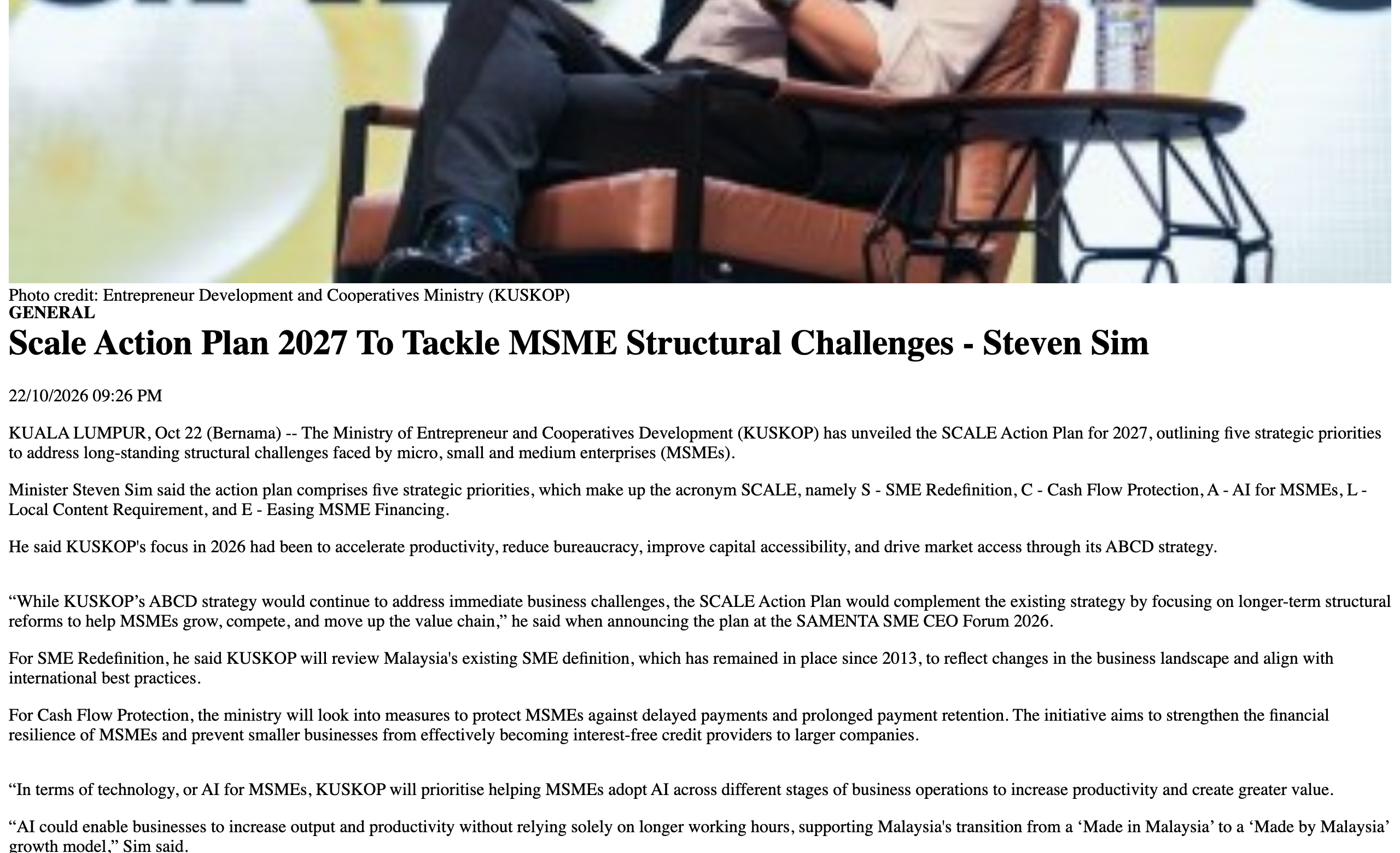
The wire report as published, showing the headline, the 22 October 2026 date stamp and the five priorities in the ministry’s own naming. Source: Bernama, Scale Action Plan 2027 To Tackle MSME Structural Challenges, 22 October 2026, bernama.com.
The only item with a date is the SME definition
SME Redefinition is the one priority the ministry has put a deadline on: the review is to be completed by 2027. Everything else is described as something Kuskop will “look into” or “explore”.
That matters because the 2013 definition is not a label. It decides whether you are eligible for the reduced corporate tax rate, for SJPP and CGC guarantees, for grants, and in some schemes for the size of the facility you can draw. A firm at RM48 million turnover that becomes a mid-tier company on a revised threshold loses access to a class of support overnight, which is precisely the failure mode the manufacturers’ federation warns about from the other direction.
So the useful preparation is unglamorous. Know your own number, know which threshold it sits against, and know which schemes you currently qualify for because of it. If the line moves in 2027, you want the list of what changes, not a scramble to reconstruct it.
Cash flow protection is a letter about your customers, not your bank
Kuskop’s phrasing is unusually direct for a policy document: the aim is to prevent smaller businesses from becoming interest-free credit providers to larger companies. Prolonged payment retention is named alongside delayed payment.
Any SME that has waited past 120 days on a certified claim will recognise the problem. Construction subcontractors have lived with it for years, and The Edge has reported the arithmetic plainly: a contractor needs to test whether its bank account survives three or four unpaid certificates while material prices climb. A policy measure in this area would change contract terms and statutory leverage. It will not collect a debt you have already written into your cash flow forecast.
What “AI for MSMEs” has to mean to be worth anything
The minister’s own framing of the AI priority is the most useful sentence in the announcement, because it names the mechanism rather than the technology.
Translated to a 40-person trading company, “output without longer hours” is a specific claim you can test. Pick the process that reliably costs the most hours per week and that a competent new hire could learn in a month. If an AI tool cannot beat that benchmark inside a quarter, it is not the priority. And if it can, the constraint moves to who checks the output, which is a management decision rather than a software one.
Kuskop has not published how it will fund or certify this. Until it does, the practical version is Budget 2027’s existing digitalisation and automation incentives, and the matching grants already open through MDEC.

The funding arithmetic as filed: RM67.9 billion in total support, RM57 billion of it in loan and financing guarantee facilities, and RM10.5 billion already disbursed to about 295,000 MSMEs. Source: Bernama, 22 October 2026, bernama.com.
What industry is still asking for
Three days after the minister spoke, the Federation of Malaysian Manufacturers published its own list, and the gap between the two is the story. FMM welcomed the one percentage point cut in SME tax rates but said it is not enough, and asked for lower rates still, wider eligibility, and the removal of the RM2.5 million paid-up capital condition for SME tax treatment.
Its bigger asks are structural: a RM1.5 billion Smart Manufacturing Support Package for 2027 to 2030, split RM500 million for automation, RM750 million for digitalisation and RM250 million for AI; a RM1 billion research endowment; and a RM100 million supply chain resilience fund. It also wants the manufacturing SME definition lifted to RM100 million turnover or 300 employees, so that a growing company does not lose support at the moment it starts to need it.
None of that contradicts SCALE. It tests whether SCALE’s letter A and letter E will carry money, or only language.
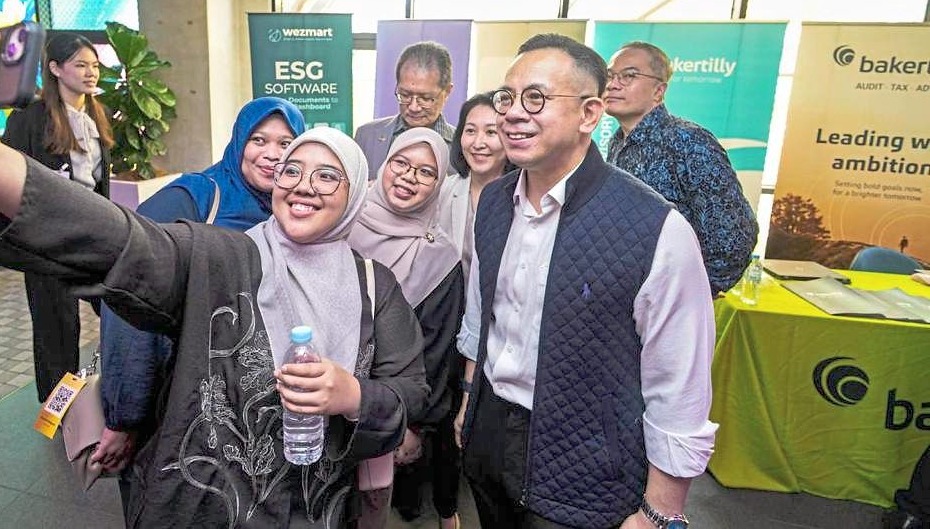
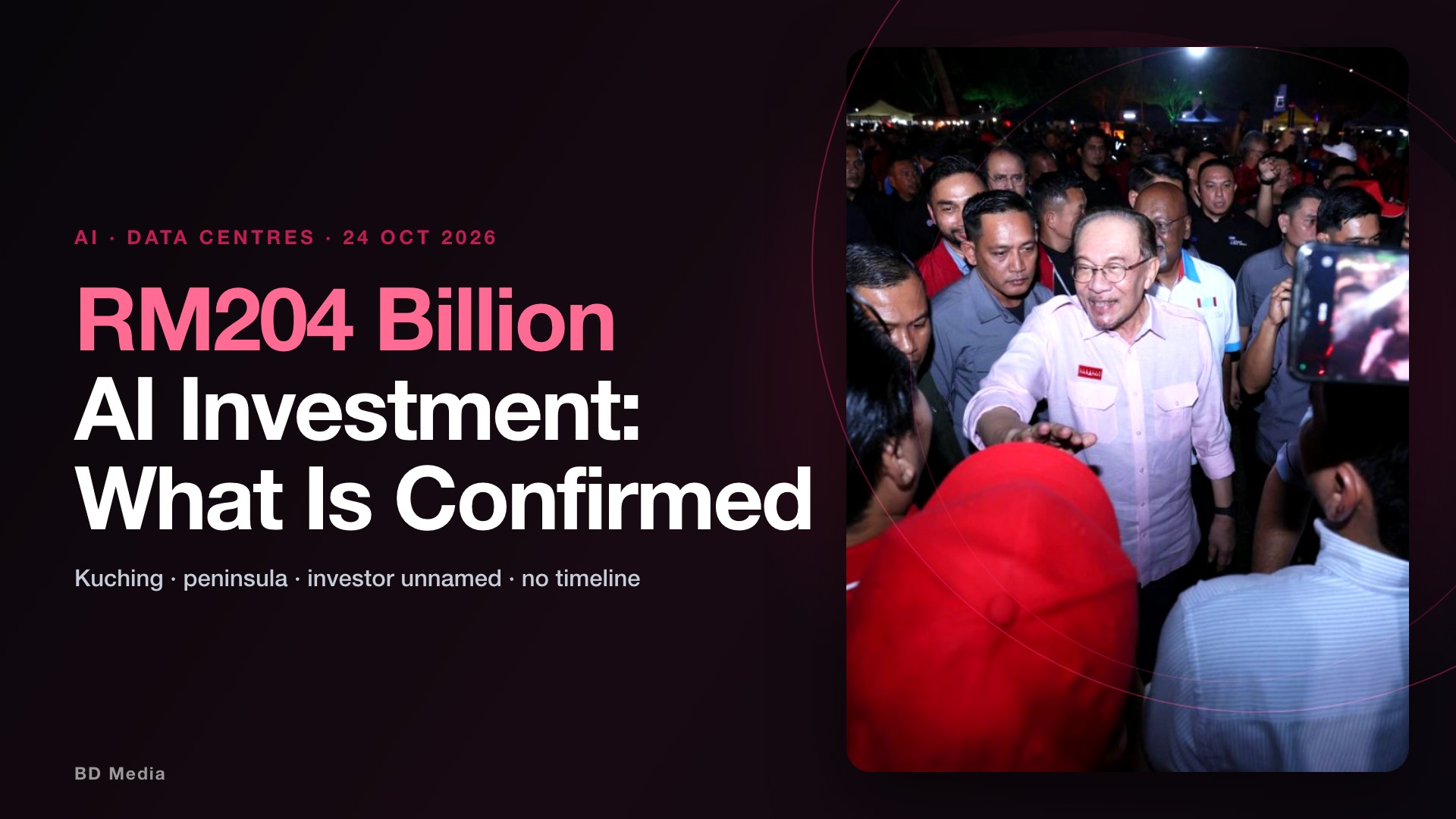
The minister with visitors at the SAMENTA SME CEO Forum 2026, where the five priorities were announced. Photo: The Star, 24 October 2026, thestar.com.my.
What is not decided yet
No implementation dates beyond the definition review. No funding attached to cash flow protection, local content or AI adoption. No indication of whether local content requirements will arrive as guidelines or as legislation, which is the difference between a procurement preference and a compliance obligation. And no published mechanism for how an SME demonstrates AI adoption in a way that unlocks anything.
We also cannot date the announcement to a single day. Oriental Daily reported the forum on 21 October, Bernama filed on 22 October, and The Star carried it on 24 October. The plan, the five priorities and the figures are consistent across all three.
Frequently asked questions
Is the SCALE Action Plan law yet?
No. It is a 2027 work programme announced by the ministry. Of the five priorities, only the SME definition review carries a stated completion target, which is 2027.
Does it replace Budget 2027?
No. It sits alongside it. Budget 2027 carries the money, including RM67.9 billion in total SME-related support and RM57 billion in loan and financing guarantee facilities; SCALE is the structural reform layer the ministry says will run underneath.
Will my SME definition change?
Possibly. Kuskop is reviewing the definition that has been in place since 2013, with the review to be completed by 2027. No new thresholds have been published. Check which schemes you currently qualify for and why, so you can see what a change would cost.
Is any of this available to apply for now?
The financing is. The RM57 billion in loan and financing guarantee facilities is Budget 2027 money, and Kuskop says RM10.5 billion had been channelled to about 295,000 MSMEs as at 30 September 2026. The other four priorities are not open programmes yet.
Why does the manufacturers’ federation want a different definition?
FMM argues that a manufacturing SME should be defined up to RM100 million turnover or 300 employees, so a company does not lose support the moment it grows into a mid-tier firm. That is a different question from Kuskop’s review, and the two have not been reconciled in public.
Sources
- Bernama, Scale Action Plan 2027 To Tackle MSME Structural Challenges – Steven Sim, 22 October 2026 (the five priorities, the minister’s quotations, the RM67.9 billion and RM57 billion figures, the RM10.5 billion disbursement) — bernama.com
- The Star, Sim unveils SCALE Action Plan for 2027, 24 October 2026 (independent report of the same announcement, the 2013 definition, the 2027 review target, the forum photograph) — thestar.com.my
- Oriental Daily, 沈志强:明年推 SCALE 五大措施 助中小企业提升竞争力, 21 October 2026 (earliest report, datelined Petaling Jaya; corroborates the five priorities) — orientaldaily.com.my
- The Edge Malaysia, FMM urges stronger push to grow Malaysian SMEs through more capital, technology and support, 25 October 2026 (the industry asks, the RM1.5 billion package split, the RM100 million turnover proposal) — theedgemalaysia.com
- Own captures, 26 October 2026: the Bernama report cropped to the headline, date and priority list, and to the funding paragraphs. Read-only, no article text altered.
- Photographs: KUSKOP via Bernama (cover) and The Star, 24 October 2026 (in-body).
BD Media is the editorial desk of Big Domain. This article reports a ministry work programme and an industry response as published by Bernama, The Star, Oriental Daily and The Edge Malaysia in October 2026. No scheme described here has been opened for application beyond the Budget 2027 facilities already in operation.