Investment marketing China is now closed to a Malaysian company that promotes investment products, trading accounts or wealth content to a Chinese audience, and the position is unusual: under China’s new rules it is not merely unlicensed, it is outside the class of entities allowed to do the marketing at all. That is the practical effect of two instruments, not one, and it is worth understanding before the next campaign goes out.
The first is the Measures for the Administration of Online Marketing of Financial Products, issued by eight Chinese departments and in force since 30 September 2026. The second is the Implementation Plan for the Comprehensive Rectification of Illegal Cross-Border Securities, Futures and Fund Business, approved by China’s State Council and issued on 22 May 2026. Read together, they close the channel rather than regulate it.
Last updated: 19 October 2026. Both Chinese instruments are cited from the issuing ministries’ own published texts. The Malaysian side is cited from the Securities Commission Malaysia’s Investor Alert List as at 31 July 2026. This article is not legal advice.
Investment marketing China: what the two instruments actually ban
Start with the definition, because everything follows from it. Article 3 of the Measures defines a financial institution as one approved by China’s State Council or its financial regulators and established within the territory of the People’s Republic of China. A Malaysian company is not that. Article 2 then provides that financial institutions and entrusted third-party platforms may conduct financial product online marketing, and that other organisations or individuals may not conduct, or disguisedly conduct, financial product online marketing.
| Provision | What it says | Effect on a Malaysian firm |
|---|---|---|
| Article 3 (definition) | A financial institution means one approved by the State Council or financial regulators and established in the PRC | A Malaysian entity is not a financial institution under this measure, whatever its Malaysian licence says |
| Article 2 (who may market) | Only financial institutions and entrusted third-party platforms; nobody else may conduct or disguisedly conduct the marketing | There is no licence to apply for. The activity itself is reserved |
| Article 6 (illegal activity) | Bans providing online marketing for illegal finance, expressly including overseas institutions providing financial products to PRC residents without permission | Marketing an offshore platform to PRC residents is named in the prohibition, not left to interpretation |
| Article 16 (channels) | Marketing by official account, livestream or short video must be by the institution’s own staff, qualified and authorised | The “investment educator” or affiliate model is the target, not the exception |
| Article 18 (names) | 27 finance-related characters, including bank, securities, fund, insurance and exchange, cannot be used in a site, app or account name without qualification | An account name alone can be the breach |
Provisions as published in the eight-department announcement, in force 30 September 2026. Source: Hubei Provincial Local Financial Administration, republishing Announcement No. 9 of 2026 with the full text, jrb.hubei.gov.cn.
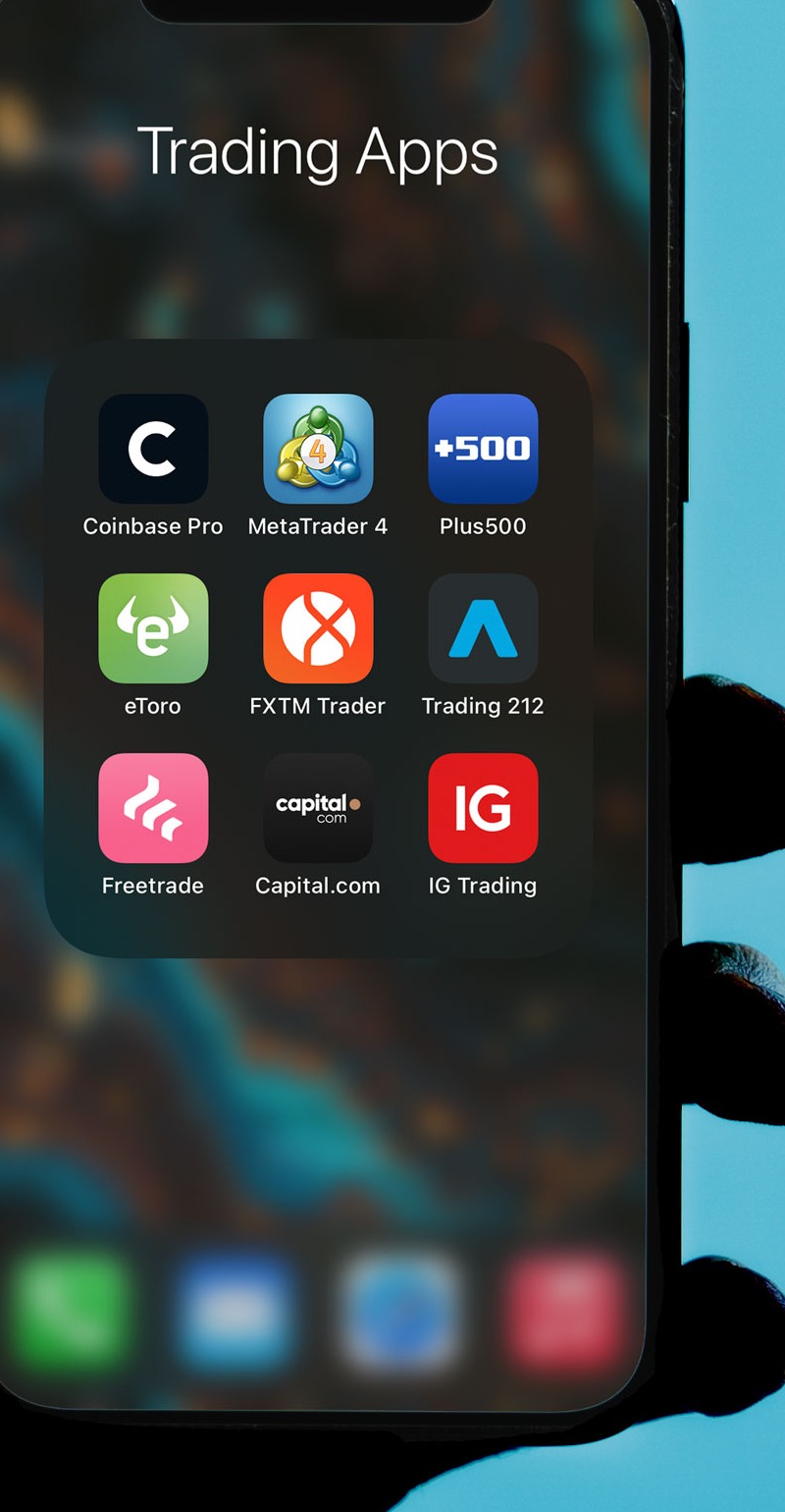
Trading apps on a phone screen. Cross-border account opening and order routing into China are explicitly banned for overseas institutions, along with the marketing that leads to them. Photo: CC BY 2.0, via Wikimedia Commons. Illustrative only. Source: Wikimedia Commons, commons.wikimedia.org.
The cross-border plan bans the traffic, not just the sale
The May plan is the part most summaries miss, because it reaches the marketing layer directly. It targets overseas institutions operating securities, futures or fund business illegally across the border, the domestic affiliates and partners that assist them, the intermediaries who solicit domestic investors, and internet platforms and self-media accounts that publish the referral material.
The prohibitions run in three directions. On marketing: overseas institutions may not conduct marketing or solicitation inside China, including operating websites or trading software there, publishing marketing information, pushing investment information, running rebate campaigns, or promoting and inducing subscriptions to overseas stocks. Platforms may not provide marketing or account-opening channels for that business, and self-media accounts may not publish the referral and traffic-diversion material. On trading: no account opening, order handling or fund transfer, including routing instructions through servers abroad. On support: no domestic party may supply the website, the trading software or the customer service behind it.
The plan also sets a two-year rectification window. During it, existing investors may only sell and withdraw. When it closes, the overseas institution must shut down its China-facing websites, trading software and servers. China’s securities regulator announced the same day that it was confiscating proceeds and penalising Tiger Brokers (NZ), Futu Securities International in Hong Kong and Longbridge in Hong Kong, along with related entities. That is the enforcement signal that gives the plan its weight.
The Malaysian end: the list, and the warning attached to it
Malaysia does not leave the gap open either. The Securities Commission maintains an Investor Alert List of unauthorised websites, investment products, companies and individuals. In its 31 July 2026 update it added five names: Kakak safety Trader, Evorse Trader Malaysia, Synthalora Investment, AI Trade Partner and IDT.
The Commission’s own framing matters more than the names. It states that the list is not exhaustive and only serves as a guide to investors before making a decision. In other words, absence from the list is not clearance. Under the Capital Markets and Services Act 2007, carrying out a regulated activity without a licence or registration is an offence, and investors who deal with unauthorised entities may not be protected by Malaysian securities law.
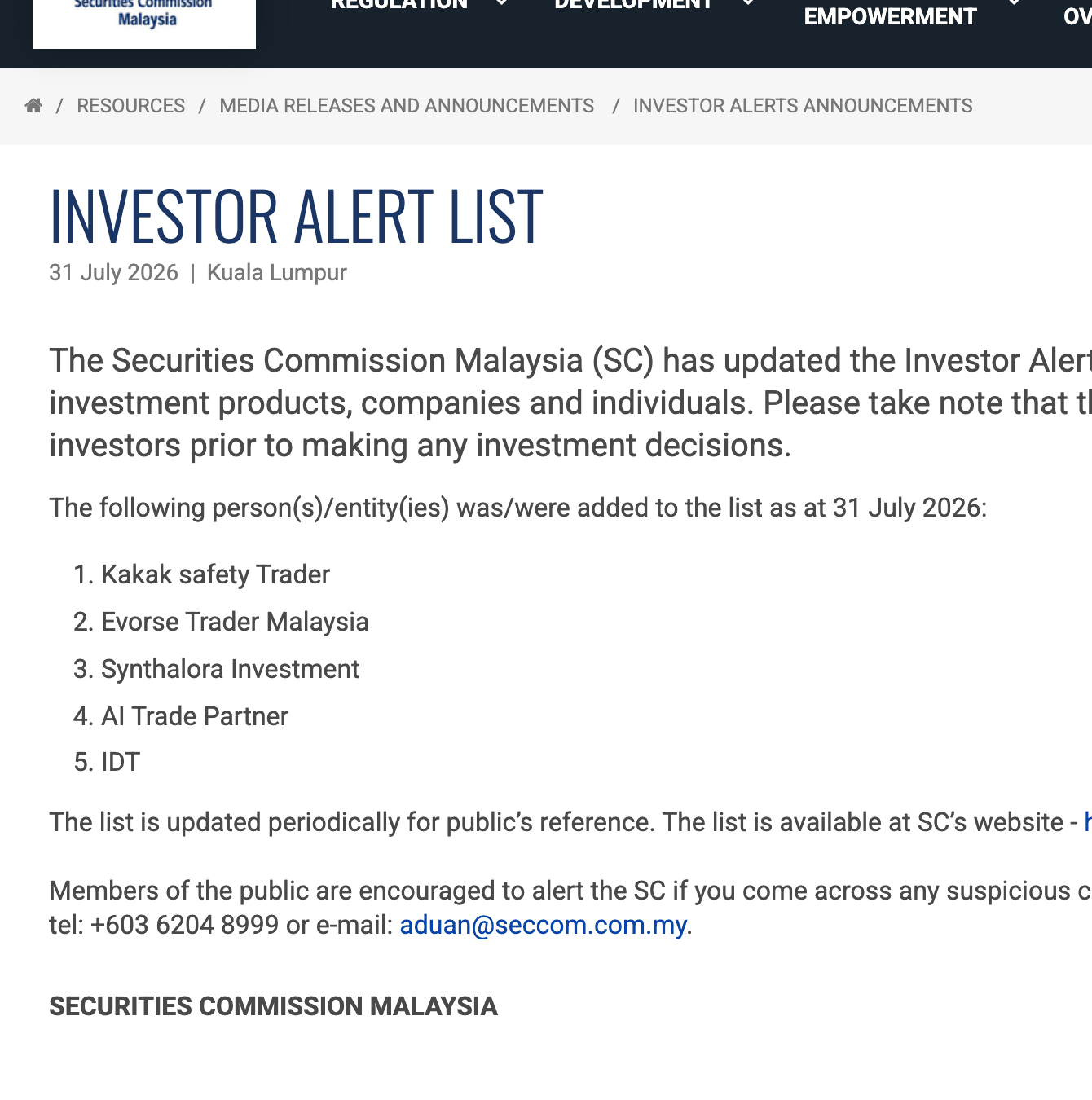
The Securities Commission Malaysia’s Investor Alert List as at 31 July 2026, showing the five entities added in that update. The Commission states the list is not exhaustive and is a guide only. Source: Securities Commission Malaysia, Investor Alert List (as at 31 July 2026), sc.com.my.
What a Malaysian firm should check this week
- Check the platform you are promoting on SC’s list. If it appears, stop. If it does not appear, that is not clearance either, because the Commission says the list is not exhaustive.
- Separate “teaching” from “marketing” in your own content. Educational framing around account opening, funding or offshore access is where the Chinese rules draw the line, and Article 16 names the channel formats explicitly.
- Strip the claims that are now prohibited wording. Guaranteed returns, low risk, high yield, instant approval and no cost are listed as banned phrasing in the Measures, in any language.
- Do not treat a Malaysian licence as authority to market into China. It is not, and no application would change that, because the permitted class is defined by where the institution is established.
- Check your account names. If an account, page or app name uses a financial term you are not licensed for, fix the name before you fix anything else.
- Write down which audience each campaign targets. The whole analysis turns on whether the audience is in China. If nobody can answer that for a live campaign, that is the finding.
What we could and could not confirm
Confirmed from the instruments’ own published texts: the 30 September 2026 commencement, the definition in Article 3, the reservation in Article 2, the Article 6 list that names overseas institutions providing financial products to PRC residents without permission, the Article 16 channel rule, the Article 18 naming rule, and the May plan’s three directions of prohibition with its two-year window. Confirmed from the Commission’s own page: the 31 July 2026 list, the five names added, and the statement that the list is not exhaustive.
Not confirmed, and we are not going to imply it: whether a Malaysian entity has been penalised under either Chinese instrument, and whether the platform-level financial content rules published by Chinese social platforms in September extend to their Malaysian operations. We also saw secondary reports of further entities added to the Commission’s list on 7 September 2026; we could not verify that on the Commission’s own page, so those names are not printed here.
Frequently asked questions
Can a Malaysian company market investment products to Chinese investors?
Under the Measures in force since 30 September 2026, financial product online marketing is reserved to financial institutions established in China and the third-party platforms they appoint. A Malaysian company is outside that class, so there is no licence route that would make the marketing compliant.
Does this stop me advertising to Malaysians?
No. Both Chinese instruments govern conduct in China or directed at people in China. Advertising to a Malaysian audience is governed by Malaysian law, which is why the Securities Commission’s licensing regime and alert list are the relevant check.
What is the Investor Alert List?
The Securities Commission’s published list of unauthorised websites, investment products, companies and individuals. It is updated periodically and the Commission states it is not exhaustive, so it works as a screening tool rather than a clearance certificate.
Was anything enforced, or is this only paper?
Enforcement followed the May plan the same day: China’s securities regulator announced confiscation and penalties against Tiger Brokers (NZ), Futu Securities International and Longbridge, with related entities. That is the clearest available signal of how the plan is being applied.
What about the platforms’ own finance content rules?
Chinese social platforms published their own financial content conventions in September, ahead of the Measures taking effect. Those are platform rules for accounts on those platforms. We have not verified whether they extend to the same platforms’ Malaysian operations, so we do not claim they do.
Sources
- Eight Chinese departments (People’s Bank of China, MIIT, SAMR, NFRA, CSRC, CNIPA, CAC, SAFE), Announcement No. 9 of 2026: Measures for the Administration of Online Marketing of Financial Products, in force 30 September 2026, full text republished by the Hubei Provincial Local Financial Administration — jrb.hubei.gov.cn
- Xinjiang Department of Justice, Q&A on the Measures for the Administration of Online Marketing of Financial Products, September 2026 (scope, the reserved class, the Article 6 list, prohibited wording) — sft.xinjiang.gov.cn
- Fujian SASAC, The Measures come into force: what changes, October 2026 (seven chapters, 39 articles; Articles 16 and 18; the prohibited wording list) — gzw.fujian.gov.cn
- China Securities Regulatory Commission, Eight departments jointly issue the Implementation Plan for the Comprehensive Rectification of Illegal Cross-Border Securities, Futures and Fund Business, 22 May 2026 (targets, the three directions of prohibition, the two-year window) — csrc.gov.cn
- Xinhua, Eight departments jointly issue plan to rectify illegal cross-border securities, futures and fund business, 22 May 2026 (State Council approval; the marketing, trading and support prohibitions) — news.cn
- Legal Daily, Eight departments block illegal cross-border securities business across the whole chain, 25 May 2026 (the CSRC action against Tiger Brokers, Futu and Longbridge; the three-part prohibition) — legaldaily.com.cn
- Securities Commission Malaysia, Investor Alert List (as at 31 July 2026) (the five entities added, the not-exhaustive statement, the contact line) — sc.com.my
- Wikimedia Commons, Good night, Kuala Lumpur Malaysia 5 January 2025, CC BY 2.0 (cover photograph), and Trading apps on an iPhone screen, CC BY 2.0 (body photograph) — commons.wikimedia.org
- Own capture, 19 October 2026: the Commission’s Investor Alert List page, cropped to the entry. Read-only; nothing on the Commission’s site was submitted or changed.
BD Media is the editorial desk of Big Domain. This article reports two Chinese regulatory instruments from their published texts and the Securities Commission Malaysia’s published list. It is not legal advice, and a Malaysian licence should not be read as authority to market into any other jurisdiction.