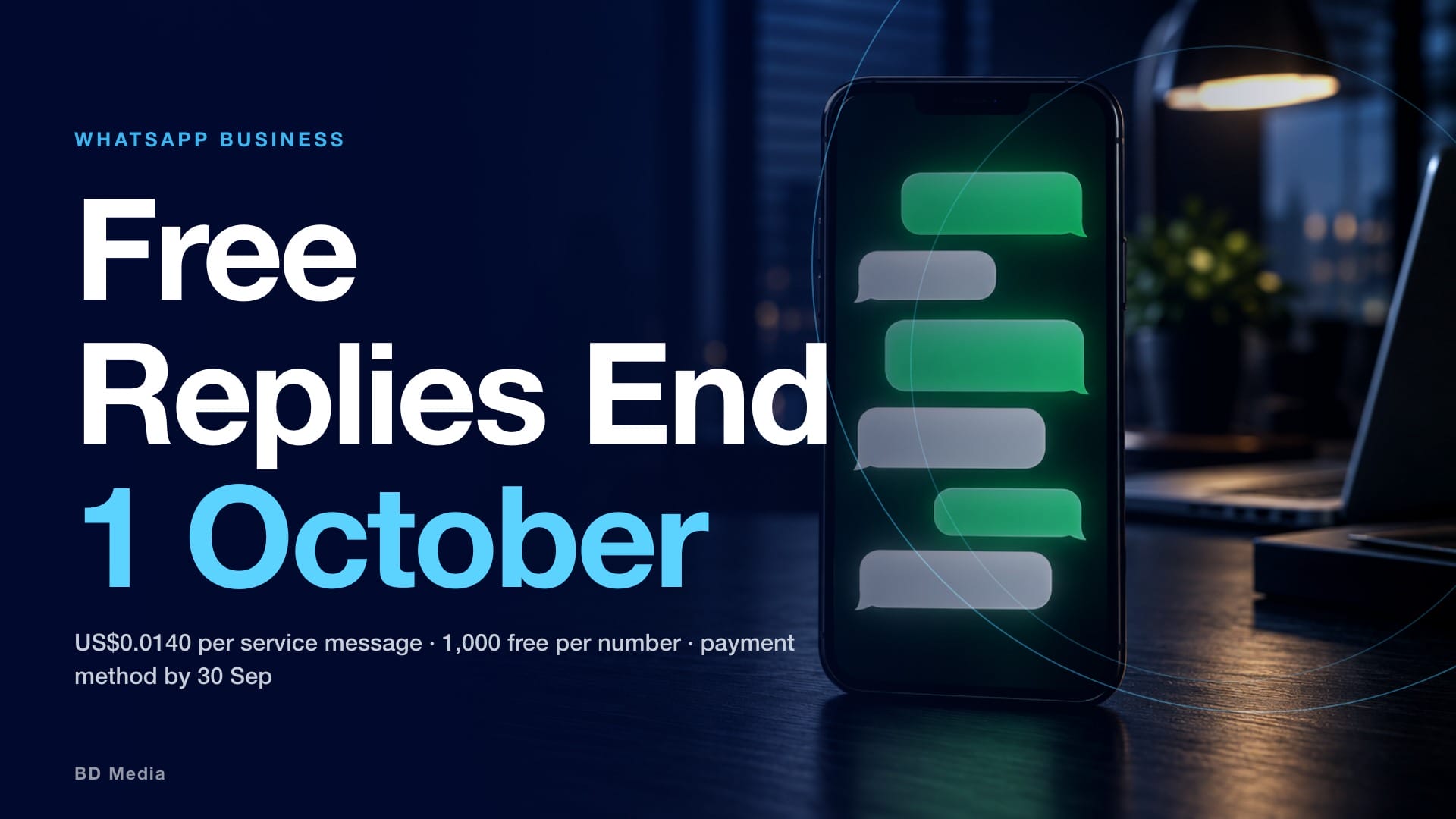
Five days from now, the free tier of WhatsApp customer service ends for Malaysian businesses running the WhatsApp Business Platform. From 1 October 2026, every service message is billed per message. And there is a harder trap before that one: if no payment method is on file by 30 September, Meta stops delivering service messages entirely.
This is not the ordinary WhatsApp Business app on a phone. That stays free. This is the platform side, the one banks, retailers and any business running a chatbot or a support queue through the API use. We covered the pricing change when Meta announced it; this is the deadline-week version, because the two details that matter most are the ones most write-ups left out.
What changes on 1 October
Meta’s own developer documentation is blunt about it: “Effective October 1, 2026, Meta will charge on a per-message basis for all service messages, consistent with how Meta charges for template messages. These messages have not been charged since November 1, 2024.”
Service messages are the free-form replies a business sends inside the 24-hour customer service window after a customer messages it. Order questions, support answers, “yes we have stock” — all of it becomes a billed message from Thursday.
There is a second change inside the same announcement, and it is the one most coverage missed. Utility messages sent in response to a customer while the 24-hour window is open — payment confirmations, order status updates, delivery notifications — also become chargeable on the same date. Meta’s wording: these “have not been charged since July 1, 2025.” Two categories that were free on Tuesday are both billed by Thursday.
The Malaysia rate card, from 1 October
| Message type | From 1 October, Malaysia (per message) | Ringgit, approx. |
|---|---|---|
| Service (in the 24-hour window) | US$0.0140 | ~RM0.056 |
| Utility (including in-window replies) | US$0.0140 | ~RM0.056 |
| Authentication | US$0.0140 | ~RM0.056 |
| Authentication, international | US$0.0418 | ~RM0.17 |
| Marketing | US$0.0860 | ~RM0.35 |
Three independent rate cards agree on the Malaysia utility and service figure of US$0.0140. It is a small number per message and a real number at volume: a support queue answering 20,000 in-window replies a month is looking at roughly US$280 a month from October, before any platform fees a Business Solution Provider charges on top.
The allowance everyone should actually know about. Each registered phone number gets 1,000 free service messages per month from 1 October. Charges start at message 1,001, and unused allowance does not roll over. A low-volume number may pay nothing. A busy shared support number will blow through the allowance in days.
The 30 September deadline nobody wants to discover on 2 October
Meta’s instruction, quoted verbatim in its update: “For any Solution Provider or directly-integrated businesses that does not have a payment method on file by September 30, 2026, Meta will stop delivering service messages as of when they become charged on October 1, 2026.”
Read that again. This is not a soft nudge and not a late fee. No payment method on file by Tuesday, and from Wednesday the platform simply stops delivering your service messages. The bot still runs. The integration still works. The replies just do not arrive. Businesses discover this kind of failure from customers, not from dashboards.
The five-item checklist
- Add the payment method today. In the WhatsApp Business Platform settings under billing. Do it now, not on the 30th — verification and first-charge authorisation can lag.
- If you use a provider, call them. The deadline applies to Solution Providers too. Your BSP without a payment method on file stops your service messages just as dead as your own account would.
- Count your in-window volume per number. Pull last month’s service-message count. Over 1,000 per number? That number has a new monthly bill from October.
- Consolidate multi-bubble replies. Five short messages answering one question become five billable messages. One composed reply is one. Teams that merged long replies into single messages have cut this line item by real percentages.
- Move the predictable updates to templates. Order confirmations and delivery notices are utility messages either way. Sending them as approved utility templates at least makes the cost per message predictable and auditable.
What does not change
The 24-hour customer service window itself stays. The 72-hour free window for conversations opened from a Click-to-WhatsApp ad or a Facebook Page button also stays free — that rule is untouched. And the per-conversation pricing model Meta moved to in 2025 continues to apply to template messages outside the window, as it already did.
The changes land on 1 October 2026, five days after this piece is published. The businesses that will feel it are the ones that find out late.
About BD Media
BD Media is the editorial desk of Big Domain. We cover the dates, rules and market shifts Malaysian businesses have to plan around, name our sources so you can check them, and mark what we could not verify instead of filling the gap.
Sources
- Meta, WhatsApp Business Platform pricing update (developer documentation) — developers.facebook.com/docs/whatsapp/pricing. The per-message charge for all service messages from 1 October 2026; the in-window utility charge from the same date; and the verbatim payment-method instruction: no payment method on file by 30 September 2026 means Meta stops delivering service messages from 1 October. (The Meta docs page blocks automated checks; the quotes were read via five independent outlets reporting the update.)
- Whatsfly, WhatsApp API pricing 2026 — whatsfly.net. Future rate card effective 1 October 2026: Malaysia marketing US$0.0860, utility US$0.0140, authentication US$0.0140, auth-international US$0.0418, service US$0.0140.
- JANUS Digital, WhatsApp Business API pricing and billing updates — web.janustech.co. The before/after table: free service replies until 30 September, billed from 1 October; 1,000 free service messages per number per month with no rollover; the 72-hour Click-to-WhatsApp window unchanged.
- ChatDaddy, WhatsApp Business API pricing by country — chatdaddy.tech. Malaysia rates corroborating utility and authentication at US$0.0140, marketing US$0.0860.
- FormBeep, Meta WhatsApp Business Platform pricing 2026 — formbeep.com. A third independent Malaysia rate card agreeing on US$0.0140 for utility and authentication.
- BD Media, “No More Free 24-Hour Replies: The Biggest WhatsApp Pricing Change of 2026 Hits Oct 1” — media.bigdomain.my. The announcement coverage; this piece is the deadline-week follow-up.
Not verified: the final Meta-published Malaysia rate card PDF (the developer pricing page blocks automated checks, so the US$0.0140 figure rests on three agreeing third-party cards rather than a direct read); the ringgit conversion uses approximately RM4.0 to the US dollar and is marked approximate; and per-provider platform fees on top of Meta’s charges vary by vendor and are not surveyed here.