
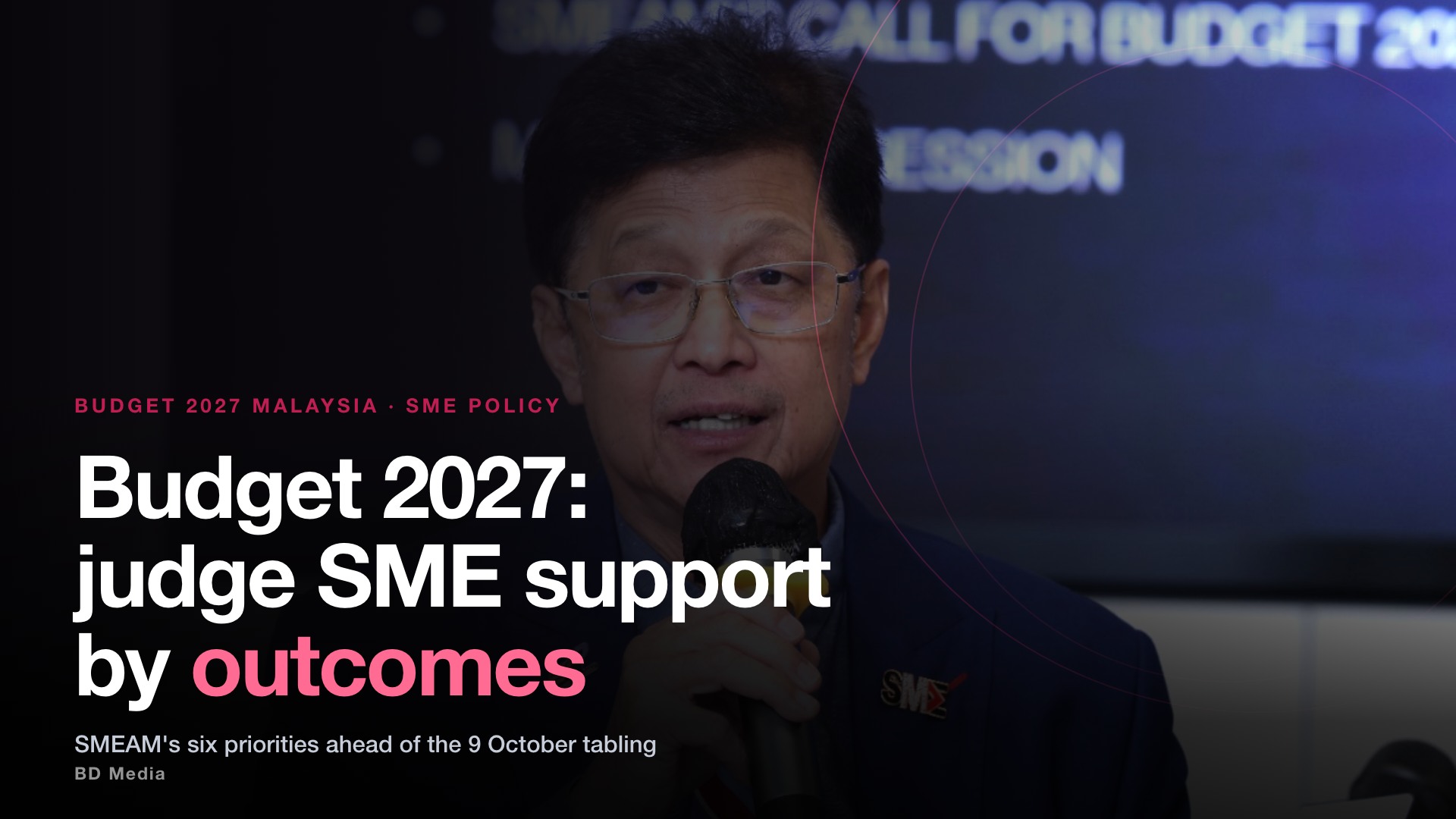
Budget 2027 Malaysia will be tabled on 9 October, and the SME Association of Malaysia has one central demand: stop measuring SME support by the size of the allocation, and start measuring whether it changes anything. National president Dr Chin Chee Seong told a press conference on 2 October that grants should be tied to demonstrable results – automation gains, competitiveness, business performance – rather than eligibility on paper.

The Edge Malaysia, SMEAM Budget 2027 submission, 2 October 2026. Captured 3 October 2026 from https://theedgemalaysia.com/node/820385
What Budget 2027 Malaysia should measure
The association’s proposal sets six priorities: reducing cumulative business costs, financing matched to growth stages, raising productivity, strengthening links between foreign direct investment and local SMEs, encouraging domestic direct investment, and creating an integrated SME development gateway. The result, not the receipt, is the test.
| SMEAM’s Budget 2027 submission | Detail | Source |
|---|---|---|
| Core demand | Assistance judged on outcomes, not allocation size | SMEAM, 2 Oct 2026 |
| Six priorities | Costs, staged financing, productivity, FDI linkage, DDI, integrated gateway | SMEAM, 2 Oct 2026 |
| Proposed condition | Demonstrate automation or performance gains before support | SMEAM, 2 Oct 2026 |
| FDI test | Count SMEs entering MNC/GLC supply chains; value of domestic procurement | SMEAM, 2 Oct 2026 |
| Tabling date | 9 October 2026 | PwC Malaysia |
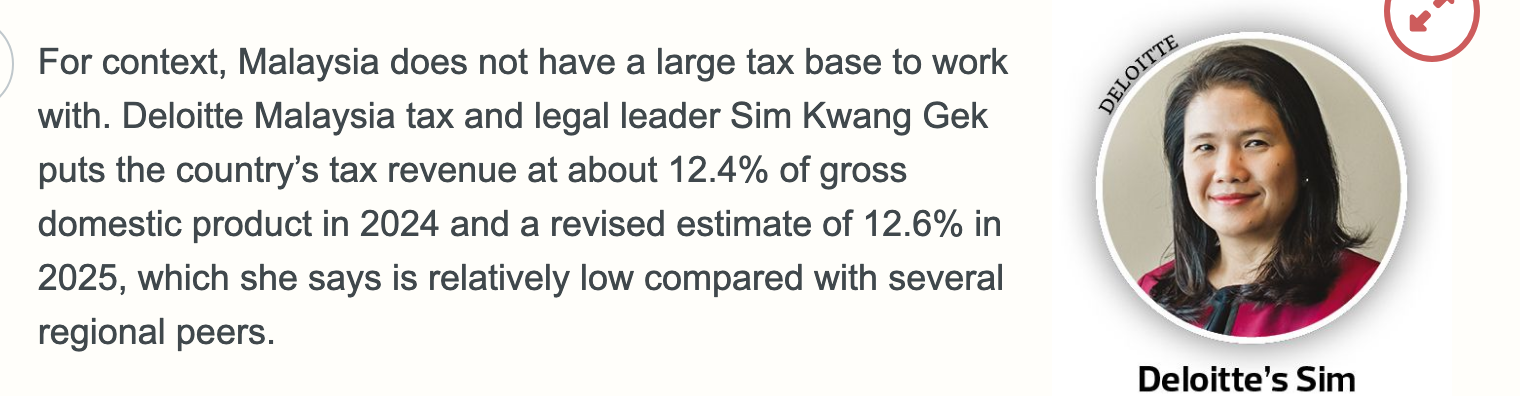
| Estimated tax base | Tax revenue about 12.4% of GDP (2024), 12.6% (2025 revised) | Deloitte Malaysia, via The Edge |
Make FDI work harder for SMEs
The sharpest language was reserved for how foreign direct investment is judged. SMEAM wants the scorecard extended beyond headline investment numbers to measurable local participation: how many Malaysian SMEs enter multinational and GLC supply chains, the value of domestic procurement, and the depth of technology transfer.
The Edge Malaysia, tax-to-GDP figure, 1 October 2026. Captured 3 October 2026 from https://theedgemalaysia.com/node/819899
The domestic investment complaint
SMEAM’s second structural point: Malaysian companies are expanding abroad because incentives at home do not reward reinvestment. “We have a lot of money here. In fact, we have many members that are expanding themselves, but not here. They build their factory in Vietnam, they build their factory in other countries. Because they do not have incentives to do it here,” Chin said.
The tax experts consulted by The Edge ahead of the budget expect the government to sweat the existing system rather than introduce new taxes – refining the expanded sales and service tax, using e-invoicing data to close compliance gaps, and reviewing outdated or underused incentives. The government’s stated approach has been to find fiscal space while narrowing the deficit, with the budget deficit and subsidy-reform savings both under pressure from high energy prices.
Sequencing matters as much as sums
The association’s final point is procedural but expensive to ignore: major policy changes should be sequenced with consultation and transition periods, so multiple cost increases do not land at once. Expanded SST, minimum wage movement and e-invoicing have all hit the same cost base in close succession – the same survey that informed this submission found most respondents want wage changes delayed for exactly that reason.
Why outcome-conditioned grants are hard to do well
The association is asking for something reasonable that is difficult to administer. Tying support to demonstrated automation or performance gains means someone has to define the baseline, verify the gain, and decide what happens when a business tries and fails. That is a measurement bureaucracy, and Malaysia has a poor track record of keeping those light. The counter-argument is that eligibility-based grants reward paperwork, not progress, and the association is explicitly rejecting that trade.
There is also a sequencing problem the submission names but cannot solve alone. If productivity grants require audited productivity data, and productivity data requires the digital systems that the grant is meant to fund, the chicken comes before the egg. The practical workaround, which other jurisdictions have used, is staged disbursement: a small tranche on the plan, a larger tranche on verified milestones. Whether Budget 2027 adopts that structure is the detail to watch.
What to watch next
Beyond the three outcome signals already flagged, watch whether the government publishes the SME support envelope as a single number or as a matrix of programmes. A single headline figure invites the association’s criticism; a matrix with conditions attached answers it. Also watch whether domestic direct investment gets a distinct incentive line, because that is the association’s clearest grievance – Malaysian capital building factories in Vietnam rather than at home.
Sources
- Ministry of Finance – Belanjawan portal
- The Edge Malaysia, “SME association says govt assistance in Budget 2027 should focus on outcomes”, 2 October 2026
- The Edge Malaysia, “Experts expect Putrajaya to sweat existing tax system”, 28 September 2026
- PwC Malaysia, Budget 2027 tabling date