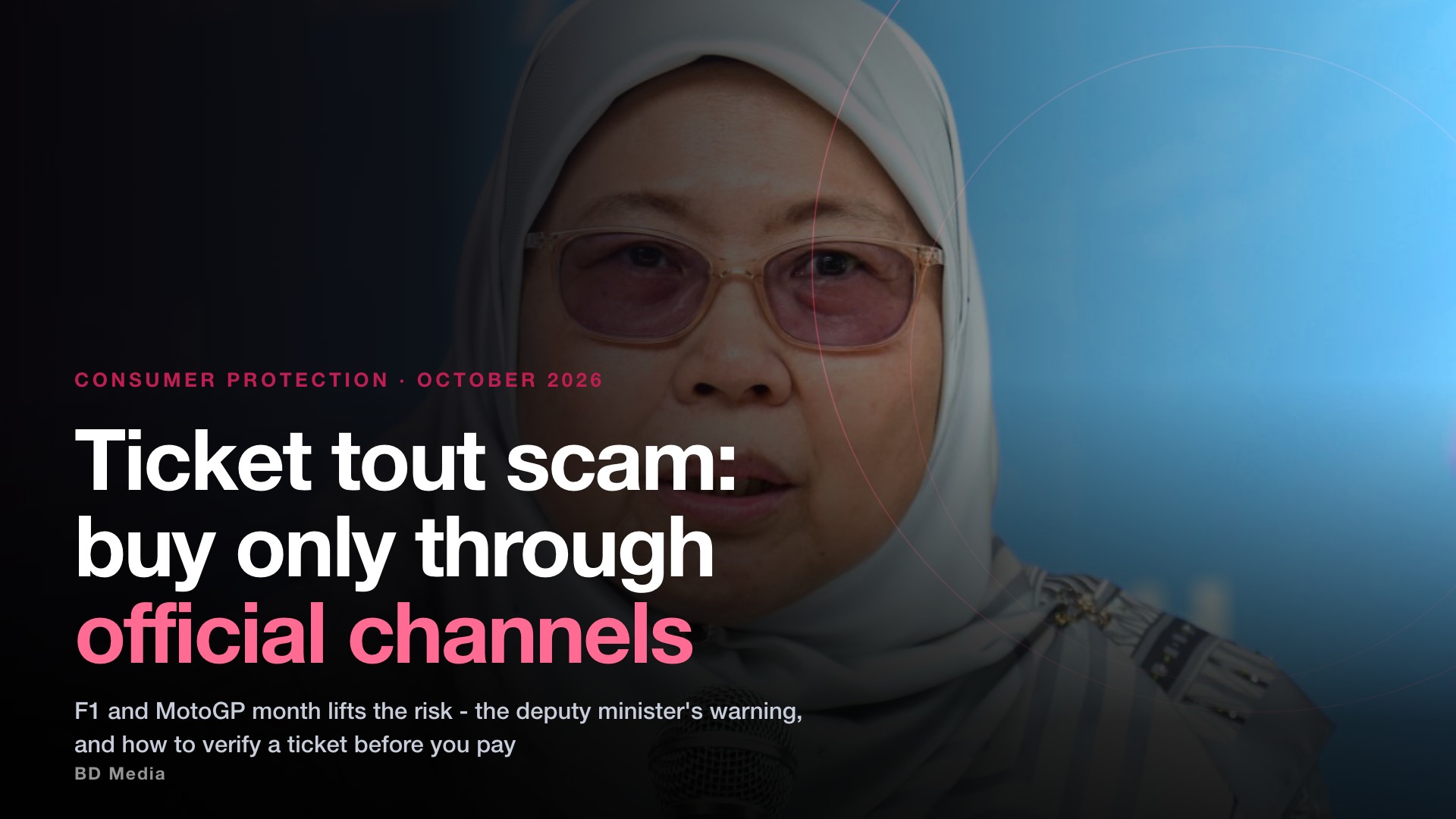
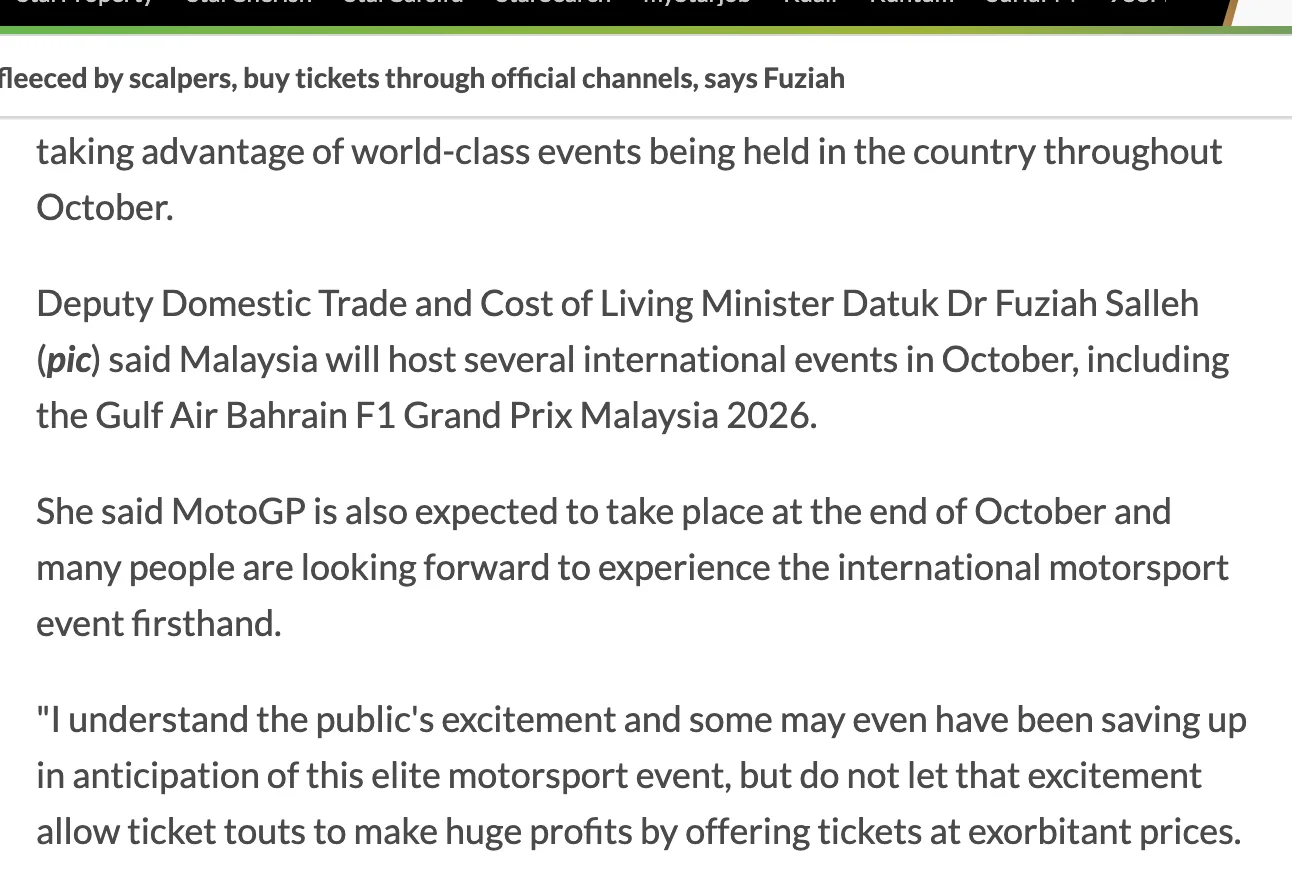
Ticket tout scam Malaysia warnings have been issued at the start of the country’s busiest event month of the year, with the Domestic Trade and Cost of Living Ministry telling the public to buy only through official channels. Deputy Minister Datuk Dr Fuziah Salleh said Malaysia hosts several international events in October, including the Gulf Air Bahrain Formula 1 Grand Prix Malaysia 2026, with MotoGP expected at the end of the month.
The timing is not incidental. Malaysia’s calendar has stacked two of the largest live crowds of the year into four weeks, and both are events where demand outstrips supply by a wide margin. That is precisely the condition ticket fraud needs.
Why the ticket tout scam Malaysia warning landed now
Fuziah’s advice was blunt and it was aimed at behaviour rather than at websites. She acknowledged the excitement around the motorsport events and the saving that precedes them, then named the exact mechanism touts rely on: the gap between what a buyer is told and what the ticket actually is.
Her second point is the one that turns a pricing complaint into a consumer protection issue. Paying above face value is unpleasant. Paying above face value for a ticket that does not scan at the gate is a total loss, and it is the loss a buyer has no way to recover once the event starts.
What a tout is actually selling you
Strictly speaking, a ticket tout sells a transferable right of entry. What often changes hands instead is a screenshot, a forwarded email, or a barcode image – none of which is the ticket. Modern ticketing systems tie admission to a named account or to a token that is verified at the gate. A photograph of a barcode carries no such binding, and it can be sent to fifty buyers at once.
The result is a class of dispute that has no clean remedy. If the ticket was never yours, the organiser has no relationship with you and cannot reissue anything. If the ticket was yours but had already been used or cancelled, the same applies. The buyer’s money has left, and the seller is usually reachable only through the same channel that produced the fake.
| What the seller provides | What it actually is | Who bears the loss at the gate |
|---|---|---|
| A photograph of a barcode or QR code | Not the ticket itself | The buyer |
| A forwarded confirmation email in someone else’s name | Not transferable without organiser consent | The buyer |
| A ticket that was already scanned | Void on second use | The buyer |
| A printed ticket bought through an unauthorised reseller | Possibly genuine, possibly voided | The buyer, unless the organiser confirms |
| A ticket bought through the organiser’s own channel | Admission | Nobody |
Fuziah’s practical instruction was narrow on purpose. She told the public to check the organiser’s official channels and the purchase terms before making any payment, and specifically not to trust screenshots or advertisements outside official channels. That last clause is the whole answer to the most common bad decision in this market.
How to check before you pay
Three checks resolve almost every case, and all three are free.
First, confirm the seller is the organiser or an explicitly authorised partner. A resale page that names the event is not the same as a page the organiser has authorised, and the organiser’s own site usually publishes its official ticketing partners.
Second, read the transfer rules before the price. Many event tickets are explicitly non-transferable, which means the validity problem exists even when the seller is honest. A genuine ticket sold in breach of a non-transfer clause can still be refused at the gate, and that refusal is lawful.
Third, pay through a channel that leaves a trace and can be disputed. Cash and instant peer-to-peer transfers leave the buyer with nothing to escalate. The trace is not a guarantee of recovery, but its absence removes every option.
If you have already paid a tout
Act before the event, not after. Gather the listing, the messages, the payment record and the seller’s identity or account details, and report to the relevant channel while there is still time for a payment to be stopped or an account to be frozen. This is also where record-keeping has a second use: evidence gathered now is what a claim needs later.
Malaysian consumers who suffer a loss on a purchase can take a claim to the Tribunal for Consumer Claims, which handles disputes up to RM50,000 for a RM5 filing fee and requires claims to be filed within three years. Whether a particular tout transaction falls inside its jurisdiction depends on the facts, including whether the seller was acting in trade rather than as a private individual, which is why the evidence matters.
The cheapest protection remains the least exciting one. Fuziah’s closing line to the public was to use purchasing power as consumers – which, translated into practice, means the official channel is not simply the safer option but the only one with a remedy attached.
What to watch next
Watch whether authorities move beyond advice as the events approach. Ticket touting has been a recurring seasonal problem in Malaysia and advice-led enforcement depends on buyers behaving differently. The tell will be whether the ministry or the organisers announce any authentication mechanism – a named-account transfer system, a verified resale window, or on-site validation ahead of the event – because those change the economics for the seller rather than the buyer.
Sources
- The Star, “Don’t get fleeced by scalpers, buy tickets through official channels, says Fuziah”, 2 October 2026 (Bernama)
- Ministry of Tourism, Arts and Culture – national events calendar
- KPDN – Ministry of Domestic Trade and Cost of Living, consumer affairs
- Bernama – national news agency, source of the ministerial statement