On 16 November 2026 the United States added Malaysia to a new licence requirement for advanced semiconductors. The rule, published by the Bureau of Industry and Security, covers exports, re-exports and in-country transfers to Malaysia, Singapore, Indonesia, Thailand and Brazil. It also reaches further than the chips themselves: a data centre anywhere in the world that provides more than 12,000,000 aggregate TPP of computing access to a company headquartered in Macau or a Country Group D:5 destination now falls inside the control.
Malaysia’s own response has been building for months. On 12 November, Investment, Trade and Industry Minister Johari Abdul Ghani said operators would be legally required to disclose electricity use, facility location and the number of graphics processing units imported. A day later his ministry confirmed it was investigating whether chips brought in by a Johor data-centre tenant had been re-exported without the permit Malaysia has required since July 2025.
These are two separate regimes with two separate triggers. The American rule governs what a supplier may send and to whom. The Malaysian rules govern what may leave the country and what operators will have to declare. A Malaysian business that only buys cloud capacity is not suddenly an exporter. But the data centre it buys from now has a reason to ask harder questions about its customers, and those questions will reach the contract.
Last updated: 17 November 2026. This article reports the rule text downloaded from the US government, two ministerial statements and the official Malaysian enforcement record. The rule’s precise effective date could not be confirmed from a government gazette; that gap is described in the final section rather than filled with a guess.
US chip licence rule: what Malaysian data centres must check
The interim final rule carries RIN 0694-AK50. Its full title names remote access to advanced semiconductors. BIS published a press release on 16 November describing it as a rule “written by and at the direction of the Department of Treasury and the National Security Council” to address remote access to advanced super intelligence chips and servers. The government text runs to 132 pages.
Four mechanisms matter to a Malaysian reader. First, the destination licence: the rule text states that “a license will be required to export, reexport, or transfer (in-country) advanced semiconductors to … Indonesia, Malaysia, Singapore, Thailand, or Brazil”. Singapore’s own MDDI–METI joint statement confirmed the same five countries on 17 November.
Second, the remote-access control. New section 744.24 reaches advanced computing items sent to a data centre in any destination, if the supplier knows the centre will provide more than 12,000,000 aggregate TPP of access to a company headquartered in Macau or in Country Group D:5. The rule explicitly counts “linked data centers”, including digitally linked infrastructure, so splitting a workload across buildings does not reset the threshold.
Third, a transition window. A data centre that was already providing such access before publication “must obtain a license with 90 days of the effective date of this IFR or face future export restrictions”. The rule carves out commercial recommender systems, the ranking and filtering used by retailers and social platforms, because BIS says those functions do not pose the same national security threat.
Fourth, a US-headquartered exemption. The licence does not apply where the ultimate consignee or end user is headquartered in the United States, or its ultimate parent is, provided reporting conditions are met. BIS also used this rule to formalise the rescission of the previous administration’s AI Diffusion Rule, which had never been enforced.
What a supplier has to do now: determine whether the end customer’s ultimate parent is in Macau or a D:5 destination; check whether the aggregated computing access crosses 12,000,000 TPP across linked facilities; and keep evidence of that due diligence. The rule places the notification duty on the exporter, re-exporter or transferor, not only on the data centre operator.
Malaysia’s side: chips may come in, but controlled chips need a permit to leave
MITI’s statement of 13 November drew a line that is easy to miss. Bringing AI chips into Malaysia for data-centre operations “does not currently require a permit or licence”. Exporting, re-exporting, transshipping or transiting high-performance US AI chips from or through Malaysia has required a MITI permit since July 2025, under the Strategic Trade Act 2010. False information given to Customs is a serious offence under the Customs Act 1967.
The ministry said verification visits to the facilities of Speedmatrix, a Johor data-centre tenant linked to Singapore’s Megaspeed International, were routine monitoring and were not a clearance. It confirmed that it was working with Customs to determine whether any chips brought into Malaysia had subsequently been re-exported, and with Singaporean and US authorities on stronger controls.
The investigation is open. No finding against Speedmatrix has been published, and nothing in MITI’s statement establishes that a re-export occurred. That distinction matters for how the story is read: the compliance obligation exists now, independently of the outcome of any investigation.
The enforcement record is not hypothetical
On 15 October, a team from the KLIA Customs Enforcement Division inspected a warehouse in the airport’s free trade zone and found 30 servers carrying advanced AI chips, declared on a single air waybill as electronic components. Bernama reported the value as nearly RM49.5 million and said preliminary investigations indicated the servers were to be re-exported to another Asian country. Customs director Aspalila Ag. Tuah told a press conference it was the fifth case involving the same syndicate that year, with total seizures across the five cases exceeding RM100 million.

Customs personnel at the KLIA free trade zone case briefing. The seizure of 30 servers declared as electronic components was announced on 28 October 2026. Photo: Bernama, Bernama report.
MITI’s Strategic Trade Secretariat senior assistant director Masyita Ismail told the same briefing that the chips were controlled as dual-use items under the Strategic Trade Act 2010. Under Strategic Trade Controller’s Directive No. 1/2025, chips with a Total Processing Performance of 4,800 or higher, or 1,600 or higher combined with a Performance Density of 3.2 or higher, require a permit applied for at least 30 days before they are brought into Malaysia. Section 12 of the Act provides for a fine of up to RM20 million for a corporation.
That permit threshold is a Malaysian rule about transit and re-export. The American 12,000,000 aggregate TPP threshold is a different rule about who can be given computing access. They are not interchangeable, and a shipment can be lawful under one while still requiring action under the other.
The disclosure law Johari described
Speaking at the launch of MITI’s MySaham mobile app on 12 November, the minister said the requirement to disclose data-centre operations would be embedded in law. The information would include electricity consumption, the number of GPU chips imported, the identity of operators and hyperscalers, and facility locations. He said 117 data-centre projects had been approved and 55 had begun operations, and that monitoring had to continue after approval.
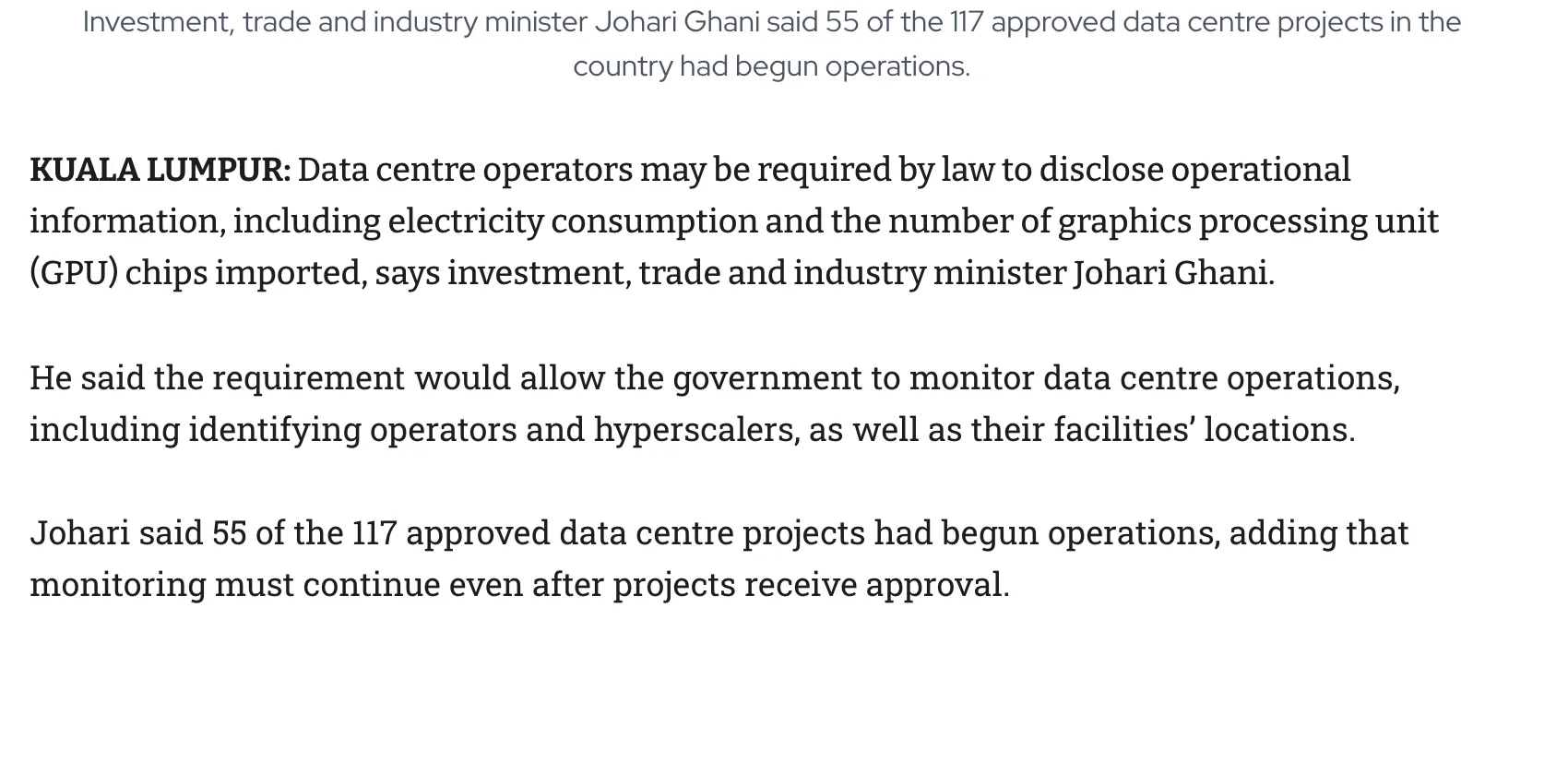
The minister’s 12 November remarks as reported by Bernama: disclosure of power use and imported GPU counts, with 55 of 117 approved projects already operating. Source: Bernama, FMT report, 12 November 2026; only the site’s own page furniture has been removed.
The same announcement introduced a commercial consequence for over-booking power. Suppliers must allocate the capacity in the supply agreement, and the minister’s example was direct: a data centre that books 100MW but uses 50MW will still be billed for the unused 50MW. The Energy Commission put data centres at 9.28% of national electricity consumption as of September, with a projected 31% by 2035, according to The Edge.
This disclosure proposal is separate from the Digital Infrastructure (Data Centre) Bill that the Economy Ministry expects to table next year. That bill concerns the pace of industry growth and pressure on energy and water. The MITI proposal concerns where chips go after they arrive.

Investment, Trade and Industry Minister Johari Ghani announced the disclosure plan on 12 November 2026. Photo: freemalaysiatoday.com, original image.
What this means for Malaysian businesses
The practical effects are uneven. A company that rents GPU hours from a local cloud provider will not apply for an American export licence. Its provider, and the provider’s silicon supplier, will. But the due-diligence obligation changes the questions asked of large customers, and that can change onboarding time, contract terms and who is accepted.
| Party | What changed | What to check |
|---|---|---|
| Data-centre operators and colocation providers | US rule adds a remote-access licence trigger based on 12,000,000 aggregate TPP; Malaysian disclosure law will require GPU and power reporting | Customer ultimate-parent ownership; linked-facility computing totals; power booking versus actual draw |
| Hardware suppliers and freight forwarders | Destination licence for five countries; Malaysian transit permit already in force since July 2025 | Whether a shipment is transit, re-export or in-country transfer; 30-day advance application for controlled chips |
| SMEs buying cloud or GPU capacity | No direct licence duty, but providers will ask who controls the buyer and what the capacity is used for | Company ownership documents; intended workload; willingness to accept audit clauses |
| Local construction, cooling, electrical and security vendors | Bookings are expected to hold in the near term, but the end-user mix is now a compliance question | Contract stage; customer provenance; exposure to projects that may be delayed by licence review |
RHB Research’s note of 16 November takes the view that near-term disruption should be limited. Orders for AI chips at data centres already under construction or close to award “should remain largely intact over the next six to 12 months”, the firm said, because hyperscalers and colocation providers have already booked them. The larger question, in RHB’s reading, is whether Nvidia can sustain its technology pace under new leadership. The firm also expects cloud providers to diversify, pointing to Google’s custom tensor processing units and Microsoft’s Maia chips, which it says are due to ramp from 2027.
That is a analyst view, not a guarantee. RHB’s own caveat is that a significant slowdown in US AI capital expenditure remains the long-term risk. Its figures also show how concentrated the build-out is: in the first ten months of 2026, ten of the top twenty non-residential contract awards by value in Johor went to Chinese data-centre players, with only two of those ten going to local contractors.
Where the opportunity still sits
Two reasons for the original investment case survive the new controls. The first is data sovereignty: RHB argues that long-term sovereignty requires infrastructure physically located inside national borders rather than hosted abroad. That argument is about location, not chip origin, and it is unchanged by a licence requirement.
The second is local content. The Data Centre Task Force has approved 27 projects worth RM225.97 billion through July 2026, with 16 in Johor, 10 in Selangor and one in Negeri Sembilan. Those projects carry a minimum 30% local content requirement and are expected to create 4,053 jobs, of which 3,523 are classed as high-skilled. Malaysians are expected to fill 89.21% of the skilled roles. Those are approval figures, not delivered revenue, and 26 of the 27 projects were still under construction at the time of the parliamentary reply.
For a supplier, the work is to be specific about what can be supplied locally and to document it in a form the project operator can use in a compliance file. For a buyer of compute, the work is to know the ownership chain behind the provider. Neither task requires a new product. Both require records that can be handed over quickly.
What could not be verified
The effective date is genuinely unresolved. The downloaded rule text carries an unfinished bracket reading “This rule is effective [INSERT DATE OF PUBLICATION IN THE FEDERAL REGISTER]”. The Edge Malaysia reported the rules as effective immediately on 17 November. A Chinese trade-law summary gives publication in the Federal Register on 19 November, effective on publication, with a 60-day comment period. A search of the Federal Register API on 17 November returned no matching document for the title, the RIN or a 16–18 November date filter. This article therefore says the rule was announced on 16 November and does not state a date on which it is legally in force.
Several other claims were checked and left out. Reported purchase figures tied to Speedmatrix were estimates in secondary reporting, not a government finding. Allegations about the private conduct of Nvidia’s former chief executive are irrelevant to the compliance question and are not repeated here. The company transition itself is documented in an SEC filing: Jensen Huang resigned as president, chief executive and board member on 12 November, Colette Kress became interim chief executive, and Harvey C. Jones was appointed the first chair of the board.
Malaysia’s disclosure requirement is an announced intention, not yet a published bill. No bill number, gazette date or clause text was available at the time of writing. The planned law is also separate from the Digital Infrastructure (Data Centre) Bill expected to reach Cabinet next year.
Sources
- US Bureau of Industry and Security, BIS Issues Rule Addressing Remote Access to American Super Intelligence Technology, 16 November 2026 (rule purpose; Treasury and NSC authorship) — bis.gov
- US Bureau of Industry and Security, Addressing Remote Access to Advanced Semiconductors, RIN 0694-AK50, 16 November 2026 (132-page rule text; destination licence; 12,000,000 aggregate TPP; 90-day window; recommender exemption; an unfilled effective-date bracket) — bis.gov/media/documents/rin-0694-ak50.pdf
- Singapore Ministry of Digital Development and Information and Ministry of Energy, Trade and Industry, Joint Media Statement on US Interim Final Rule (remote access to advanced semiconductors), 17 November 2026 — mti.gov.sg
- NVIDIA, Announces CEO Transition, SEC exhibit 99.1, 12 November 2026 — sec.gov
- Bernama, KLIA Customs Foils Attempt To Transit AI Chips With Potential Military Use, 28 October 2026 (30 servers, nearly RM49.5 million; Directive 1/2025 thresholds; Section 12 penalty) — bernama.com
- Bernama via Free Malaysia Today, Data centre operators may have to disclose operational details, 12 November 2026 — freemalaysiatoday.com
- The Star (Bernama), Keeping tabs on data centres, 13 November 2026 — thestar.com.my
- The Star, Miti says it has never cleared Megaspeed or subsidiary Speedmatrix, 13 November 2026 — thestar.com.my
- Scoop, Miti and Customs probe Nvidia-linked Speedmatrix on possible re-export of AI chips, 13 November 2026 — scoop.my
- The Edge Malaysia, US imposes new export controls on Malaysia, Singapore for advanced semiconductors, 17 November 2026 — theedgemalaysia.com
- NST via KLSE Screener, Nvidia uncertainty unlikely to derail Malaysia’s data centre projects, says RHB, 16 November 2026 — klsescreener.com
- The Star, Malaysia’s data centres, costs and spillovers, 2 November 2026 — thestar.com.my
- BullBuzz, Malaysia Approves RM225.97bn in Data-Centre Projects, 2026 (DCTF figures and MIDA total) — bullbuzz.io
- SAYS, EPF Owns Nearly 6.85 Million NVIDIA Shares, November 2026 (corroboration of MIDA and DCTF figures) — says.com
BD Media is the editorial desk of Big Domain. This article records a published rule, two ministerial statements and an official enforcement case. It does not state a legal effective date that could not be confirmed from the government gazette, and it makes no finding against any company under investigation.