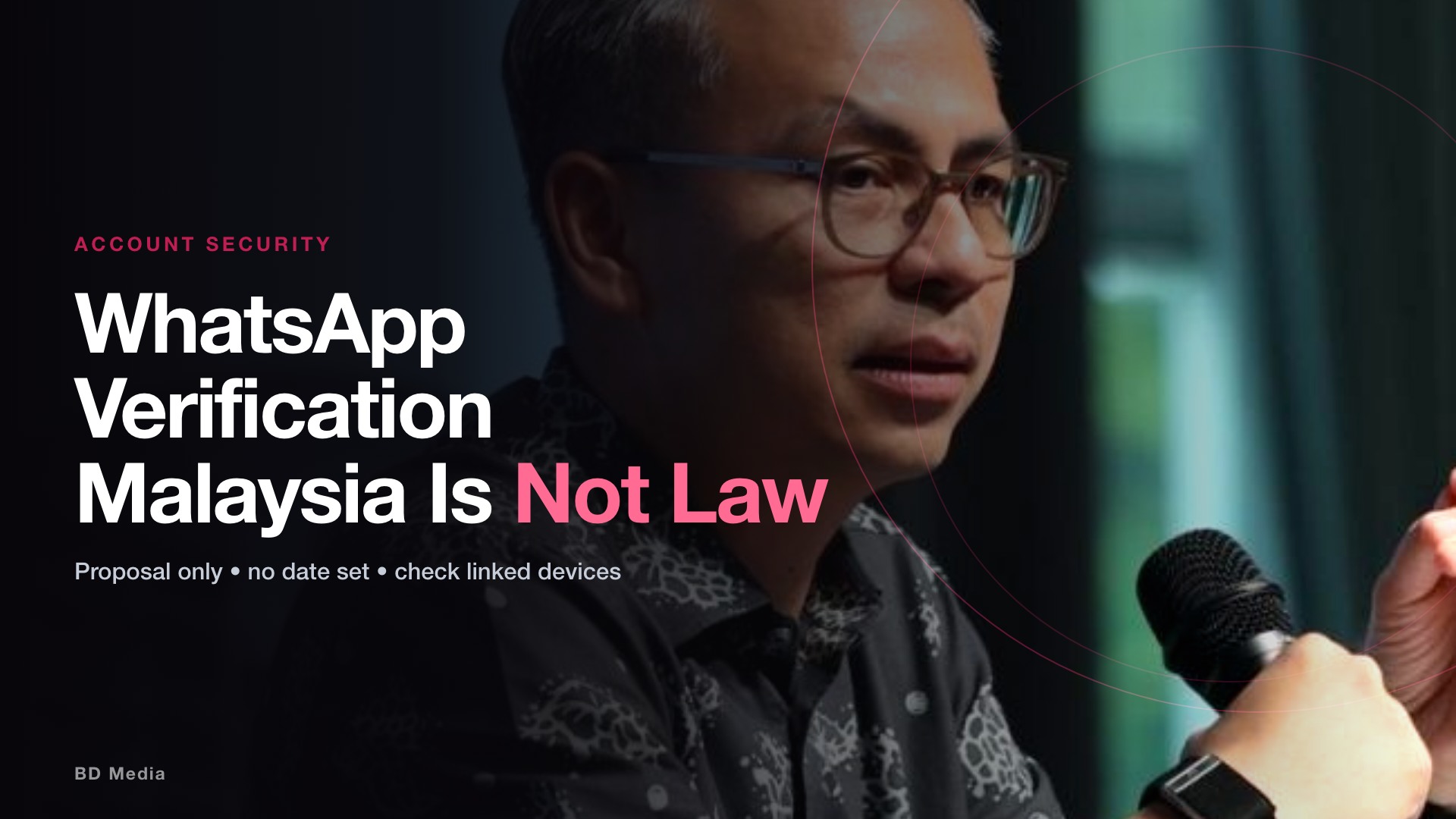
WhatsApp verification Malaysia is under study, not in force. The Communications Ministry said on 15 November that it is examining whether the messaging platform should verify the identities and phone numbers linked to accounts. No implementation date, technical design or document list was announced. For Malaysian SMEs, the useful response is not to wait for a rule. It is to check which business accounts, linked devices and staff logins exist today.
Published 17 November 2026 · ministerial statement made 15 November 2026 · page will be updated when a decision is published.
WhatsApp verification Malaysia: what SMEs must check now
Communications Minister Datuk Seri Fahmi Fadzil made the statement at a press conference in Kuala Lumpur. Bernama reported him saying: “The Communications Ministry is studying the feasibility of requiring WhatsApp to verify the telephone numbers linked to WhatsApp accounts. At present, WhatsApp does not impose any account verification requirement.”
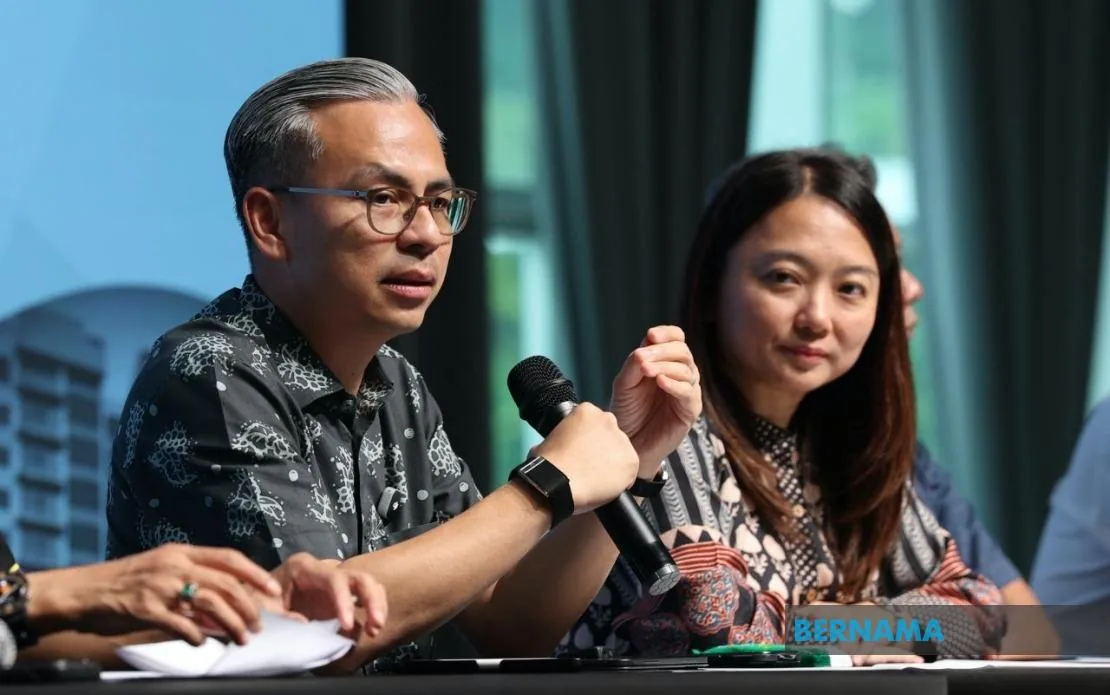
Source: Bernama photograph, press conference at Razak Mansion, 15 Nov 2026 · captured 17 Nov 2026 from www.bernama.com/en/news.php?id=2634724
The distinction between a study and a requirement matters. A study allows the ministry to test feasibility. It does not change how WhatsApp onboarded an account yesterday, and it does not give any agency power to demand new identity documents today. Any business message that claims verification is already compulsory would be wrong.
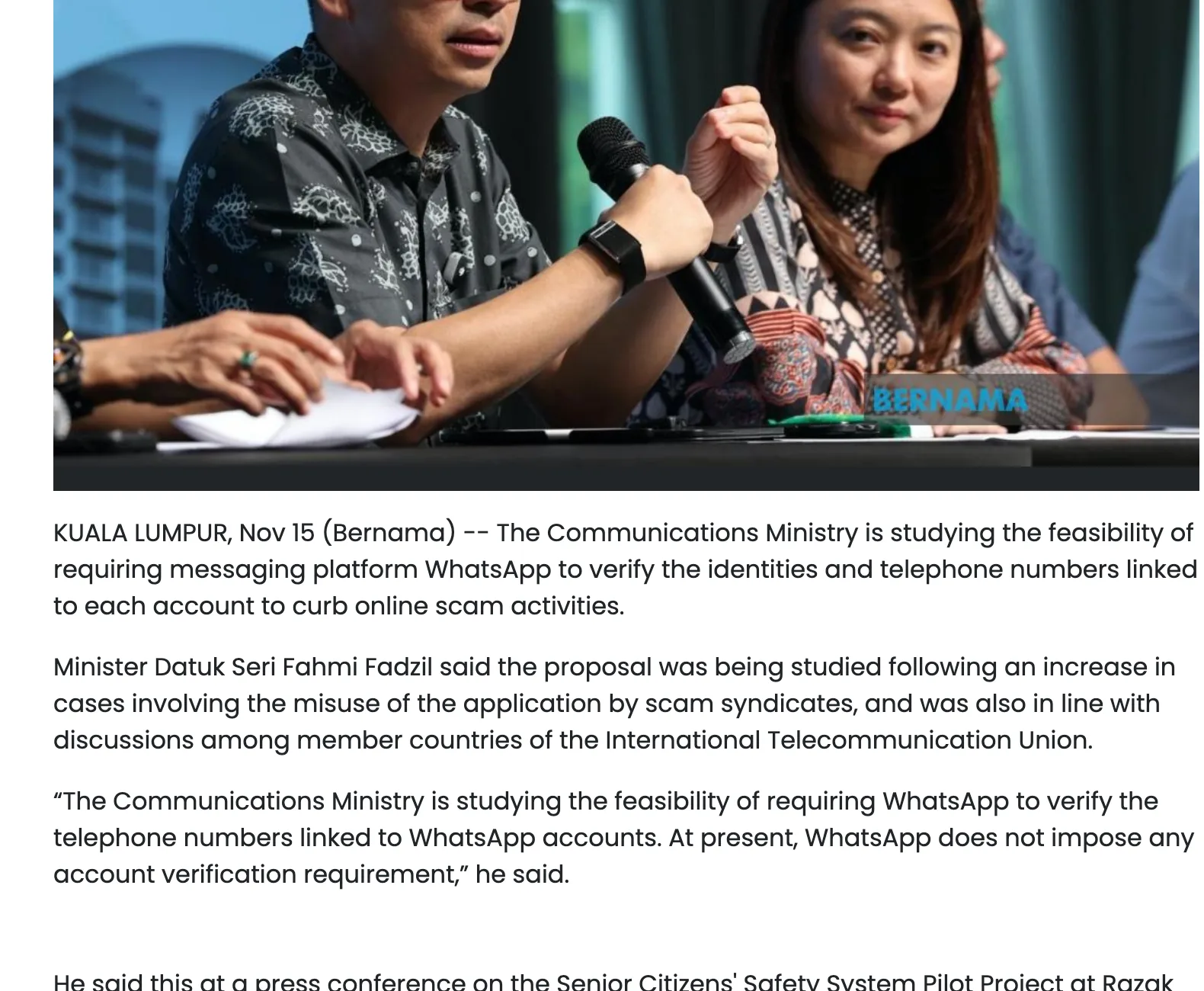
Source: Bernama, Govt Studying Feasibility Of Mandatory Whatsapp Account Verification To Curb Online Scams – Fahmi, 15 Nov 2026, lead and quote paragraphs · captured 17 Nov 2026 from www.bernama.com/en/news.php?id=2634724
Why the proposal surfaced now
The minister linked the proposal to a change in fraud tactics. Authorities had introduced technical controls against falsified caller identity, after which fraudulent activity shifted toward messaging apps and loan offers tied to online gambling. The Star reported that 61 suspects had been arrested in relation to impersonation cases involving the Malaysian Communications and Multimedia Commission. No loss total or victim count appears in either report read for this article.
Fahmi also repeated a boundary that businesses should note in their own call scripts. The ministry and MCMC do not call people about unpaid telephone bills or enforcement matters. Billing belongs to the telecommunications company. A caller who claims otherwise is using an official-sounding name to create urgency.
| Question | What is confirmed | What is not confirmed |
|---|---|---|
| Is verification required? | No. The minister said WhatsApp currently has no account verification requirement. | Whether a future rule would cover identity, phone number, or both in a defined workflow. |
| Is there a date? | No date was announced. | Any rollout timetable or transition period for businesses. |
| What triggered the study? | Increased misuse of the app and discussions among ITU member countries. | Whether Malaysia would act alone or through a regional or platform-wide change. |
| What can a business do now? | Review accounts, linked devices and access controls using WhatsApp’s published security guidance. | Any requirement to hand new identity documents to a platform or regulator. |
What this means for a business WhatsApp account
Many Malaysian SMEs run sales, support and order taking through WhatsApp Business numbers. Those numbers are company assets in practice, even when a personal phone registered them. A verification change would land on that operational reality: who controls the number, who can link a device, and whether a departing staff member still has a session.
That is why the account audit matters before any policy lands. A business with one owner-operated phone has a short list. A business with sales staff, a part-time bookkeeper, an agency and a desktop dashboard has more. Unknown linked devices, old registration codes shared in chat and a two-step PIN known to several people are the same weaknesses a verification rule would be designed to close.
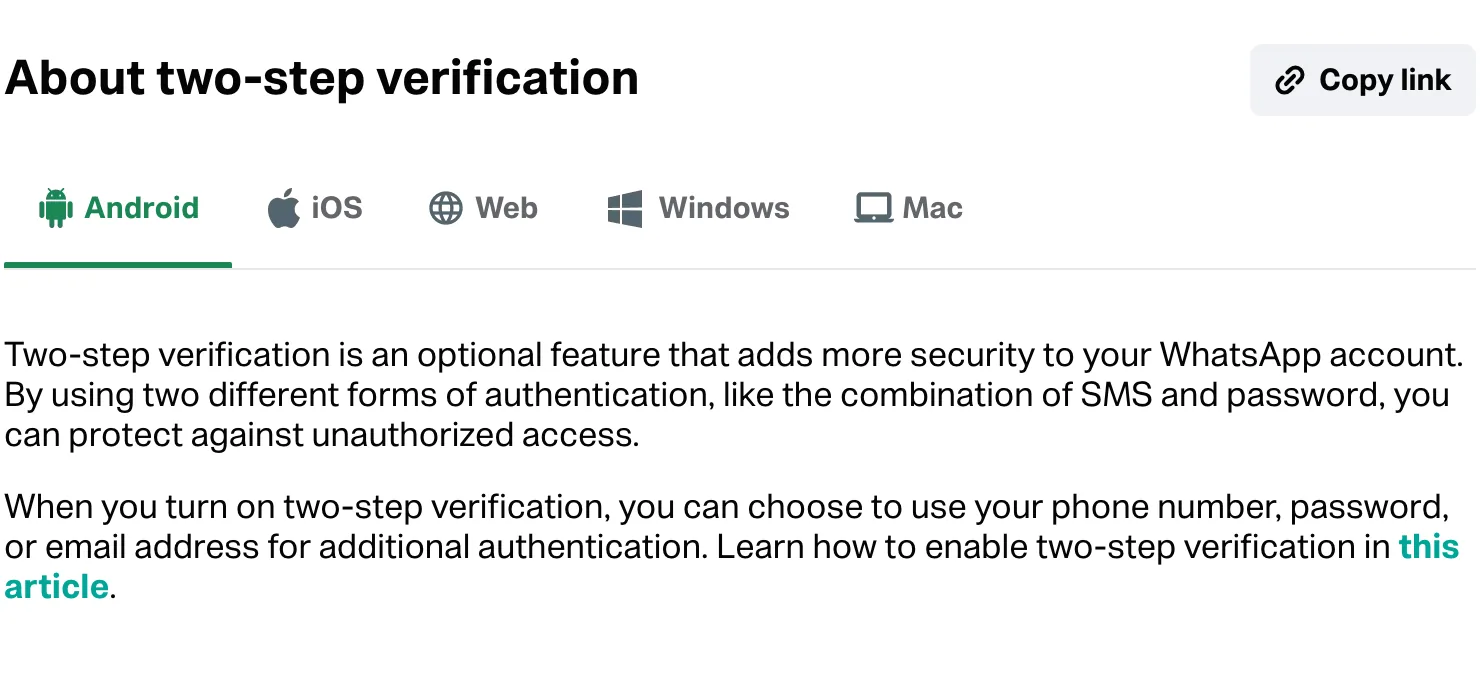
Source: WhatsApp Help Center, About two-step verification, Android tab, accessed 17 Nov 2026 · captured from faq.whatsapp.com/1278661612895630/?cms_platform=android&locale=en_US
WhatsApp’s own help article describes two-step verification as an optional feature that adds a second form of authentication. The account security guidance also tells users to check linked devices regularly. Neither page describes a Malaysian identity mandate. They are the controls available now, before a decision is made.
What an SME should check this week
This is housekeeping, not a new compliance regime. It reduces the chance that a company number is controlled by someone who should no longer have access.
- List every number used for sales, support or payments, including numbers registered on a staff member’s personal device.
- Review linked devices on each business account and log out anything unknown or no longer used.
- Enable two-step verification and keep the PIN and recovery email with the business, not only in one employee’s memory.
- Stop sharing registration codes or PINs in chat. Treat a code request as a security event, not a routine help desk task.
- Brief customer-facing staff that neither MCMC nor the Communications Ministry calls about telephone bills or enforcement matters. Escalate instead of arguing with a caller.
- Record who owns each number and what happens to it when that person leaves. The same issue applies to the paid reply window covered in BD Media’s October guide.
None of these steps depends on the ministry reaching a decision. They also do not prove that an account is safe from every form of fraud. They put the business in a position where it can answer basic questions about its own numbers, which is the part no platform can do on the company’s behalf.
What not to assume
Four claims should stay out of customer messages and internal memos for now: that verification is mandatory, that it starts on a named date, that WhatsApp already checks real-world identity, and that MCMC calls businesses about bills. The minister said none of those things. Reporting that a proposal exists is different from reporting that a rule has started.
The same caution applies to cost. No fee, registration charge or new licence was announced. A business that receives a message asking for payment to “complete WhatsApp verification” should treat that message as suspicious and report it through the proper channel.
BD Media’s earlier guide to WhatsApp bans and appeals remains the reference for account restrictions. This page records the separate verification proposal and will be updated if the ministry publishes a decision.
About BD Media. BD Media is the editorial desk of Big Domain, a Malaysian web hosting and digital services company. We report on the policy, security and cost decisions that Malaysian businesses have to act on.
Sources
- (T2) Bernama, Govt Studying Feasibility Of Mandatory Whatsapp Account Verification To Curb Online Scams – Fahmi, 15 Nov 2026 17:31. Read 15–17 Nov 2026. Verbatim ministerial quote, 61-suspect enforcement reference, and the statement that WhatsApp currently imposes no account verification requirement. Bernama photograph credited in the caption.
- (T2) The Star, WhatsApp verification under study, 16 Nov 2026. Read 17 Nov 2026. Corroboration of the proposal, the ITU reference and the boundary on ministry or MCMC calls about bills.
- (T1) WhatsApp Help Center, About two-step verification, accessed 17 Nov 2026. Definition of two-step verification and the authentication methods available.
- (T1) WhatsApp Help Center, Account security tips, accessed 17 Nov 2026. Guidance on registration codes, two-step verification and reviewing linked devices.
Verification note. No implementation date, design or fee was published in the sources read. None is stated here.