E-invoicing Malaysia has passed its biggest milestone yet: more than 268,000 taxpayers have submitted 1.99 billion e-invoices as at 1 October 2026, Inland Revenue Board chief executive Datuk Dr Abu Tariq Jamaluddin said at the launch of Bulan HASIL 2026 in Putrajaya. 196,031 of those taxpayers came in under phase four – the wave the government just shrank by raising the exemption threshold from RM1 million to RM3 million in annual turnover, effective 1 September 2026.
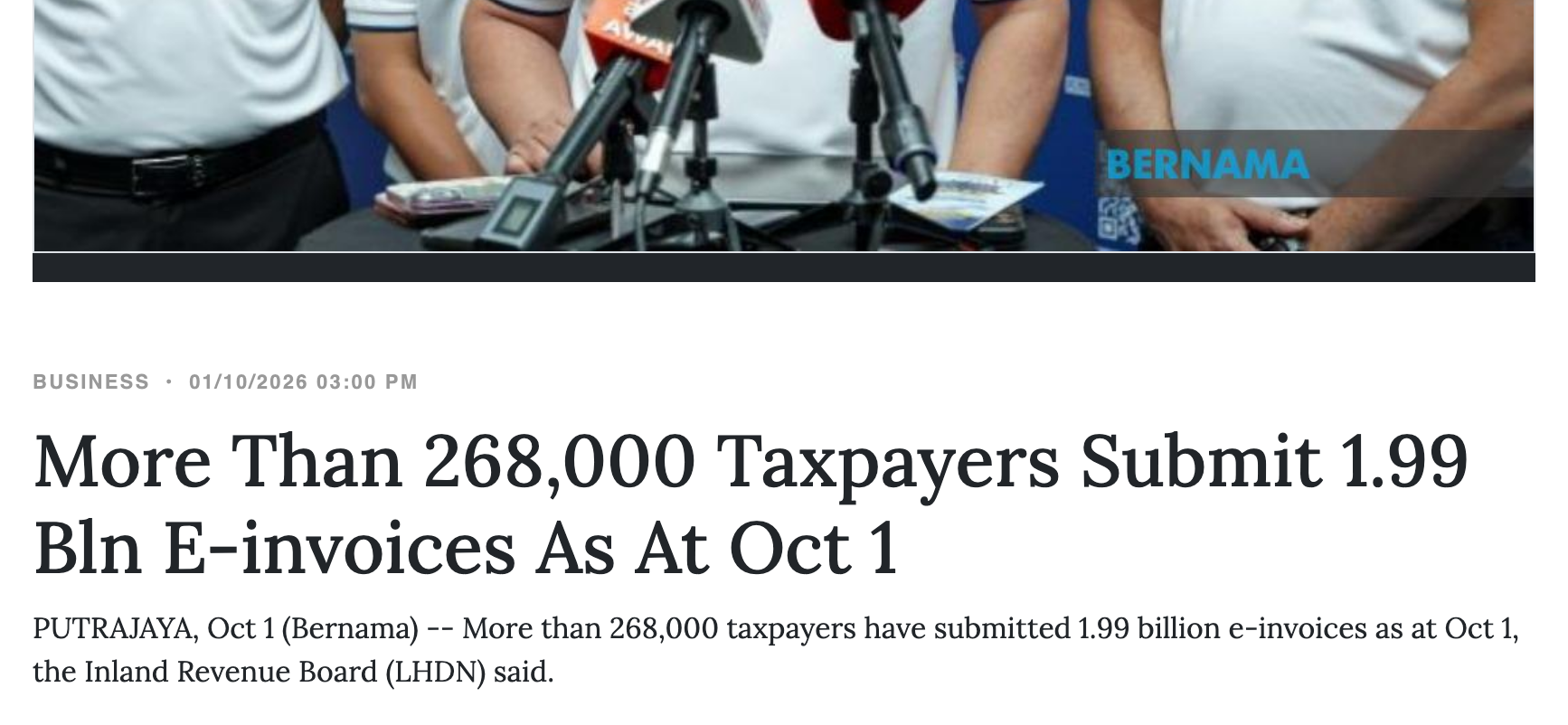
Bernama, 268,000 taxpayers / 1.99 bln e-invoices, 2 October 2026. Captured 3 October 2026 from https://www.bernama.com/en/business/news.php?id=2614144
What the e-invoicing Malaysia numbers say
That threshold change is the most consequential fact for small business: businesses with annual turnover below RM3 million are no longer required to implement e-invoicing at all. LHDN estimates more than 1.1 million businesses benefit from the exemption. Adoption is nonetheless accelerating hard – phase four alone accounts for roughly three-quarters of all taxpayers in the system.
| Malaysia’s e-invoicing rollout at 1 October 2026 | Figure | Source |
|---|---|---|
| Taxpayers submitting e-invoices | 268,000+ | LHDN via Bernama, 1 Oct 2026 |
| E-invoices submitted for validation | 1.99 billion | LHDN via Bernama, 1 Oct 2026 |
| Phase 4 taxpayers | 196,031 | LHDN via Bernama, 1 Oct 2026 |
| Phases 1 / 2 / 3 | 5,582 / 14,579 / 51,815 | LHDN via Bernama, 1 Oct 2026 |
| Exemption threshold | Raised RM1m to RM3m from 1 Sep 2026 | LHDN e-Invoice Guideline v4.8 |
| Penalty-free correction window | Until 31 December 2027 (PKPS e-Invois) | LHDN via The Star, 1 Oct 2026 |
| Active tax files (31 Aug 2026) | 620,000+ corporate, 7.6m+ individual | LHDN via Bernama, 1 Oct 2026 |
The mistake tax: 15% versus 45%
Abu Tariq’s sharpest line was about timing. A voluntary disclosure under the PKPS carries a 15% penalty rate. The same error found in an audit rises to 45%, and 60% or more if it surfaces in an investigation.
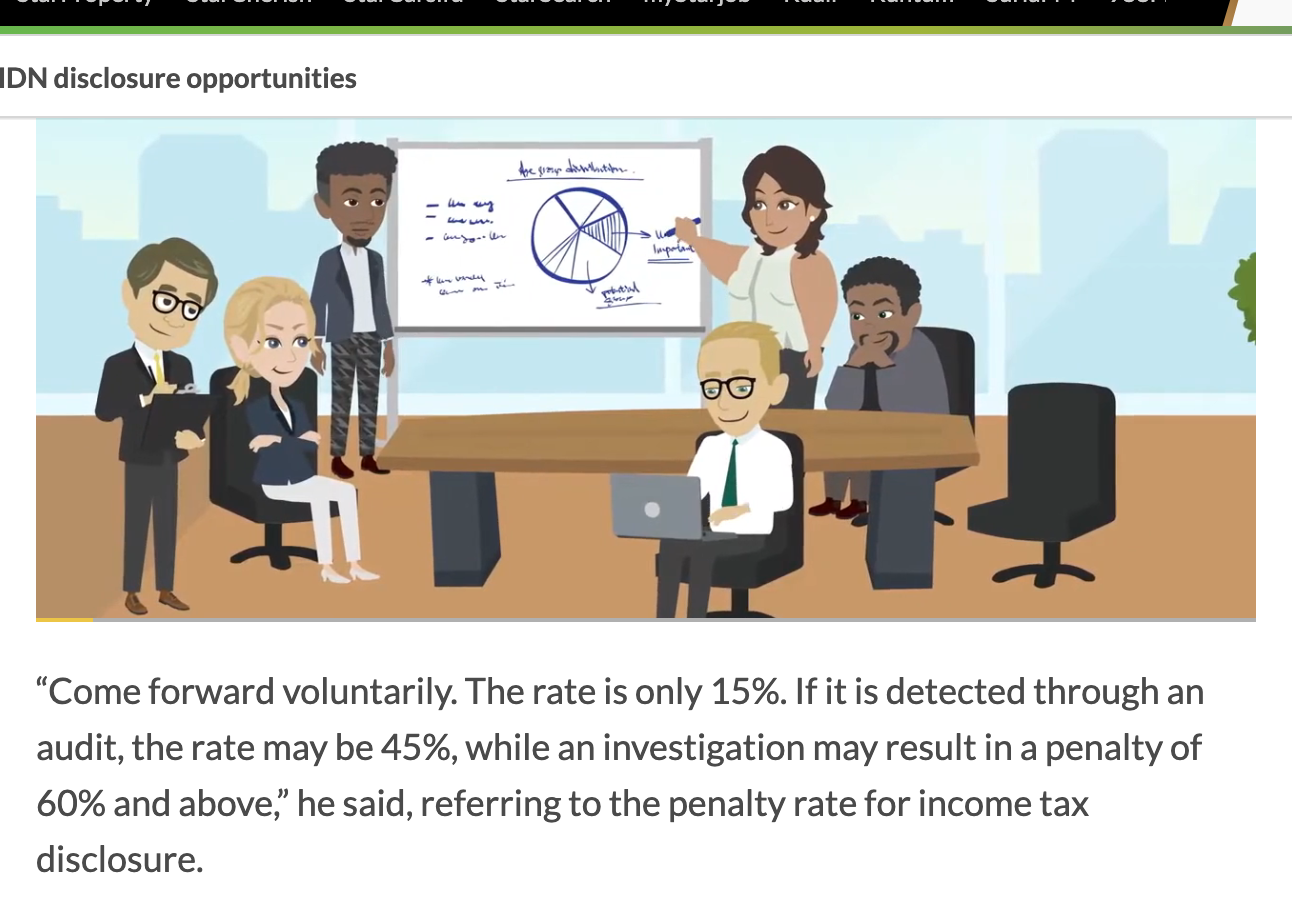
The Star, LHDN special disclosure programme, 2 October 2026. Captured 3 October 2026 from https://www.thestar.com.my/news/nation/2026/10/02/special-lhdn-disclosure-opportunities
What an exempted business should still do
The RM3 million exemption is not automatic in every case. Under Guideline v4.8 it does not apply where the business has a non-individual shareholder, a holding company, or a related company or joint venture with turnover of RM3 million or more. Businesses starting from YA2026 that cross RM3 million in their first year begin e-invoicing on 1 January of the second year following that year of assessment.
Businesses already in the system that made submission errors can correct them penalty-free under PKPS e-Invois until 31 December 2027, and LHDN says voluntary corrections have begun. On the same day, LHDN also flagged a stamp-duty voluntary disclosure programme with nearly one million applications, ahead of stamp-duty self-assessment.
Why the threshold change matters more than the milestone
Read the two announcements together and the government’s strategy becomes clear. The 1.99 billion invoices prove the infrastructure works at scale. Raising the exemption from RM1 million to RM3 million proves the government listened to the compliance-cost argument. Those two facts do not sit in tension – they are the same policy maturing. Get the system proven on large taxpayers, then give small ones room rather than forcing a million tiny businesses onto a portal before the tooling is ready.
The exemption’s design carries a deliberately narrow definition. It keys off turnover, but also off corporate relationships: a small company with a large shareholder, parent or joint-venture partner does not qualify, because the group’s compliance burden is assessed at group level. That is standard anti-fragmentation logic, and it is the trap a family-owned group with one large subsidiary can fall into without noticing.
What to watch next
Watch the phase-five schedule. The exemption covers businesses below RM3 million now, but the rollout has never stopped moving – the question is when the government announces the next band and what the interim relaxation period looks like. Also watch the stamp-duty self-assessment rollout, which landed alongside the e-invoice programme and carries its own one-million-application voluntary disclosure track; businesses that have un-stamped tenancy or loan documents have the same penalty arithmetic working against them.
Sources
- LHDN – official portal and Bulan HASIL 2026 programme page
- LHDN e-Invoice Guideline v4.8 – threshold change effective 1 September 2026
- Bernama, “More Than 268,000 Taxpayers Submit 1.99 Bln E-invoices As At Oct 1”, 1 October 2026
- The Star, “Over 268,000 businesses adopt e-invoicing…”, 1 October 2026
- The Star, “Special LHDN disclosure opportunities”, 2 October 2026