
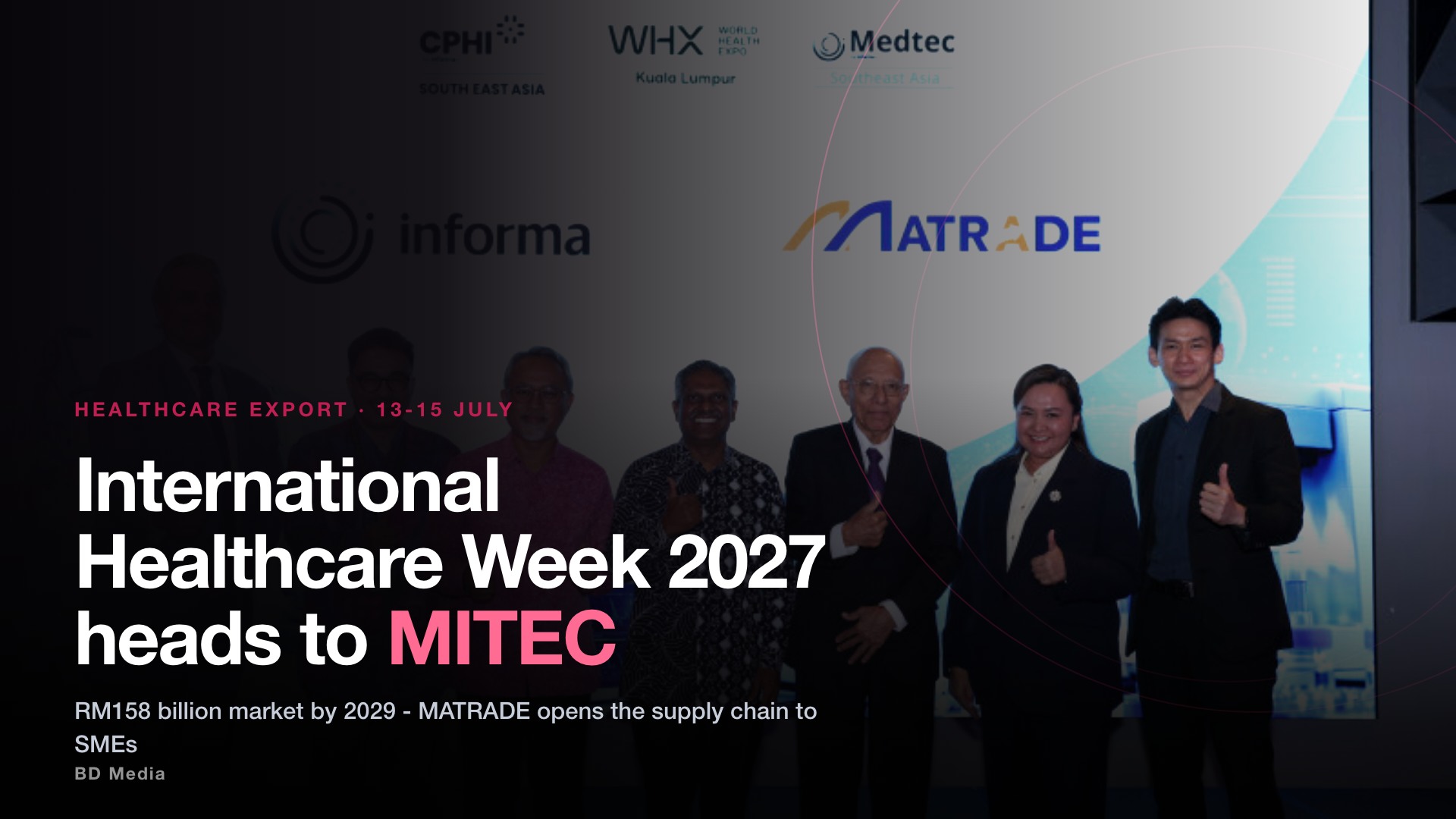
International Healthcare Week 2027 will run from 13 to 15 July at MITEC in Kuala Lumpur, a MATRADE-partnered event designed to plug Malaysian exporters and MSMEs into global healthcare supply chains, the organisers announced on 1 October 2026. The timing is not accidental: Malaysia’s private healthcare market is projected to grow from RM74 billion in 2022 to RM158 billion by 2029, an 11.4% annual growth rate.
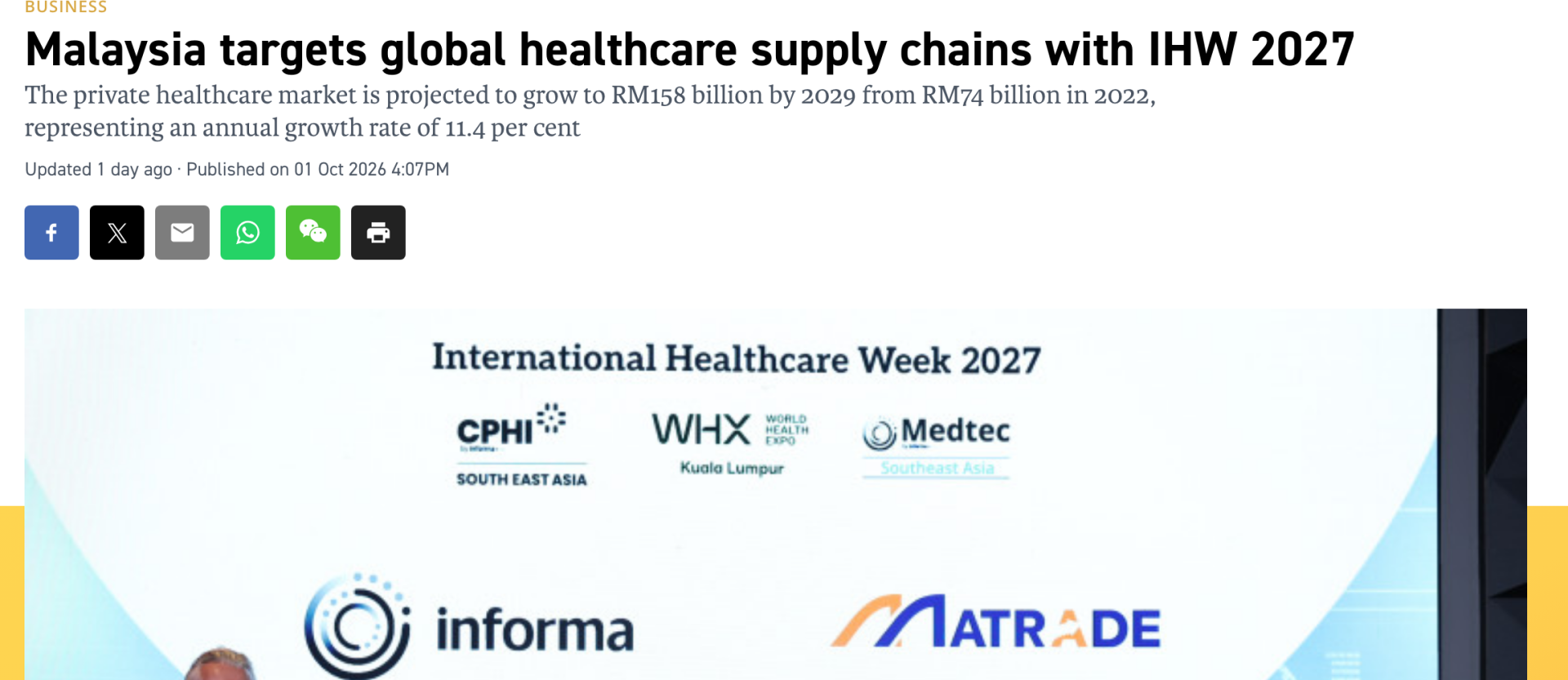
The Vibes, IHW 2027 healthcare export target, 2 October 2026. Captured 3 October 2026 from https://www.thevibes.com/articles/business/127866
What International Healthcare Week 2027 covers
It combines three exhibitions under one roof: CPHI South East Asia for pharmaceutical manufacturing (ingredients, contract manufacturing, packaging), World Health Expo Kuala Lumpur for hospital buyers, distributors, equipment and solutions, and Medtec Southeast Asia for the medical device supply chain. For a Malaysian SME, that is the entire hospital procurement chain in one hall.
| International Healthcare Week 2027 | Detail | Source |
|---|---|---|
| Dates and venue | 13-15 July 2027, MITEC Kuala Lumpur | MATRADE, 1 Oct 2026 |
| Co-located exhibitions | CPHI SEA, World Health Expo KL, Medtec SEA | MATRADE, 1 Oct 2026 |
| Private healthcare market 2022 | RM74 billion | Frost & Sullivan, via MATRADE |
| Private healthcare market 2029 | RM158 billion projected (11.4% CAGR) | Frost & Sullivan, via MATRADE |
| Private hospital beds by 2028 | 23,500 projected | via MATRADE, 1 Oct 2026 |
| Medical tourism revenue 2025 | RM3.35 billion | via MATRADE, 1 Oct 2026 |
| Organisers | MATRADE and Informa Markets | MATRADE, 1 Oct 2026 |
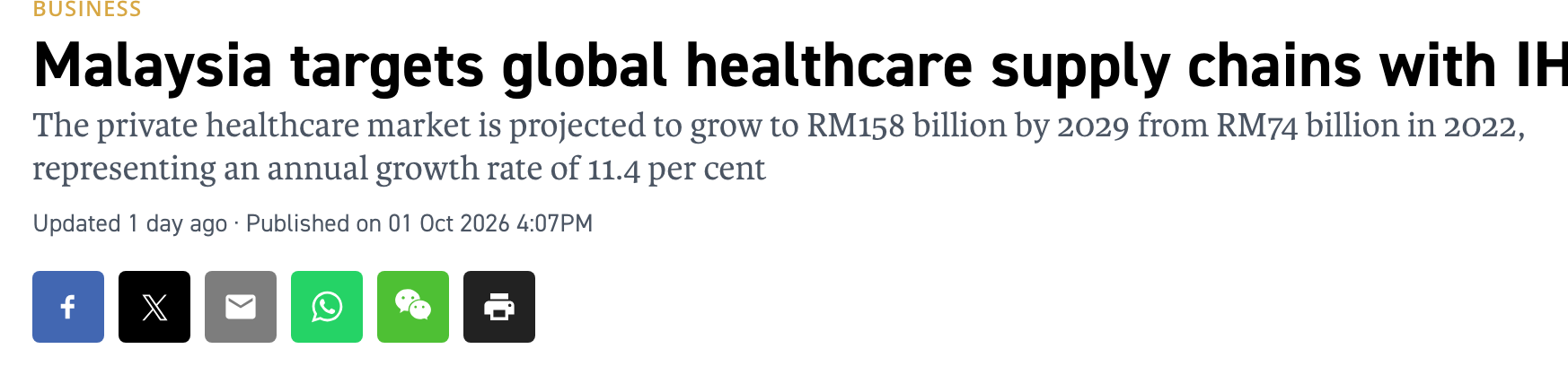
The Vibes, private healthcare market size (Frost & Sullivan), 2 October 2026. Captured 3 October 2026 from https://www.thevibes.com/articles/business/127866
The demand signals underneath
Private hospital bed capacity is projected to reach 23,500 by 2028, and medical tourism generated RM3.35 billion in revenue in 2025. Both feed the same conclusion: hospital build-outs and patient inflows create procurement demand that local suppliers – consumables, devices, hospital services, logistics – can capture if they are in the room when buyers are sourcing.
MATRADE frames the event itself as an ecosystem play rather than a trade show. “For MATRADE, this is more than an exhibition, it is a strategic ecosystem marketplace to attract strategic collaboration that will strengthen Malaysia’s position in the global healthcare value chain,” Abu Bakar said. Informa Markets regional portfolio director for ASEAN Rungphech Chitanuwat described the event as a bridge connecting healthcare businesses across the region.
Why healthcare is the hardest export sector to enter
Healthcare exports do not behave like most trade categories. A medical device or a pharmaceutical ingredient cannot be sold on price alone; it needs registration with the destination market’s regulator, often a lengthy and expensive process, plus clinical or quality documentation that smaller Malaysian manufacturers rarely have assembled. That is the real barrier, and it is why an exhibition alone does not move the needle. What MATRADE is assembling under IHW is closer to a matchmaking and capability-signalling exercise than a sales floor.
The three co-located exhibitions reflect the sector’s structure rather than an event organiser’s convenience. Pharmaceuticals need ingredient and contract-manufacturing suppliers; hospitals need equipment distributors and service providers; device makers need components, sterilisation and packaging. A Malaysian SME typically sits in one of those layers, not all three, and the format lets it find the buyer at its own level.
What to watch next
Watch whether MATRADE publishes co-exhibition support terms for MSMEs – funding for a booth is what converts interest into participation for small firms. Also watch whether the private healthcare growth projection holds through the next fiscal year, since hospital capital expenditure is the demand that ultimately pulls device and consumable orders through the chain.
The medical tourism thread
Medical tourism is the quiet engine behind Malaysia’s healthcare export story. RM3.35 billion in 2025 revenue represents patients travelling to Malaysia for procedures, and those patients create demand for hospital capacity, equipment and consumables that local suppliers can serve. It also creates a reputational asset: international patients who have a good experience become the credibility argument for Malaysian healthcare products in their home markets. That link between patient experience and product export is not always made explicitly, but it is the reason healthcare sits alongside palm oil and electronics in trade promotion conversations.
For a Malaysian SME, the practical implication is that the addressable market is not just Malaysian hospitals. Regional hospital groups, distributors and procurement agents are all reachable through a platform that aggregates the whole supply chain in one venue, which is precisely what three co-located exhibitions deliver.
Sources
- MATRADE – official website
- MITEC – venue official site
- The Vibes, “Malaysia targets global healthcare supply chains with IHW 2027”, 1 October 2026