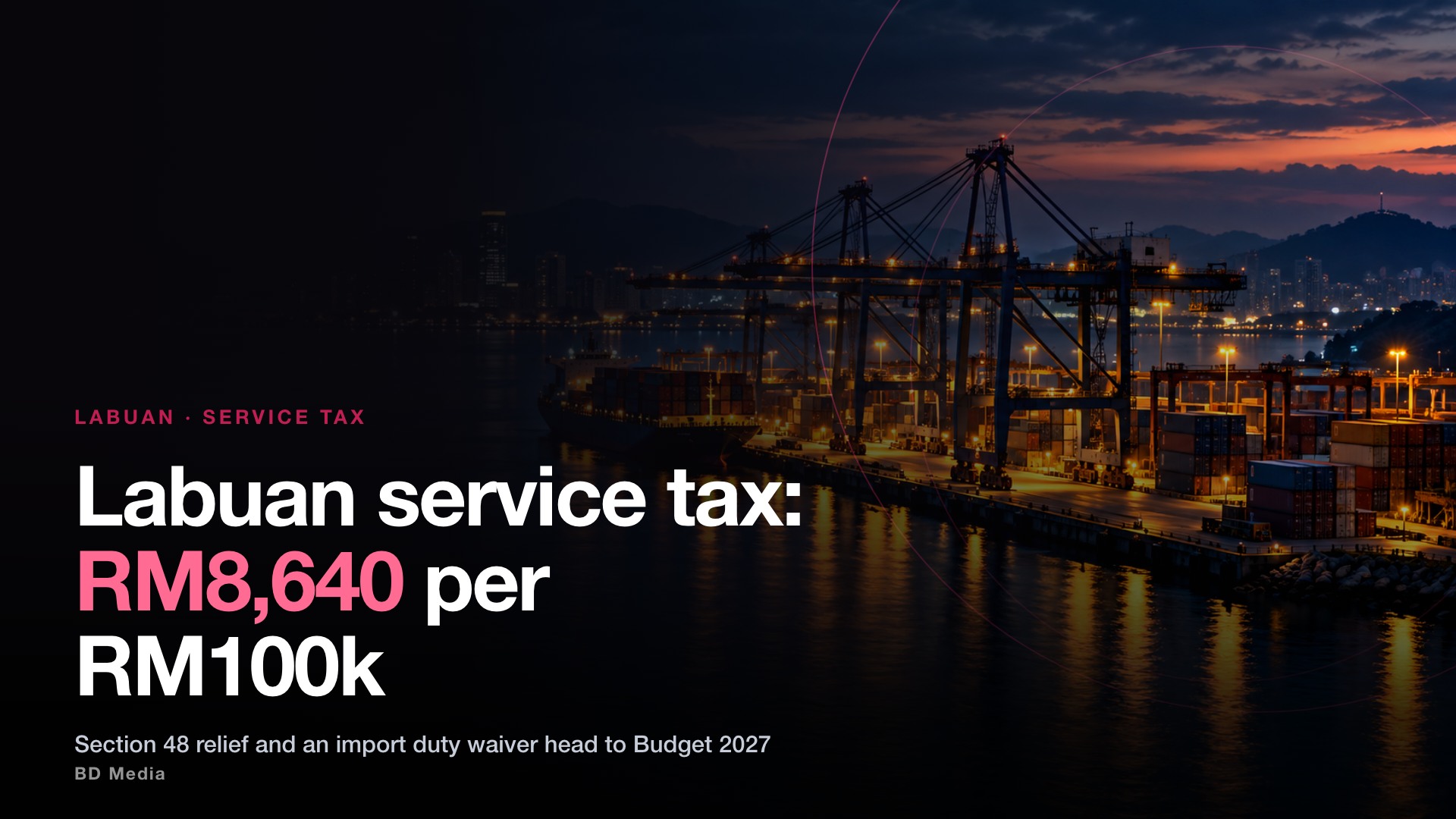
Labuan service tax relief is again on the table, and the island’s SME association wants it settled in Budget 2027. The Small and Medium Enterprises Association of Labuan, led by president Jefery Tan, called on 2 October 2026 for the Section 48 service tax exemption to be applied to services performed entirely on the island – and for import duty to be waived on goods produced by Labuan MSMEs and sold to the rest of Malaysia.
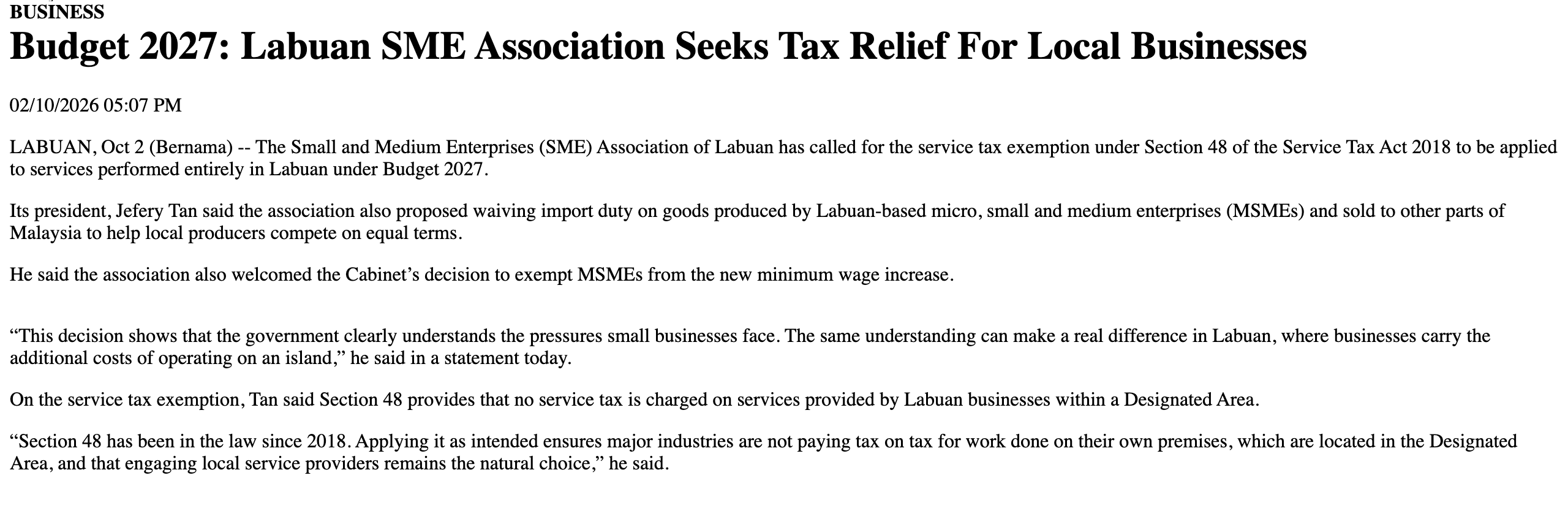
Bernama, Labuan Section 48 tax relief, 2 October 2026. Captured 3 October 2026 from https://www.bernama.com/misc/rss/news.php?id=2614643
What the Labuan service tax problem is
Section 48 of the Service Tax Act 2018 has provided since 2018 that no service tax is charged on services provided by Labuan businesses within the Designated Area. In practice, Tan said, major industry players award multi-disciplinary contracts to mainland contractors, who then sub-contract work on Labuan premises to local providers – and the exemption is not applied down the chain.
| Labuan’s Budget 2027 asks | Detail | Source |
|---|---|---|
| Ask 1 | Apply Section 48 to services performed entirely in Labuan | SME Association of Labuan, 2 Oct 2026 |
| Ask 2 | Waive import duty on Labuan-made MSME goods sold in Malaysia | SME Association of Labuan, 2 Oct 2026 |
| Mechanism proposed | Exempt by provider location, not customer registration | SME Association of Labuan, 2 Oct 2026 |
| Statutory basis | Service Tax Act 2018, Section 48 (Designated Area) | Act, in force since 2018 |
| Service tax rate | 8% | SME Association of Labuan, 2 Oct 2026 |
| Cost impact cited | RM8,640 added per RM100,000 of work, incl. RM640 tax on tax | SME Association of Labuan, 2 Oct 2026 |
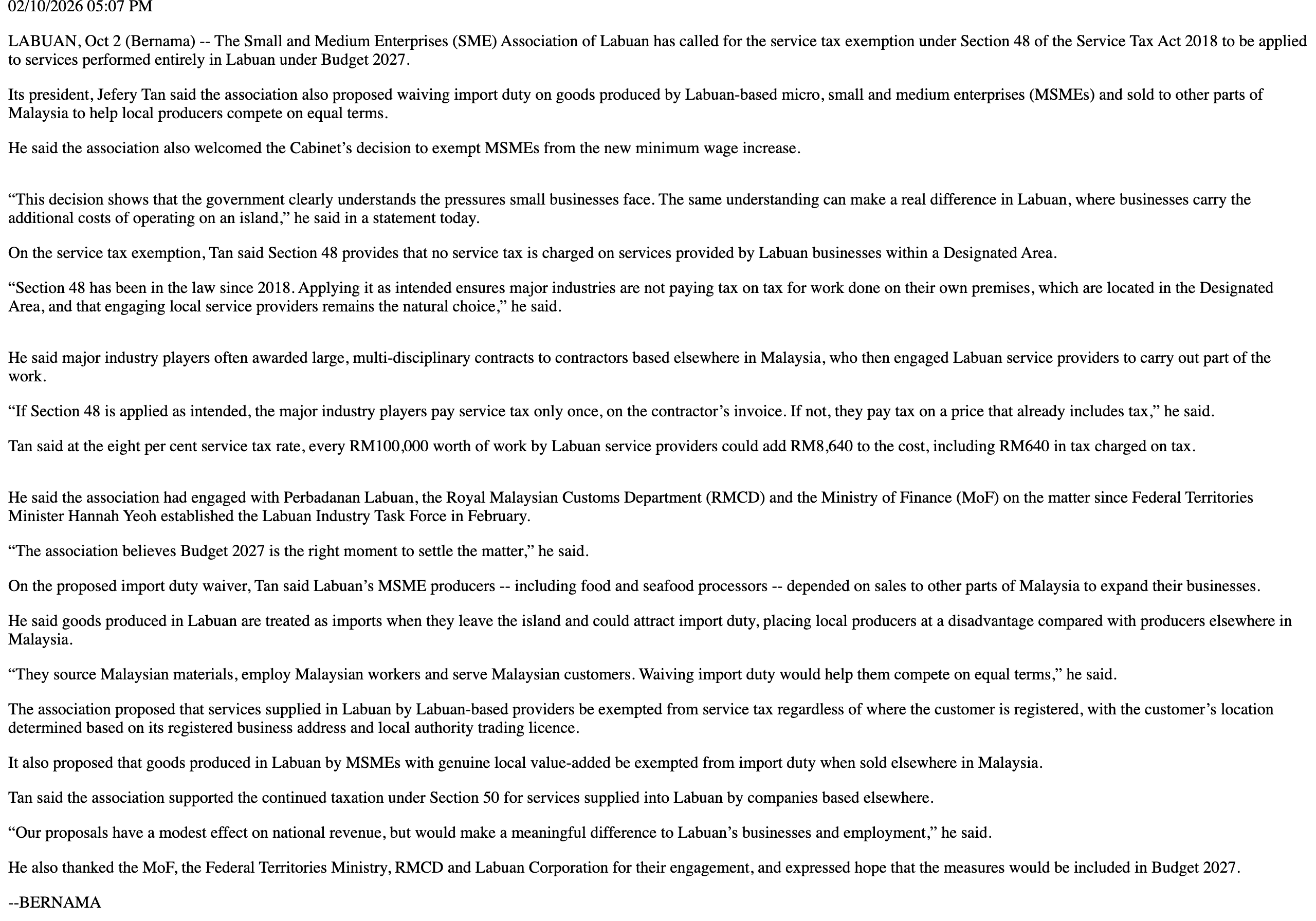
Bernama, Labuan Section 48 service tax arithmetic, 2 October 2026. Captured 3 October 2026 from https://www.bernama.com/misc/rss/news.php?id=2614643
The import duty asymmetry
The second ask targets an island-specific distortion: goods produced in Labuan are treated as imports when they leave the island, attracting import duty that mainland competitors never face. Tan’s argument is plain – Labuan producers “source Malaysian materials, employ Malaysian workers and serve Malaysian customers” and should compete on equal terms. Food and seafood processors are the most exposed.
The association has engaged Perbadanan Labuan, the Royal Malaysian Customs Department and the Finance Ministry since Federal Territories Minister Hannah Yeoh established the Labuan Industry Task Force in February. “The association believes Budget 2027 is the right moment to settle the matter,” Tan said, noting the proposals’ effect on national revenue would be modest.
Why a decade-old exemption is still not being applied
The interesting question is not whether Section 48 exists – it has existed since 2018 – but why a statutory exemption needs a Budget announcement to take effect. The answer is in how the tax is administered rather than written. Service tax sits on the issuer of the invoice, and where a mainland prime contractor invoices for a package that includes Labuan-delivered work, the exemption depends on how the transaction is structured and documented. The association’s complaint is effectively that the default treatment is to tax the full contract value, leaving the Labuan provider to argue its way to relief after the fact.
That is why the association’s proposed fix is about the definition rather than the rate. It wants the exemption to follow the provider’s location, not the customer’s registration – a mechanical test that removes the argument. Whatever the merits, the proposal is modest in revenue terms by the association’s own admission, which is the strongest argument it has.
What to watch next
Two markers. Whether the Finance Ministry’s Budget 2027 annexe addresses Designated Area treatment at all – silence would leave the issue to another year of engagement. And whether the Labuan Industry Task Force, established in February, produces a public position before the budget, because that would signal the machinery is moving rather than absorbing the request.
The wider Designated Area argument
Labuan’s tax architecture exists to make an offshore financial centre viable, and the service tax treatment is one plank of it. If work performed on the island is taxed at the point of a mainland contract, the island’s cost advantage erodes quietly – not dramatically enough to make headlines, but steadily enough to change where a subcontract goes. That is the association’s real fear: not a visible tax bill, but a slow drift of work to mainland providers who never had to argue about the exemption in the first place.
The import duty asymmetry is the sharper version of the same problem. Goods leaving Labuan are treated as entering Malaysia, so an island producer faces a levy its mainland competitor does not. For a food processor selling to Kuala Lumpur, that is a permanent structural disadvantage built into the geography. Waiving it does not create an advantage; it removes an artificial one against the island.
Sources
- Royal Malaysian Customs Department – official portal, service tax administration
- Labuan Corporation – official portal
- Bernama, “Budget 2027: Labuan SME Association Seeks Tax Relief For Local Businesses”, 2 October 2026