
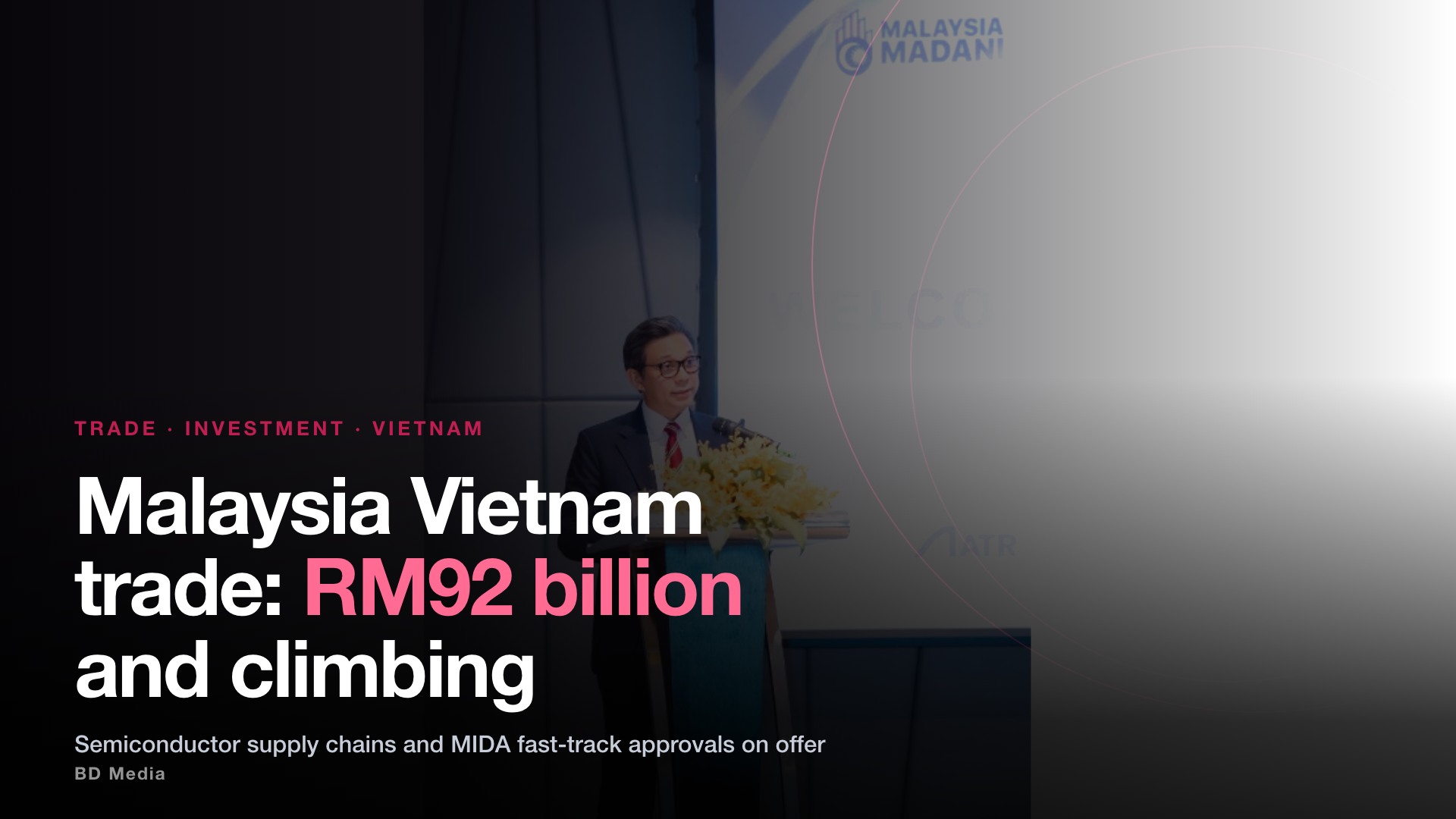
Malaysia Vietnam trade reached RM92 billion in 2025, and Malaysia is now courting Vietnamese manufacturers rather than waiting for them. Consul General of Malaysia in Ho Chi Minh City Firdauz Othman told the “CEO Forum – Doing Business With Malaysia” on 1 October 2026 that Malaysian supply chains, green manufacturing and fast-track approvals are open to Vietnamese investors. The forum was supported by MATRADE and the Malaysia Business Chamber in Vietnam.
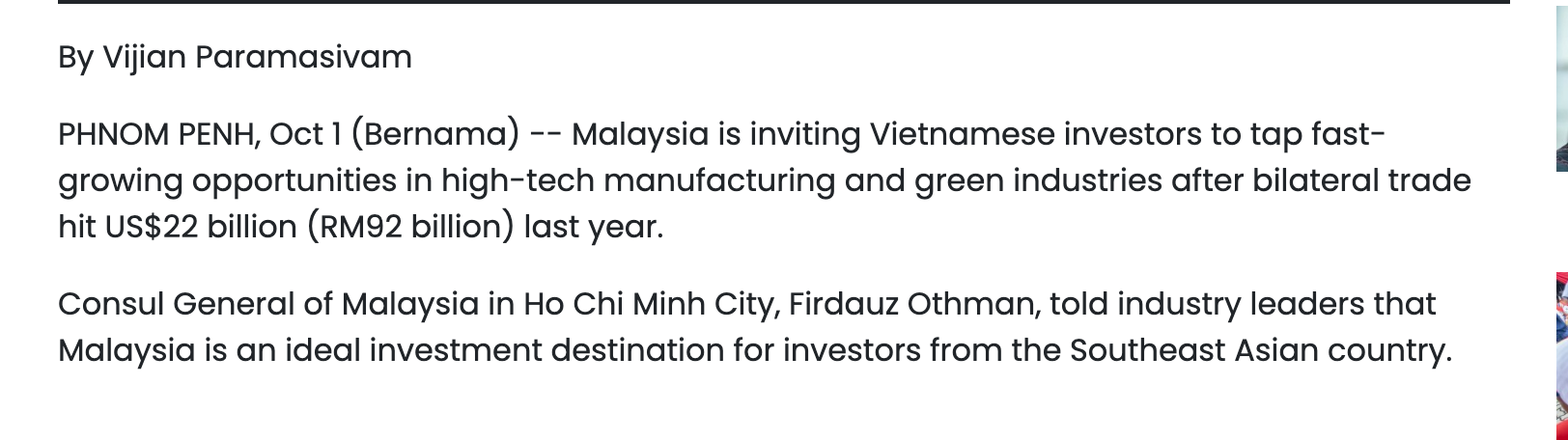
Bernama, Malaysia-Vietnam trade, 2 October 2026. Captured 3 October 2026 from https://www.bernama.com/en/world/news.php?id=2614167
The Malaysia Vietnam trade picture
Malaysian exports to Vietnam reached RM55.24 billion, led by electrical and electronic products, chemicals, petroleum products, and metal and machinery manufactures. Imports from Vietnam stood at RM36.89 billion. Malaysia is the second-largest ASEAN investor in Vietnam after Singapore, and the relationship was elevated to a Comprehensive Strategic Partnership in November 2024.
| Malaysia Vietnam trade, 2025 | Figure | Source |
|---|---|---|
| Total bilateral trade | RM92 billion | Bernama, 1 Oct 2026 |
| Malaysian exports to Vietnam | RM55.24 billion | Bernama, 1 Oct 2026 |
| Malaysian imports from Vietnam | RM36.89 billion | Bernama, 1 Oct 2026 |
| Leading export categories | E&E, chemicals, petroleum products, metal and machinery | Bernama, 1 Oct 2026 |
| Malaysia’s ASEAN investor rank in Vietnam | Second, after Singapore | Bernama, 1 Oct 2026 |
| Bilateral framework | Comprehensive Strategic Partnership, November 2024 | Bernama, 1 Oct 2026 |
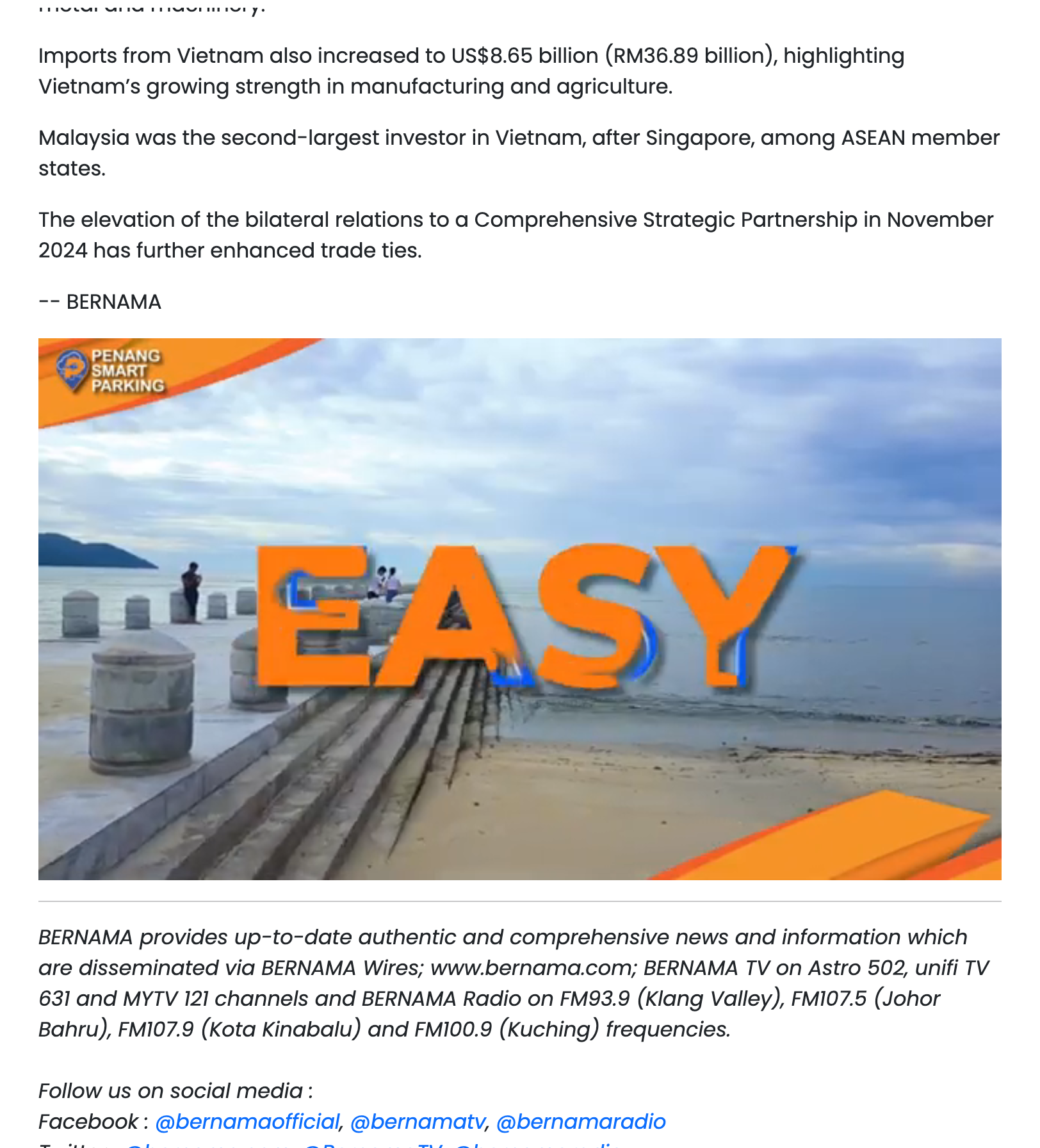
Bernama, Malaysia’s investor ranking in Vietnam, 2 October 2026. Captured 3 October 2026 from https://www.bernama.com/en/world/news.php?id=2614167
What each side brings
The pitch to Vietnamese firms leans on two instruments: integration into Malaysia’s semiconductor and electronics supply chains, and MIDA “Green Lane” fast-track approvals for large-scale projects that transfer technology and create high-skilled employment. Green manufacturing, solar components especially, is the second pillar, with incentives aligned to sustainability goals.
Firdauz also pointed Vietnamese investors toward the investment authority for tailored incentives, framing Malaysia as a gateway for firms working in solar components or green manufacturing. The forum drew industry leaders in Ho Chi Minh City, organised by the Consulate General of Malaysia with support from MATRADE and the Malaysia Business Chamber in Vietnam.
Why the trade is growing in both directions
The composition of the trade explains the relationship. Malaysia sells electronics, chemicals and petroleum products upstream; Vietnam sells manufactured goods and agricultural produce back. That is a complementary pattern rather than a competitive one, which is why bilateral value has grown without the friction seen in some other ASEAN pairs. Vietnam’s manufacturing build-out needs components and inputs, and Malaysian suppliers of those inputs sit at exactly the right point in the chain.
The investment relationship has a second dimension. Malaysian firms have been among the larger ASEAN investors in Vietnam for years, drawn by lower labour costs and a manufacturing-friendly investment regime. The pitch at the Ho Chi Minh City forum is partly an attempt to rebalance that flow – to attract Vietnamese capital back into Malaysian high-tech and green projects rather than accept a one-way relationship.
What to watch next
Watch whether the Green Lane approvals actually shorten timelines in practice, since fast-track promises are easy to make and harder to evidence. Also watch the semiconductor angle: Malaysia’s packaging and testing clusters need vendors, and Vietnamese precision-engineering firms entering as suppliers would deepen the relationship in a way trade statistics alone will not capture.
The Comprehensive Strategic Partnership as a practical instrument
Elevating a bilateral relationship to a Comprehensive Strategic Partnership in November 2024 sounds like diplomatic language, but it changes the working mechanics. It creates standing channels between ministries, makes joint committee meetings routine rather than exceptional, and gives business chambers a formal counterpart to escalate problems to. For a Malaysian exporter hitting a customs or standards obstacle in Vietnam, that structure provides a route that did not exist at the same level before.
It also sets the direction of travel. Partnerships of this kind typically come with sectoral workstreams, and the sectors named at the Ho Chi Minh City forum – semiconductors, electronics, precision engineering, green manufacturing – are the ones most likely to receive institutional attention. Businesses in those chains should read the elevation as advance notice of where facilitation will be concentrated.
Sources
- MATRADE – official website
- MIDA – Malaysian Investment Development Authority
- Bernama, “Malaysia Urges Vietnamese CEOs To Tap High-Tech, Green Manufacturing Boom”, 1 October 2026