
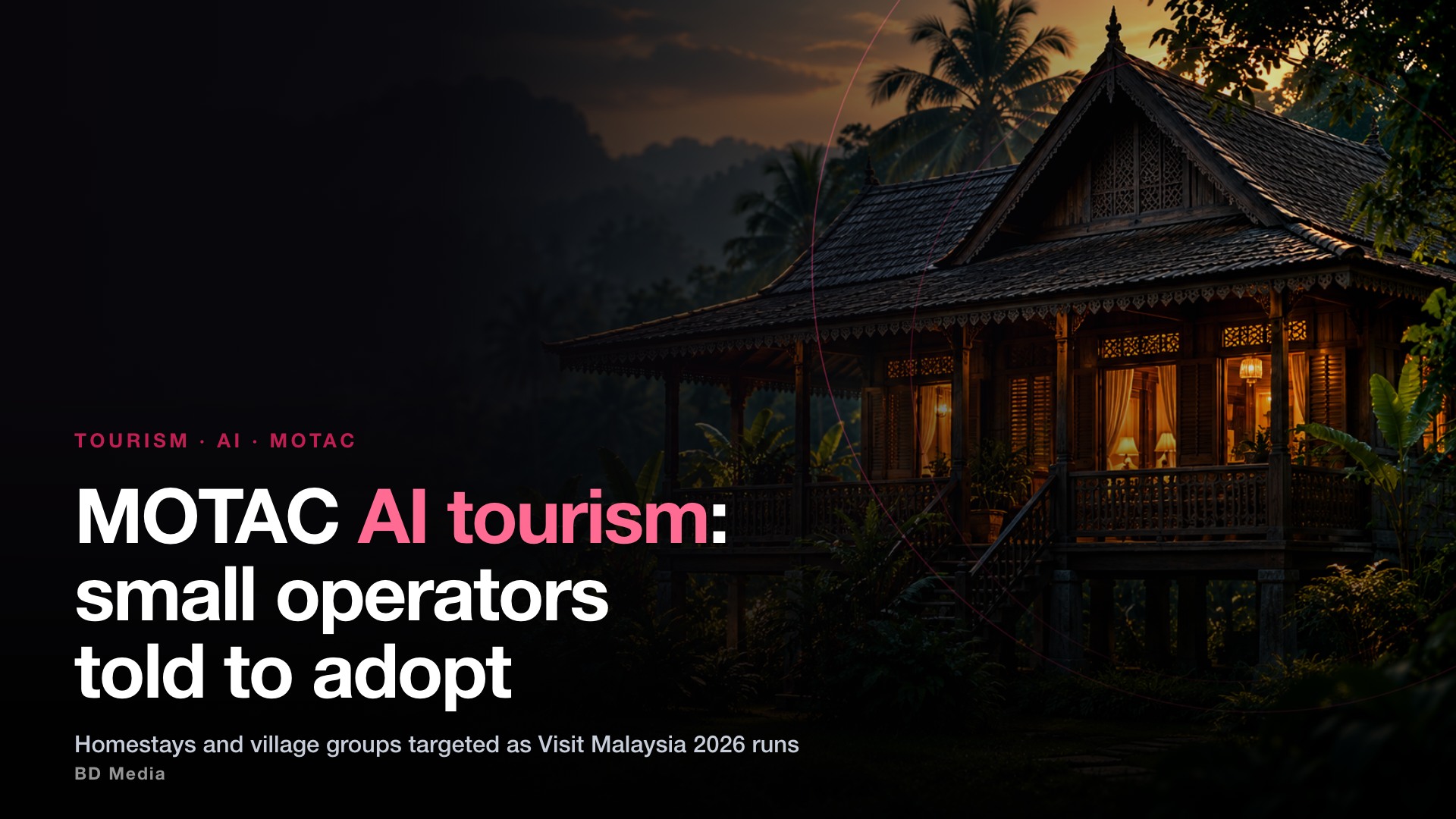
The MOTAC AI tourism call went out to the smallest operators in the country: homestays and village-level community tourism groups, not hotel chains. The Tourism, Arts and Culture Ministry framed this year’s World Tourism Day celebrations around “Digital Agenda and Artificial Intelligence to Redesign Tourism”, running 28 September to 2 October 2026 at its Putrajaya headquarters.

What the MOTAC AI tourism push actually says
The ministry wants grassroots operators – from homestay hosts to community-based tourism groups – to integrate digital tools into how they promote destinations, manage services and reach travellers. Its stated logic: AI and digital platforms help international and domestic visitors discover Malaysia’s attractions and plan trips more easily, reinforcing the country’s strengths in cultural diversity, heritage and natural landscapes. The framing sits inside the MADANI aspirations and the ongoing Visit Malaysia 2026-2027 campaign.
| World Tourism Day 2026 and the MOTAC AI push | Detail | Source |
|---|---|---|
| Theme | Digital Agenda and Artificial Intelligence to Redesign Tourism | MOTAC, via TIN Media, 1 Oct 2026 |
| Dates and venue | 28 September to 2 October 2026, MOTAC Putrajaya | MOTAC, via TIN Media |
| Target audience | Homestay operators and community-based tourism groups | MOTAC, via TIN Media |
| Alignment | Malaysia MADANI; Visit Malaysia 2026-2027 | MOTAC, via TIN Media |
| Funding and training detail | Not yet announced | MOTAC, via TIN Media |
The gap between message and mechanism
What MOTAC has announced is direction, not programme. Training, digital literacy schemes and AI-adoption incentives are signalled but not detailed: no funding lines, no implementing agency, no timeline. Industry stakeholders will be watching whether the ministry follows through with concrete support. As reported, the ministry has yet to detail specific funding or implementation mechanisms.
The emphasis on balancing AI adoption with heritage and environmental preservation also reflects a wider regional conversation, as ASEAN destinations weigh the efficiency gains of AI-driven tourism marketing against concerns about over-tourism and cultural commodification.
Why grassroots adoption is the hard part
Malaysian tourism is structurally unusual: a large share of its capacity sits in small, family-run operators – homestays, village cooperatives, single-property guesthouses – who have neither the staff nor the budget for technology projects. Large hotel groups have revenue management systems, channel managers and marketing teams. Between the two sits a gap that no amount of ministerial encouragement closes on its own, because the constraint is capability, not willingness.
That is also why the heritage caveat in MOTAC’s messaging is more than rhetoric. Community tourism sells authenticity, and heavy-handed digital marketing can erode the very thing visitors came for. The ministry’s instinct to pair adoption with preservation is sound, even if the mechanism for doing so is unclear.
What to watch next
Watch for three concrete signals: a named implementing agency, a funding line, and a training programme with dates. Directional announcements without those three are difficult for a homestay operator to act on. In the meantime, the Visit Malaysia 2026-2027 campaign continues, and the operators who build even basic digital capability before that demand arrives will capture the booking volume the campaign generates.
What the technology actually costs a small operator
It is worth being concrete about the barrier. A homestay with six rooms does not need a revenue management platform; it needs a way to answer enquiries in three languages without hiring staff, and a way to be found by visitors planning a trip abroad. Both are now achievable with off-the-shelf tools at a monthly cost comparable to a single night’s booking. The obstacle is not price, it is knowing which tool solves which problem and having the hours to set it up.
That is the gap a ministry programme could fill cheaply, and it is why the absence of detail matters. Directional announcements are abundant in tourism policy; a training programme with named dates, a funding line and an implementing agency is what changes adoption rates at the grassroots level where Malaysia’s tourism capacity actually sits.
Sources
- MOTAC – official portal
- Tourism Malaysia – official site, Visit Malaysia 2026-2027
- TIN Media, “MOTAC Urges Small Tourism Operators to Embrace AI as World Tourism Day 2026 Kicks Off”, 1 October 2026