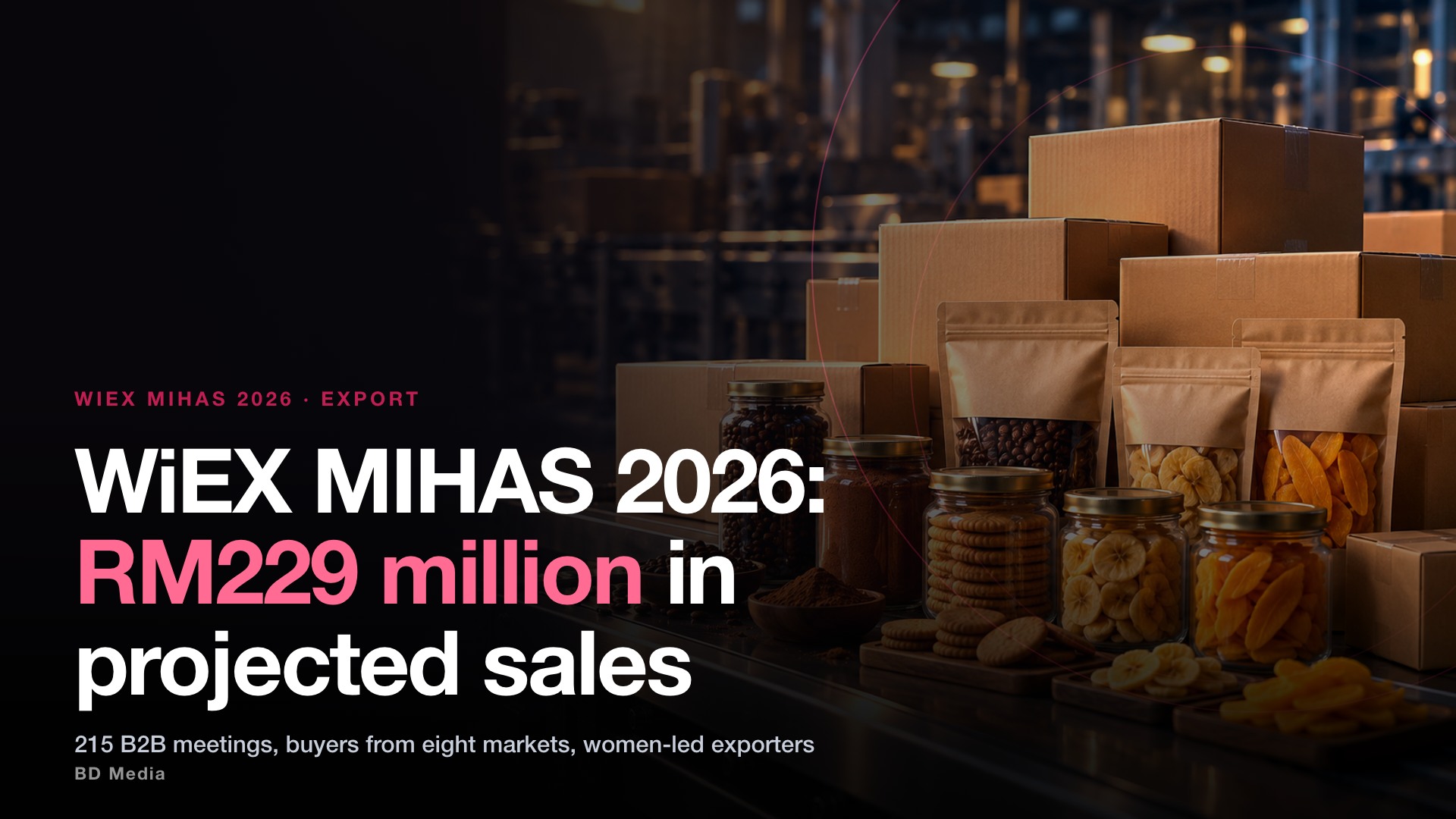
WiEX MIHAS 2026 produced RM229 million in projected export sales for women-led Malaysian enterprises, the result of 215 pre-arranged B2B meetings with international buyers, MATRADE announced on 1 October 2026. Buyers came from Egypt, Kazakhstan, Uzbekistan, China, Hong Kong, Thailand, Indonesia and Myanmar.

What WiEX MIHAS 2026 delivered
Women-owned companies from Selangor, Kedah, Kuala Lumpur, Perak and Penang topped the sales table with a combined RM129.84 million – confectionery, snacks, coffee, tea, cocoa and sportswear. The pavilion ran as part of MIHAS, the Malaysia International Halal Showcase, at MITEC from 23 to 26 September 2026.
| WiEX @ MIHAS 2026 | Figure | Source |
|---|---|---|
| Projected export sales | RM229 million | MATRADE, 1 Oct 2026 |
| Top five states and territories | RM129.84 million combined | MATRADE, 1 Oct 2026 |
| B2B meetings | 215 targeted | MATRADE, 1 Oct 2026 |
| Buyer markets | 8 (incl. China, Egypt, Kazakhstan, Uzbekistan) | MATRADE, 1 Oct 2026 |
| Products named | Confectionery, snacks, coffee, tea, cocoa, sportswear | MATRADE, 1 Oct 2026 |
| Event dates and venue | MIHAS 2026, 23-26 September, MITEC KL | MIHAS official site |
| Programme structure | MATRADE with HAWA Malaysia; KKDW, MARA, SME Corp, NCER, UBS, UDA | MATRADE, 1 Oct 2026 |

Why the pipeline matters more than the headline
Projected sales are a leading indicator, not booked revenue. The number to track is conversion over the next two quarters. What makes WiEX structurally interesting is the sequencing: capacity-building domestically, then placement into international market matching through MIHAS, the region’s largest halal exhibition. For women-owned food and consumer-goods exporters, the combination of halal certification pathways and B2B matching is the actual product here.
The inter-agency structure is deliberate. MATRADE led with HAWA Malaysia, drawing in the Ministry of Rural and Regional Development, MARA, SME Corp, the Northern Corridor Economic Region, Wanita Berdaya Selangor and UDA Holdings. That is a whole-of-government pipeline from domestic capability to international placement, rather than a standalone trade show.
Why halal certification is the actual product
Read past the RM229 million and the structure of this programme becomes the interesting part. Women-owned Malaysian food businesses do not struggle primarily with product quality; they struggle with the certification, documentation and buyer-readiness that international distributors require. Halal certification in particular is not a label but a supply-chain audit, covering ingredients, premises, logistics and traceability. A pavilion inside MIHAS gives a small exporter access to buyers who have already decided that halal compliance is a prerequisite – which removes the hardest part of the sales conversation before it starts.
That is why the inter-agency structure is not administrative padding. MARA and SME Corp fund capability-building, the Northern Corridor and Selangor agencies organise state-level cohorts, and MATRADE places the finished businesses in front of buyers. The pavilion is the last step in a pipeline that starts long before the exhibition opens.
What to watch next
Watch conversion, not the headline. Projected sales become revenue only if deposits and shipping follow, and no follow-up data exists yet. Also watch whether the state-level concentration repeats – if Selangor, Kedah, Kuala Lumpur, Perak and Penang dominate again next year, the pipeline is working where the agencies are strongest, and operators elsewhere need a different route in.
The women-export gap this programme targets
Women-owned enterprises are a larger share of Malaysia’s SME base than they are of its exporters. The gap is not product quality or ambition; it is the working capital, trade-finance access and documentation capability that exporting demands. A domestic business can sell on a handshake and an invoice. An export order arrives with a letter of credit, a bill of lading and a certification dossier. Each of those is a barrier that a small operator meets for the first time on their first export attempt.
The agencies wrapped into WiEX address those barriers directly: MARA and SME Corp run capability programmes, the state development arms organise cohorts, and MATRADE manages the buyer relationships. The RM229 million projection is the output of that pipeline, not the pipeline itself, which is why retention rates across editions will matter more than any single year’s figure.
Sources
- MATRADE – official website
- MIHAS – official event site, dates and venue
- Media OutReach Newswire via CNA, WiEX @ MIHAS 2026 results, 1 October 2026