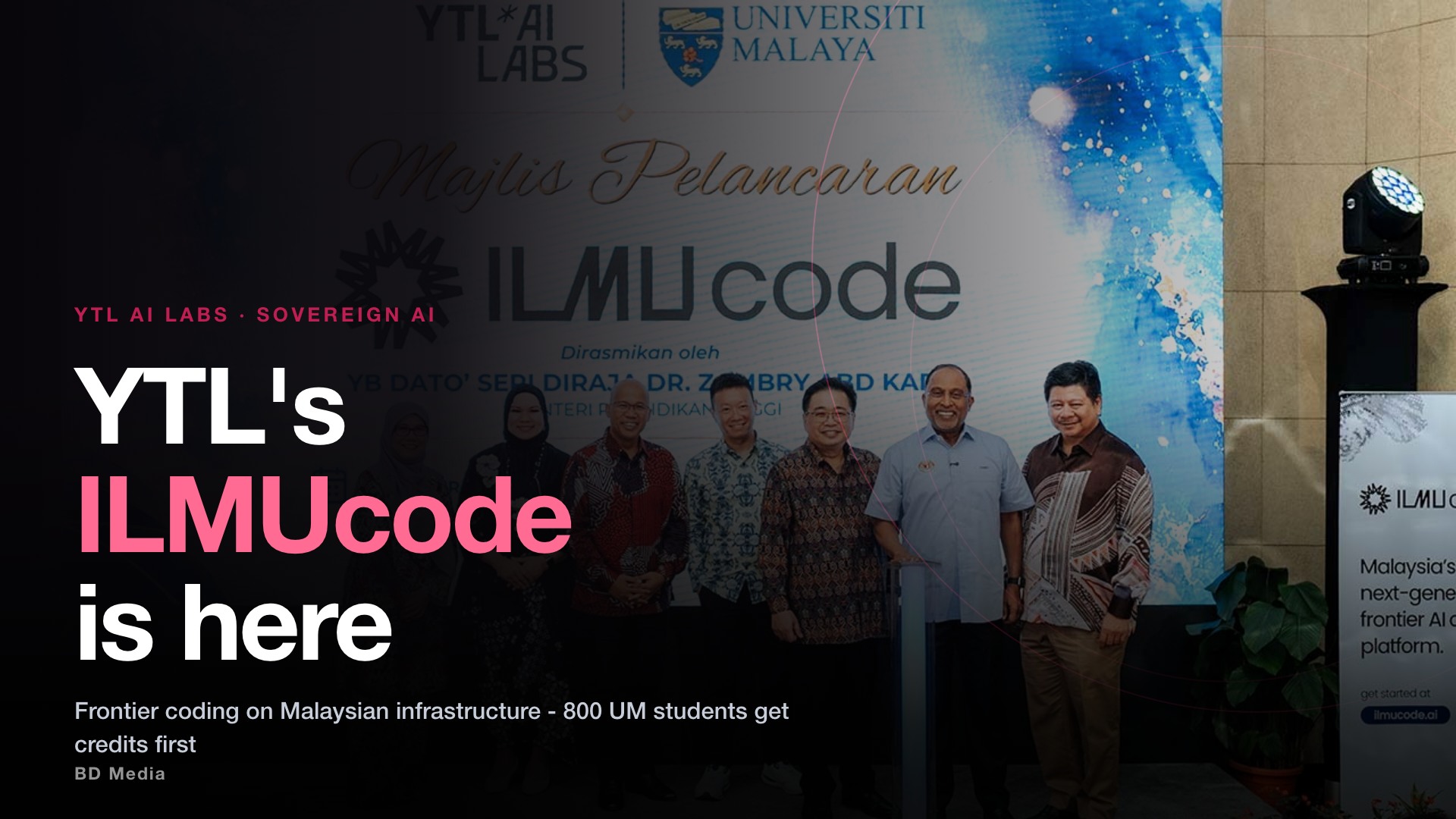
ILMUcode launched on 1 October 2026 at Universiti Malaya, an agentic AI coding assistant built on ILMU-GLM-5.3, the newest model in YTL AI Labs’ ILMU family, developed in partnership with Z.ai. YTL is selling it as frontier-level coding capability on Malaysian sovereign infrastructure at a fraction of the cost of the foreign platforms developers currently rent. The launch was officiated by Higher Education Minister Datuk Seri Dr Zambry Abd Kadir.

What ILMUcode actually is
It is two things in one package: an agentic coding assistant, and the ILMU-GLM-5.3 model underneath it. The assistant works across a whole codebase – understanding existing code, writing and modifying it, troubleshooting, and carrying an idea through to working software. YTL AI Labs says it ranks among the world’s leading coding models on benchmarks including Terminal-Bench 2.1 and DeepSWE.
Agentic here means the platform takes a goal and plans, executes and iterates across a project: build a feature, migrate an API, add authentication. It extends with skills (code review, frontend design, debugging, git workflow), runs scheduled automations such as a daily risk scan or documentation sync, and executes parallel tasks. It connects to a terminal, Git, running applications and browser previews. It also accepts Bahasa Malaysia prompts – YTL’s own examples include “Tolong fix bug ni, submit form asyik error” and “Bina laman web untuk perniagaan kuih keluarga saya”.
| ILMUcode launch | Detail | Source |
|---|---|---|
| Launch date and venue | 1 October 2026, Universiti Malaya | EdgeProp.my, 2 Oct 2026 |
| Officiated by | Higher Education Minister Datuk Seri Dr Zambry Abd Kadir | Bernama, 2 Oct 2026 |
| Model underneath | ILMU-GLM-5.3, built with Z.ai | Bernama, 2 Oct 2026 |
| Benchmarks cited | Terminal-Bench 2.1 and DeepSWE | Bernama, 2 Oct 2026 |
| UM rollout | 800 first-year computer science students | EdgeProp.my, 2 Oct 2026 |
| Credits per student | RM100 monthly for 3 months (up to RM300) | EdgeProp.my; Astro Awani, 2 Oct 2026 |
| Access | ilmucode.ai; sign-up via console.ilmu.ai with free credit | ilmucode.ai, 3 Oct 2026 |

The ILMU family this joins
ILMUcode extends a portfolio, not a single model. The family pairs locally built capability with two global partners – Z.ai for the GLM coding line and NVIDIA for the Nemotron-based agentic line – while keeping inference on Malaysian infrastructure. We covered the original model when YTL released Malaysia’s first multimodal AI model in 2025.
Three products sit on the model layer. ILMUcode is the new coding assistant. ILMUclaw, launched earlier in 2026, lets users build autonomous AI agents on the NVIDIA-partnered ILMU-Nemo models. ILMUchat is the consumer conversational app on the Apple App Store and Google Play. Underneath, the flagship multimodal model tops the MalayMMLU benchmark for Bahasa Melayu, and the family includes speech recognition, text-to-speech and embedding models. In September, YTL and NVIDIA also released Nemotron-Personas-Malaysia, an open dataset of 1.35 million synthetic personas tuned to Malaysian demographics.
Z.ai co-founder and chief scientist Prof Jie Tang framed the partnership plainly: “Our mission is to make frontier AI accessible to builders around the world. Through our partnership with YTL AI Labs on ILMUcode, we are putting that mission into action with Malaysia’s next generation.”
What it means for Malaysian SMEs
The pitch that matters to a cost-conscious Malaysian developer or SME is sovereign infrastructure, local-language capability and price. YTL AI Labs has not published a public price list in the launch materials, only “a fraction of the cost” – so evaluate against your current bill before committing. For SMEs priced out of USD-billed frontier coding tools, the free-credit on-ramp lowers the experiment cost to roughly zero. The honest caveat: the benchmark claims are the vendor’s, and independent head-to-head testing on your own codebase is the only evaluation that counts.
Sovereign AI is a procurement argument, not a slogan
The word “sovereign” does the heavy lifting in YTL’s pitch, and it is worth unpacking. For a Malaysian bank, hospital group or government agency handling sensitive data, sending source code and business logic to a foreign model provider raises questions that procurement teams now ask routinely: where does the data go, under whose jurisdiction does it sit, and who can be compelled to disclose it. YTL’s answer is that inference runs on Malaysian infrastructure under a Malaysian entity. That is the same argument Malaysian cloud and data-centre providers have been making to enterprise buyers for three years, applied to AI.
The second half of the pitch is cost. Malaysian developers have been paying in US dollars for frontier coding assistants, which means every ringgit of currency movement changes their tooling budget. A ringgit-denominated option removes that exposure. YTL has not published rates, so the claim remains unverified – but it is a coherent commercial argument, not marketing noise.
What to watch next
Three things will determine whether ILMUcode matters beyond the campus. First, independent benchmark replication – Terminal-Bench 2.1 and DeepSWE scores are the vendor’s, and a coding assistant’s real test is a messy, undocumented legacy codebase. Second, first-party pricing once the free-credit period ends, because that is when the “fraction of the cost” claim gets tested. Third, the pipeline: 800 first-year students is a talent play, but the commercial question is whether Malaysian software houses adopt it on client work.
Sources
- ILMUcode – official product page, accessed 3 October 2026
- Bernama, “YTL AI Labs Launches ILMUcode, Malaysia’s Frontier AI Coding Platform”, 2 October 2026
- EdgeProp.my, “YTL AI Labs launches ILMUcode, offers coding credits to 800 UM students”, 2 October 2026
- Astro Awani, “800 pelajar Universiti Malaya terima akses ILMUcode YTL AI Labs”, 2 October 2026