
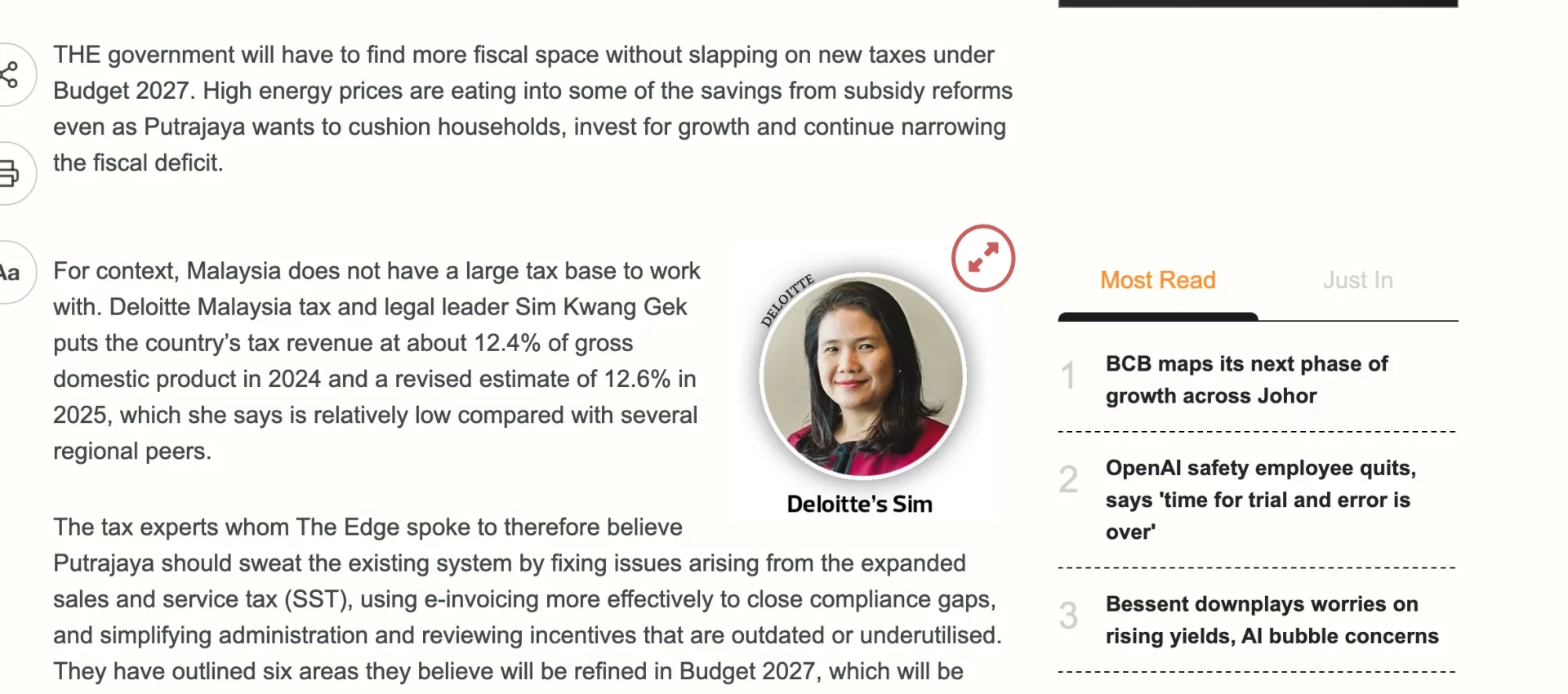
Malaysia does not tax much, and it knows it. The country’s tax revenue sits at roughly 12.6 per cent of gross domestic product, low against regional peers, and the government has ruled out a new tax to close the gap. That leaves one obvious lever for Budget 2027: make the sales and services tax work better than it currently does.
Budget 2027 will be tabled in Parliament on 9 October 2026. Ahead of it, Malaysia’s largest tax practices have set out what they think should change — and unusually, they agree on the diagnosis even where they differ on the remedy.
What the tax experts actually asked for
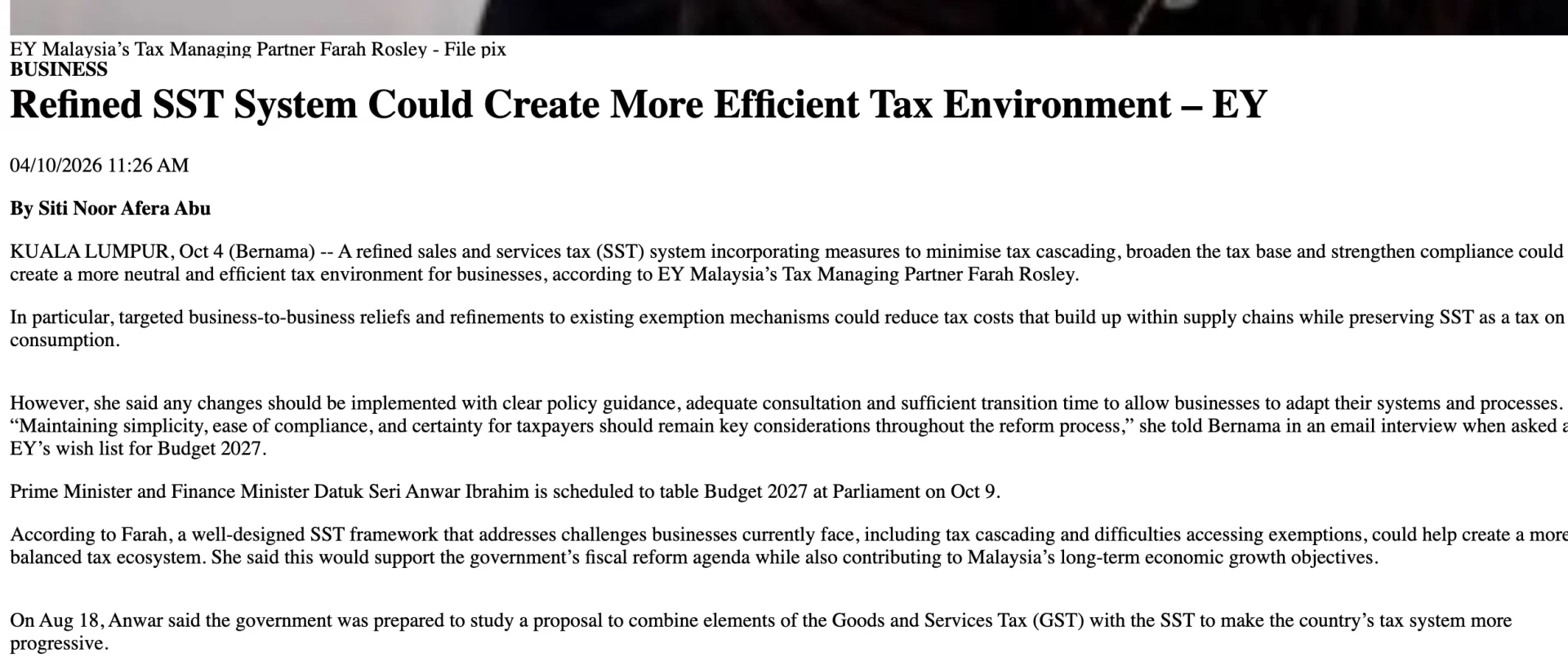
EY Malaysia’s tax managing partner Farah Rosley put the case for refinement rather than expansion. A sales and services tax that minimises tax cascading, broadens the base and strengthens compliance, she told Bernama, “could help create a more neutral and efficient tax environment for businesses” — with targeted business-to-business reliefs and refinements to existing exemption mechanisms doing the work.
Her caveat matters as much as the proposal. Any change, she said, needs clear policy guidance, adequate consultation and sufficient transition time for businesses to adapt their systems. “Maintaining simplicity, ease of compliance, and certainty for taxpayers should remain key considerations throughout the reform process.”
KPMG’s head of tax, Soh Lian Seng, framed the same point from the business side: after several years of change to the tax regime, “businesses are looking for greater certainty, consistency and simplicity rather than additional tax measures”. The government, he argued, should collect existing taxes more effectively and make compliance less cumbersome rather than adding to the load.
Tax cascading is the practical problem
The clearest operational complaint is cascading — where a business pays service tax on an input it cannot recover, so the tax becomes part of its cost base before the next taxable transaction in the chain. It shows up hardest in sectors with several layers of providers: leasing, construction, professional services, financial services and logistics.
The proposed remedies are narrower than another broad expansion of the tax. Broadening business-to-business exemptions for genuine business inputs — leasing on a taxable construction project, logistics and warehousing used to deliver taxable goods, professional or IT services acquired as inputs to an onward taxable service. Introducing clear apportionment rules where an input supports both taxable and non-taxable activity, so a business can apportion rather than be denied relief outright.
Grant Thornton’s Chow Chee Yen set out why the obvious fix is not the easy one. The goods and services tax provided for input tax credits; the sales and services tax relies on exemption facilities instead. Fully adopting an input tax credit mechanism while keeping the existing exemptions, he said, “would represent a significant change” — one that poses challenges not only to businesses and the public but to the tax authorities themselves. His more practical route is to fine-tune the exemptions, either by broadening the scope of exempted services or by making existing exemptions less restrictive.
The allowance nobody has been able to claim since 2021
One concrete anomaly surfaced in the same review. The investment allowance for approved service projects under Schedule 7B of the Income Tax Act 1967 remains in force, but new applications have not been accepted since 7 January 2021. Deloitte Malaysia’s Sim Kwang Gek said Budget 2027 should settle what happens to it — whether it is revived, redesigned as part of the services sector phase of the New Investment Incentive Framework, or formally closed.
That is the shape of a useful budget for business: not a new tax, but a clear answer to a five-year-old question.
PwC Malaysia’s tax leader Steve Chia pointed at a lever the government already owns. Transaction-level e-invoicing data, he suggested, could be used more aggressively to detect leakages, verify taxable supplies and improve compliance — an argument that treats the e-invoicing rollout as a compliance instrument rather than purely an administrative one.
Why the government has little room to spend
The context is tighter than a growing economy suggests. The war in West Asia has pushed energy prices up and turned fuel subsidies — which the government spent years trying to rationalise — back into a fiscal burden. The Ministry of Finance now estimates the fuel subsidy bill could reach RM40 billion this year, approaching the RM49 billion originally allocated under Budget 2026 for all subsidies and social assistance, even after earlier subsidy reform generated annual savings of about RM15.5 billion.
Federal government debt stood at RM1.3 trillion, or 64.7 per cent of GDP, as at June 2025, against 52.5 per cent in 2019. The fiscal deficit has come down from 6.4 per cent of GDP in 2021 to 3.7 per cent in 2025. Under the Public Finance and Fiscal Responsibility Act 2023, the government is targeting a deficit of no more than 3 per cent of GDP and debt no more than 60 per cent of GDP by 2028.
The tension in one line. The deficit path points down; the external shock points up. RAM Rating Services economist Nadia Mazlan’s reading is that meeting the 3 per cent target strengthens policy credibility, but that slower progress caused by an external shock need not carry the same consequence as a structural deterioration — provided the spending increase is temporary and there is a credible adjustment plan behind it.
On 18 August 2026, Prime Minister and Finance Minister Datuk Seri Anwar Ibrahim said the government was prepared to study combining elements of the goods and services tax with the sales and services tax to make the system more progressive, while retaining the sales and services tax as the national system. That framing — borrow features, keep the system — is consistent with what the tax practices are asking for.
What to watch on 9 October
| Watch for | Why it matters to a business |
|---|---|
| Any movement on Schedule 7B | A service-sector investment allowance that has been unclaimable since January 2021 would either reopen or be formally closed |
| B2B exemption scope | Decides whether cascading gets fixed where it actually bites — leasing, construction, logistics, professional services |
| Apportionment rules | Businesses with mixed taxable and non-taxable activity currently face an all-or-nothing position |
| Transition windows | EY’s point: a change with no adaptation time is a compliance cost, not a reform |
For SMEs specifically, the sharper question is whether any of this reaches them at all. Malaysia’s smallest businesses were already asking for outcomes rather than allocations — and on the minimum wage, the Cabinet has exempted micro, small and medium enterprises from the new rate for now while the new rate itself remains unannounced.
Budget 2027 is tabled on 9 October. The tax practices have told the government what they would change. Whether any of it lands is now a five-day question.
Sources
- Bernama, “Refined SST System Could Create More Efficient Tax Environment – EY”, 4 October 2026.
- The Edge Malaysia Weekly, cover story, “Experts expect Putrajaya to sweat existing tax system”, 28 September – 4 October 2026.
- The Edge Malaysia, “Budget 2027: Narrowing room to manoeuvre”, 28 September – 4 October 2026.
- Bernama, “Budget 2027: Labuan SME Association Seeks Tax Relief For Local Businesses”, 2 October 2026.