
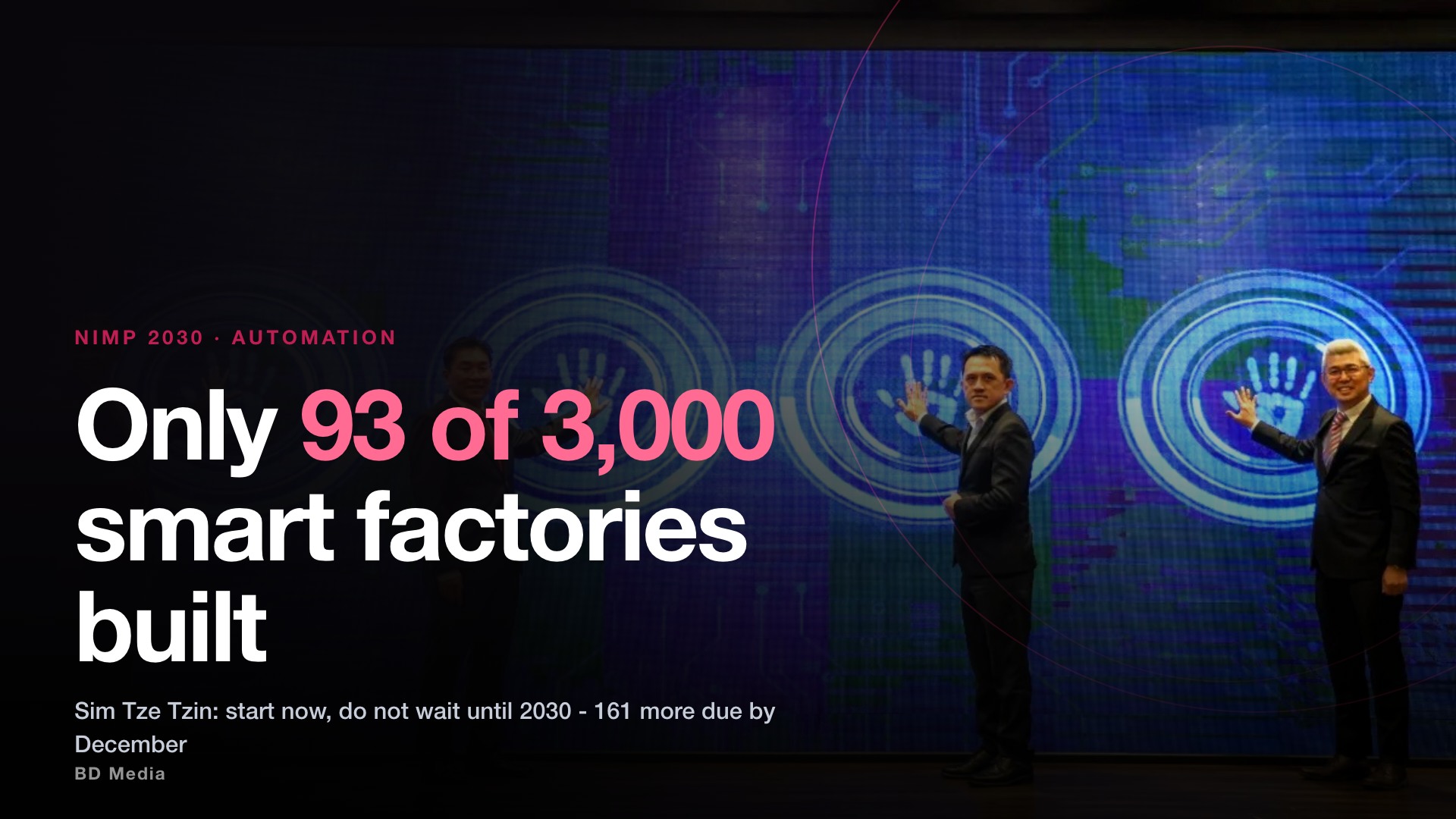
Deputy Investment, Trade and Industry Minister Sim Tze Tzin put both numbers in the same sentence in George Town on 2 October 2026, and smart factory Malaysia progress is the story of the gap between them: 93 manufacturers have been recognised as transformed, against a national target of 3,000 by 2030. He was speaking after launching the Malaysia Smart Manufacturing Awards (MSMA) 2027, the third edition of an awards programme co-organised by Bizsphere, MIDF and Smart4wrd and endorsed by MITI.
The 3,000 figure is not a slogan. It is Mission-Based Project 2.1 of the New Industrial Master Plan 2030 (NIMP 2030), MITI’s manufacturing blueprint launched in September 2023. Sim’s own assessment of where it stands: “Under our New Industrial Master Plan 2030, we want to achieve 3,000 smart factories, but unfortunately, our take-up rate is still very low.”

Source: Ministry of Investment, Trade and Industry (MITI) official portal, NIMP 2030 mission-based projects page, captured 3 October 2026 from https://www.miti.gov.my/index.php/pages/view/2704
What the smart factory Malaysia numbers show
The arithmetic is unforgiving. Even if all 161 manufacturers now in the pipeline convert by December 2026, taking the recognised total to 254, that is under 9% of the 2030 target with just over four years to run. The remaining 2,746 would need to land at roughly 640 a year, every year.
| Malaysia’s smart factory programme | Figure | Source |
|---|---|---|
| Target under NIMP 2030 | 3,000 smart factories by 2030 (Mission-Based Project 2.1) | Bernama, 2 Oct 2026 |
| Completed so far | 93 manufacturers recognised | Bernama, 2 Oct 2026 |
| In the pipeline | 161 more expected by December 2026 (total 254) | Bernama, 2 Oct 2026 |
| Awards programme | MSMA 2027, third edition, endorsed by MITI | The Sun, 2 Oct 2026 |
| Sectors named | Semiconductors, machining, furniture, automotive | Bernama, 2 Oct 2026 |
| Foreign worker quota | Cut from about 20% to 15%; 13% of the workforce now; 10% targeted by 2030 | Bernama, 2 Oct 2026 |

Source: The Edge Malaysia, report of the MSMA 2027 launch, 2 October 2026, captured 3 October 2026 from https://theedgemalaysia.com/node/820330
Why manufacturers are not moving
Sim tied the slow take-up to labour economics rather than technology. Cheap foreign labour removes the incentive, he argued, and the government is deliberately tightening the tap. “Industries will not automate when it is easy to get foreign labour. They do not push their capabilities higher or move their manufacturing process to a higher level. So we remain as a middle-income level nation.”
His closing instruction was the shortest sentence of the day: “Start doing it now. Do not wait until 2030.” He framed the stakes beyond any single factory, noting Malaysia has sat in the middle-income bracket for more than 30 years and that government analysis found Malaysia, South Korea and Singapore on similar productivity trajectories through the 1970s and 1980s before the other two pulled ahead in the 1990s.
What automation support actually exists
The ministry’s assistance architecture is layered rather than a single grant. MIDF provides financing instruments for capital equipment, SIRIM handles the technical assessment and certification pathway that a factory needs before it can call itself “smart”, and MITI coordinates the programme under NIMP 2030. The practical sequence for a manufacturer is assessment first, then financing, then implementation – which is why the awards programme matters more than it looks. Recognition is the only public signal that a factory has completed the sequence.
Sectorally, the sectors named at the launch reveal where the pressure is sharpest. Semiconductors and machining face global customers who increasingly demand digital traceability; furniture and automotive face labour-intensive assembly lines where a 10% workforce quota is an existential cost issue rather than an efficiency project. That explains why the minister’s framing was about survival rather than competitiveness.
What to watch next
Three signals will show whether the 2030 target is recoverable. First, whether the 161 pipeline factories actually convert by December 2026 – that figure is a commitment, not a projection. Second, whether Budget 2027 on 9 October carries automation grants conditioned on outcomes, as the SME Association of Malaysia has demanded. Third, whether the foreign worker quota reduction continues on schedule toward 10% by 2030, because that is the forcing function the minister is relying on.
Sources
- MITI – NIMP 2030 mission-based projects page
- Bernama, “Malaysian manufacturers told to speed up adoption of automation”, 2 October 2026
- The Edge Malaysia, MSMA 2027 launch report, 2 October 2026
- The Sun, MSMA 2027 launch report, 2 October 2026