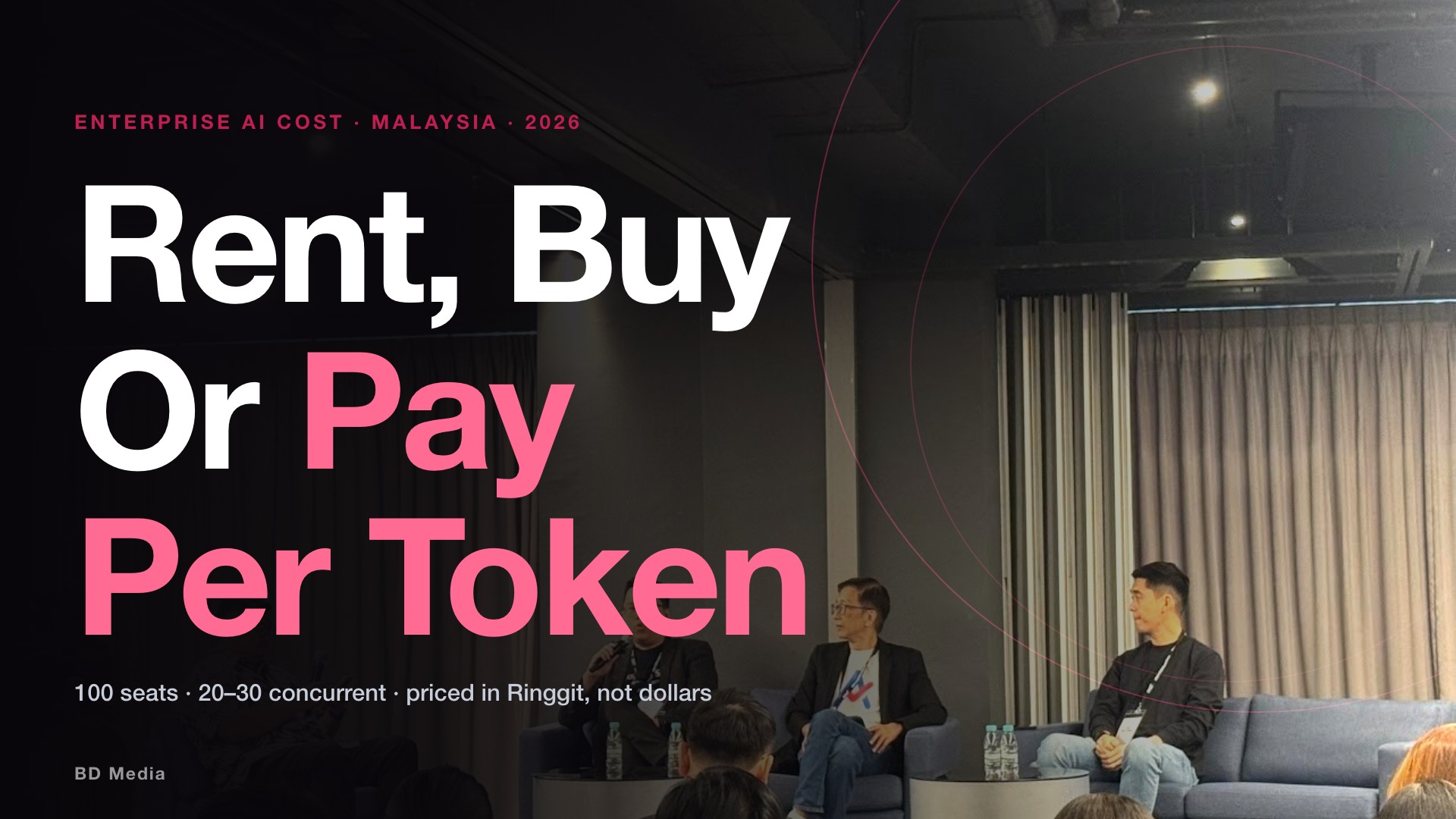
A Malaysian enterprise planning enterprise AI cost in Malaysia for a hundred people is usually handed three quotes and no way to compare them. One vendor sells seats. One sells a rented GPU by the month. One sells a server you own. Nobody puts the three next to a common measure, so the decision gets made on instinct, and instinct is expensive here.
What makes this decision genuinely hard is that the answer depends on something most cost guides never measure: how many tokens your people actually burn. Not how many seats you buy. Not which model you pick. Tokens. The published benchmarks below, from Chinese enterprise deployments to Uber’s own budget crisis, span a range of more than 400 to 1 between the lightest and heaviest user. That range is the whole story.
Last updated: 12 October 2026. Currency basis: one US dollar is RM4.09 and one Chinese yuan is RM0.61, spot 12 October 2026, corroborated by the indicative rate Big Domain publishes on its gateway page (RM4.08 to the dollar, 19 September 2026). Every figure is converted to Ringgit; no price in this article is printed in a foreign currency. Token consumption benchmarks are from published deployment data, not vendor marketing.
Enterprise AI cost in Malaysia: three usage tiers that decide everything
Before any Ringgit figure, we need to agree on what a hundred people actually consume. We model three tiers, calibrated against live enterprise deployment on DeepSeek V4.1-Flash in Malaysia and cross-checked against published benchmarks from FinOps LLM, Sina Finance and onprem.ai. There is no light tier, because in practice no enterprise deploys AI and keeps it light for long.
| Tier | RM / user / day | Implied tokens / user / day | What it looks like |
|---|---|---|---|
| Average | RM5 – 30 | 2.9M – 17.5M | Daily office agent tasks, document drafting, summarisation, search. DeepSeek Flash territory. |
| High | RM30 – 50 | 17.5M – 29.2M | Sustained agentic workflows on real documents. Contract review, research, multi-step analysis. |
| Extremely high | RM50 – 300 | 29M – 175M | Complex multi-model usage. GLM-5.3 / Kimi K3 for deep reasoning, coding, multi-agent orchestration. |
Assumptions: 100 seats, 22 working days per month, 67% input / 33% output (agentic ratio), 90% cache hit rate on input. Token volumes are derived from the RM/day figures using the blended rate for each model. Disclaimer: actual token consumption varies by role, seniority, workload complexity and how aggressively the organisation adopts AI. The tiers above are calibrated from live deployment data confirmed by Dr Henry Tye, not vendor benchmarks. Measure your own usage before committing a budget.
The single biggest error in most enterprise AI cost guides is the output-to-input ratio. A chat workload is 95 per cent input and 5 per cent output, which makes the blended rate RM0.38 per million tokens. A real agentic workload is closer to 67 per cent input and 33 per cent output, which makes the blended rate RM1.71 per million tokens on DeepSeek Flash — 4.5 times higher. The output tokens are where the cost lives, because DeepSeek bills output at RM4.90 per million against input at RM1.23. Get this ratio wrong and every downstream number is wrong by 4 to 5 times.
The gap between Average and Extremely high is 60 to 1 in Ringgit terms. An agentic task consumes 5 to 30 times more API tokens than the same question asked as a chat message, because every step re-sends the full conversation history plus tool definitions. And a hundred seats will contain a mix of all three tiers, which means the company-wide bill is driven by the heavy tail, not the average.
Route one: pay per token
The table below prices the same workload across all four profiles on DeepSeek V4.1-Flash, the cheapest frontier-class rate card available. It is shown at peak pricing because the Malaysian working day falls inside DeepSeek’s peak window (09:00–12:00 and 14:00–18:00 Malaysian time).
| Tier | RM / user / day | Company RM / month | DeepSeek Flash tok/user/day | GLM-5.3 tok/user/day |
|---|---|---|---|---|
| Average | RM5 – 30 | 11,000 – 66,000 | 2.9M – 17.5M | 0.7M – 4.3M |
| High | RM30 – 50 | 66,000 – 110,000 | 17.5M – 29.2M | 4.3M – 7.2M |
| Extremely high | RM50 – 300 | 110,000 – 660,000 | 29M – 175M | 7.2M – 43M |
The company RM/month is the same regardless of which model you use, because the tier is defined by your Ringgit budget. The token volume changes: a Ringgit buys 4 times more tokens on DeepSeek Flash than on GLM-5.3, and 12 times more than on Kimi K3. Choose the model that matches the task, not the one that looks cheapest per token.
Route two: rent a GPU
| Rental | RM / month | Basis |
|---|---|---|
| H100, long-tail reserved 3-year | 4,622 | Cheapest credible route, needs a 3-year commitment |
| RTX PRO 6000 Blackwell 96GB, Malaysian host | 8,616 | One dedicated card, 176GB RAM, 16 vCPU, Ringgit billing |
| H200, long-tail on-demand | 7,455 | 141GB, the long-context card |
| H200, hyperscaler on-demand | 17,892 | The same card at hyperscaler pricing |
Route three: buy the hardware
| Owned option | One-off capex | All-in RM / month |
|---|---|---|
| One 96GB Blackwell card, lean start | 60,867 | 5,831 |
| 8-GPU H200 node, a real AI farm | 1,511,450 | 35,341 |
Sizing: what 20 to 30 concurrent users actually need
Before the cost comparison, let us work out what serves the stated requirement. A 70-billion-parameter model at 4-bit weighs roughly 35 GB. At 8-bit it weighs 70 GB. The KV cache that holds each user’s conversation context is the cost nobody plans for.
| Model | Precision | Weights | KV for 25 x 8K | Total | Fits on |
|---|---|---|---|---|---|
| Llama 3.3 70B | FP8 | 80 GB | 41 GB | 121 GB | H200 141GB only |
| Llama 3.3 70B / Qwen2.5-72B | INT4 | 40 GB | 41 GB | 87 GB | H200 141GB, 96GB Blackwell |
| Qwen3-32B | INT4 | 18 GB | 41 GB | 62 GB | 96GB Blackwell, H100, H200 |
| 49B-class MoE | FP4 | 28 GB | 41 GB | 72 GB | 96GB Blackwell, H200, H200 |
KV cache computed as 30 sessions x 8,000 tokens x 0.175 MB per token at FP8 = 41 GB. An 80GB H100 running 70B at FP8 has zero GB left for cache, which means it cannot serve 70B at all at this concurrency. Even at 4-bit, 80GB is tight: 46 GB of weights plus 41 GB of cache equals 87 GB, which does not fit. The H100 serves 32B or 49B-class at this concurrency, not 70B.
The vendor’s claim that 96GB runs 70B-class at FP8 is worth correcting. It does not. At FP8 the weights alone eat 70 of the 96 GB, leaving no meaningful cache. It runs 70B-class at 4-bit, which is a different model quality and a different deployment decision.
| Hardware | Aggregate tok/s | Per user at 25 concurrent | Source |
|---|---|---|---|
| 1x 96GB Blackwell (70B INT4) | ~600 | 24 | Published guide |
| 1x H100 80GB (70B FP8) | 1,496 | 60 | SemiAnalysis, measured |
| 1x H100 80GB (49B FP4) | 3,000+ | 120+ | Vendor claim |
| 8x H100 80GB SXM | 3,500 | 140 | Published guide |
| 8x H200 141GB SXM | 5,500 | 220 | Published guide |
The comparison that decides it
Now put the three routes side by side at each tier. This is the table that changes the answer depending on who your people are. The self-hosted GPU costs reflect the actual models your workload demands — a 552B MoE cannot run on the same hardware as a 70B dense model.
| Tier | API RM/mo (range) | Self-host GPU (RM/mo) | GPUs needed | Cheapest | GPU advantage |
|---|---|---|---|---|---|
| Average | 11,000 – 66,000 | 14,910 | 2× H200 | API at low end, GPU at high end | 1.3–4.4x GPU |
| High | 66,000 – 110,000 | 14,910 | 2× H200 | GPU | 4.4–7.4x GPU |
| Extremely high | 110,000 – 660,000 | 29,820–52,185 | 4–7× H200 | GPU | 3.7–22.1x GPU |
Self-host GPU costs vary by model: DeepSeek Flash INT4 on 2× H200 = RM14,910/mo. GLM-5.3 INT4 on 4× H200 = RM29,820/mo. Kimi K3 Q2 on 7× H200 = RM52,185/mo (degraded quality). All require 141GB H200 cards — a single 96GB Blackwell cannot run any of these models at 30 concurrent users.
Break-even: at approximately 2.3 million API tokens per user per working day on DeepSeek Flash, the rented GPU becomes cheaper than paying per token. Below that, the API wins. Above it, the GPU wins decisively. Most enterprises running agent-based AI reach this level within weeks of deployment.
The break-even is the line that matters, and it is lower than almost every cost guide suggests. At roughly 2.3 million tokens per user per working day, a hundred-seat company crosses from the API being cheaper to a rented card being cheaper. That is the equivalent of ten to fifteen agentic loops per person per day on real documents. If your organisation matches Henry’s observed RM10–20 per user per day, you are already at or past this line.
Where WorkBuddy fits, and how it differs from other agents
The cost model above prices tokens and silicon. It does not price what your staff actually do with them, and that is where the three product categories diverge.
Chat assistants answer. You ask ChatGPT, Claude or Gemini a question and you get a paragraph of advice, which you then paste somewhere and finish by hand. Drafting and thinking are genuinely good here, and the frontier cards above are priced for exactly that.
WorkBuddy belongs to a different category. It is Tencent’s agentic workspace, built by the CodeBuddy team for ordinary office work rather than coding. You describe an outcome, and the agent plans the task, works inside folders you authorise, and hands back a finished file: a report, a deck, a spreadsheet. It runs in cloud mode, where the work happens on Tencent’s servers, or computer-connected mode, where the app drives your own desktop. It also routes each job to a model that suits it rather than pinning you to one vendor.
That difference matters to the arithmetic, because an agentic workflow consumes 5 to 30 times more API tokens than a chat interaction. An assistant that returns advice leaves the last mile with your staff. An agent that returns the file removes it, but charges you for the loop that produced it.
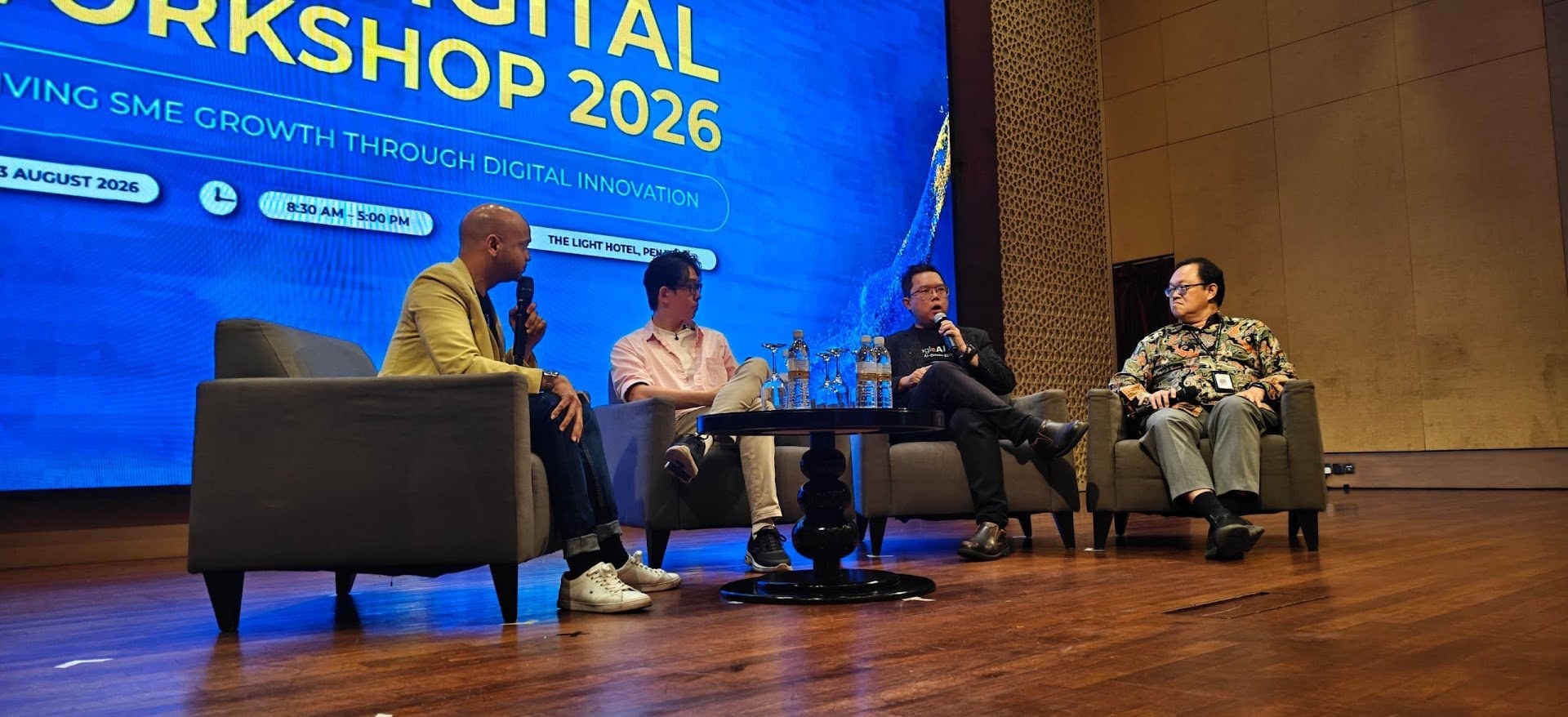
Digital Workshop 2026, 3 August 2026. The closing panel on SME growth through digital innovation, where this cost question came up repeatedly from owners who had been quoted a GPU before being quoted a use case. Photo: Dr Henry Tye.
Why one gateway matters more than one good rate card
Route one is the cheapest route, and it has an operational trap: most enterprises do not buy one model. Marketing wants one, engineering another, finance a third. Within a quarter you have several vendor accounts, several currencies, several invoices and no single view of what the company spends on inference.
That is the problem a gateway solves, and it is a budget-control argument rather than a technical one. One OpenAI-compatible endpoint means one key, one bill and one number for the board. Switching between DeepSeek, GLM, Kimi and Hunyuan becomes a one-line change in a model name rather than a procurement cycle, which is what makes the 46-times spread usable rather than theoretical. You can move a workload to a cheaper card when it is fit for purpose and back when it is not.
It also removes the currency problem. A Ringgit invoice against a Ringgit budget is worth real money in a year when the exchange rate does the moving.
Big Domain is building its LLM Token Hub for that job: a single OpenAI-compatible key across DeepSeek, GLM, Kimi, Hunyuan and MiniMax, billed locally, with pay-as-you-go rates available on top of a subscription. It is at early-access stage rather than general availability, and any reader planning on it should confirm the current state before committing a budget line to it.

An export workshop for Malaysian businesses. The audience question is the same in every room: what does the AI actually cost us, and how do we keep it from becoming a subscription nobody owns. Photo: Dr Henry Tye.
What else belongs in the budget
- Utilisation. The whole model turns on this. A resource at 20 per cent utilisation costs five times what its sticker says.
- Data residency and PDPA. If a workload cannot leave your premises, the API column is closed and the comparison changes completely.
- Model licensing. Open weights are not the same as unrestricted weights. Check the model card before deployment.
- Staffing. A senior MLOps engineer in Malaysia sits in the RM18,000 to RM22,000 a month band and is genuinely scarce.
- Refresh and residual value. GPU generations turn over roughly every 18 months. H100 hardware has a functioning secondary market; newer cards do not.
- Egress, storage and tooling. Observability, evaluation runs and vector databases typically add 1.4 to 1.6 times the visible model API bill.
The recommendation
For enterprises running agentic AI, the GPU is cheaper than the API, and the crossover happens sooner than almost anyone expects. That is the conclusion the corrected output-ratio model forces, and it is the opposite of what most cost guides tell you.
The reason is simple. Every cost guide prices the API as if output tokens are a rounding error. They are not. In an agentic workflow, the model generates reasoning tokens, tool call responses, intermediate drafts and the final deliverable. Those output tokens bill at RM4.90 per million on DeepSeek Flash — four times the input rate. When output is a third of your token volume instead of a twentieth, the blended cost rises from RM0.38 to RM1.71 per million tokens. That single ratio error is why most enterprise AI budgets are wrong by a factor of four.
For light and moderate users — an executive assistant, a recruiter running keyword searches — the API is still 4 to 46 times cheaper and there is no argument. Buy tokens. But the moment your people run sustained agentic workflows on real documents, the arithmetic inverts.
| Your users | API (RM/mo, 100 seats) | Rented GPU (RM/mo) | What to do |
|---|---|---|---|
| Average (RM11K-66K/mo API) | 11,000 – 66,000 | 14,910 | API at low end, GPU at high end. |
| High (RM66K-110K/mo API) | 66,000 – 110,000 | 14,910 | GPU. 4–7x cheaper. |
| Extremely high (RM110K-660K/mo API) | 110,000 – 660,000 | 29,820 – 52,185 | GPU. 4–22x cheaper. |
The right decision for a hundred-seat Malaysian enterprise running agentic AI is a mixed deployment: the API for the 20 to 30 per cent of seats that are genuinely light, and a dedicated GPU — rented first, owned once the workload is proven — for the rest. In most real deployments the heavy users are the ones who find the use cases that matter, so the GPU seats are the seats that produce value, not the ones you are trying to save money on.
What is no longer defensible is assuming the API must be cheaper because it looks cheaper per query. The per-query cost is misleading. The per-month cost, driven by the output tokens your agent generates inside every loop, is what actually lands on the invoice. Measure it, then decide.
When you do make the switch, the sizing depends on which model you are running. DeepSeek V4.1-Flash at INT4 needs 2× H200 141GB and costs RM14,910/mo rented. GLM-5.3 at INT4 needs 4× H200 and costs RM29,820/mo. These are multi-GPU deployments, not single-card setups, because the models are 552B–753B parameters. Plan accordingly.
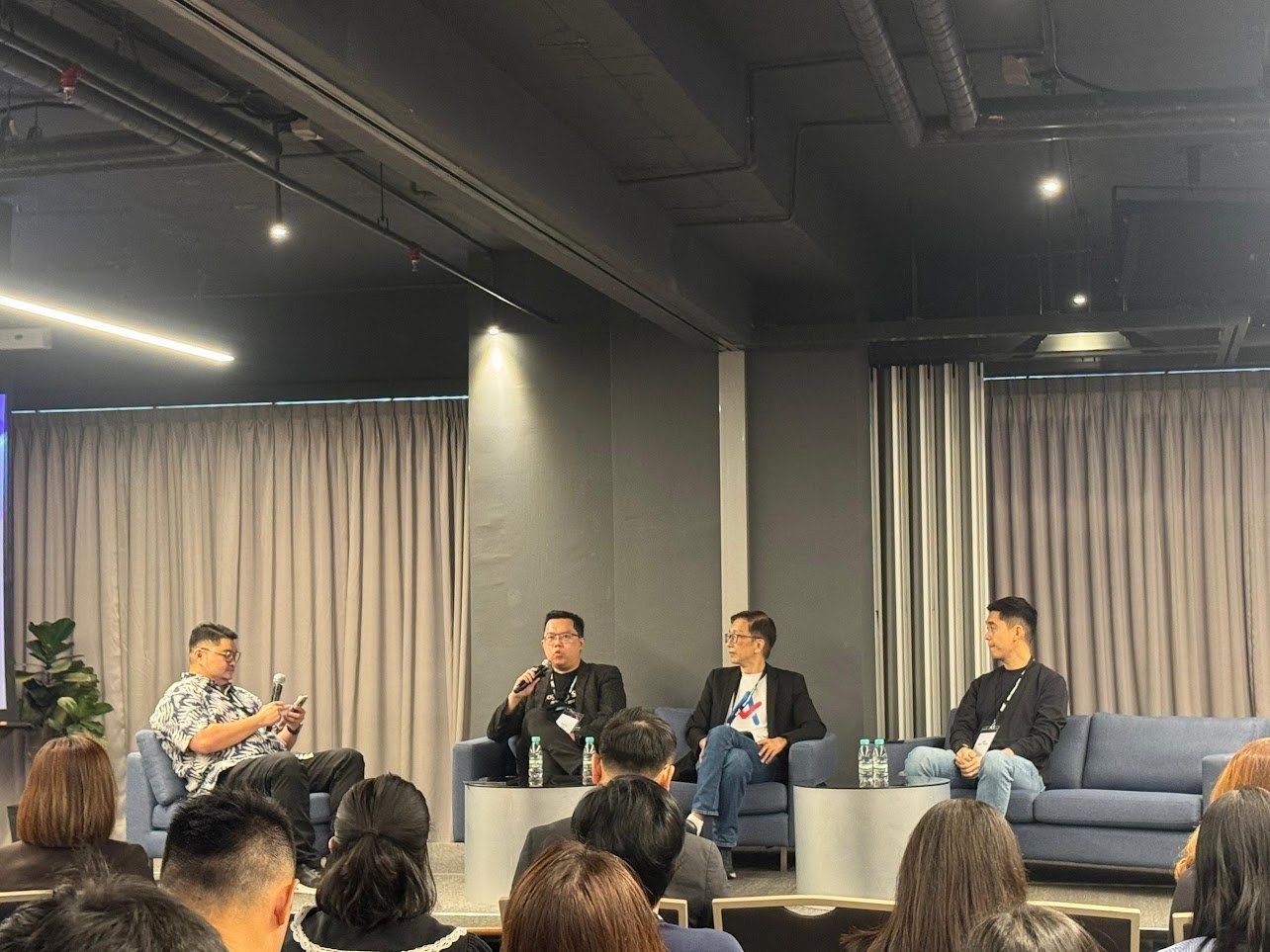
A panel session with Malaysian business owners. The questions that decide an AI budget are rarely technical; they are about occupancy, ownership and who signs the invoice. Photo: Dr Henry Tye.
Sources
- DeepSeek, Models & Pricing (V4.1-Flash and V4-Pro rates, peak windows, cache tiers, concurrency limits) — api-docs.deepseek.com, read 12 October 2026
- Zhipu AI, API pricing (GLM-5.3, GLM-5.3-Flash, cache-hit rates) — docs.bigmodel.cn, read 12 October 2026
- Sina Finance, 一人一周烧掉20亿Token (Chinese enterprise token consumption: 10M–300M per person per day; one researcher 2.3B in one week on Codex) — finance.sina.com.cn, 5 June 2026
- FinOps LLM, LLM Cost Per User Benchmarks (knowledge worker: light 3M in/1.5M out, typical 12M/6M, heavy 30M/15M per day) — finopsllm.com, July 2026
- Product Curious, A Manager’s Guide to Reducing AI Costs (Uber CTO: annual budget consumed in four months; single-agent task ~200K tokens per run, 3–10 runs/day; total cost 1.4–1.6x the model API bill) — productcurious.com, April 2026
- SemiAnalysis InferenceX, Running Llama 3.3 70B on H100 (measured throughput at every interactivity target; 1,496 tok/s aggregate at 50 tok/s per user) — inferencex.semianalysis.com
- Iternal, Token Usage Guide 2026 (agentic multiplier 5–30x vs chat; per-task token ranges by agent complexity) — iternal.ai
- llmtest.io, LLM agent cost in production 2026 (8-step agent loop: 57,800 input + 4,300 output; agent costs 6–7x single-shot from context re-transmission) — llmtest.io
- onprem.ai, AI Costs by Office Role (role-based daily burn: assistant 32K, analyst 99K, lawyer 197K, engineer 315K tokens/day) — onprem.ai
- Mercatus, NVIDIA H200 Price 2026 and H100 Server Price 2026 (8-GPU HGX system cost, secondary-market retention, the owned-cost formula) — mercatus-ai.com
- Enzu, RTX PRO 6000 Price 2026 (Server Edition card band, 8-GPU power draw) — enzu.com
- Big Domain, NVIDIA GPU Hosting Malaysia (RM1,811–34,466/month openly priced in Ringgit; published capacity and model-fit table) — bigdomain.my/nvidia-gpu-hosting/, read 12 October 2026
- FactoryHub, TNB Tariff 2026 for Factories and i2 Energy, TNB commercial tariff 2026 (RP4 energy, capacity, network and retail components; AFA mechanism) — factoryhub.my
- SuperJobs, AI & Machine Learning Salary Guide Malaysia 2026; Seekers, How to hire AI engineers in Malaysia in 2026 (MLOps salary bands) — superjobs.my
- ExchangeRate-API, live rates used for every conversion (one US dollar = RM4.09, one Chinese yuan = RM0.61, spot 12 October 2026) — open.er-api.com
A Big Domain research note, written by Dr Henry Tye. Disclosure, because it belongs in the first paragraph and not the last: Big Domain sells GPU hosting and is building the Token Hub named above, so it earns money from two of the three routes in this article and from none of the others. Weigh that, then weigh the arithmetic, which is reproducible from the published rate cards cited above. The token-consumption benchmarks in the first section are from published deployment data, not our own measurement, and they span a range we did not invent. The facility cost used in the owned-GPU model is a United States reference, because Malaysian high-density colocation for GPU is quoted rather than published. Confirm current terms with each vendor before you commit a budget.
If you would rather test the arithmetic against your own token counts before you commit to any of the three routes, Big Domain runs the Ringgit-billed gateway described above and publishes its own GPU hosting rates in the open: BD LLM Token Hub.