
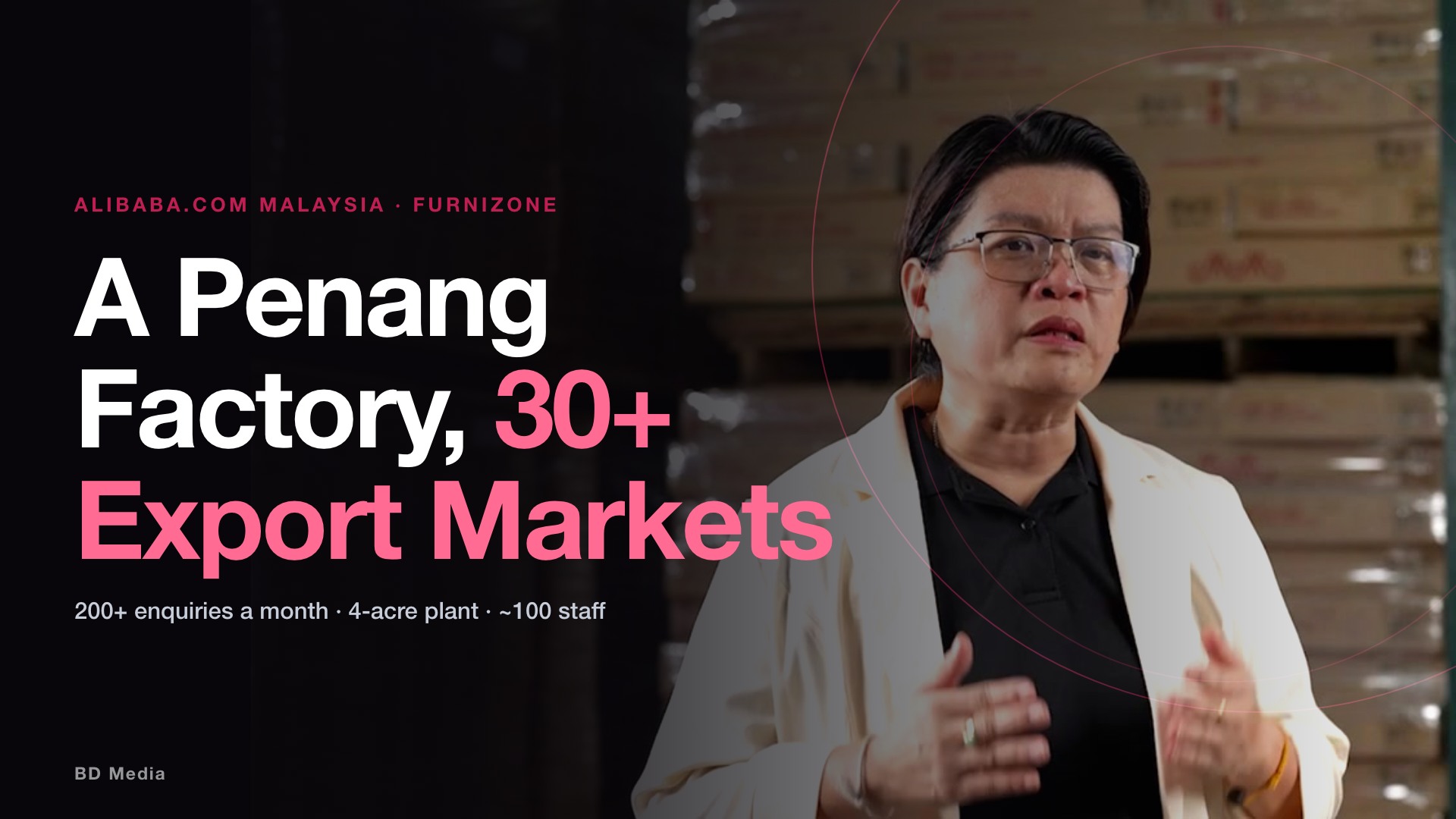
Furnizone Industries, a knock-down furniture maker in Nibong Tebal, Penang, has been an Alibaba.com Malaysia seller since 2015. Eleven years on, the company says it now receives more than 200 enquiries a month and ships to over 30 markets, from the United States to South America and across Southeast Asia. Those are the company’s own figures, given in a new video recorded at its plant and published this month, and they answer the question most Malaysian exporters ask before paying for a membership: what does the platform actually produce, and how long does it take.
The answer in the video is a timeline rather than a promise. Furnizone grew into its results over a decade of platform work. The company’s factory is now roughly four times its original size, sits on about four acres with close to 100 staff, and runs modern panel-processing machinery. It still makes furniture in Penang, and almost everything it makes now leaves the country.
Furnizone Industries, Nibong Tebal, Penang: four minutes on how a local panel-furniture factory became a supplier to more than 30 markets. Narrated in Mandarin with English subtitles. Source: Furnizone Industries video, November 2026.
What Alibaba.com Malaysia replaced
Before the platform, Furnizone found overseas buyers the way most Malaysian manufacturers still do: trade exhibitions, agents, referrals from existing customers, and flights to visit prospects in person. Every one of those channels works. Every one of them is also priced in airfare, hotel nights and senior time, and none of them scales without adding more of each.
The platform did not replace the sales work. It moved the first contact, the catalogue and the quotation to a place where a buyer in another timezone could find the company without either side booking a flight first.
The numbers the video puts on the record
Furnizone is a mid-sized manufacturer: about 100 staff, four acres, one product family. What makes the case useful is that the company states its numbers on camera, in a video it published itself, rather than in a testimonial paragraph written by a marketing department.
| Measure | Figure | What it means for an exporter |
|---|---|---|
| Founded | 2009 | Six years of manufacturing before the platform account opened; seventeen in manufacturing to date |
| Joined Alibaba.com | 2015 | Eleven years on the platform, not eleven months |
| Enquiries now | Over 200 a month | Roughly seven a day, every day, arriving as work to answer |
| Factory size | About four times the original | Capacity followed demand, not the other way round |
| Site area | Approximately 4 acres | Physical plant behind the online storefront, which is what buyers verify |
| Workforce | Close to 100 staff | Production, logistics and the people who answer enquiries |
| Export markets | Over 30 countries | United States, South America, Southeast Asia and beyond |
Source: Furnizone Industries video, November 2026. All figures are the company’s own statements on camera. The founding year of 2009 also appears in the company description on its own Alibaba.com storefront.
The market mix changed with it. A factory that once sold where its agents happened to have contacts now sells where the enquiries come from, and the enquiries come from everywhere.
What the platform did not do for them
This is where first-year memberships usually stall, and the video is explicit about it. Joining a marketplace puts a company in front of buyers. It does not make the company worth buying from, and it does not answer the enquiry that arrives at 2am Kuala Lumpur time.
The work the director describes is operational, and it is the same list any Malaysian exporter will recognise: learning how to run the account rather than merely owning it, understanding what the buyer is actually asking for, replying while the buyer is still shopping, building a credit record that survives scrutiny, and improving how the company presents itself online. None of that is a feature of a membership tier. All of it is staff time.
Two details in the video are easy to miss. The first is that early enquiries took years to turn into repeat orders, which means the value of a lead is realised on the second and third order, not the first. The second is that the company keeps investing in how its storefront looks and reads, which is the difference between a catalogue that converts and one that merely exists.
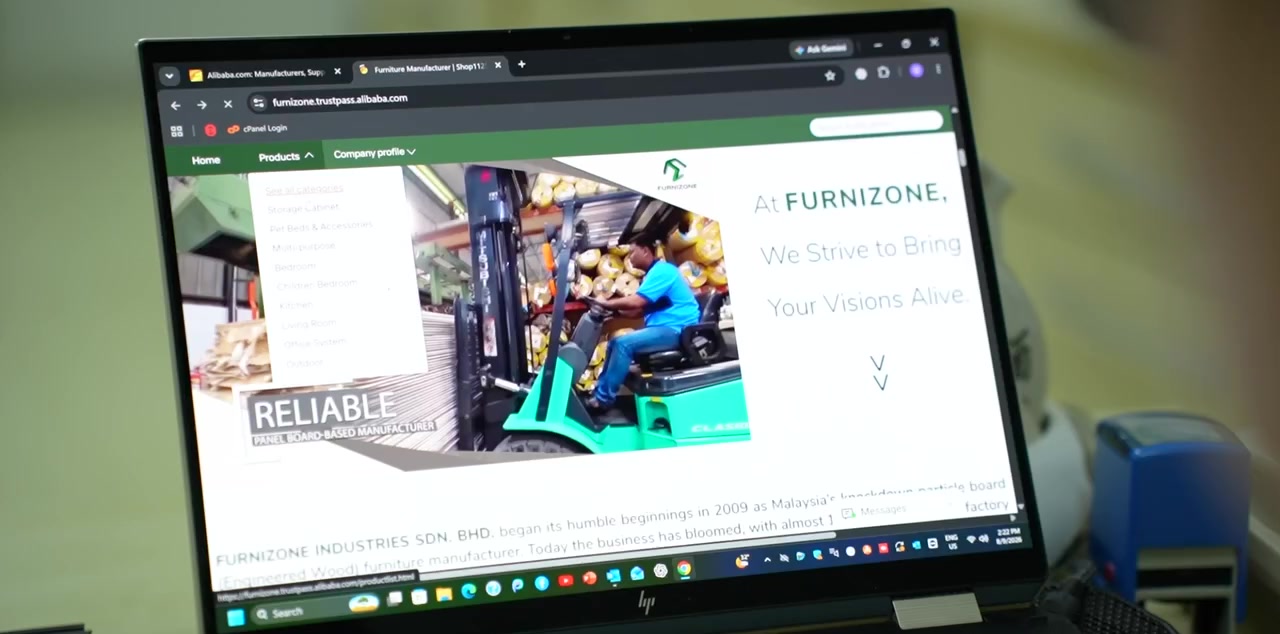
The company’s own Alibaba.com storefront, filmed in the video: navigation, a factory photograph and a written introduction that dates the business to 2009. This is the page a buyer judges before sending an enquiry. Source: Furnizone Industries video, November 2026.
Five things a Malaysian exporter can copy from this
- Budget years, not months. Furnizone describes its growth as cumulative. A membership judged at month three will look like a failure and probably is not one.
- Staff the enquiry queue before you staff the storefront. Two hundred enquiries a month is a workload. A company that cannot answer inside a working day is paying for leads it will lose.
- Let the factory show. The video is shot on the floor, among pallets, machines and people. Overseas buyers filter for suppliers who can prove production exists, which is exactly what a Verified Supplier audit formalises.
- Treat the storefront as a sales page, not a catalogue. Product photographs, English copy and a company introduction that states the founding year, capacity and export markets do the qualifying before a human speaks.
- Convert the first order into a reference. Long-term partnerships, in the director’s account, came from handling early enquiries well, not from the size of the first order.
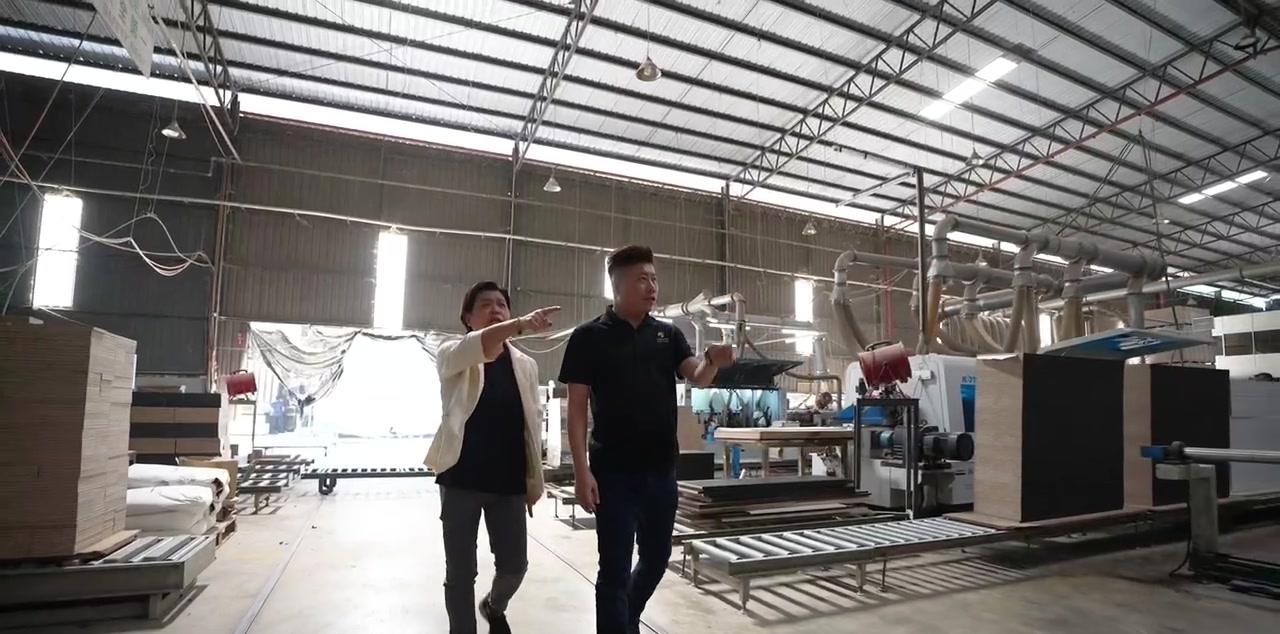
The Furnizone plant floor, where the video was recorded: stacked panel material on trolleys, extraction ducting and panel-processing machinery. Buyers who ask for a factory video are asking for this view. Source: Furnizone Industries video, November 2026.
Where Big Domain fits, and what it costs
Big Domain is an Alibaba.com Partner in Malaysia, and the work it does for an exporter is the unglamorous part of the list above: opening the membership, designing the storefront, uploading and writing product listings in English, running the RFQ queue, and filing the MATRADE eTRADE 2.0 claim that reimburses part of the onboarding cost.
Big Domain’s published 2026 price list for Malaysia puts GGS Booster at RM22,880 a year with RM12,480 of keyword-advertising credit, Booster Plus at RM35,360 with RM24,960 of credit, Verified Supplier Lite at RM56,280, and Verified Supplier at RM93,720 with RM49,920 of credit. The gap between the two families is the SGS or TÜV factory audit, which is the badge large international buyers filter on.
Working out which tier fits: the packages differ by what gets done for the company, not by how big the membership is. See the Alibaba Gold Supplier packages and current prices.
The eTRADE 2.0 grant is worth its own line. Under MATRADE’s programme, eligible Malaysian SMEs, meaning SSM-registered companies with at least 60 per cent local ownership, can claim up to RM5,000 against Alibaba.com onboarding costs, and Big Domain prepares and files the application. It does not make a membership cheap, but it reduces what the first year costs to try.
What one case does and does not prove
One case is one case. Furnizone sells a product with a global market, makes it at a scale that survives a factory audit, and had six years of manufacturing behind it before it joined. A company without those three things will not get the same result from the same membership.
The five points above are about method, not outcome. They describe how the decade was spent, not a promise that another company can compress it into a year.
What the video does establish is narrower: a Penang factory with under 100 staff built an export business across more than 30 markets over about a decade, and the platform was the channel that made the first contact possible. That is the part to study if the same decision is on the table.
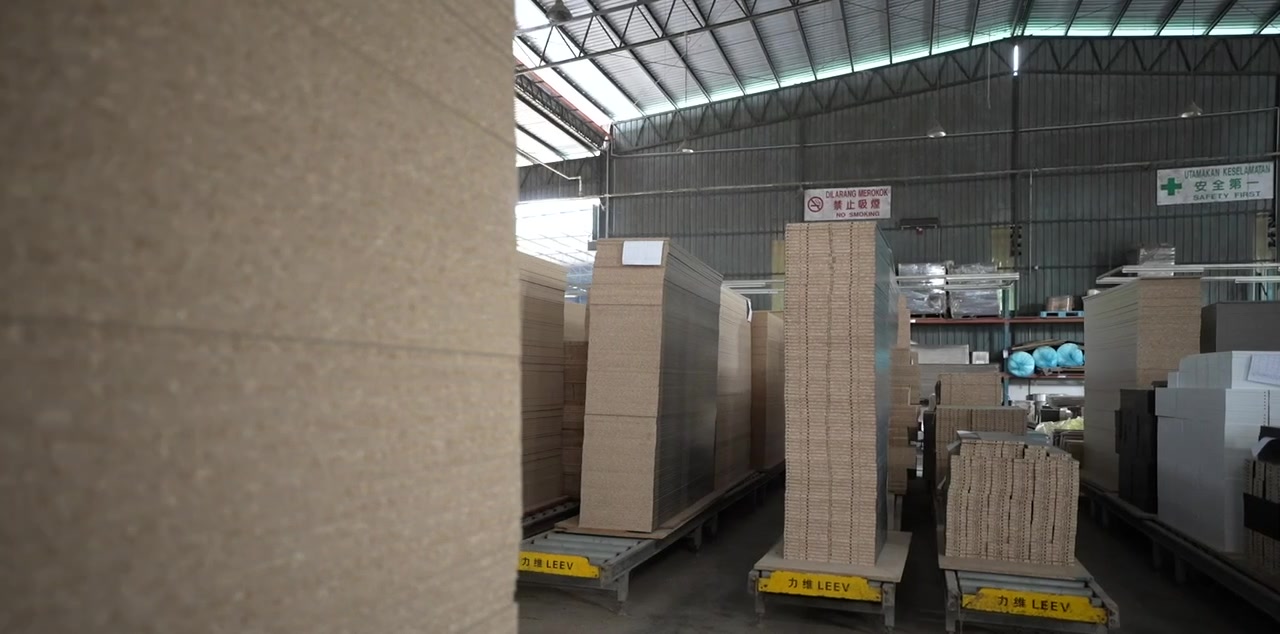
Flat-pack cartons staged for despatch at the Nibong Tebal plant. Almost all of Furnizone’s output is now exported. Source: Furnizone Industries video, November 2026.
Read next: the full Alibaba.com Gold Supplier pricing and ROI breakdown for 2026, and what Alibaba.com and MATRADE announced at the B2B AI Seller Summit. Alibaba.com’s own seller page for Malaysia is at seller.alibaba.com, and Furnizone Industries is at furnizone.com.
Last updated: 6 November 2026. Figures are as stated by Furnizone Industries in its November 2026 company video and are not independently audited by Big Domain. Membership prices are the 2026 Malaysian list prices published on bigdomain.my.