The Online Safety Act Malaysia deadline of 28 December applies to licensed social media service providers, not to ordinary shop owners. A Malaysian SME selling through Instagram, TikTok or Facebook does not file an Online Safety Plan because it has a business account. The platform does. What reaches the seller is indirect: contract terms, platform rule changes, and age-verification flows that alter how customers find and contact a store.
Deputy Communications Minister Teo Nie Ching told Parliament on 11 November that licensed service providers must submit an Online Safety Plan to the Malaysian Communications and Multimedia Commission by 28 December under the Online Safety Act 2025, Act 866. Bernama, The Star and The Malaysian Reserve reported the same answer on 11 and 12 November.
This article is written for the seller, not the licence holder. It separates the filing duty from the platform’s other obligations, and it marks clearly where reporting stops and interpretation begins.
Last updated: 23 November 2026. This article reports a parliamentary answer and named reporting on the Online Safety Act. It is not legal or regulatory advice, and it does not assume that any SME is a licensed provider.
What the Online Safety Act Malaysia deadline on 28 December actually is
The deadline is a filing obligation. Licensed social media service providers must submit an Online Safety Plan to MCMC before or by 28 December. The Star quoted Teo: “They will also have to present any additional matters taken to improve safety for their users. This has to be submitted before or by Dec 28.”
Bernama reported that the plan must set out the improvements and planning the provider will undertake to give users a safer digital environment. The obligation sits under the Online Safety Act 2025, Act 866. MCMC is the recipient.
The word that matters is licensed. The reporting names service providers, not merchants or advertisers. A business that sells products through a platform is not thereby a licensed provider.
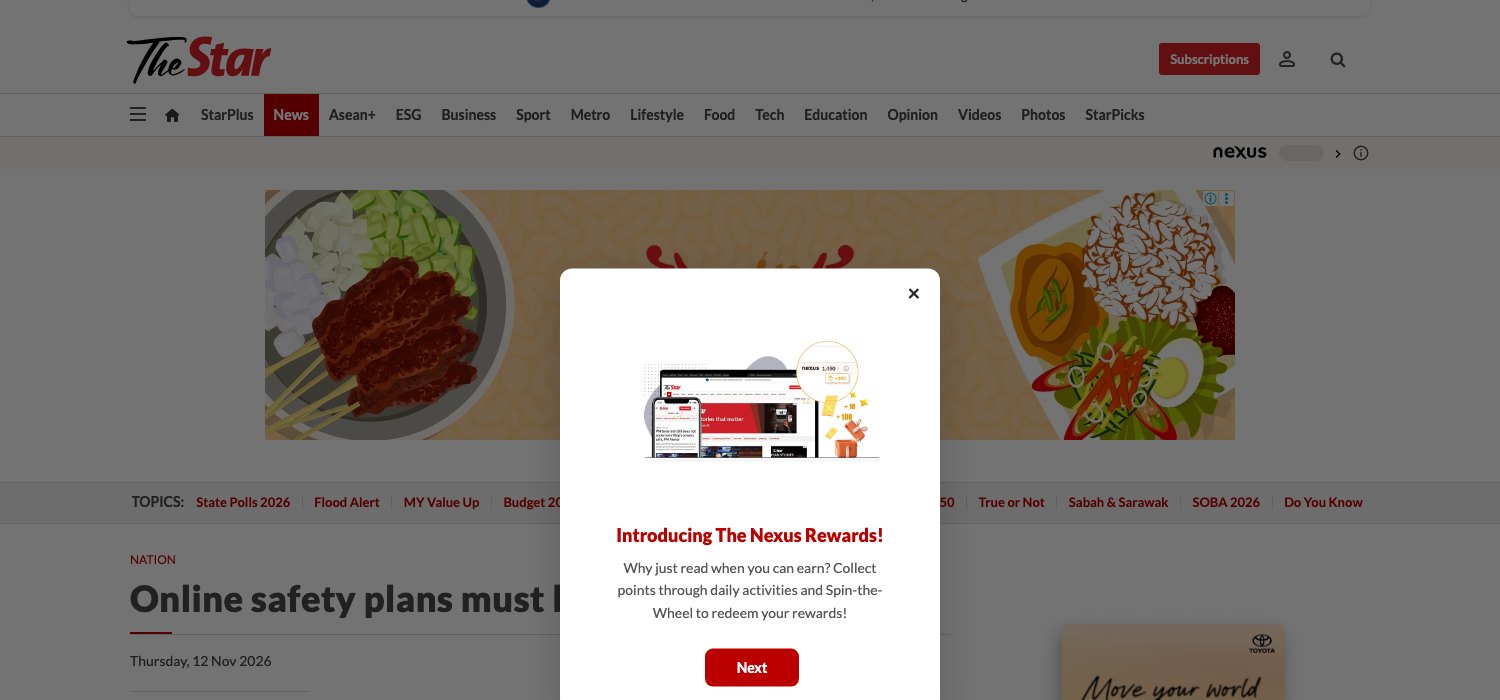
The Star’s 12 November 2026 report on the 28 December filing deadline. Source: The Star, read 23 November 2026.
Does a business App need an Online Safety Plan?
For the overwhelming majority of Malaysian SMEs, no. A shop account, a business page, a branded app used for customer messages, or a membership portal is not the same thing as a licence holder under Act 866.
Three cases are worth separating. A merchant operating a store page on a third-party platform is a user of that platform. A company running its own customer app is generally an app operator, not a provider holding an ONSA licence. A business that actually provides a social media service to users, and holds the corresponding licence, is the party the reporting describes.
Bernama and The Star reported that MCMC has issued directions to social media service providers including Meta, TikTok and Google. Those directions are aimed at the platforms. They are not notices to every business advertising on them.
What MCMC expects inside the plan
The parliamentary answer describes the plan as a statement of improvement measures and planning for a safer digital environment. The Star reported that providers must also present any additional matters taken to improve user safety.
MCMC’s official Online Safety Act microsite sets out a broader framework. Its homepage states that ONSA “sets out measures for online services to address harmful content” and that it “strengthens online safety by setting clearer expectations for licensed service providers”. Listed expectations include mitigation of exposure to harmful content, accessible reporting mechanisms, easier reporting and support, and measures specified in the code for child users.
That microsite is an official entry point. It does not carry the 28 December date and does not reproduce the full text of Act 866. The deadline in this article comes from the three T2 reports named in Sources, not from the microsite.
What changes in early 2027 with age verification
Teo said social media platforms are expected to implement user age verification in early 2027, after the current transition period ends. Bernama quoted her saying that platforms will then submit data on the number of accounts verified and closed.
The wording is deliberately not a date. “Early 2027” is the ministerial formulation. No 1 January 2027 effective date was published in the reporting reviewed; the ministerial wording is “early 2027”.
For a seller, the operational effect is a change in the customer journey. Age-check prompts, account verification steps and the handling of under-16 accounts may affect sign-ups, message delivery and audience size. Those are platform changes that a business may need to absorb in its own customer support, even though the filing duty remains with the platform.
What the RM1m, RM100k-a-day and RM10m penalties really apply to
The reported penalties attach to licensed service providers that fail to meet ONSA obligations. Bernama reported that a non-compliant licensed provider may be fined up to RM1 million and, where the violation continues after conviction, an additional daily fine of up to RM100,000.
The RM10 million figure carries a section-number difference in the sources. The Star reported that “a notice of non-compliance can also be issued under Section 37 of the Online Safety Act alongside another financial penalty not exceeding RM10mil”. The Malaysian Reserve, as recorded in the research brief, attributed the RM10 million penalty to section 39. The Act text was not read for this article, so both attributions are printed and the difference is left open.
| Reported figure | Who it is reported to apply to | Source |
|---|---|---|
| Up to RM1 million | Licensed service provider failing an ONSA obligation | Bernama, 11 November 2026; The Star, 12 November 2026 |
| Up to RM100,000 per continuing day | Continuing violation after conviction | Bernama, 11 November 2026; The Star, 12 November 2026 |
| Up to RM10 million | Notice of non-compliance and financial penalty | The Star names section 37; The Malaysian Reserve names section 39 |
Penalty figures reported by Bernama and The Star; the section number for the RM10 million penalty differs between The Star and The Malaysian Reserve. Source: named reports, 11–12 November 2026.
None of these figures is described in the reporting as a fine on a seller for having a shop page. They are platform-level enforcement amounts.

A business using social media is not automatically a licensed service provider. Photo: “Person looking at smartphone in the dark (2)”, Wikimedia Commons, CC BY-SA 2.0.
The two codes already in force since 1 June 2026
The Child Protection Code and the Risk Mitigation Code took effect on 1 June 2026 under ONSA. The Star reported that Malaysia began enforcing age verification for the registration and opening of social media accounts from that date as a measure to protect children under 16.
MCMC’s official microsite lists child-safety duties among the expectations it publishes for licensed providers and gives a dedicated “Protecting Children Online” section. The microsite is the authority’s public entry point; the 1 June commencement itself comes from the named reporting.
For a business, the codes matter as a signal of platform behaviour. Customer registration flows, age gates and content moderation are likely to keep changing through the transition period. Merchants should expect platform rule updates rather than a new filing obligation of their own.
Why age verification is not identity verification
Teo was explicit on this point. Bernama reported that age verification for social media users aged above 16 does not involve verifying user identity, and that the mechanism therefore cannot directly solve the fake-account problem. The Star reported the same distinction: platforms undertake age verification and not identities.
The difference matters to a seller. An age check may confirm that a user is above a threshold. It does not confirm who the user is. Fraudulent accounts, impersonation and disputed orders are still commercial risks that a business must manage through its own checks, payment controls and support process.
For background on how platform-level rules reach businesses and users, see how platform rules reach Malaysian users. The same separation applies here: a decision made about a platform does not automatically become a duty on every merchant using it.
When a business builds software for a licensed platform, what the contract may push onto it
A different question arises for a vendor that develops software for a licensed platform. Industry commentary has suggested that obligations placed on the licence holder may be passed down through contract terms to suppliers and integrators. That is an industry reading, not a provision quoted from the Act or from MCMC’s published microsite.
The practical response is contractual rather than statutory. A developer should read the service agreement and any data-handling schedule for clauses on user reporting, age-gate behaviour, content escalation, record keeping and audit access. If such a clause exists, it binds the parties to the contract; it does not by itself turn the developer into a licensed service provider.
For teams weighing the wider control question, what AI agent safety means for businesses covers a different but related distinction between platform rules and a company’s own operating controls. Another platform-level change with its own obligations is described in how platform-level rules differ from seller obligations.
What we could not confirm
- The eight-million-user threshold. The research record notes that the Minister had said in January the threshold was under review. No result of that review was found, so the article does not state a current threshold.
- Which section carries the RM10 million penalty. The Star says section 37; The Malaysian Reserve says section 39. Act 866 was not read for this article.
- A precise date for age verification. The parliamentary answer says early 2027 after the transition period. No calendar date was published in the reporting reviewed.
- A plan template or submission portal. MCMC’s microsite provides navigation to regulatory material but the filing mechanism was not located in the pages opened.
- Contract pass-through as regulation. The suggestion that obligations reach vendors through contracts is industry interpretation, not statutory text.
What dates to register next
Three dates are worth recording. The Online Safety Plan filing date of 28 December applies to licensed service providers. The Child Protection Code and Risk Mitigation Code have been in force since 1 June 2026. Age verification is expected in early 2027, with no exact day published.
A fourth item is not a date for this article: the separate Finance Bill and its proposed 2027 tax changes are often discussed in the same compliance conversations, but they are a different statute. Readers tracking those can consult other 2027 rule changes SMEs are tracking without conflating them with ONSA.
The next reliable update will come from MCMC or from a further parliamentary answer. Until then, an SME’s useful task is to confirm its own status, read any platform agreement it signs, and avoid adopting a filing duty that belongs to the platform.
Sources
- Bernama, Social media platforms to implement age verification in January; Teo: data to be submitted after transition period (BM original), 11 November 2026 (28 December plan deadline; Act 866; RM1m and RM100k penalties; 1 June codes; MCMC directions to Meta, TikTok and Google; age verification is not identity verification) — Bernama, 11 November 2026
- The Star, Online safety plans must be filed by Dec 28, 12 November 2026 (deadline quote; RM1m, RM100k daily and RM10m figures; section 37 attribution; codes from 1 June; platforms verify age, not identity) — thestar.com.my, 12 November 2026
- The Malaysian Reserve, Online safety plans mandatory for licensed social media platforms, 11 November 2026 (reported section 39 attribution for the RM10m figure, as recorded in the research brief; page returned 403 in this session) — themalaysianreserve.com, 11 November 2026
- MCMC, Online Safety Act 2025 microsite (official entry point; homepage states ONSA duties for licensed providers; does not contain the 28 December date or the full Act 866 text) — mcmc.gov.my/onsa
- SE Ranking, DATA_getKeywordsMetrics, source MY, measured 23 November 2026 (three candidates returned no data) — internal SEO record, see meta.json
demandblock
BD Media is the editorial desk of Big Domain. This article reports a parliamentary answer and named reporting on obligations that fall on licensed service providers. It is not legal or regulatory advice. Businesses should confirm their own status before acting on any platform-level rule.