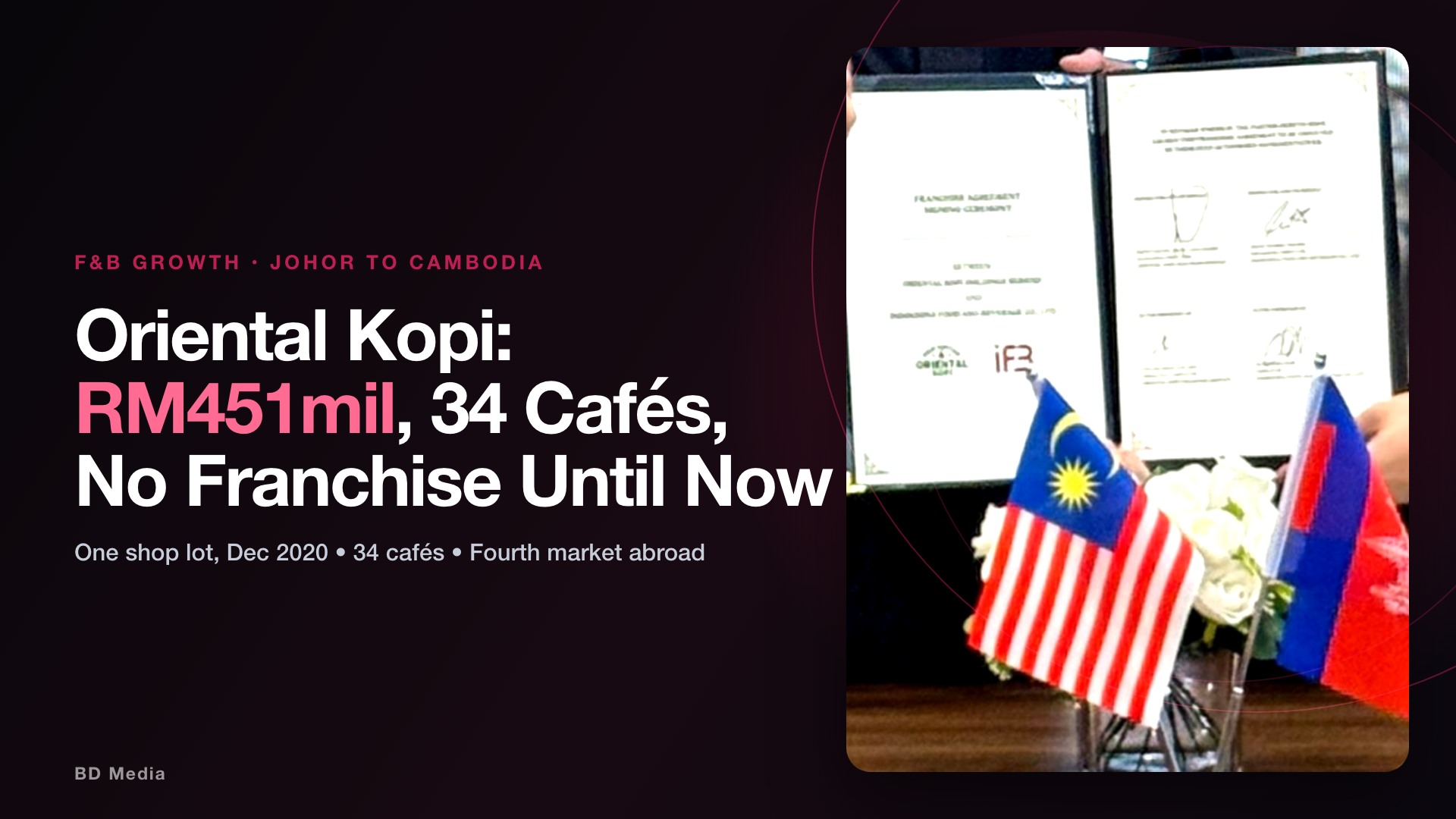
KUALA LUMPUR, 24 November 2026 — Oriental Kopi will be developed across Cambodia under a five-year territory franchise, the company told Bursa Malaysia on Monday, making the kingdom the fourth market outside Malaysia that the café chain has entered in about two years.
The agreement was signed on 23 November between Oriental Coffee International Sdn Bhd, an indirect wholly owned subsidiary of Oriental Kopi Holdings Bhd, and Indochina Food and Beverage Co Ltd, a Cambodian company. Indochina gets exclusive rights to build and run Oriental Kopi outlets in the country, must open its first one in Phnom Penh within 365 days, and pays a franchise fee plus a monthly royalty for each outlet it operates. Oriental Kopi’s shares closed two sen lower at 78 sen on Monday, valuing the group at RM1.56 billion.
The size of the deal is not the story. The announcement does not put a figure on the fee or the royalty, and the company says it will have no material effect on earnings for the financial year ending 30 September 2027. What matters is what the deal says about how a five-year-old kopitiam learned to sell something other than food. It now exports its operating system.
That is a reversal. As recently as this year, the group’s position was the opposite of a franchise. Asked about expansion, managing director Datuk Chan Jian Chern said the company would grow at a “measured pace” rather than rely on the franchise model common in Malaysian food and beverage, so that it could keep control of how its outlets are run, The Edge Malaysia reported.
How Did Oriental Kopi Start?
The first Oriental Kopi opened in December 2020, in a rented shop lot in Johor Jaya, Johor, in the middle of the pandemic. It was founded by Chan Jian Chern, who is known as Datuk Calvin Chan, together with Chan Yen Min and Koay Song Leng, according to the company’s IPO prospectus as reported by Vulcan Post.
Chan was not a restaurateur. He finished secondary school in 1999 and started selling mobile phones and accessories. He set up Tenggara Telecentre Trading in 2003, Mars Mobile Distribution in 2009 and Leagoo (M) in 2014, then left the management of all three businesses in 2018. That year he co-founded Golden Whale International with Chan Yen Min, which ran a bubble tea chain under the Black Whale brand. He stepped back from that business in 2021 to concentrate on Oriental Kopi.
The expansion was quick and deliberate about location type. A second outlet opened in May 2021 at The Mall, Mid Valley Southkey, in Johor. The first outlet outside Johor followed in November 2021 in Bandar Puteri Puchong, Selangor, and a Kuala Lumpur outlet opened at Pavilion Bukit Jalil in April 2022.
Both of the first two outlets were in Johor, the state that borders Singapore. That geography later became a marketing channel of its own, because a Johor outlet is a day trip for a Singaporean who already knows the brand from social media.
Why Did One Egg Tart Sell The Whole Brand?
Most food businesses buy attention. Oriental Kopi manufactured it out of pastry. Its signature egg tart is built from 128 hand-folded layers of pastry made with imported butter, baked daily, and the company sells it as the reason to queue.
The queue is the point. In a shopping mall, a visible line is the cheapest advertising available, and it converts a passer-by who has never heard of the brand into someone who assumes the food must be good. The photograph below is a normal weekday at one outlet, not a launch.
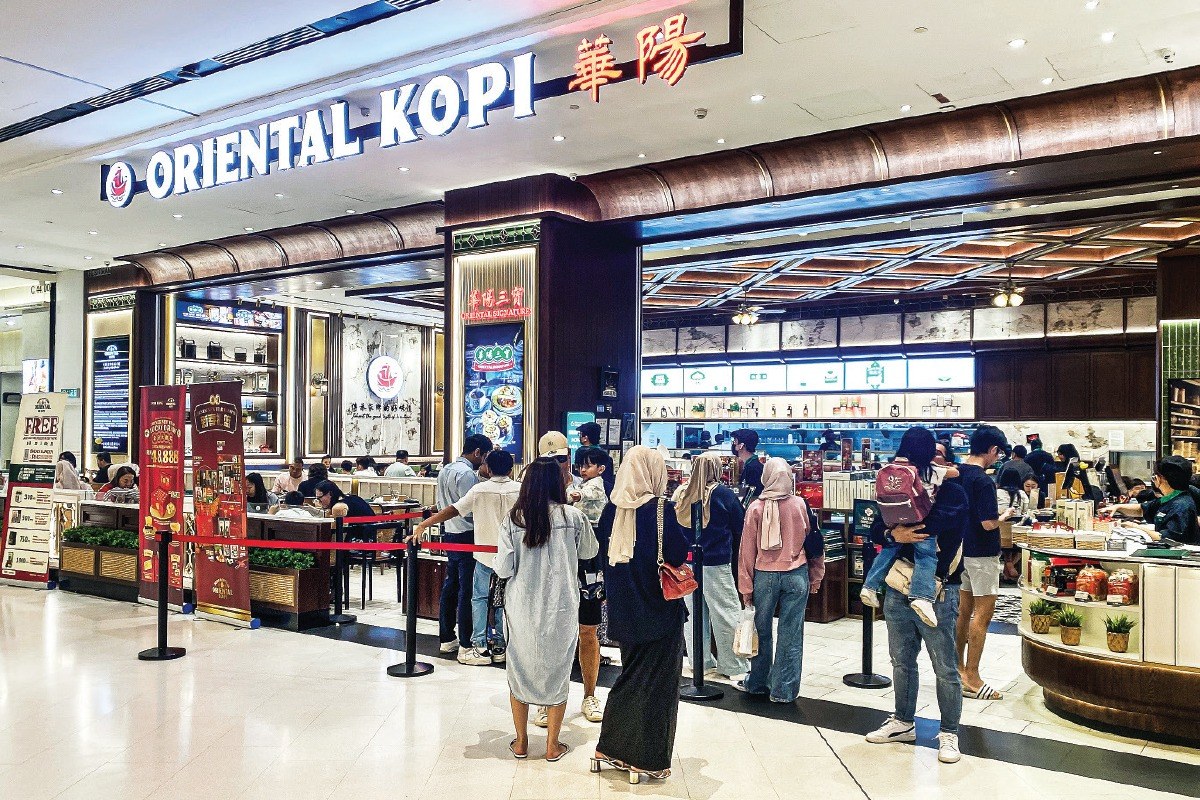
A queue outside an Oriental Kopi outlet, the format the chain has repeated in malls across Malaysia. Photo: Zahid Izzani/The Edge, published 5 January 2026.
Then the company did something most chains do not: it had the volume certified. The Malaysia Book of Records recognised its egg tart as the thickest in 2021 and for the most sold in 2022, and its polo bun for the most sold in 2023. Its Oriental Classic White Coffee took a three-star Superior Taste Award from the International Taste Institute in 2021. In 2025, at the opening of a Melaka outlet, ASEAN Records certified three dishes for the highest verified annual sales in the region between 1 May 2024 and 30 April 2025: 673,007 sets of mee siam, 614,972 sets of curry laksa and 497,246 plates of char kway teow.
Read that list again as a brand strategy rather than a trophy cabinet. Every line converts an internal operating number into a third-party claim. A restaurant that sells a lot is a business. A restaurant that holds a certificate for selling a lot has an answer to the only question a first-time customer asks before joining the line.
Merchandise does the same work off-premises. The company sells gift boxes and bags for Chinese New Year and Hari Raya, a curry paste, a coconut biscuit and a tote bag, and it has run a limited-edition T-shirt with Uniqlo. None of this is a large revenue line. All of it puts the brand in front of people who are not in a mall.
Did Halal Certification Change The Market?
The single most consequential decision was not on the menu. In June 2024 the chain received halal certification from the Department of Islamic Development Malaysia, or JAKIM, presented at a ceremony at its Suria KLCC branch. At the time, 14 outlets were trading, the Suria KLCC and KLIA2 arrival and departure hall outlets were certified, and the company was selling 21 halal packaged products through Aeon, Jaya Grocer, Mercato, Giant and Watsons.
A traditional kopitiam serving pork cannot make that claim. That is not a small exclusion: it removes the majority of the domestic market from the addressable pool and it makes a mall landlord nervous about the tenant mix. Certification did the opposite on both counts. It let a Hainanese coffee shop trade as a national brand rather than a Chinese one, and it gave the company a format that could be exported to Muslim-majority markets. When the group signed its Indonesian joint venture in August 2026, it said the venture would work towards Indonesian halal certification for its ingredients, preparation and supply chain.
How Fast Does One Outlet Pay For Itself?
Oriental Kopi owns and runs its outlets. It does not sub-let the brand, and every café is in a shopping mall, air-conditioned, with tiles and fittings that photograph well.
The economics are the reason the model could be repeated so fast. Management puts capital expenditure at RM2.5 million to RM2.8 million per outlet, with an average payback of 10 to 12 months, and new cafés generally take five to six months to mature, according to research notes from Phillip Capital and MBSB reported by The Edge Malaysia. A business that recovers its fit-out in under a year does not need to franchise to grow. It needs landlords.
For most of the expansion the strategy was trophy sites: Suria KLCC, Pavilion Bukit Jalil, KLIA, and most recently Merdeka 118. With those largely taken, the company is now moving into second-tier malls, which CGS International Research noted should keep rental costs in check while the payback holds.
| Outlet count | Date | Source |
|---|---|---|
| 14 in Malaysia | June 2024 | Bernama |
| 28 in total, 25 of them in Malaysia | 30 September 2025, end of FY2025 | The Edge Malaysia, 5 January 2026 |
| 34 in total, 31 in Malaysia and 3 in Singapore | July 2026 | The Star, 5 November 2026 |
| 40 to 41 in Malaysia, targeted | By 31 December 2026 | CGS International Research, November 2026 |
What Do The Accounts Say?
The company listed on the ACE Market on 23 January 2025 at 44 sen a share, raising RM184 million and valuing it at RM880 million. The public portion was oversubscribed about 60 times, and the stock opened at 75 sen, a gain of 70.45 per cent.
Then the trading got ahead of the business, and later the business caught up with the trading. In the financial year to 30 September 2025, revenue reached RM450.92 million, up 62.6 per cent from RM277.28 million, and net profit rose 40.8 per cent to RM60.75 million from RM43.13 million.
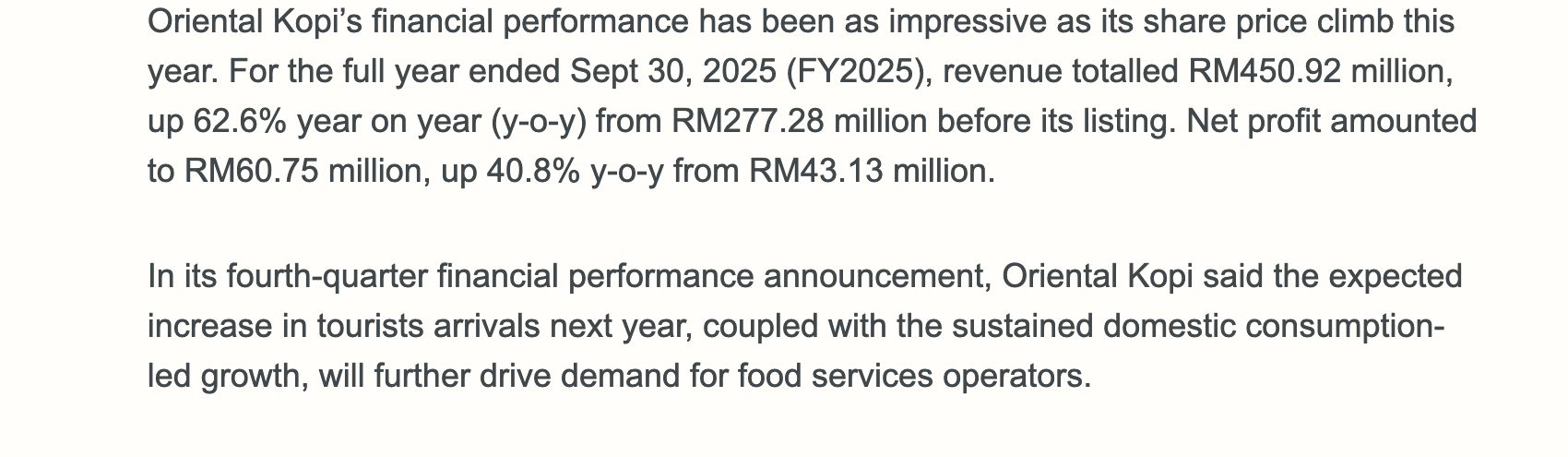
The FY2025 result as reported: revenue of RM450.92 million and net profit of RM60.75 million. Source: The Edge Malaysia, “Deals of 2025: Best Initial Public Offering”, 5 January 2026. Cropped to the financial paragraph; no other change.
The current year has been harder. Analysts expect core net profit of about RM67 million for FY2026, which is growth of roughly a tenth on a revenue base that has grown much faster. Same-store sales growth was 14.7 per cent in the first half of FY2026, down from 15.5 per cent a year earlier. Hong Leong Investment Bank kept a buy call and a target price of RM1.17, noting that raw material prices had held steady after talks with major suppliers. Tradeview Research, the most cautious of the houses tracked, cut its valuation multiple instead, citing rising execution risk and softer consumer sentiment.
The share price tells the same story. From a peak of RM1.49 it had fallen to 78 sen by 23 November, and about RM800 million of market value had gone by early August. JF Apex Securities upgraded the stock to buy on the day of the Cambodia announcement, arguing that the retreat had more than priced in the pressure from this year’s openings. The balance sheet is not the problem: the group has held net cash since FY2021 and had RM54 million of it at the end of March 2026, and it paid a one sen dividend for FY2025, a payout of 32.9 per cent.
Why Did It Refuse To Franchise, Then Change Its Mind?
The overseas programme began as a joint venture rather than a franchise. Singapore was entered in November 2024 through a partnership with Paradise Group, in which Oriental Kopi Global holds 30 per cent and the partner 70. Three cafés now trade there, at Bugis Junction, NEX and Westgate.
In August 2026 the company signed two agreements on the same day, and the difference between them is the strategy in miniature. In Indonesia it took equity: a joint venture with PT Era Boga Nusantara, part of the listed Erajaya group, with the Indonesian partner holding 60 per cent and Oriental Coffee International 40, on paid-up capital of RM4.91 million. In Mauritius it took no equity at all: a six-year territory franchise with Coffee Time Ltd, which carries the capital cost and pays a fee and royalties, with a first outlet due within 300 days.
Cambodia follows the Mauritius template. Read the terms closely: they show how the company now thinks about risk.
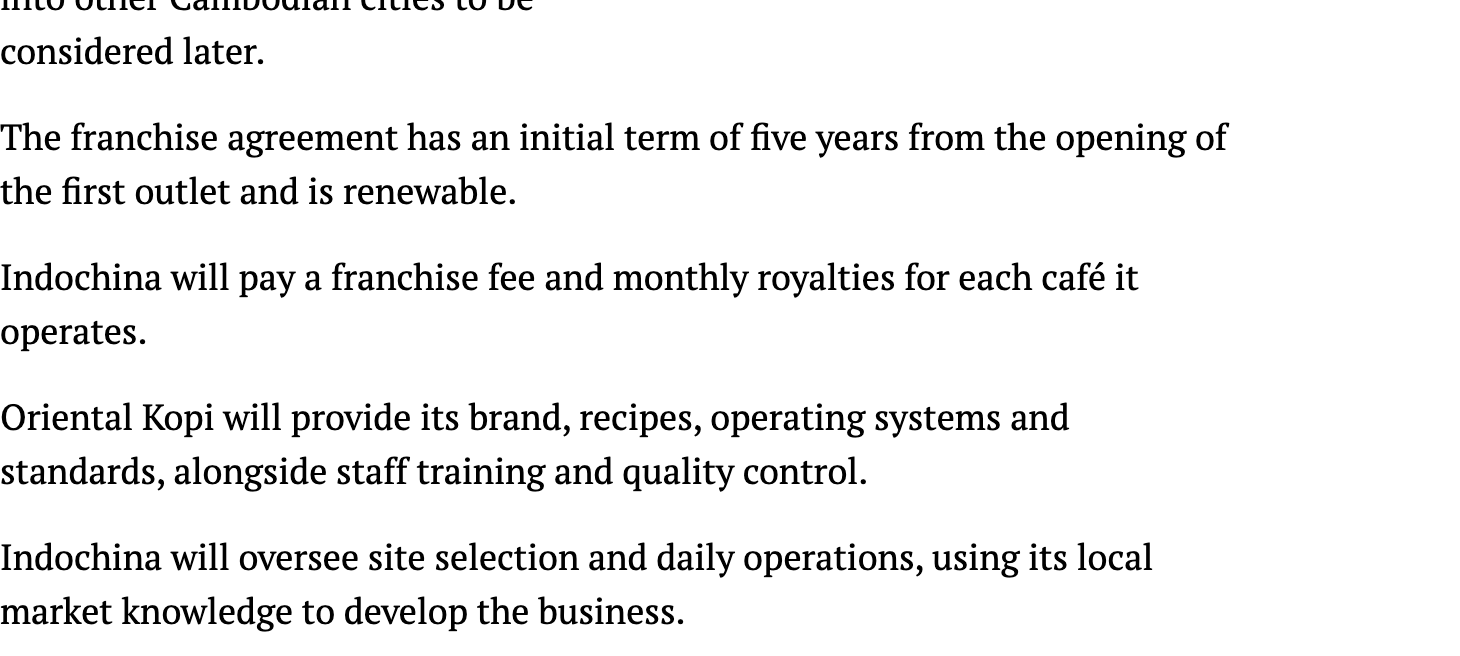
The Cambodia terms as reported: a five-year initial term from the first outlet, a franchise fee and monthly royalties per café, and brand, recipes, operating systems and staff training supplied by Oriental Kopi. Source: QSR Media, 24 November 2026, article body cropped to the terms paragraphs.
The initial term runs five years from the first outlet, renewable; the deadline is 31 December 2026 or 365 days from signing, whichever is later, and missing it lets Oriental Kopi terminate without compensation. The royalty stays payable during disruption or closure, benchmarked to the previous month’s amount, a structure JF Apex Securities noted mirrors the Mauritius agreement. The fee and the rate are not disclosed.
Indochina Food and Beverage’s managing director, David Sambo Ngorn, said the Cambodian company had decided to partner with the brand after watching its following in Malaysia and Singapore, and plans to expand the network nationwide after the Phnom Penh opening, The Edge reported.
Why the change of mind? Three reasons are visible in the filings, and none of them is sentiment. A franchise converts expansion from capital expenditure into a fee stream, which matters when a company’s own openings are squeezing its margins. A partner with local site knowledge answers the question the company cannot answer from Petaling Jaya, which is which mall in Phnom Penh works. And after 34 outlets the company has something to sell that it did not have at 14: a documented operating system, with recipes, standards, training and quality control attached.
What Did The Menu Row Cost?
The brand’s weakest month was not financial. In early October 2026, after the company published a patriotic social media post, a user pointed out that its menus were printed in English and Chinese but not in Malay. Calls for a boycott followed. Chan apologised in Malay on Threads, and the company redesigned the menu in three languages.
The repair was cheap and fast. Reprinting about 2,000 menu books cost an estimated RM150,000, or about 0.2 per cent of forecast core earnings for FY2026, according to Hong Leong Investment Bank. The trilingual menu appeared first at the Aman Central outlet in Alor Setar on 28 October and is being rolled out, with a Tamil edition planned. Both Hong Leong and CGS International said they found no meaningful change in footfall or customer mix afterwards, and three outlets opened in the following ten days drew queues.
The lesson for any brand that crosses from a community to a country is uncomfortable but simple. Certification buys the market. It does not buy immunity inside it. Once a kopitiam is halal-certified, sells in Aeon and puts a festive box in every mall, it is no longer a Chinese business that Malaysians visit; it is a Malaysian business that every community has an opinion about, and its operating details are now public property.
What Can An SME Copy, And What Can It Not?
Five things here are portable to a business that will never open a café.
One product carries the brand. The egg tart is not the best-selling item and does not need to be. It is the reason a stranger walks in, and everything else is sold to someone who is already seated.
Certification is market access, not paperwork. Halal, ISO, halal supply-chain, export licences: the certificate is a door, and a door is cheaper than the market behind it.
Payback before scale. Ten to twelve months per outlet is why the company could grow without losing control. A business that cannot state its payback period is not ready to open a second location, let alone franchise one.
Own the format until it repeats. Oriental Kopi refused to franchise for five years, and franchised once the format was documented. Franchising a format it has not proved is selling a problem to a stranger.
Convert volume into proof. Records, awards and certifications are third-party evidence, and they cost less than advertising that nobody believes.
What does not transfer is just as important. Chan holds 42.2 per cent of the company, with executive directors Chan Yen Min at 15.57 per cent and Sean Koay Song Leng at 10.92 per cent; the concentration is what allowed five years of decisions without a committee. The brand also caught two pieces of luck that cannot be bought: a pandemic-era rent market, and a product that photographs well enough to spread without being paid for.
Last updated: 24 November 2026.
Sources
- The Edge Malaysia, “Oriental Kopi inks fourth franchise deal to expand into Cambodia”, 23 November 2026: theedgemalaysia.com
- The Star, “Oriental Kopi expands into Cambodia”, 24 November 2026: thestar.com.my
- QSR Media, “Oriental Kopi enters Cambodia through franchise agreement”, 24 November 2026: qsrmedia.com
- JF Apex Securities Research, via i3investor, “Oriental Kopi Holdings Berhad: Expands into Cambodia via Territory Franchise”, 24 November 2026
- The Edge Malaysia, “Oriental Kopi expands into Indonesia, Mauritius in overseas growth push”, 6 August 2026
- The Edge Malaysia, “Deals of 2025: Best Initial Public Offering, ACE Market”, 5 January 2026
- The Edge Malaysia, “Oriental Kopi’s expansion drive tests investor appetite amid lofty expectations”, 2026
- The Star, “Boycott calls yet to dent Oriental Kopi sales”, 27 October 2026
- The Star, “Oriental Kopi expansion on track despite menu language controversy”, 5 November 2026
- Bernama, “Oriental Kopi receives halal certification from Jakim”, 14 June 2024: bernama.com
- Vulcan Post, “Here’s the story of Oriental Kopi, the public-listed chain that made RM43mil profits last yr”, on the IPO prospectus
- Oriental Kopi, brand story and awards pages: orientalkopi.asia
- ASEAN Records, record citations for mee siam, curry laksa and char kway teow, 2025
- South China Morning Post, “How a Malaysian coffee shop menu became latest political battleground”, October 2026
- Related reading on this desk: Chinese F&B brands in Malaysia and Franchise Expo Malaysia