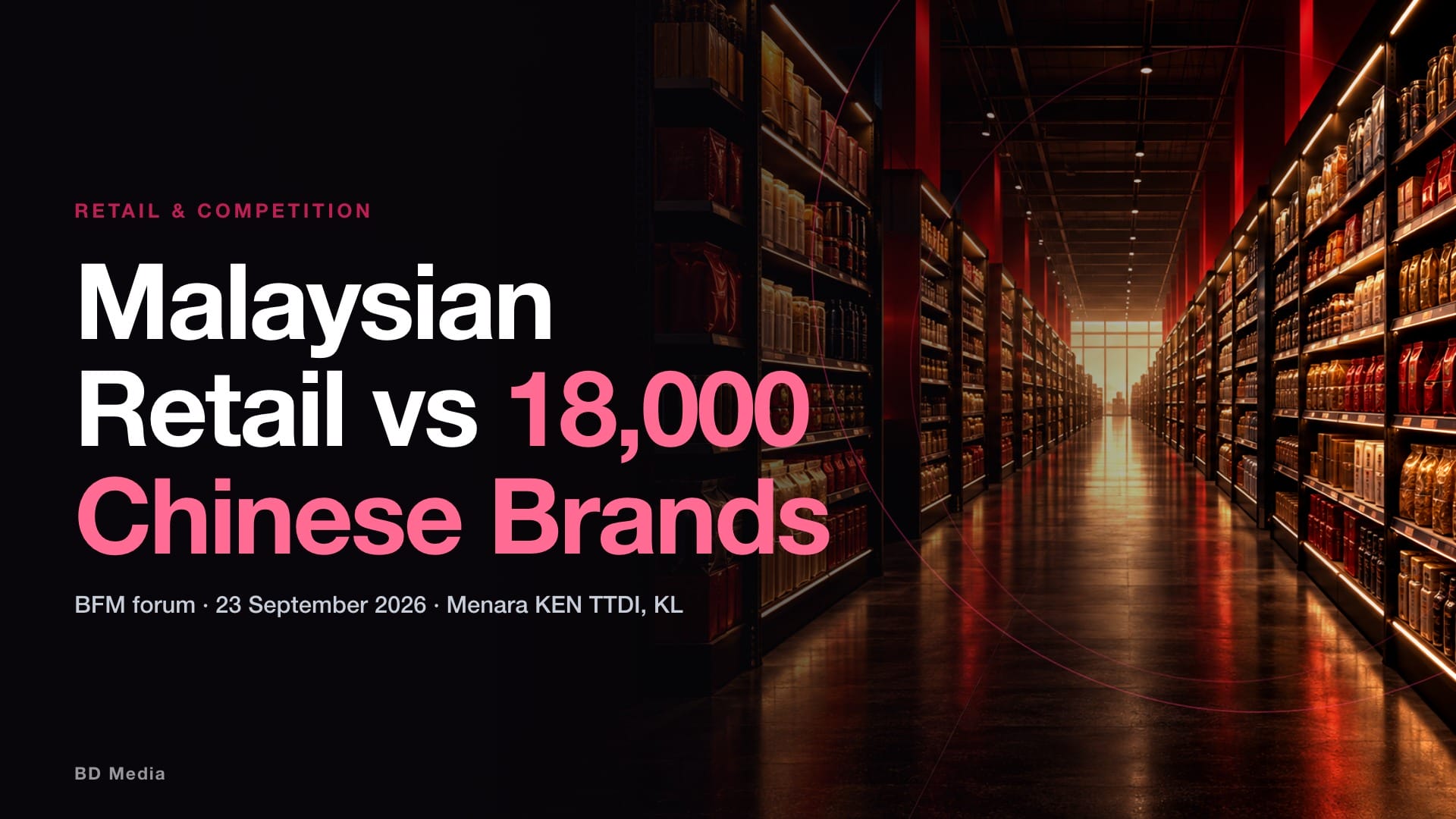
More than 18,000 Chinese food and beverage brands are now trading in Malaysia. If you run a shop, a restaurant or a mall tenancy, that number is the whole argument.
BFM is running a forum on it on Wednesday 23 September at Menara KEN TTDI in Kuala Lumpur. Not a celebration, and not a warning either. The working title is a question local retailers keep asking: how do you compete with a competitor who is cheaper than you and better funded?
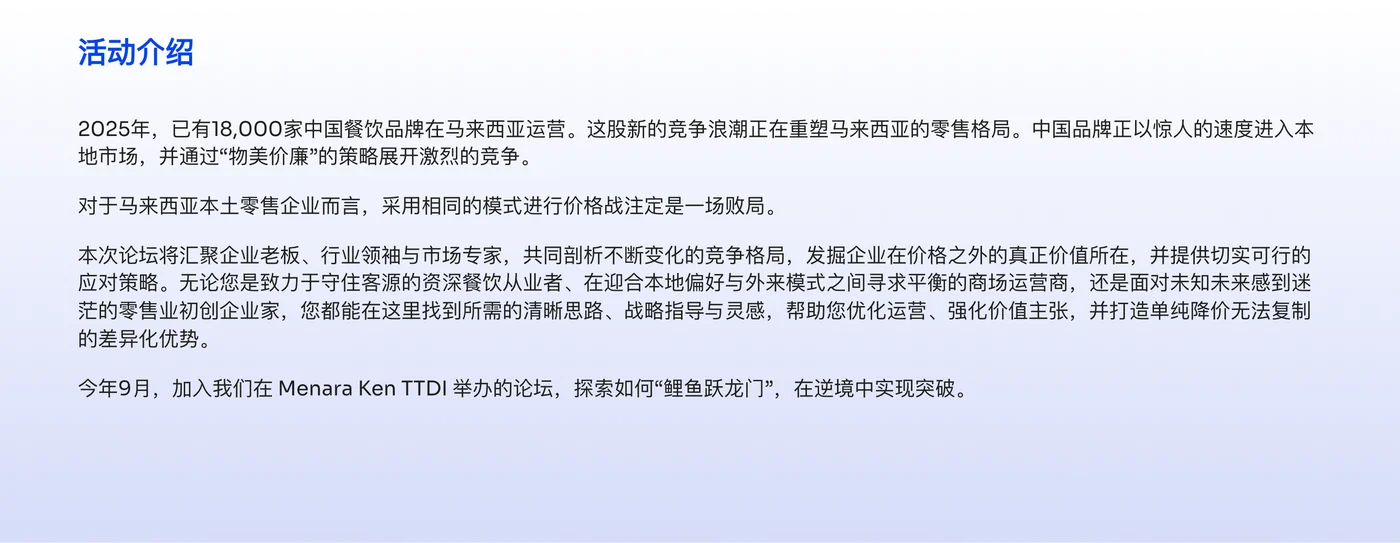
The forum is in Mandarin, and the pitch is blunt about the trap. As the organisers put it, for a Malaysian retailer, fighting the same fight on price “注定是一场败局” — a losing game.
Chinese F&B brands in Malaysia: what the numbers actually say
Start with the number, because it is doing a lot of work in this debate and it is not as solid as it looks.
The 18,000 figure comes from the Malaysia Chinese Restaurant Association. It appears in the organisers’ own event copy, and The Edge Malaysia reported the association saying there are “more than 18,000 Chinese F&B brands operating in Malaysia”, with hotpot concepts accounting for roughly a third of them.
The two figures do not agree, and we are not going to pick one. The Malaysian Reserve reported the same association’s president putting the count at 20,000 to 25,000 Chinese F&B outlets, about 60 per cent of them in the Klang Valley. “Brands” and “outlets” are not the same unit, and the range is wide. Treat the count as somewhere north of 18,000 and rising.
What is not in dispute is the squeeze. The Associated Chinese Chambers of Commerce and Industry of Malaysia surveyed 245 Malaysian business owners in November. Of those, 70.9 per cent described competition from Chinese businesses as intense or very intense, 86.4 per cent named pricing pressure as the biggest impact, and 45.1 per cent said they were pessimistic about their own industry’s competitiveness over the next five years.
What the price gap looks like in ringgit
| Product | Chinese chain | Local or Western |
|---|---|---|
| Classic milk tea | Mixue RM6.50 | Tealive RM7.55 |
| Strawberry sundae | Mixue RM5.00 | McDonald’s RM6.46 |
| Americano | Lucky Cup RM6.00 | Zus Coffee RM6.90 |
| Iced latte | Lucky Cup RM6.50 | Zus Coffee RM10.20 |
None of those gaps is enormous on its own. That is exactly the problem. The scale figures published by the chains show why they can be sustained: Mixue reported more than 700 Malaysian outlets by 2025 after entering in 2022. Chagee opened its 200th Malaysian outlet in Bukit Bintang in October 2025, out of a global network of over 6,000 stores.
Why it is not really a marketing fight
The most useful framing of this I have seen came from the president of the Small and Medium Enterprises Association, Datuk William Ng. He told The Malaysian Reserve that the big Chinese chains are supply chain companies disguised as F&B players.
That is worth sitting with. Their advantage is not a better menu or a cleverer campaign. It is procurement at a scale no single Malaysian operator can reach, central kitchens, automated inventory, and franchise models that drop into a new location like a plug. His line was that they can run on razor-thin margins “that would instantly bankrupt a typical local SME”.
So the advice that follows is not “try harder”. It is “stop choosing that battlefield”. Localisation, product differentiation and community loyalty are the three he names — the things a chain cannot buy at scale.
The rent problem shows up at renewal, not on day one
There is a second squeeze that gets less attention and hurts more. Mall operators and landlords prefer large foreign chains: they have the financial backing, the proven model and the foot traffic. They can commit to multiple outlets and long leases and spend heavily on fit-out.
The practical risk to an established local operator is rarely a sudden eviction. Malaysian tenancy law generally protects the term of a signed lease. The exposure lands at renewal — a landlord who has watched a nearby unit let for 30 to 50 per cent more to a new entrant has a reason to push hard, or to prefer a tenant who will pay a year’s rent upfront.
What the 23 September forum covers

This is the same series and the same room that BFM used for its April SME forum, which we covered in full here. Three panels this time, all on the retail question:
| Time | Panel | What it covers |
|---|---|---|
| 09:30 to 10:15 | 洞察趋势 — reading the trend | The scale and strategy of the Chinese brand push, which Malaysian retail segments are most exposed, and where local operators are genuinely outmatched and why. |
| 10:15 to 11:00 | 本土策略 — the home-ground play | How local retailers hold position: understanding local consumers, building loyalty, controlling cost without a price war, digitalisation, delivery, and better site selection. |
| 11:30 to 13:00 | 装备升级 — tools and regional expansion | Retail technology including POS and inventory systems, e-commerce integration, data-driven customer insight, automation, and financing routes to expand into ASEAN. |
The speaker list pulls in both sides of the trade. It includes the presidents of the retail chain and grocers’ associations, the founder of the direct-to-consumer brand Oxwhite, the founder of the restaurant chain Dua Nasi Malatang, a crowdfunding platform founder, an e-commerce association president, and a corporate strategy adviser who works on SME financing.
| Practical detail | Detail |
|---|---|
| Date and time | Wednesday 23 September 2026, from 09:00 |
| Venue | Space 2 & 3, Level 2, Menara KEN TTDI, Kuala Lumpur |
| Language | Mandarin |
| Organiser | BFM Media Sdn Bhd |
| Ticket, standard | RM350 |
| Ticket, group of 3 or more | RM300 per person |
| Tax | Prices exclude 8 per cent sales and service tax |
| Training claim | Priced under the HRD Corp claimable scheme, subject to approval |
| Sales close | 23 September 2026 |
One detail matters more than the price. The tickets are listed as HRD Corp claimable, which means a registered employer can often put the fee through the levy it has already paid rather than treat it as new spend. That route needs approval, so it is worth starting before the 23rd rather than on the morning.
What a local retailer can actually do
Strip the noise out and the sources converge on a short list. None of it is glamorous.
- Concede the price war, deliberately. The association’s own view is that the market will mature and brands will settle into clearer segments. Positioning above the discount floor is a strategy, not a defeat.
- Sell what does not travel. Local taste, local service, local community and a specific neighbourhood’s habits are things a centralised chain has to work harder to replicate.
- Fix the boring operations first. Inventory, POS, delivery, data. The third panel exists because this is where the gap is widest and where the tools are cheapest.
- Watch the renewal date, not the rent. The pressure arrives when a lease comes up. Knowing your renewal timeline three years out is a negotiation asset.
- Consider supplying rather than opposing. The association’s own point is that as these chains localise they need local suppliers, cold-chain logistics, renovation contractors and agencies. That is revenue, not just competition.
What is not in this article
The 18,000 figure and the 20,000 to 25,000 figure are both attributed to the Malaysia Chinese Restaurant Association through two different publications, and the association has not published a single public number that reconciles them. We have printed both rather than choose.
We also did not obtain an independent, official count of Chinese-owned F&B outlets in Malaysia. No such dataset was located while writing this. If a registration-based figure exists, it would settle the disagreement, and it is not in the public material we could reach.
Everything about the event — date, venue, price, panels, ticket terms — was taken from the organiser’s own event page on 18 September 2026, and prices and availability can change. Check them there before you buy.
Running a retail or F&B business online?
Big Domain works with Malaysian retailers on getting found and selling beyond their own neighbourhood — search, marketplaces and the storefront systems behind them. If the forum’s third panel is the part that applies to you, that is a conversation we can have.
About BD Media
BD Media is the editorial desk of Big Domain. We cover the events, rules and market shifts that Malaysian businesses have to plan around, and we name our sources so you can check them. Where two sources disagree, we print both.
Sources
- BFM, event page for the 2026 BFM 财今实战论坛, retrieved 18 September 2026 — event.bfm.my/dragon. Event date, venue, language, ticket prices and terms, panel times and titles, speaker list, and the organiser’s statement that 18,000 Chinese F&B brands were operating in Malaysia in 2025.
- The Edge Malaysia, “Swamped by China businesses seeking new markets”, cover story — theedgemalaysia.com. The Malaysia Chinese Restaurant Association’s “more than 18,000” figure, hotpot as roughly one third, and the full-chain model.
- The Edge Malaysia, “Are Chinese F&B chains reshaping Malaysia’s rental game?” — theedgemalaysia.com. The November ACCCIM survey of 245 business owners, the renewal-time rent pressure, and the 30 to 50 per cent uplift.
- The Malaysian Reserve, “Chinese F&B boom reshapes Malaysia’s affordable market”, 6 July 2026 — themalaysianreserve.com. The 20,000 to 25,000 outlet estimate and Klang Valley share, the chain store counts, the price comparisons, and Datuk William Ng’s comments.
- BD Media, “Malaysia BFM SME Practical Forum Event 2026 Recap”, 7 May 2026 — our coverage of the April edition of the same series.
Not obtained: an official, registration-based count of Chinese-owned F&B outlets in Malaysia, which is why the association’s two published figures are both shown rather than reconciled.