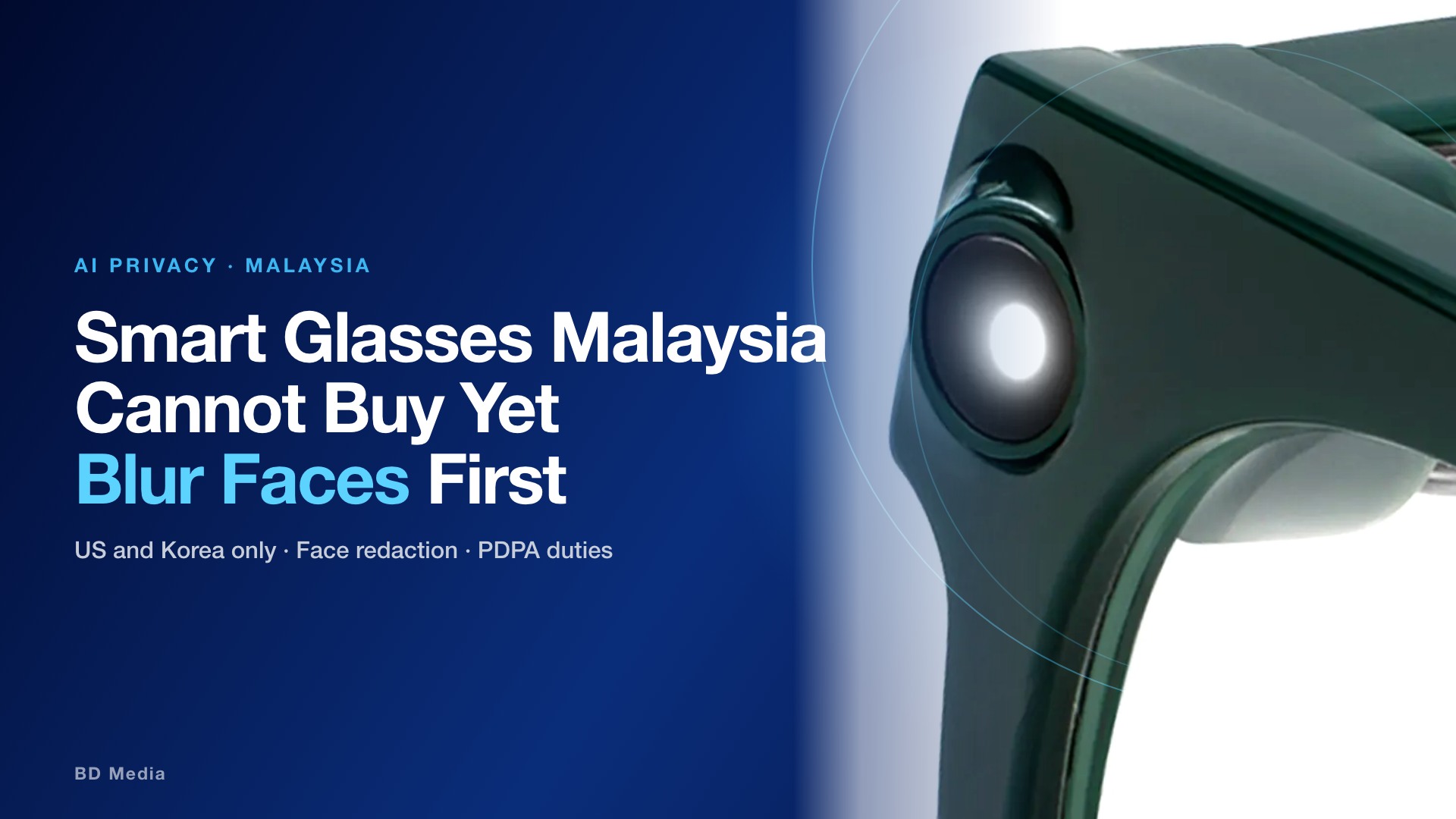
Google’s Gemini glasses reach shop counters in the United States and South Korea on 10 December. Warby Parker, which makes three of the styles, lists roughly 41 grams and a 12-megapixel camera sitting above the bridge of the nose. Launch pricing is set in US dollars and no ringgit price has been published anywhere. For a Malaysian reader the price is academic. These will not be sold here, and no smart glasses Malaysia can currently buy work the way these do.
The rule set is what travels. Google has published, in plain language, what its camera is not allowed to do. That matters to any Malaysian business that expects staff or customers to be filmed by a device on someone’s face, because this is the first consumer wearable to ship with its privacy limits written into the hardware rather than buried in a terms page.
Why can’t smart glasses Malaysia be bought in stores yet?
Google’s own footnote puts availability at the United States and Korea. Warby Parker, one of the two eyewear partners, sells only through its own US stores and website. Gentle Monster, the other, covers the US and South Korea. Samsung has announced the retail date as 10 December. Warby Parker’s press release is looser, saying deliveries begin “mid-December”.
Nothing in either company’s material mentions Malaysia, Singapore or any other Asean market. There is no local price, no carrier bundle, no regulator filing to point at. Any smart glasses Malaysia sees this year will arrive as personal imports. Anyone who wants to handle a pair this year is buying grey or waiting.
| Line | Markets | Timing |
|---|---|---|
| Warby Parker, styles Alden, Reid and Wren, optical and sun | United States | Pre-orders open 12 November 2026 (Warby Parker); deliveries from mid-December |
| Gentle Monster, six styles, per Samsung | United States and South Korea | Retail 10 December 2026, per Samsung |
Source: Warby Parker Inc. press release, 12 November 2026 (styles, markets and delivery timing); Samsung announcement as reported by MySmartPrice, November 2026 (Gentle Monster markets and the 10 December date). Launch pricing is set in US dollars. No ringgit conversion is asserted here.
What does Google’s camera refuse to do?
The commitments come from Shahram Izadi, Google’s vice president and general manager for XR, in a post dated 12 November 2026. Read as a list, they are unusually specific for a product launch.
Camera visuals are not saved into Gemini History. They are not used to train models. They are not used to target ads. Data sitting on the frames is encrypted, and data leaving them for a phone or the cloud is encrypted in transit. Every pair has a physical power switch, so the hardware can be made inert.
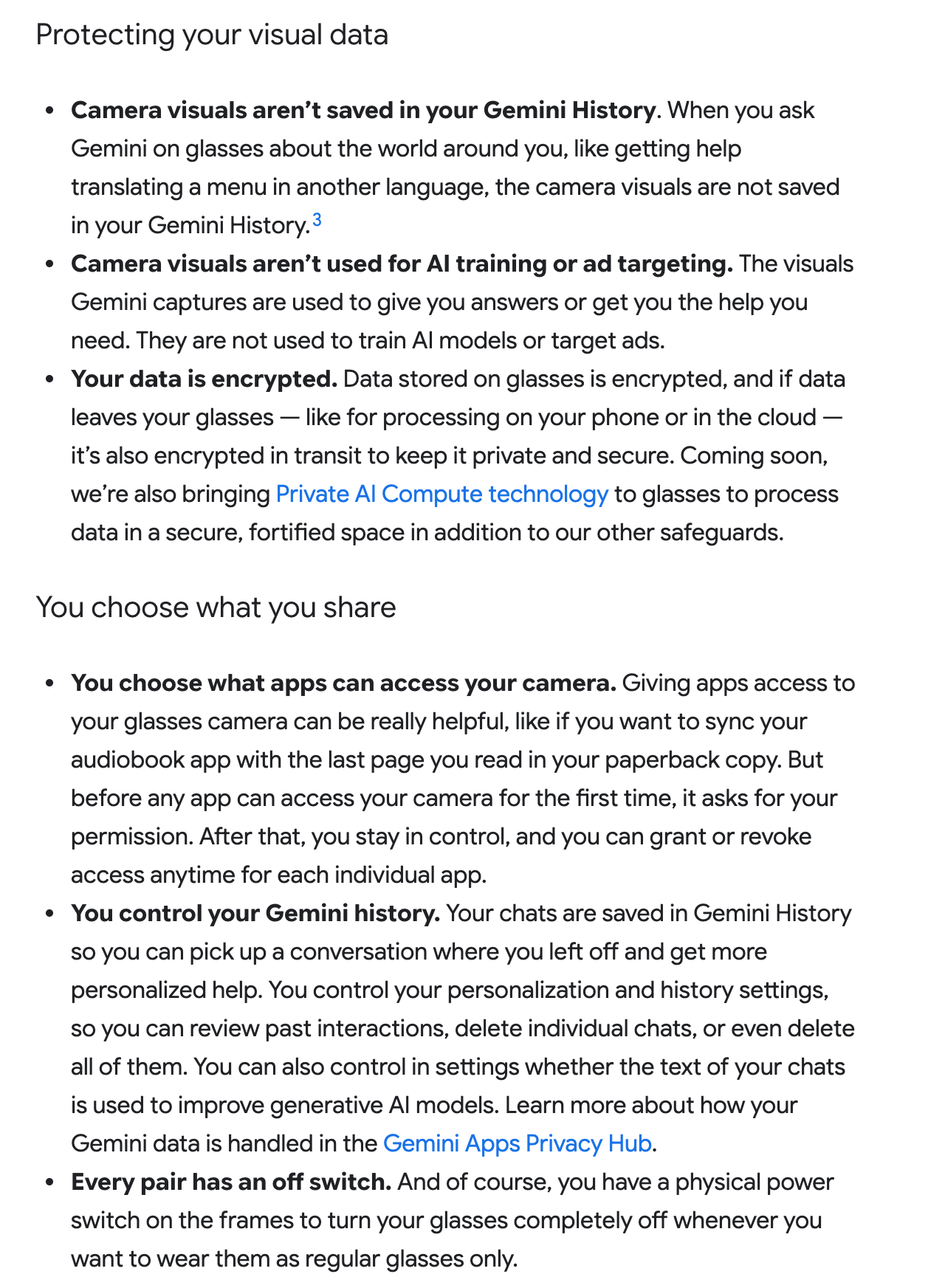
Google’s own wording on what happens to camera visuals. Source: Google, Designing for privacy on intelligent eyewear, 12 November 2026.
Then comes the part that decides whether any of the rest is credible. The indicator light is not decorative. Google says sensors detect if it has been covered or tampered with, and if they do, the glasses will not take the photo or video at all. A wearer cannot switch the warning off and keep the camera.
Google has pushed the same rule outward into its own stores. Its Shopping and Ads policies forbid promoting products that disable or hide recording indicator lights on smart glasses. Google Play bans apps that use the camera for social live-streaming or real-time facial identification. It also bans apps that change how the light behaves. Setup requires an 18-or-over Google Account.
Are bystanders’ faces blurred before Gemini sees them?
This is the detail most coverage skipped. When a wearer asks Gemini about something in front of them, other people are often in frame. Google says the glasses are designed to automatically redact bystanders’ faces before the visual reaches Gemini for processing.
If that works as described, the person standing beside the wearer is never a face in a model request, and never a training candidate. The claim is a design intent rather than a test result. There are no independent measurements of the redaction yet, and a determined wearer can still photograph a crowd straight into the gallery, where the light and the policy are the only controls.
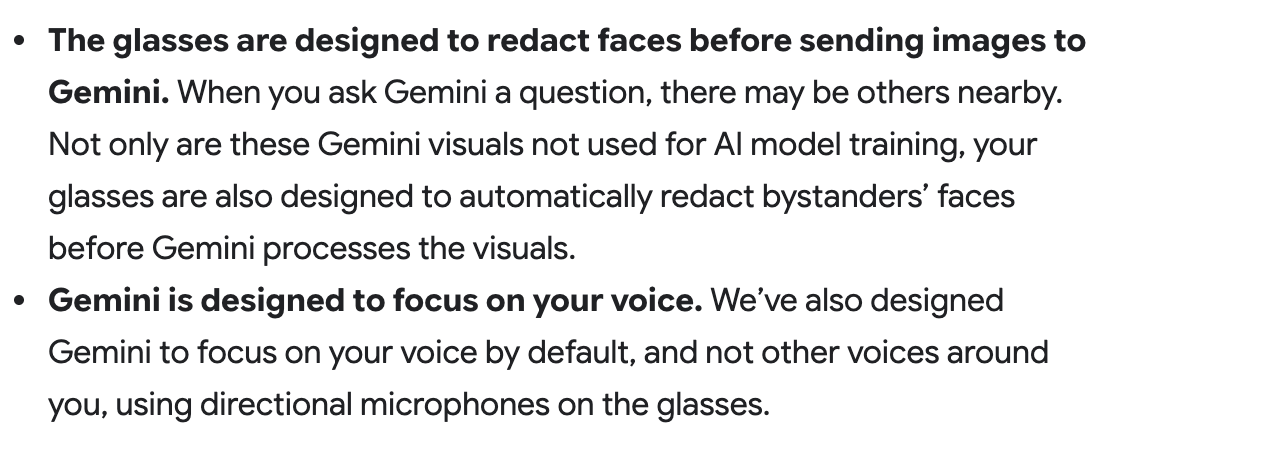
The redaction claim in Google’s own words, plus the directional-microphone behaviour. Source: Google, Designing for privacy on intelligent eyewear, 12 November 2026.
Those three rules are contractual. Agreeing to them is a condition of use, and Google states that breaking them is a breach of its Terms of Service that can result in a user’s glasses being disabled. Three obligations, in other words, that a buyer accepts on screen: ask first, stay out of bathrooms and clinics and schools, and leave the light alone.
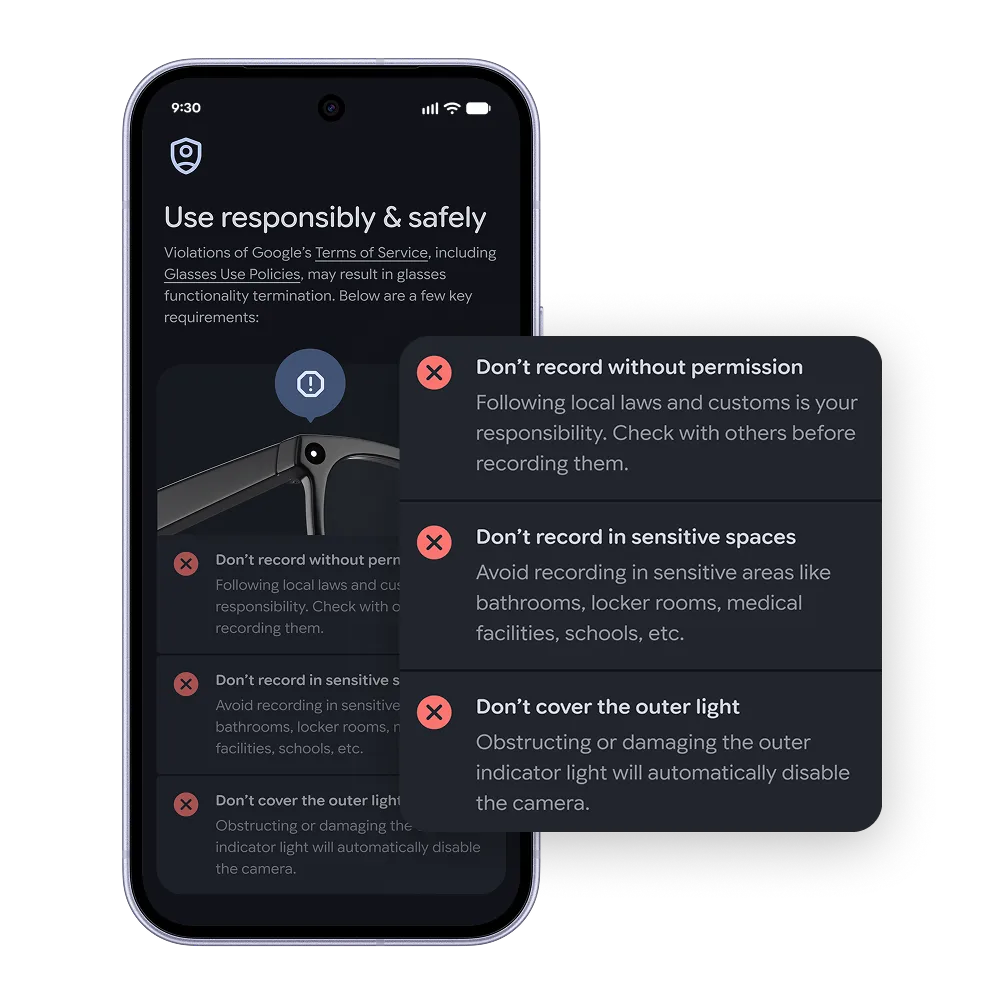
The setup screen every pair shows before use. Source: Google, Designing for privacy on intelligent eyewear, 12 November 2026.
Where does this collide with Malaysia’s PDPA?
Malaysia’s Personal Data Protection (Amendment) Act 2024 came into force in three phases, the last on 1 June 2025, per DFDL’s summary of the commencement notification. From that date, data controllers and processors must appoint at least one data protection officer and notify the Commissioner of the appointment, and controllers must report a personal data breach. Mayer Brown’s reading of the amendment puts the maximum fine for breaching the data protection principles at RM1,000,000, up from RM300,000, with up to three years’ imprisonment.
The same amendment expanded “sensitive personal data” to include biometric data. A face is biometric data. Which means a Malaysian organisation that operates camera wearables, or permits them on its premises, is not a bystander to this conversation. It is a data controller for images of people who never agreed to anything.
The Personal Data Protection Department’s published FAQ puts the appointment threshold at processing personal data of more than 20,000 data subjects, or sensitive and financial data of more than 10,000, or any activity requiring regular and systematic monitoring. A retail chain running a few pairs for stock checks will not clear that bar on headcount. A mall, a hospital or a factory floor might clear it on monitoring.
Is the engineering worth copying into a local policy?
The hardware has earned some respect. Warby Parker’s own figures put the frames around 41 grams, which is ordinary-spectacles weight, with nine hours on a charge and a case that refills them seven times. Sixty-four gigabytes on board, a 12-megapixel ultra-wide camera at a 103-degree field of view. No display in the lens, which is the right call for something worn to a meeting.
“We considered every detail, from the proportion of each silhouette to the interplay of color, material, and finish, with the same attention to fit, comfort, and optical quality that defines Warby Parker.” Neil Blumenthal, co-founder and co-CEO, Warby Parker. Press release, 12 November 2026.
Pairing is tight out of the gate. The compatibility list Samsung published covers Pixel 7 and newer on Android 17, recent Galaxy S, FE or Z models on One UI 9.0, or an iPhone 13 Pro and newer with at least 6 gigabytes of RAM on iOS 26.6. That last clause quietly excludes a lot of phones still in daily use across this region.
So the honest read for a Malaysian business is this. The privacy architecture is the most serious attempt yet at making a face-worn camera socially survivable, and it deserves to be copied. But it is being copied into a market we cannot buy into, on a compatibility list that assumes hardware many local customers do not carry. The policy will arrive here before the product does. That gap is where the compliance work sits.
One practical note for anyone drafting an internal policy now. The obligations that matter are not the ones Google wrote. They are the ones staff accept when they put a camera on. Ask-first, sensitive-spaces, indicator-light is a reasonable floor to copy into a workplace acceptable-use policy this quarter, while the regulator is still quiet on wearables and before the first dispute arrives.
Sources
1. Google, Designing for privacy on intelligent eyewear, Shahram Izadi, VP and GM, XR, 12 November 2026: blog.google
2. Google, Intelligent eyewear collections with Gemini features, November 2026: blog.google
3. Warby Parker Inc., Warby Parker Opens Preorders for First Intelligent Eyewear Collection, 12 November 2026 (source of the Neil Blumenthal quotation): investors.warbyparker.com
4. MySmartPrice, Samsung’s Gemini-Powered Smart Glasses Launch on December 10, November 2026: mysmartprice.com
5. Personal Data Protection Department, Malaysia, Frequently Asked Questions on Data Protection Officer thresholds: pdp.gov.my
6. Mayer Brown, From Legislative Reform to Practical Guidance: Key Amendments to Malaysia’s PDPA, July 2025: mayerbrown.com
7. DFDL, Malaysia: Implementation of the Personal Data Protection (Amendment) Act 2024: dfdl.com
About the author
Dr Henry Tye writes on AI, data protection and infrastructure for BD Media, the editorial desk of Big Domain in Penang. This article is analysis of published primary sources and is not legal advice.