Malaysia exported RM1.571 trillion of goods in the first nine months of 2026, up 34.0 per cent on the same period last year, with total trade at RM2.910 trillion. That demand did not come only from the conglomerates. A growing share of it came from companies with fewer than 200 staff that learned how to export from Malaysia with Alibaba.com, put a product in front of a buyer they had never met, and answered the enquiry before their competitors woke up.
Alibaba.com is the shortest route from a Malaysian factory floor to an international buyer. A seller account is free to open, a listing goes live the day it is published, and the first enquiry can arrive inside a week. What separates the sellers who get orders from the ones who get nothing is rarely the platform. It is four things prepared beforehand: the company file, the HS code, the listing, and a reply that can be sent in an hour.
This guide is that sequence, in the order that works. Every cap and figure below is published by MATRADE or by Royal Malaysian Customs, and each step ends with something a founder or an ops lead can finish this week.
How to export from Malaysia with Alibaba.com: what the finished file looks like
- A company file that clears seller verification on the first attempt
- An HS code for each of the top ten products, written into the listing itself
- A MATRADE membership, which is the front door to the funding in step 8
- A live Alibaba.com listing with real photographs, a specification table, an MOQ and a lead time
- A quotation template with an Incoterm, a payment term and a delivery port already decided
1. Assemble the company file before touching a platform
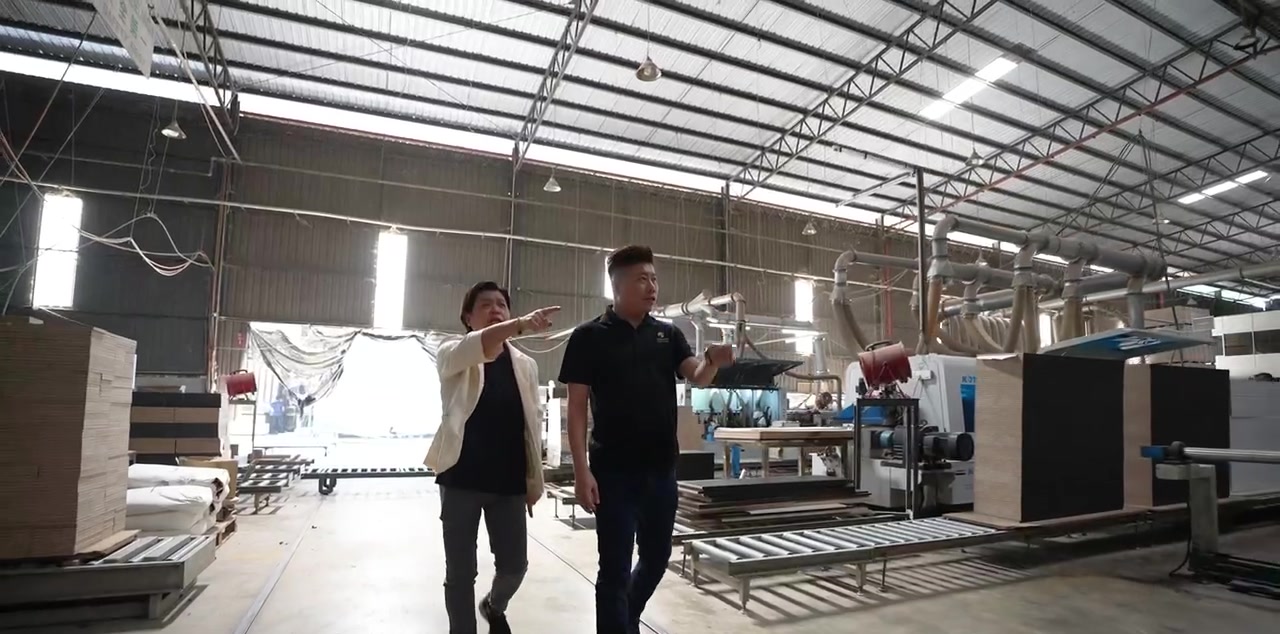
Photo: BD Media — the production floor at Furnizone, Penang. A buyer cannot visit this; the paperwork in step 1 is what stands in for the visit.
Seller verification on a cross-border marketplace asks for almost exactly the same papers MATRADE asks for on an export incentive application. Assemble the file once and it serves both. The list below is MATRADE’s own:
- SSM or SKM registration (Form 9, Form D, or the SKM equivalent)
- Latest audited financial report for a Sdn Bhd; latest management account for a sole proprietorship or partnership
- Form of Annual Return of a Company Having Shareholders, for a Sdn Bhd
- Latest EPF statement
- Product brochure
- A Letter of Declaration of Products Made in Malaysia, required for trading companies
Two of these stop people cold. The audited report is the long pole: a company that has never been audited, or whose audit is a year behind, needs weeks rather than days, so start it first. The origin declaration surprises traders — a company that buys Malaysian goods and resells them abroad has to declare the origin in writing, and it is a one-page document.
2. Classify the product and know its HS code
A product’s Harmonised System code is what Royal Malaysian Customs uses to classify the goods. It drives the duty rate, the freight quote and the import paperwork on the buyer’s side, which is why a professional buyer asks for it in the first two emails. Take the code from Customs’ tariff material, not from a competitor’s listing, and put it in the product description and the specification table.
Do this for ten products, not a thousand. Ten listings with a real code, a real specification and a real lead time will outperform a catalogue of two hundred vague entries, because the platform rewards completeness and buyers filter on it.
3. Register as a MATRADE member
Membership is the front door to every scheme in this article, and nothing downstream is reachable without it. It is also what makes the Market Development Grant available, which carries a lifetime limit of RM300,000 for an eligible Malaysian SME company. Do this before the platform, not after, because the membership number is asked for at more than one point in the chain.
4. Pick the route: platform direct, or a local partner
Alibaba.com runs a free seller account and a paid Gold Supplier membership, and the difference is visibility rather than access. Both put a product in front of buyers; the paid tier buys placement, a minisite and analytics. What actually varies between going direct and going through a partner is who does the work — product photography, listing copy, keyword advertising and the buyer replies.
Malaysia has a real intermediary layer here. One Alibaba.com partner was appointed to enrol SMEs in Kedah, Penang, Perak and Perlis, and its published package bundles a minisite, product photography, product posting and write-ups, onboarding training, local technical support and a quarterly account review. That is a genuine service with a genuine cost, and the honest way to compare it against doing it yourself is to price the hours: a founder who will shoot forty product photographs, write two hundred listings and answer enquiries at midnight should go direct; a factory whose strength is production should not.
5. Build the listing that converts
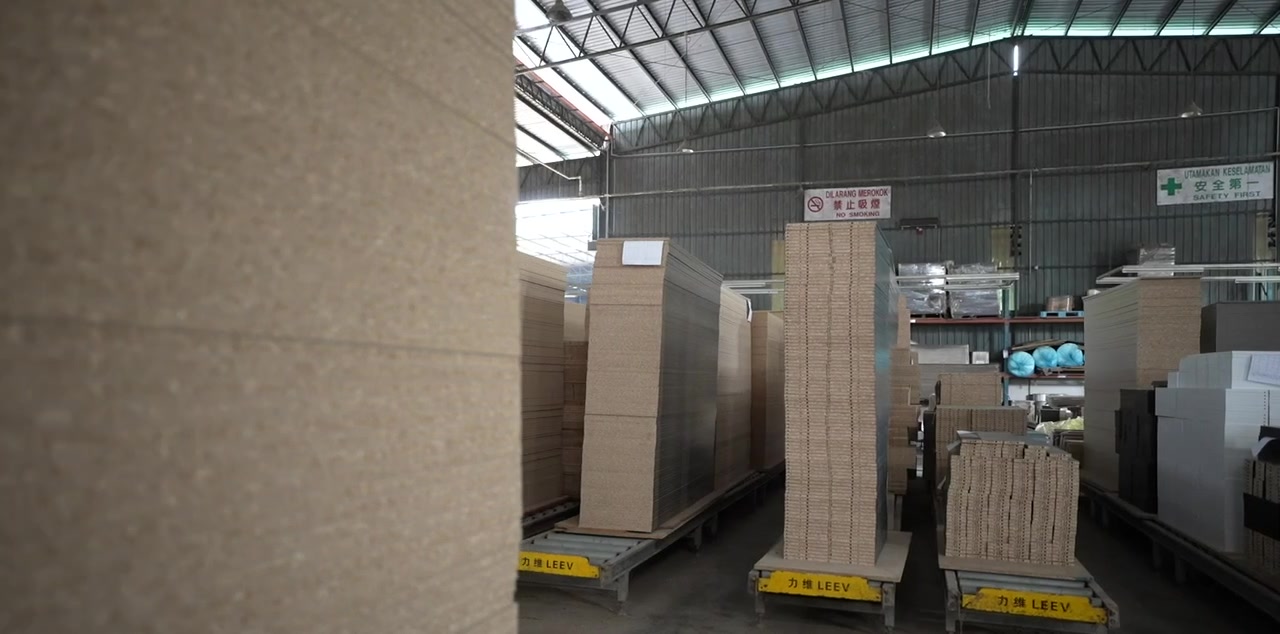
Photo: BD Media — finished panels staged at Furnizone’s Penang plant, the SME in our 6 November case study. Stock ready to photograph is what a listing is built from.
Product posting quality is the only lever a new seller fully controls in the first month. A listing that converts has six things, and none of them are optional:
| Element | What good looks like | Why the buyer needs it |
|---|---|---|
| Title | Product name plus the one attribute buyers search on — material, capacity, certification | It is the only text most buyers ever see |
| Photographs | Six or more, shot on white, plus one in use and one showing packaging | Removes the “is this a real factory” doubt |
| Specification table | Dimensions, material, weight, certification, and the HS code | Lets a buyer qualify a supplier without an email |
| MOQ | A number the factory can produce profitably | Filters out enquiries the factory cannot serve |
| Lead time | A range the factory can hold on a bad week | The single most common reason a quote is dropped |
| Price range | A tiered range, not one figure | Signals a supplier who understands volume pricing |
Source: BD Media editorial, 10 November 2026. This is the listing pattern that converts, not a platform requirement — Alibaba.com sets its own posting rules.
6. Answer every enquiry inside one working day
Response rate and response time are what separate a page that exists from a supplier a buyer will risk a deposit on. A first reply does not need a price. It needs five answers, in this order: what the buyer is understood to want, the MOQ, the lead time, the port of shipment, and the payment term accepted. A reply that lands inside a working day is already ahead of most of the quotations in that buyer’s inbox.
Keep a template. Most first enquiries are the same four questions, and a seller who answers them in fifteen minutes converts several times better than one who researches for two days. The buyer is usually talking to five suppliers at once, and the first coherent reply sets the shortlist.
7. Quote and ship without losing the margin
Three decisions turn a good listing into a paid order, and all three belong in the quotation rather than in the fourth email:
| Decision | The options that matter | What to write in the quote |
|---|---|---|
| Incoterm | EXW, FOB, CIF | Which one, and the named port — “FOB Port Klang” is a quote; “FOB” is not |
| Payment term | Telegraphic transfer, typically a deposit with the balance against documents; letter of credit for larger first orders | The exact split and what triggers the balance |
| Documents | Commercial invoice, packing list, bill of lading or air waybill, certificate of origin where the destination requires it | Who prepares each one and who pays for it |
Source: standard export practice. Documentary requirements vary by destination — confirm them with the freight forwarder before the first shipment.
The most common first-order mistake is not the price. It is quoting EXW when the buyer assumed CIF, then discovering that the freight and insurance were never in the number. Decide the Incoterm before the price, not after.
8. The funding that sits behind a Malaysian exporter
Two MATRADE schemes are built specifically for this sequence, and they pay back costs the exporter has already incurred rather than paying up front.
| Scheme | Cap per company | What it covers | Claim basis |
|---|---|---|---|
| Onboarding | Up to RM5,000 | Onboarding onto one or more cross-border e-commerce platforms, one-year subscription | Invoice and receipt from the platform or its authorised partner, plus a screenshot of the company’s page on the platform |
| Digital Marketing & Training | Up to RM20,000 | Digital marketing activity and/or e-commerce training to sustain participation on the platform | Invoice and receipt, an outcome report of the marketing activity, and a training attendance sheet with certificates |
| Market Development Grant | RM300,000 lifetime | Market development activity for eligible Malaysian SME companies | Per MATRADE’s claim documentation |
Source: MATRADE’s eTRADE Programme 2.0 scheme description and application document lists, and its Financial Assistance page, read 8 November 2026. Both eTRADE schemes are reimbursement-based. Caps, eligibility and scheme status are set by MATRADE and change from time to time — confirm the current position with MATRADE before committing spend against any of them.
The practical point is the sequence, not the paperwork: a company that already holds the invoices, receipts, page screenshot and outcome report claims in weeks, and a company that starts assembling evidence after it has spent the money joins a queue. Build the case file as the spend happens.
Where the demand is coming from
| Measure | January–September 2026 | Year on year |
|---|---|---|
| Total trade | RM2.910 trillion | +30.1 per cent |
| Exports | RM1.571 trillion | +34.0 per cent |
| Imports | RM1.339 trillion | +25.7 per cent |
| Trade balance | RM232.38 billion | +115.7 per cent |
Source: MATRADE, homepage panel headed “Malaysia’s Trade Performance — JANUARY – SEPTEMBER 2026 (Year on year growth)”, matrade.gov.my/en, captured 8 November 2026.
Exports of RM1.571 trillion, imports of RM1.339 trillion, and a trade balance of RM232.38 billion. Read that as an exporter and the message is straightforward: the buyers exist, the trade lanes are open, and the constraint sits on the seller’s side of the transaction. Which is exactly what steps 1 to 7 are for.
What to do this week
- Pull the six company documents into one folder. If the audit is behind, start it now; that is the long pole and it is measured in weeks.
- Get HS codes for the top ten products. Ten, not a thousand. The listing that converts is the one with a code and a lead time.
- Register the MATRADE membership. Nothing downstream is reachable without it.
- Decide DIY or partner in writing. Name who owns photography, listing copy and buyer replies, and what that costs.
- Draft the five-line first reply. MOQ, lead time, port, payment term, and what you understand them to want. Save it as a template.
What this guide does not settle
Alibaba.com’s own seller fees and Gold Supplier pricing are set by the platform and change; they are not quoted here because a price read off a partner’s page is not the platform’s price — ask for the current schedule in writing. Duty rates and destination documentary requirements depend on the HS code and the importing country, so confirm both with Royal Malaysian Customs and the freight forwarder before the first consignment. And the funding caps above are the published caps, not an entitlement: eligibility is assessed, and MATRADE is the only party that can confirm it.
Last updated: 10 November 2026 — MATRADE’s eTRADE programme page, its financial assistance page and its trade performance panel were opened and captured for this edition. The document list, the caps and the trade figures are quoted from those pages, not from a partner’s marketing.
Sources
- MATRADE, Financial Assistance — the eTRADE Programme 2.0 scheme description, the Onboarding Scheme and Digital Marketing & Training Scheme caps of RM5,000 and RM20,000, the reimbursement basis and evidence lists, and the Market Development Grant lifetime limit of RM300,000 — matrade.gov.my/en/export-to-the-world/step-6-financial-assistance
- MATRADE, eTRADE Programme — the application document list quoted in step 1 (SSM/SKM registration, audited report or management account, annual return, EPF statement, product brochure, Letter of Declaration of Products Made in Malaysia) — matrade.gov.my/en/export-to-the-world/step-6-financial-assistance/etrade-programme
- MATRADE, trade performance panel, January–September 2026 (total trade RM2.910 trillion +30.1%; exports RM1.571 trillion +34.0%; imports RM1.339 trillion +25.7%; trade balance RM232.38 billion +115.7%), captured 8 November 2026 — matrade.gov.my
- Alibaba.com partner appointment covering Kedah, Penang, Perak and Perlis, and the bundled service list — sme.asia, and the partner’s own announcement at exabytes.my
- BD Media, Alibaba.com Malaysia: How One Penang Factory Reached 30+ Export Markets — media.bigdomain.my
BD Media is the editorial desk of Big Domain. This article reports MATRADE’s published scheme caps and Malaysia’s trade figures as at November 2026, and standard export practice for a first-time seller. Scheme caps and status are set by MATRADE; duty rates and destination requirements are set by the authorities of the importing country. It is not tax, legal or customs advice for any specific business.