
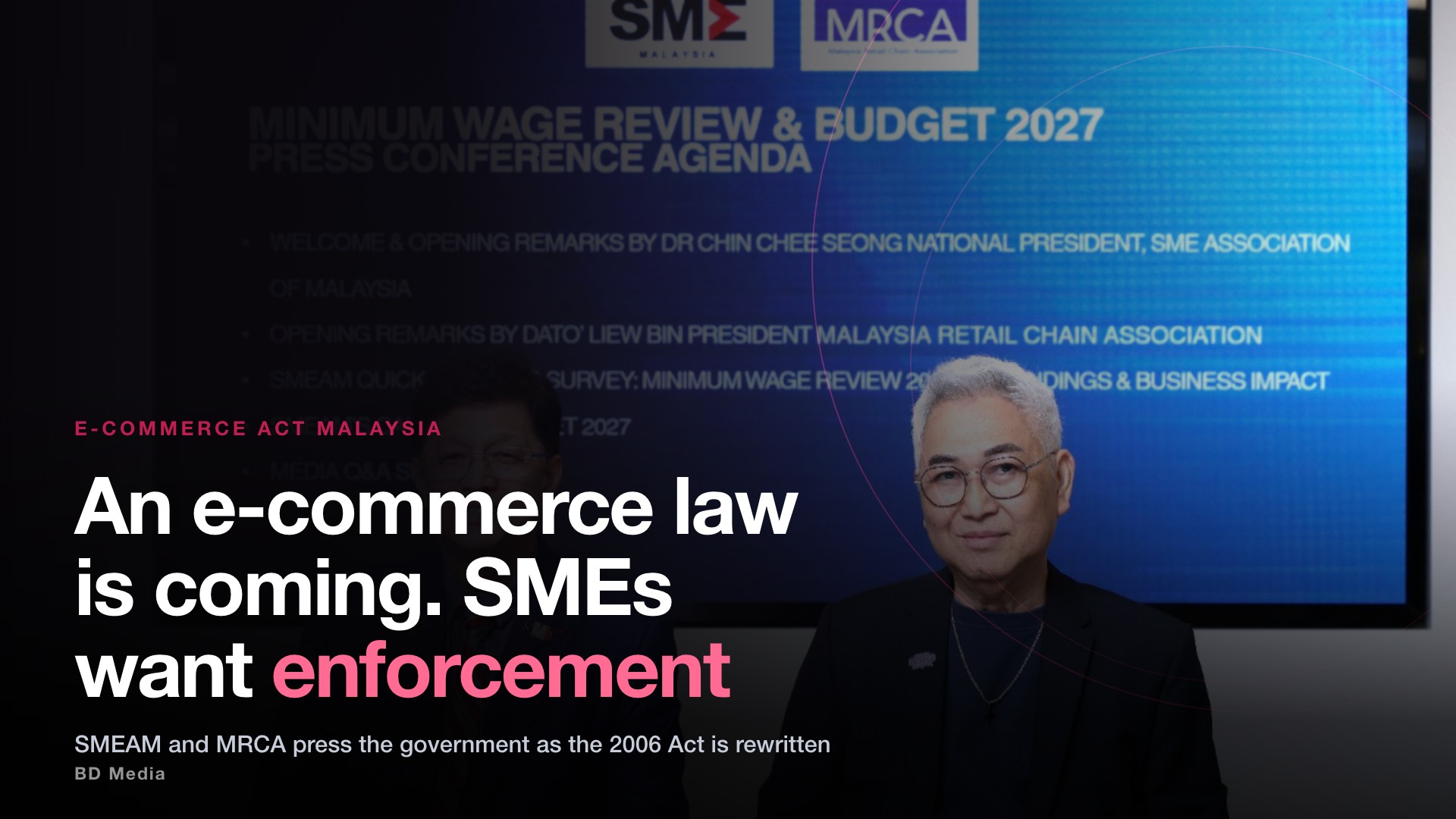
Malaysia is rewriting the E-Commerce Act Malaysia has operated under since 2006, and the two associations representing the country’s SMEs and retail chains say the rewrite means nothing without enforcement. The SME Association of Malaysia and the Malaysia Retail Chain Association told a joint press conference on 2 October 2026 that the influx of low-priced products through cross-border platforms is hollowing out local retail, and that the bill replacing the Electronic Commerce Act 2006 must close that gap.

The Edge Malaysia, SMEAM on the e-commerce law, 2 October 2026. Captured 3 October 2026 from https://theedgemalaysia.com/node/820386
What the E-Commerce Act Malaysia rewrite covers
The timeline is now public. Domestic Trade and Cost of Living Minister Datuk Armizan Mohd Ali said on 19 September that the new bill should be finalised this year, with engagement planned across platforms, service providers and industry players. The MCMC has separately said registration requirements for e-commerce platforms are being considered – a step that would touch Shopee, Lazada and TikTok Shop directly.
| The E-Commerce Act Malaysia rewrite | Detail | Source |
|---|---|---|
| Law being replaced | Electronic Commerce Act 2006 | Act 658, laws of Malaysia |
| Government target | Bill finalised this year | Minister Armizan, 19 Sep 2026 |
| Regulator position | Platform registration requirements under consideration | MCMC, as reported 2 Oct 2026 |
| Association ask 1 | Enforcement at entry and on complaint handling | SMEAM, 2 Oct 2026 |
| Association ask 2 | Foreign platforms to register locally | MRCA, 2 Oct 2026 |
| Consultation status | SMEAM says it has not been consulted | SMEAM, 2 Oct 2026 |
The register-locally proposal
MRCA president Datuk Liew Bin put forward the sharpest structural ask: force foreign platforms to register in Malaysia. “What we propose to the government is to force them to register here. So, when we force them to register, we can regulate them,” he said. Registration, in the associations’ logic, is the precondition for everything else – product safety enforcement, seller identity verification, and a working complaints channel for businesses and consumers.

The Edge Malaysia, replacement of the Electronic Commerce Act 2006, 2 October 2026. Captured 3 October 2026 from https://theedgemalaysia.com/node/820386
The gap SMEAM flagged
SMEAM says it has not been consulted on the bill’s contents – “there’s no discussion with us,” Chin said. For a law deciding platform liability, seller verification and cross-border flows, the absence of the SME voice at the drafting stage is the associations’ core procedural complaint.
What it means for sellers
For Malaysian sellers on Shopee, Lazada and TikTok Shop, the bill’s practical impact hinges on three things: whether foreign platforms must register locally, whether product standards are enforced at entry rather than after complaints, and whether a genuine reporting channel exists for non-compliant goods. SMEAM’s Budget 2027 submission and the enforcement ask are two halves of the same cost-competitiveness argument.
The enforcement problem is structural, not political
It is easy to read this as local retailers complaining about cheap imports. The more useful reading is a regulatory capacity problem. Malaysia’s consumer protection and product safety regime was built for goods arriving through ports and licensed importers, where a single inspection point catches a container. Cross-border e-commerce replaced the container with millions of individually addressed parcels, each below the threshold that triggers duty or inspection. No amount of new legislation fixes that arithmetic on its own – which is precisely why SMEAM and MRCA keep returning to registration as the enabling condition.
Registration changes the enforcement surface. A platform with a Malaysian legal entity can be served with a notice, held to product standards, and required to suspend a non-compliant seller. A platform with no local presence can be asked nicely. That is the whole argument, and it is why the MCMC’s consideration of platform registration is the detail that matters most in this story.
What to watch next
Three markers. First, whether the bill tabled this year includes a registration or licensing regime, and at what threshold. Second, whether SMEAM and MRCA are brought into consultation before the draft is finalised – the associations’ complaint about being uninvolved is a test of the process, not the policy. Third, whether a complaints channel is created with published response times, because an enforcement regime without a reporting mechanism is a press release.
Sources
- MCMC – official website
- KPDN – Ministry of Domestic Trade and Cost of Living
- The Edge Malaysia, “SME, retail groups call for stronger enforcement amid revision of E-Commerce Act”, 2 October 2026
- The Edge Malaysia, “SME association says govt assistance in Budget 2027 should focus on outcomes”, 2 October 2026