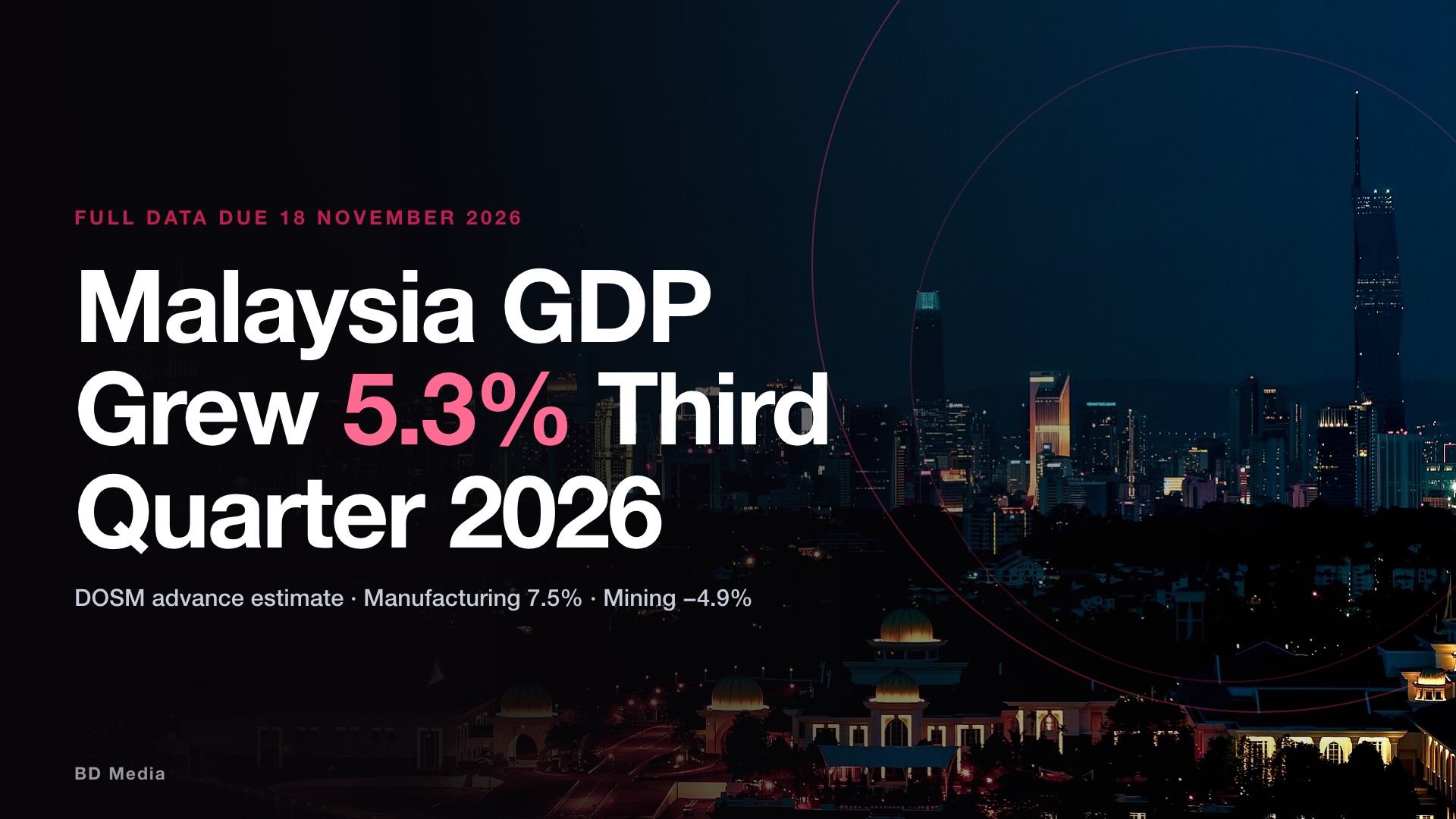
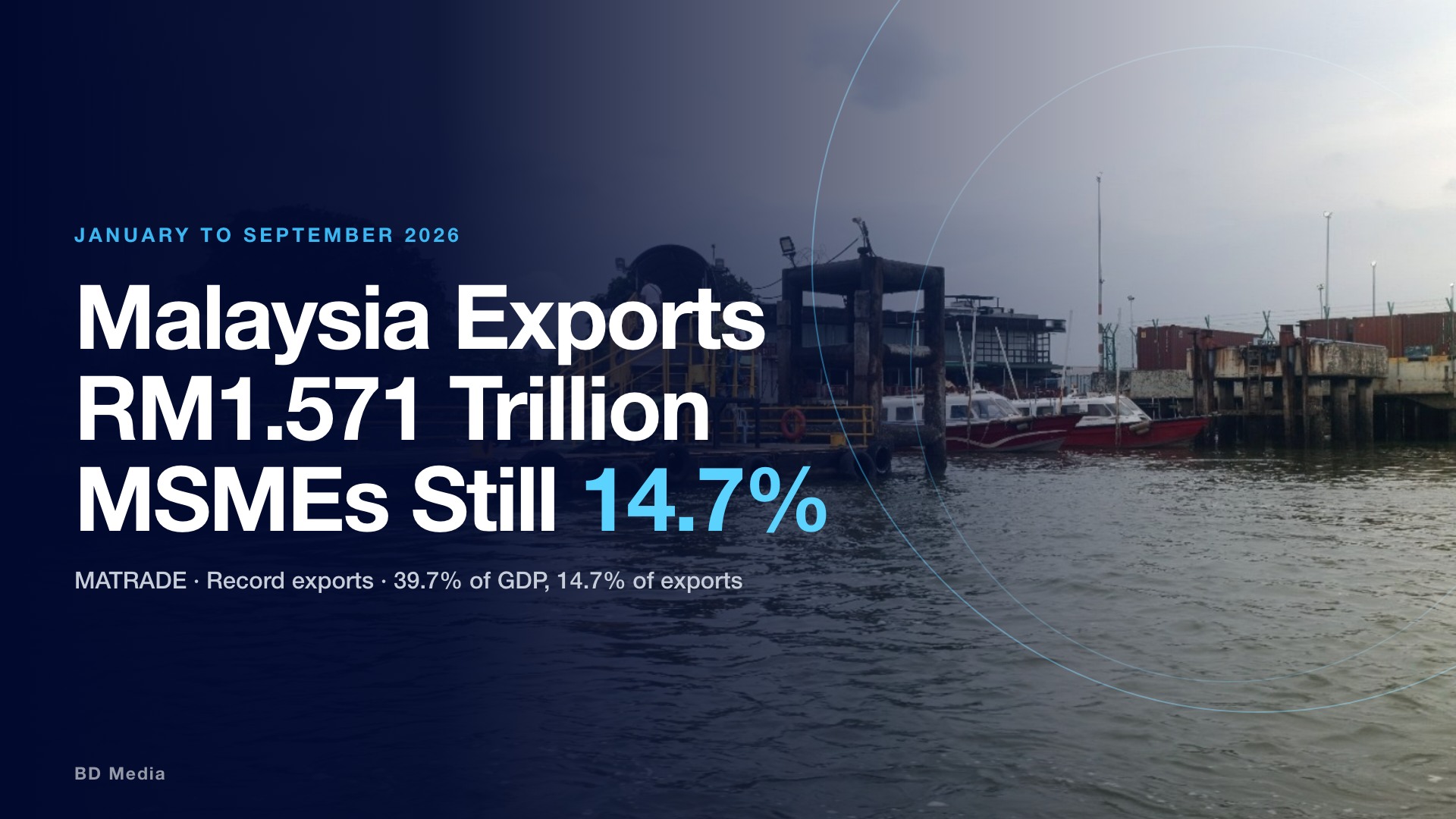
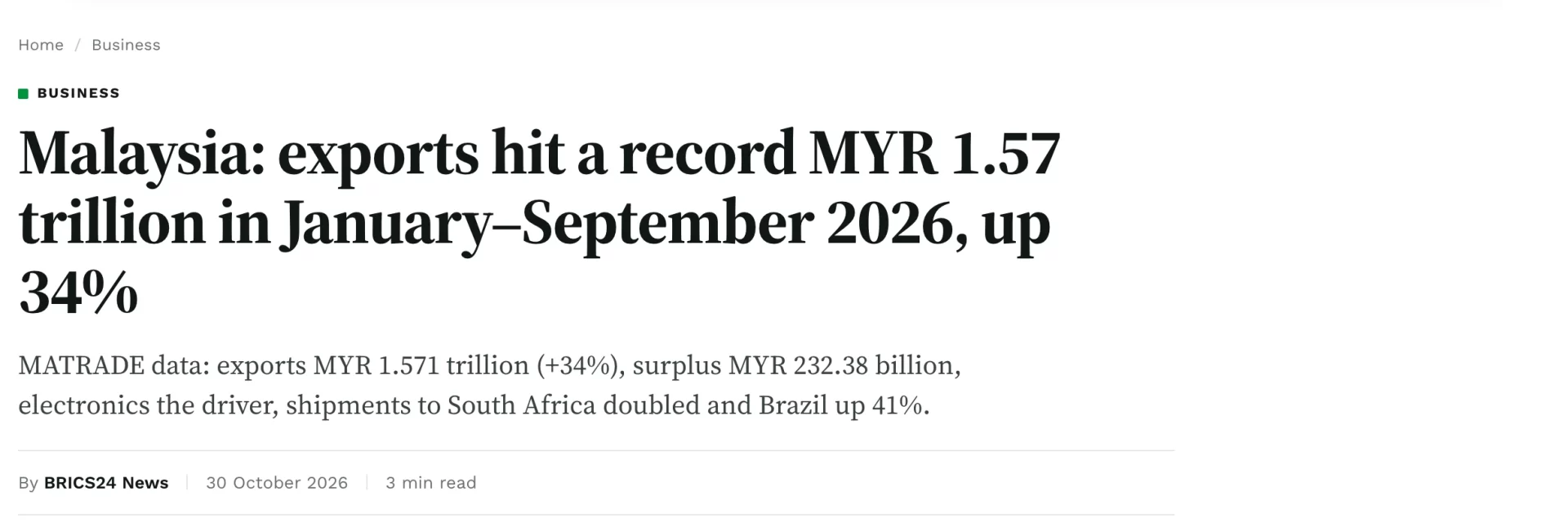
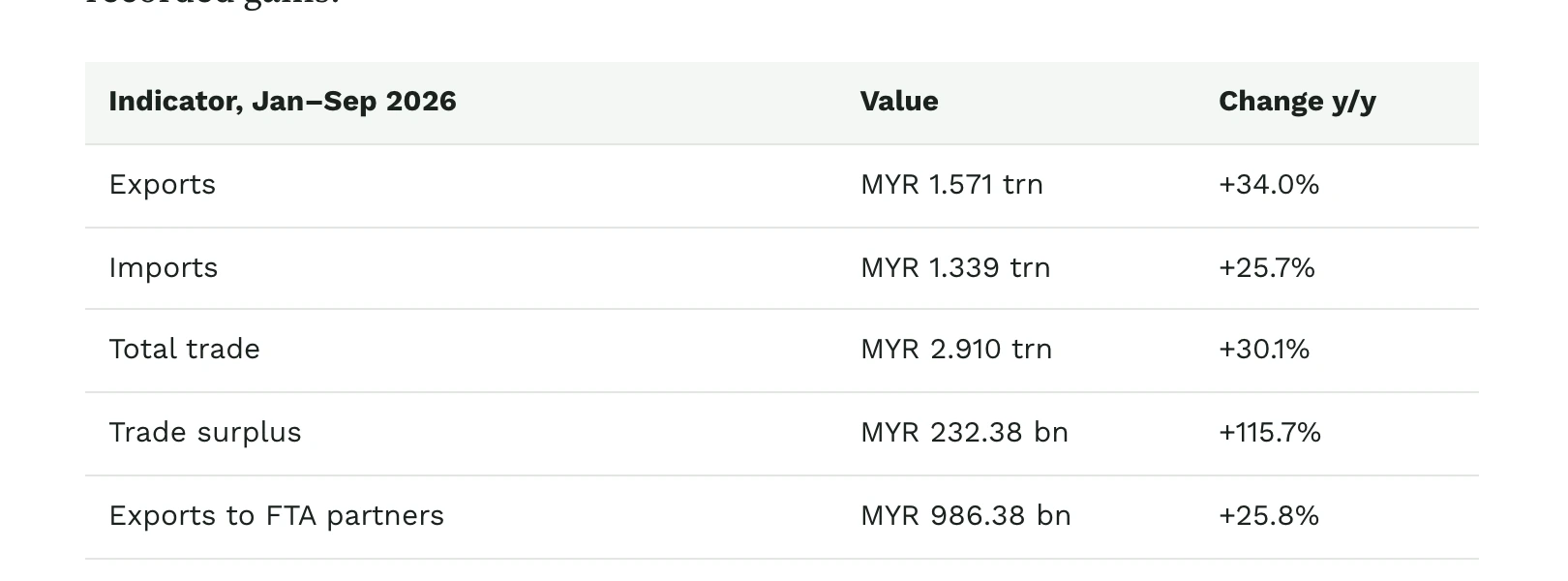
Malaysia’s exports reached RM1.571 trillion in the first nine months of 2026, up 34.0% on the same period last year and a record for the January-to-September window. The trade surplus more than doubled to RM232.38 billion, and total trade rose 30.1% to RM2.910 trillion.
Those are the numbers MATRADE published in late October. They are genuinely excellent, and they describe a very narrow slice of the economy.
The same body of reporting carries the other figure. Micro, small and medium enterprises account for about 39.7% of Malaysia’s gross domestic product but only 14.7% of exports. A sector that produces two-fifths of national output sells about one-seventh of the country’s exports abroad.
That gap is the story. The record belongs to semiconductors.
The trade numbers, and what drove them
| Indicator | January to September 2026 | Change year on year |
|---|---|---|
| Exports | RM1.571 trillion | +34.0% |
| Imports | RM1.339 trillion | +25.7% |
| Total trade | RM2.910 trillion | +30.1% |
| Trade surplus | RM232.38 billion | +115.7% |
| Exports to free trade agreement partners | RM986.38 billion, 62.8% of total | +25.8% |
| Exports to non-traditional markets | RM136.36 billion | +21.5% |
| Electrical and electronics export value added | +RM253.88 billion | — |
Source: MATRADE figures for January to September 2026, as reported by Vietnam News Agency from Kuala Lumpur on 23 October 2026 and carried by BRICS24.
Electrical and electronics exports added RM253.88 billion in value on their own. MATRADE attributed the increase to demand connected to artificial intelligence and data-centre construction, which pulls chips, assembly and testing work out of Penang, Kulim and the Klang Valley.
Read that sentence again, because it explains almost everything else in the data. The single largest contributor to Malaysia’s record export year is a supply chain that runs through a few industrial corridors and a few hundred firms. Petroleum products, optical and scientific equipment, machinery and liquefied natural gas followed. Downstream palm oil kept double-digit growth. Automotive parts, pharmaceuticals, metal furniture and aerospace components all rose, and those categories do contain many smaller exporters.
But they rose from a small base. The headline is a semiconductor story.
Concentration is the risk nobody prices
A 34% export increase sounds like broad strength. What it actually describes is a country whose export performance is increasingly correlated to one global capital expenditure cycle.
If AI infrastructure spending holds, the numbers hold. If the hyperscalers slow their data-centre build-out, the correction lands on Penang and Kulim within two quarters, and it lands hard because the concentration has grown.
This is not a prediction. It is the straightforward consequence of RM253.88 billion of the growth coming from one product family.
For an SME the implication is practical rather than macroeconomic. If your customers are in that supply chain, you are more exposed than you were eighteen months ago, and your own diversification matters more than the national headline suggests. If your customers are not in that supply chain, the record export year has probably not reached you at all, which the 14.7% figure quietly confirms.
Two official sources disagree, and we are not going to pick one. Reporting carried by CNA attributes to MATRADE a forecast that the 2026 trade surplus would grow 15% to 20% over last year’s RM156.83 billion, which implies a full-year surplus somewhere around RM180 billion to RM188 billion. The January-to-September figure alone is already RM232.38 billion. Those two statements cannot both be right. Either the forecast was about a different measure, or one of the figures is wrong, or the reporting conflated exports with the surplus. We have printed both rather than choose, and we have not built any conclusion on the forecast.
The 14.7% problem
The MSME export share of 14.7% is not new and it is not a scandal. It is the structural result of how Malaysian SMEs are financed, staffed and oriented. Most are domestic by design: a restaurant, a clinic, a contractor, a retailer. Exporting requires a buyer abroad, a payment mechanism, a logistics chain and someone who can absorb the cost of getting it wrong the first time.
MATRADE’s stated response is training: programmes to help businesses that have never exported enter international markets, and to help existing exporters open additional markets. Both are reasonable and both are slow.
There is a faster lever available now that did not exist five years ago, and it is worth naming because it is under-used. Discovery has moved. A buyer in Dubai or Lagos researching a Malaysian supplier increasingly starts inside an AI assistant or an AI-summarised search result rather than on page one of Google. If your product content does not exist in a form those systems can read and cite, you are absent from the first step of the buying process, regardless of how good the product is.
That is not a substitute for a trade mission. It is the cheapest thing an SME can fix before one, and it takes weeks rather than years.
What an SME should take from this
- Do not read the record as your own. A 34% national export increase driven by semiconductors is not evidence that demand for your product rose. Check your own order book against last year.
- If you are in the electronics supply chain, stress-test the concentration. Ask what happens to your revenue if the data-centre build cycle pauses for two quarters, and whether you have a second customer segment.
- If you are not, the export gap is your opportunity rather than your problem. 14.7% means the field is thin. The barriers are real but they are known: buyer discovery, payment terms, logistics and compliance.
- Fix discoverability before you book a flight. Product content that an AI assistant can parse, quote and verify is now part of export readiness, not a marketing extra.
- Check the free trade agreement coverage. RM986.38 billion, 62.8% of exports, went to FTA partners. If you are exporting without using an applicable agreement, you are absorbing a duty your competitor is not.
- Watch the non-traditional markets. RM136.36 billion, up 21.5%, with South Africa up 101% and Brazil up 41%. Growth is fastest where competition is thinnest.
Frequently asked questions
How much did Malaysia export in 2026?
RM1.571 trillion in the first nine months, January to September 2026, up 34.0% year on year. That is a record for the period.
What is Malaysia’s trade surplus?
RM232.38 billion for January to September 2026, up 115.7% on the same period in 2025.
What share of Malaysia’s exports come from SMEs?
About 14.7%, against a 39.7% share of gross domestic product. That gap is the structural weakness in an otherwise strong trade performance.
What drove the export growth?
Electrical and electronics, which added RM253.88 billion in value. MATRADE attributed it to AI and data-centre demand pulling chips, assembly and testing through Penang, Kulim and the Klang Valley.
Is the growth broad-based?
No. Automotive parts, pharmaceuticals, metal furniture and aerospace components all grew, and they contain many smaller exporters, but the headline number is dominated by one product family.
Which markets grew fastest?
Non-traditional markets rose 21.5% to RM136.36 billion, with South Africa up 101% and Brazil up 41%. Free trade agreement partners took 62.8% of exports at RM986.38 billion.
Does this mean my SME should start exporting?
Not on the strength of this data. It means the field is thin at 14.7% and the barriers are known. Decide on your own buyer demand and your capacity to absorb a first failed shipment.
Sources
- MATRADE figures for January to September 2026 as reported by Vietnam News Agency from Kuala Lumpur on 23 October 2026, carried by BRICS24 — exports of RM1.571 trillion up 34.0%, imports of RM1.339 trillion up 25.7%, total trade of RM2.910 trillion up 30.1%, the surplus of RM232.38 billion up 115.7%, FTA partner exports of RM986.38 billion at 62.8%, non-traditional markets of RM136.36 billion up 21.5% with South Africa up 101% and Brazil up 41%, and the RM253.88 billion electrical and electronics increment attributed to AI and data-centre demand — brics24.news.
- Central News Agency (Taiwan), 東協財經/2026年11月3日東協快訊, 3 November 2026, citing Malay Mail — the MSME share of 39.7% of GDP against 14.7% of exports, and MATRADE’s stated training programmes for non-exporters — cna.com.tw. This is also the source of the surplus forecast that conflicts with the nine-month figure; the conflict is stated in the body.
- Own captures, 4 November 2026: the MATRADE indicator table as published by BRICS24. Read-only, no figures altered.
One caveat that matters. These are named reports of MATRADE’s data rather than MATRADE’s own release, so a revised figure would not show up here. The 14.7% export share is the softest number in the article — single-sourced, and we could not pin the year it measures.
BD Media is the editorial desk of Big Domain. This article reports MATRADE trade data as published by named outlets on 23 October and 3 November 2026. It is not investment advice.