If you file SOCSO and EIS contributions by uploading a text file to PERKESO, the file you have been using expires at the end of this month. From 1 October 2026 the new format is the only one PERKESO will take.
The deadline has not had much airing. The format specification is dated February. The sentence that fixes the date is buried inside a FAQ, and it is one line long.
What the PERKESO contribution text file format change means on 1 October 2026
Two things change together, and payroll teams tend to conflate them.
The first is the file. Under the old arrangement you sent one file per Act: one for Act 4, which is PERKESO and SOCSO, and a separate one for Act 800, which is EIS. The new teks fail caruman pekerja merges both into a single file. PERKESO’s Soalan-Soalan Lazim (FAQ) Format Teks Fail Caruman Pekerja defines it as a combination of Act 4 and Act 800 contribution records in the new format, and it names the fields that are mandatory: employer code, employee name, the employee’s KPPN number, and salary.
The second is the cutover date. This is the FAQ’s answer, verbatim.
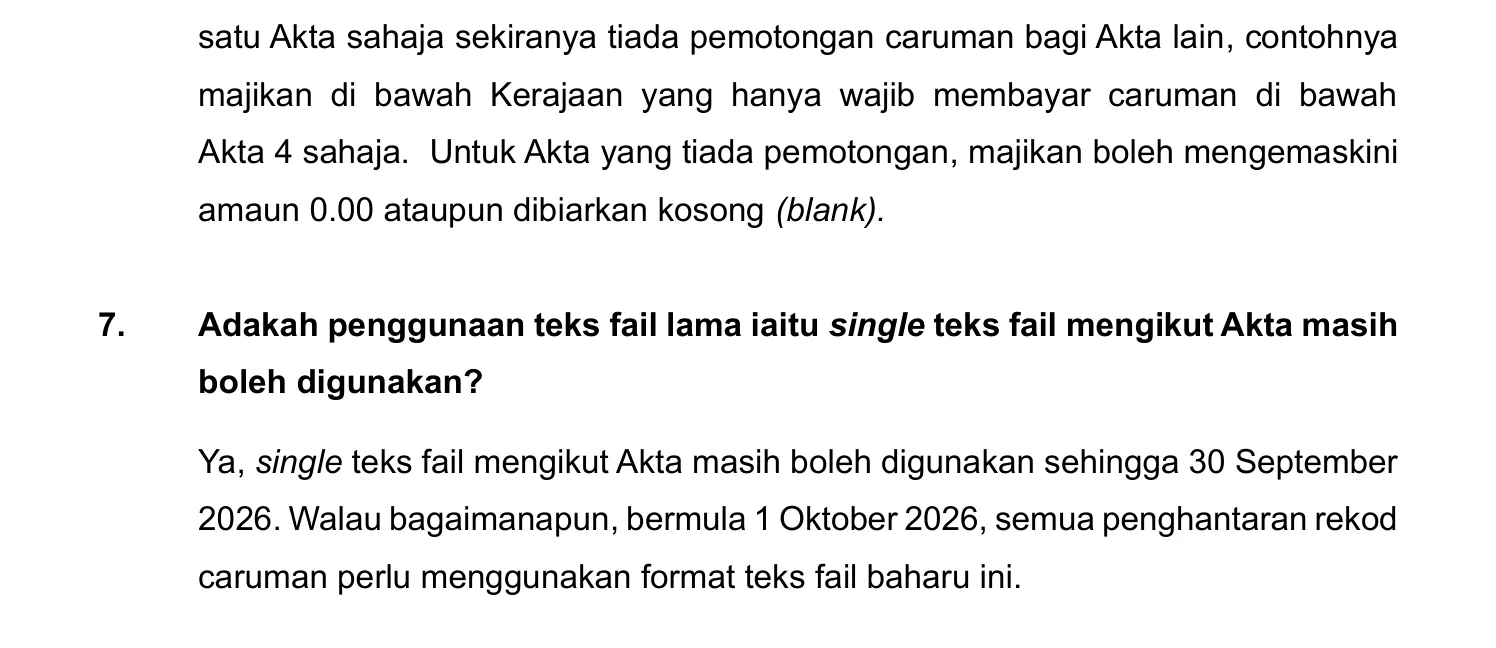
September is the last month you can file in the old shape. That is the whole of it.
Who this lands on
The FAQ scopes it narrowly. The new file is for employers who use the ASSIST 2.0 portal to submit contribution records, from June 2026, and the file has to be uploaded inside that portal. If your payroll is outsourced, the question for your provider is not whether they know about the change. It is which portal they file through and which file format they are sending this month.
Two details in the FAQ that payroll clerks get wrong
Both come out of the same document. Neither produces an obvious failure. One produces a misallocated amount, the other a rejected field.
The SKBBK amount is not a line you add on its own
The FAQ asks how the SKBBK contribution is entered in the single text file, and the answer is the opposite of what a clerk would assume.
Note what the question is about. It is the single-Act text file, and the instruction is not to bolt on a new line. You compute SKBBK alongside the employer and employee shares you already enter, and PERKESO’s system does the splitting at its end.
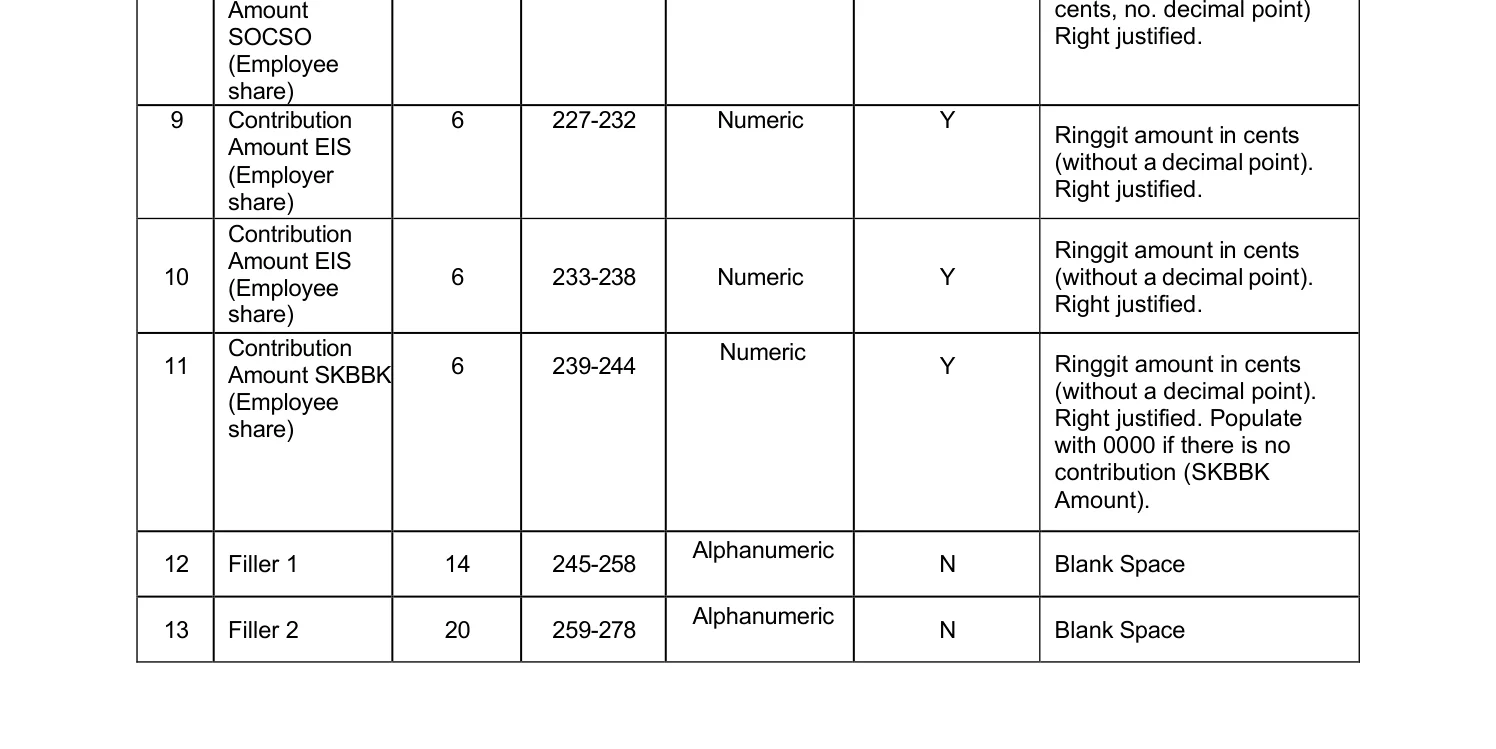
The Version 2.1 specification for the new combined file, Combine SOCSO + EIS Contribution Text File Format, dated 13 February 2026, takes it a step further and gives SKBBK a field of its own. Field 11 of 13 is named “Contribution Amount SKBBK (Employee share)”. It is mandatory, and its remark reads: populate with 0000 if there is no contribution. So the same rule arrives twice from two different PERKESO documents. The amount belongs to the employee, and a nil month is a zero rather than an empty field. If you are unsure which document governs the file you are about to upload, put that question to PERKESO before the cutover rather than after it.
An Act with no deduction can be entered as 0.00 or left blank
The FAQ asks whether the file can be used to submit for one Act only, giving the example of a government employer obliged to contribute under Act 4 alone. The answer is yes, and then this.
That is a permission, not a requirement, which means both forms are valid. Worth knowing if your payroll software insists on one and your reviewer expects the other.
The switchover, in order
- Confirm your filing route. The new file applies to employers using ASSIST 2.0 for contribution submissions, and the file is uploaded in that portal.
- Check that the record carries the four fields PERKESO marks mandatory: employer code, employee name, the employee’s KPPN number, and salary.
- Enter the contribution month as MMYYYY. The format specification’s remark on that field is that the month due cannot be an advanced date.
- Enter salary in ringgit and sen with no decimal point. The specification gives salary field positions 201 to 214 and states the amount in cents.
- Enter the SOCSO employer share and employee share in fields 7 and 8, then the EIS employer share and employee share in fields 9 and 10.
- Enter the SKBBK employee share in field 11. If there is no contribution, populate it with 0000.
- Where an Act carries no deduction, enter 0.00 or leave the field blank.
- Upload in ASSIST 2.0. Arrears can go through the same file. The FAQ states that outstanding contributions may use this text file.
What happens if the file will not go through
PERKESO’s FAQ does not set out a rejection or resubmission procedure, and we are not going to invent one. Two things are on the record, though, and they are the ones that decide whether a failed upload costs you a month.
The first is that the contribution month is a field in the file, not a property of the upload. If a file bounces, the month it was meant to cover does not move. The second is that arrears are accepted in this file, which means a month that slips can be carried into a later submission in the same format rather than in the old one. Both of those are now fixed by the format specification’s field list.
Do this before 1 October. If your payroll software can already produce the new combined file, run it against September’s payroll now. September can still be filed in the old format, so you will find any field-length or missing-value errors while you still have a fallback.
On demand data. No traffic or search-volume figure was obtained for this topic. The proxy is a regulator’s own FAQ carrying an explicit cutover date, alongside a versioned and dated format specification, against zero posts on this site mentioning SOCSO filing formats at all. That is a proxy, not a volume number.
About BD Media. BD Media is the editorial desk of Big Domain, a Malaysian web hosting and digital services company. We write about the things a Malaysian business owner has to act on: tax, payroll, statutory contributions, e-Invoice and the digital tools that sit around them.
This article is a general guide to a published change. It is not a substitute for advice from your own accountant, payroll provider or PERKESO.
Sources. (T1) PERKESO, Soalan-Soalan Lazim (FAQ) Format Teks Fail Caruman Pekerja, 11 pages, no version number or date printed on the document. Downloaded and read 17 September 2026 from https://www.perkeso.gov.my/images/lindung/lindung-24-jam/SoalanLazimFormatTeksFail_BM.pdf — HTTP 200. Questions 1, 2, 3, 4, 6, 7, 8 and 10 read; quotes verbatim in Malay above.
(T1) PERKESO, Combine SOCSO + EIS Contribution Text File Format, Versi 2.1, Tarikh 13 Februari 2026, 3 pages. Downloaded and read 17 September 2026 from https://www.perkeso.gov.my/images/borang/lindung24jam/28072026-formatteksfail.pdf — HTTP 200. The 13-field record layout, field names, positions, mandatory flags and remarks; field 11 name and remark quoted.
What we could not check. PERKESO’s Pekeliling Majikan Bil. 1 Tahun 2026 is served as an image-only scan with no extractable text. We did not read it and we do not cite it; the 1 October date in this article comes from the FAQ above, which carries the same date in readable text. PERKESO’s LINDUNG 24 JAM scheme page returned a firewall rejection page rather than content when fetched on 17 September 2026, so nothing here relies on it. The FAQ PDF carries no publication date on its face, so the version of the FAQ we read cannot be dated with certainty.