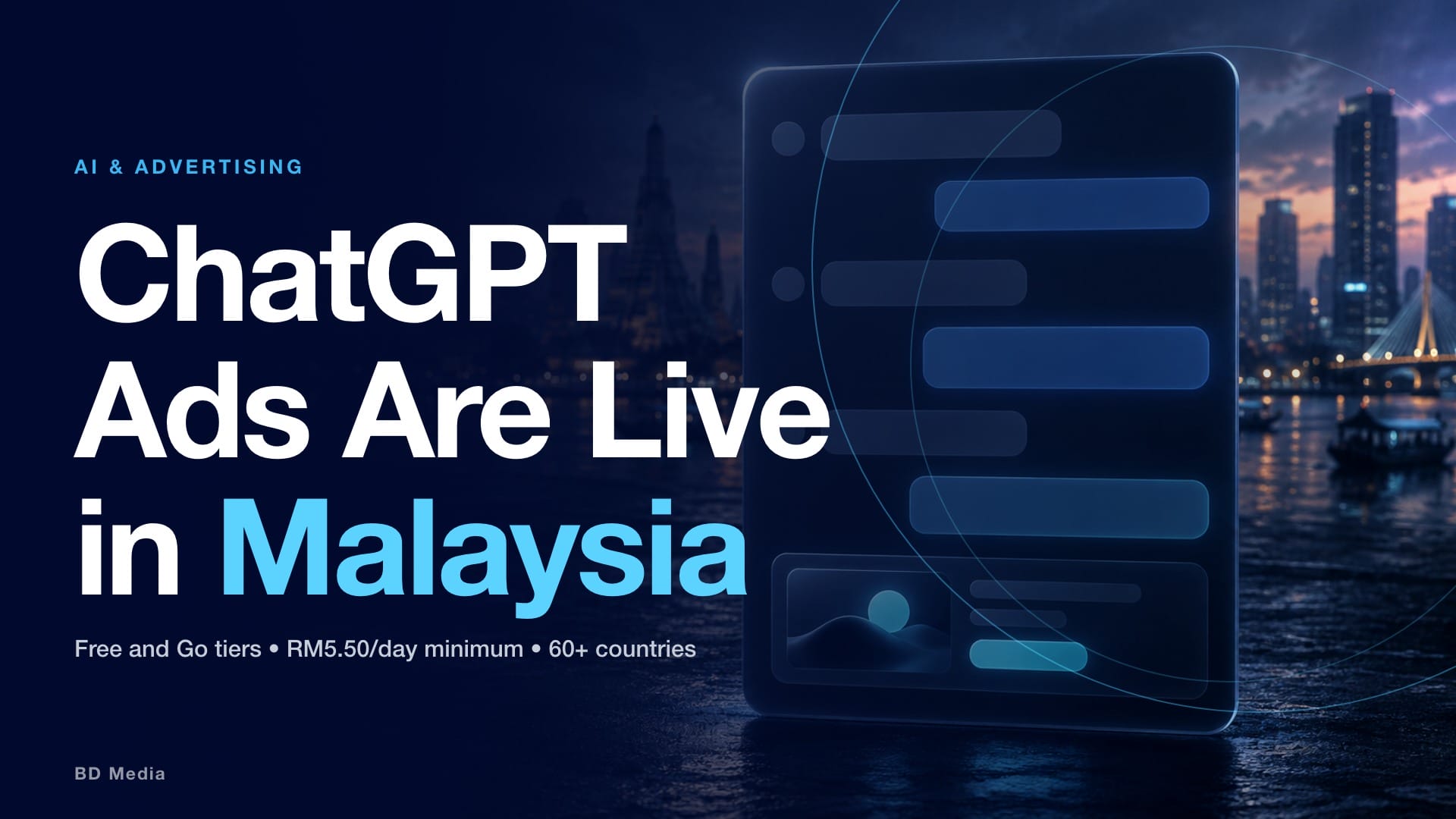
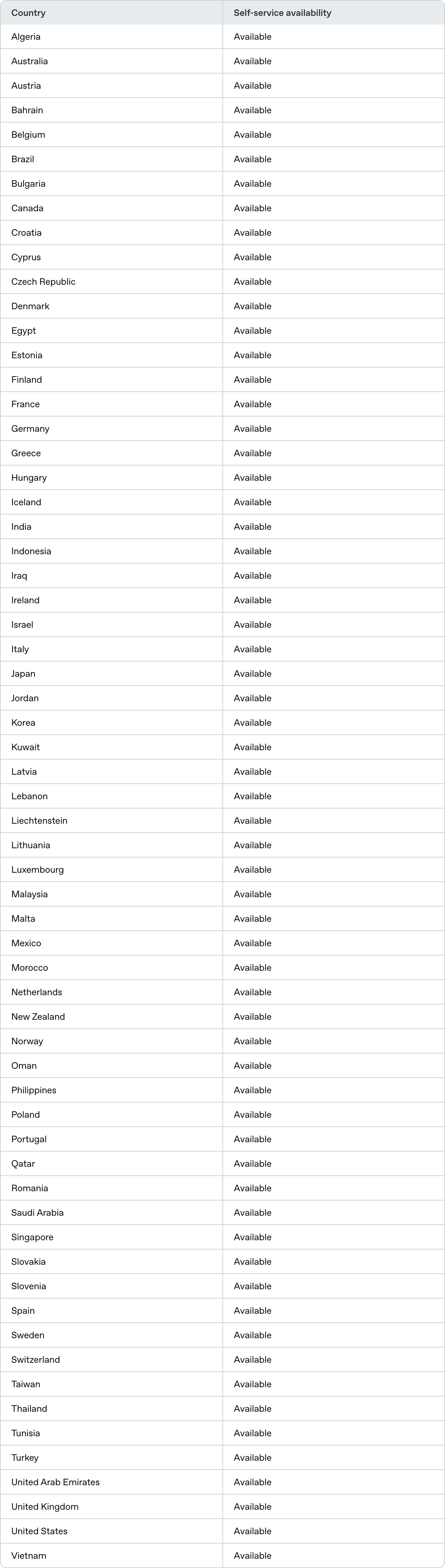
ChatGPT Ads Malaysia went live on 23 September 2026, in the same expansion wave as Indonesia, the Philippines, Singapore, Thailand, Vietnam and Taiwan. Unlike some earlier markets, Malaysian businesses got self-serve access from day one, with a minimum daily budget of RM5.50. Five days in, most local marketers have not noticed. That gap is worth understanding before it closes.
ChatGPT Ads Malaysia: the 60-second version
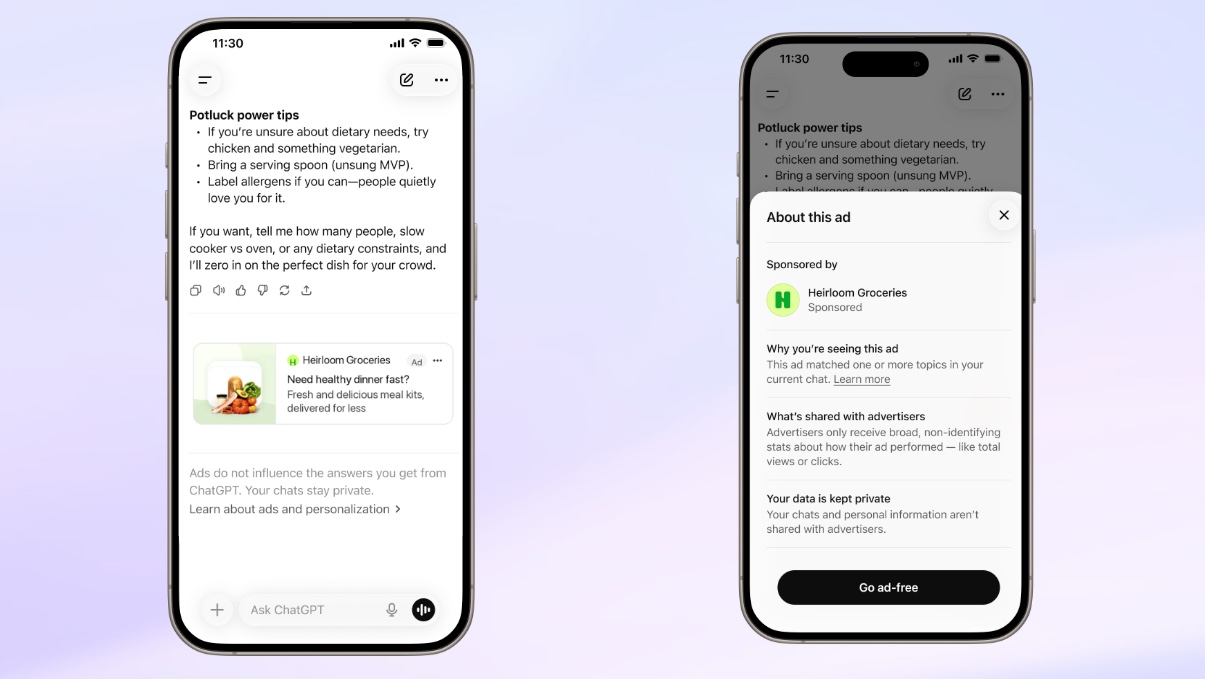
ChatGPT Ads is OpenAI’s advertising product. It shows a clearly labelled “Sponsored” card below a ChatGPT answer, matched to what the user is already asking about. Someone planning a family trip to Langkawi might see a hotel offer. Someone asking ChatGPT for the best accounting software for an F&B business might see a vendor card under the reply.
The rollout has moved fast. OpenAI announced the product on 16 January 2026, switched it on in the United States on 9 February, disclosed US$100 million in annualised revenue after six weeks, and passed a US$1 billion annualised run rate across more than 40 countries by 31 August. Malaysia is roughly market number 63.
| Date (2026) | Milestone |
|---|---|
| 16 January | OpenAI announces ads for ChatGPT |
| 9 February | Live in the US on the Free and Go tiers |
| 26 March | US$100M annualised revenue, six weeks in; Canada, Australia and NZ announced |
| 5 May | Self-serve Ads Manager opens to all US businesses, no minimum spend, CPC bidding added |
| 31 August | US$1 billion annualised run rate in 40+ countries |
| 23 September | Malaysia and six more Asian markets go live, 60+ countries total |
Who actually sees the ads
Only users on the Free and Go plans. Plus, Pro, Business and Enterprise subscriptions stay ad-free, and no ads appear to logged-out minors or accounts OpenAI predicts belong to under-18s. Ads are excluded next to sensitive topics: health, mental health and politics. Health and finance advertisers can apply for case-by-case clearance, a route OpenAI opened on 12 August.
Two OpenAI commitments matter for planning. First, the company states ads never influence ChatGPT’s answers, so nobody can pay to be named inside a response. Second, advertisers never see individual chats. Matching runs on conversation topic, past chats and saved memory, not on identity.
The reach implication is easy to miss: you are not buying ChatGPT’s whole audience. You are buying its free-tier audience, which in Malaysia is the majority of a very large base. SE Ranking’s Malaysian search database measured around 20 million monthly searches for “chatgpt” as of September 2026, a 50% jump over six months.
Targeting works nothing like Google Ads
There are no keywords to bid on. Advertisers write context hints instead: plain-language descriptions of the conversations where an ad should appear. “SME owners comparing e-invoicing tools” is a context hint. “web hosting, VPS, cloud, server” is a keyword list, and the wrong shape for this platform.
The auction is relevance-weighted and second-price, in the same family as Google’s. A tightly matched ad on a smaller bid can beat a generic one on a bigger budget. OpenAI’s own guidance puts starting CPC bids at US$3 to US$5. Observed CPMs have fallen from about US$60 at launch to the US$25–45 range as inventory grew.
What it costs in Malaysia
| Item | Figure |
|---|---|
| Minimum daily budget | RM5.50 (about US$1.30), among the lowest entry points on the platform |
| Recommended starting CPC | US$3–5 per click |
| Observed CPM range | About US$25–45, down from roughly US$60 at launch |
| Buying routes | Self-serve at ads.openai.com, or via agencies including dentsu, Havas Media, Omnicom Media, Publicis Groupe and WPP |
For regional context: Vietnam’s floor is about US$0.72 a day and Singapore’s about US$3.10. Malaysia sits in the middle. The entry price is no longer a reason to wait.
What early advertisers say, both sides
Nine months of US data tell a two-sided story, and both halves deserve the space.
The positive read: clicks are genuinely cheap. Practitioners report CPCs of US$3–9 in most tests, and one documented r/PPC test hit a 2.4% click-through rate, which its author put at two to three times Google Display. Intent is real, because people arrive at ChatGPT mid-decision rather than mid-scroll. Similarweb measured ads appearing in 26% of US desktop chats by July, and Evertune’s June analysis found ads in roughly 12% of responses.
The negative read: conversions are thin and attribution is shaky. Canadian agency Choice OMG spent US$415 on small tests and reported “not a single interested buyer.” B2B agency Cleverly stopped after seeing clicks that never matched reality. SEO firm Camino5 spent about US$1,000 and found no corresponding data in Google Analytics. Conversion tracking only arrived in May 2026, geographic targeting in August. The working consensus among media buyers: treat ChatGPT Ads as an experiment budget, not a reallocation.
Category structure matters too. In a Search Engine Land study of nearly a million queries across 20 industries, retail and fashion took 39% of all US ad placements, logistics, home and garden, and beauty showed the highest ad frequency, and legal, pharma, banking and nonprofit saw zero ads at all.
The honest verdict. This platform is months old, its measurement is behind Google and Meta by years, and its prices will only rise as more advertisers arrive. Learn now with small money, or pay more later with less experience. Both are defensible. Ignoring it while your competitors learn the platform is not.
Should your business run ChatGPT ads now?
Reasonable test candidates: e-commerce and retail, travel and hospitality, local services, education, SaaS, and any brand whose customers already ask ChatGPT for recommendations before buying. Shopee is OpenAI’s named launch partner for Southeast Asia, which says something about where the demand is.
Check eligibility first, or hold: legal, pharmaceutical, banking and nonprofit categories saw no ads in the US study, and health and finance need case-by-case approval. Note also that OpenAI’s ads operate under its published ads principles, which keep answers independent of ad spend.
The move most Malaysian businesses are missing
When someone asks ChatGPT “which web hosting company in Malaysia is good for e-commerce?”, two slots can appear. The organic answer names specific brands and costs nothing. The sponsored card sits below it and costs money. If ChatGPT does not know your brand, you can lose both slots at once.
Getting named inside the answer is AI search optimisation, and the ads budget cannot buy it. Structured content, clear entity signals and citations that AI engines trust decide it. The paid channel just opened. The organic one has been open for two years, and the businesses winning both are the ones that built the organic foundation first.
First steps this week
- Sign up at ads.openai.com. Self-serve is live for Malaysia.
- Confirm your category is eligible before planning spend.
- Start with a small test budget. The RM5.50 minimum is real, but plan for enough volume to learn: hundreds of ringgit, not thousands.
- Set up GA4 UTM tracking before launch. Ads Manager reporting alone is not reliable enough yet.
- Write context hints as customer intent, not keyword lists.
- Audit whether ChatGPT already mentions your brand organically. If it does not, that gap matters more than any ad campaign.
About BD Media
BD Media is the editorial desk of Big Domain. We cover the dates, rules and market shifts Malaysian businesses have to plan around, name our sources so you can check them, and mark what we could not verify instead of filling the gap.
Sources
- OpenAI, “ChatGPT Ads expands to Southeast Asia and Taiwan” (23 September 2026) — openai.com. Launch markets, self-serve access, ad-free paid tiers, Shopee partnership, US$1B run rate.
- OpenAI, “Testing ads in ChatGPT” (updated 11 August 2026) — openai.com. US test timeline, ads principles, answer independence, conversation privacy, case-by-case health and finance route.
- OpenAI Help Center, “Ads in ChatGPT: the basics” — help.openai.com. Ad format, context hints, second-price auction, US$3–5 CPC guidance, Ads Manager reporting metrics.
- Index Lab, “ChatGPT Ads Opens Across Southeast Asia and Taiwan” (23–24 September 2026) — indexlab.ai. Malaysia minimum daily budget RM5.50 (~US$1.30); Vietnam US$0.72; Singapore US$3.10; 63-country advertiser list.
- PPC Land, “OpenAI gains 7 Asian markets for ChatGPT ads” (24 September 2026) — ppc.land. Self-serve from day one in all seven markets; agency roster; rollout history.
- Keywords Everywhere, ChatGPT Ads rollout tracker — keywordseverywhere.com. Dated milestones: 16 January announcement, 9 February US launch, 5 May self-serve, 31 August US$1B run rate.
- AI-Advisors, “Inside OpenAI’s Advertising Platform” — ai-advisors.ai. US$100M annualised revenue six weeks after launch (CNBC, 26 March 2026); minimum spend cut from US$200K to US$50K; CPM compression from US$60.
- TechCentral, “ChatGPT ads are still generating little revenue” (September 2026) — techcentral.ie. Choice OMG US$415 test with no buyers; Cleverly stopped; Camino5 US$1,000 with no GA data.
- Sprites.ai, marketer Reddit roundup (13 September 2026) — sprites.ai. CPCs US$3–9; the 2.4% CTR test; “experimental” budget framing.
- Search Engine Land, “What ChatGPT Ads data reveals about your competitors” — searchengineland.com. ~1M-query study: retail 39% of US ad items; logistics 12.4% frequency; legal/pharma/banking/nonprofit zero.
- Evertune, “How ChatGPT Ads Work” (June 2026 analysis) — evertune.ai. Roughly 12% of responses contain an ad; geotargeting markets.
- Similarweb via Keywords Everywhere (22 July 2026) — ads in 26% of US desktop chats.
- SE Ranking Data API, Malaysian database, retrieved 28 September 2026. “chatgpt” ~20.4M monthly searches, up ~50% in six months.
Not verified: current Malaysian ad-serving density (the US 12% and 4.5% figures predate the SEA launch); ringgit CPC benchmarks for Malaysia specifically, since the market is five days old. We will update both once local campaign data exists.