
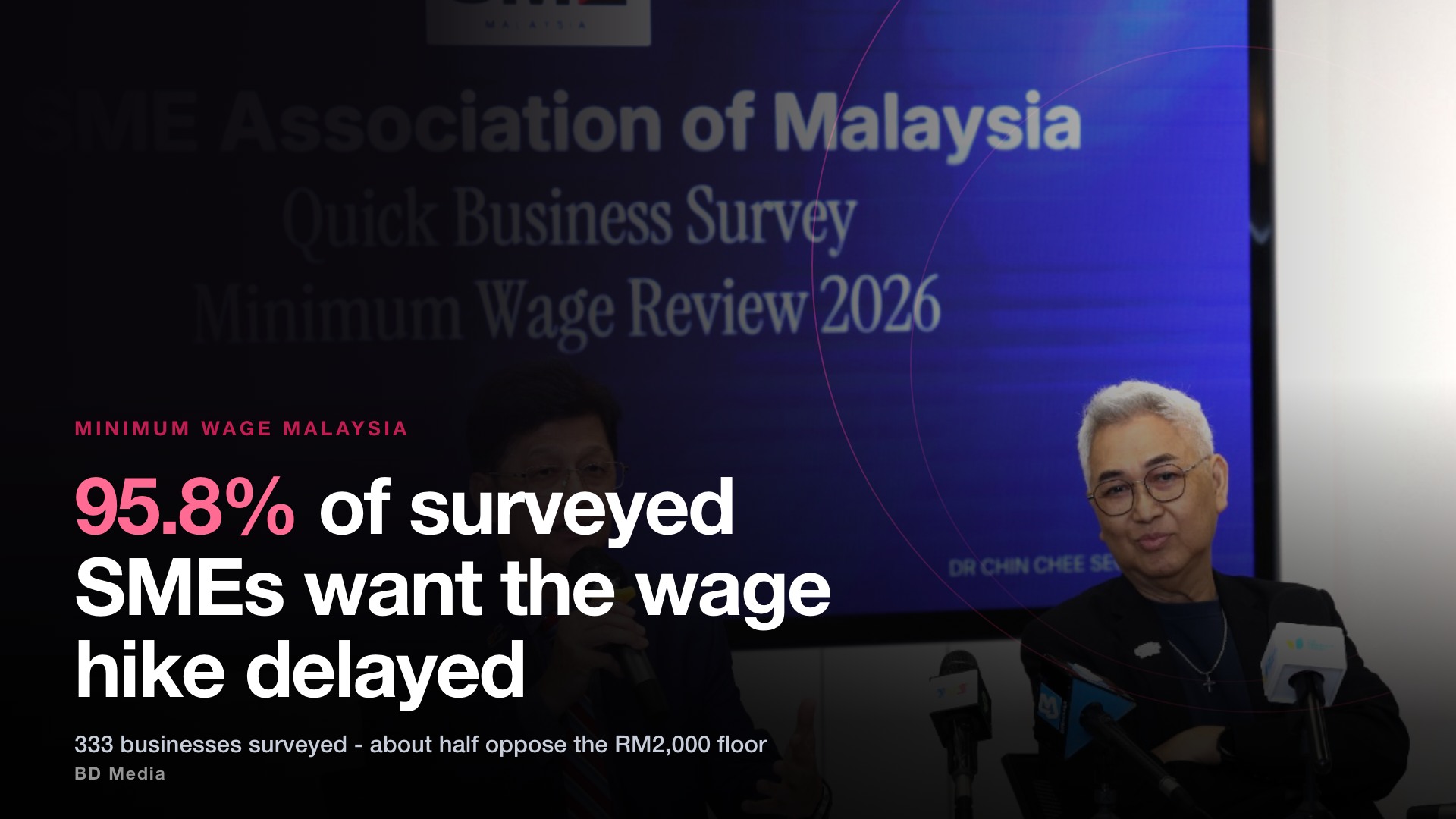
95.8% of 333 businesses surveyed by the SME Association of Malaysia want the minimum wage Malaysia review delayed, with a phased implementation if the government proceeds anyway – the central finding of the association’s quick survey, released on 2 October 2026. Nearly half of respondents oppose raising the floor from RM1,700 to RM2,000 outright. Only 6.6% support going to around RM2,200.
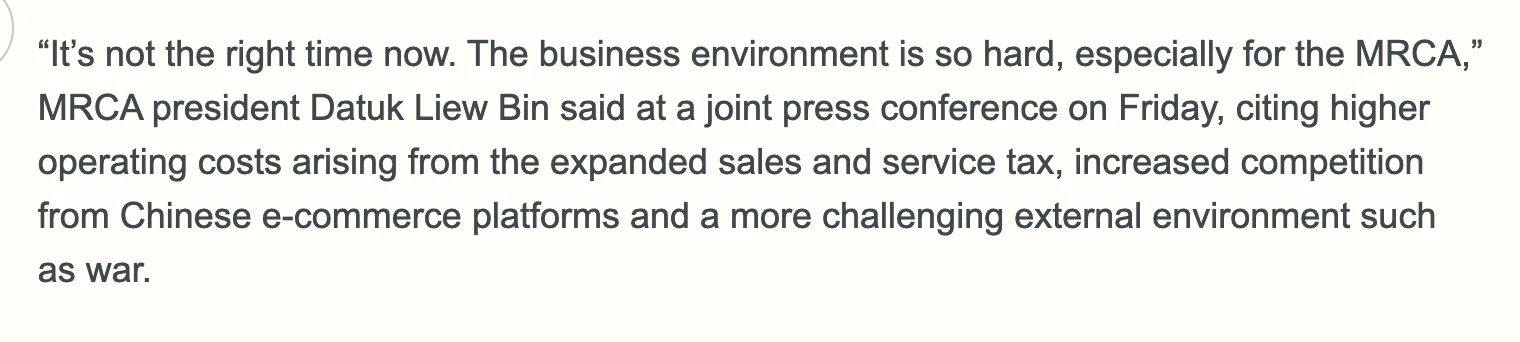
What the minimum wage Malaysia survey found
The most expensive number is 93%: the share expecting pressure to raise the wages of workers already earning above the minimum, compressing salary bands upward across the whole payroll. About three-quarters expect significantly higher operating costs. Respondents warned of thinner margins, slower hiring, workforce reductions and price increases. Two-thirds said business conditions had worsened year-on-year; only 8.4% said theirs had improved.
| SMEAM minimum wage survey (333 businesses) | Finding | Source |
|---|---|---|
| Prefer to delay any increase | 95.8% | SMEAM survey, via The Edge, 2 Oct 2026 |
| Oppose raising RM1,700 to RM2,000 | About half | SMEAM survey, via The Edge, 2 Oct 2026 |
| Support about RM2,200 | 6.6% | SMEAM survey, via The Edge, 2 Oct 2026 |
| Expect knock-on wage pressure | 93% | SMEAM survey, via The Edge, 2 Oct 2026 |
| Expect significantly higher costs | About three-quarters | SMEAM survey, via The Edge, 2 Oct 2026 |
| Employ 50 workers or fewer | 73.3% of respondents | SMEAM survey, via The Edge, 2 Oct 2026 |
| Current minimum wage floor | RM1,700 | Minimum Wages Order, in force |
The MSME exemption and its limits
The government has temporarily exempted micro, small and medium enterprises from the new minimum wage increase. SMEAM’s Dr Chin Chee Seong acknowledged the relief but cautioned it “may not provide much help to businesses in the long run” – MSMEs already struggle to retain staff against larger companies that can afford to meet a higher floor. Entrepreneur and Cooperative Development Minister Steven Sim Chee Keong said further measures will follow, including wage subsidies under the Progressive Wage Policy, with more in Budget 2027 on 9 October.
Respondents’ preferred alternatives were consistent: roughly three-quarters called for tax cuts or incentives, more than half want lower regulatory costs, and the association wants stronger support for digitalisation, automation, financing and working capital. The manufacturing sector was the most concerned about the increase.
The knock-on effect is the cost nobody budgets for
The 93% finding deserves more attention than the headline opposition figure. A minimum wage increase is usually discussed as if it only affects workers at the floor. In practice it compresses the entire lower band of the payroll: a supervisor earning RM2,100 sees a new starter at RM2,000 and expects a differential restored. Multiply that across a 40-person workforce and the actual cost is a multiple of the nominal increase. That is why employers consistently estimate the impact of a wage floor change above the government’s own costing, and why the association’s survey asked about it explicitly.
The survey’s other numbers trace the same logic. Two-thirds reporting worse business conditions and only 8.4% reporting improvement gives the deferment request its context – this is not a confident sector asking for a favour, it is a strained one asking for time. The 73.3% share employing 50 workers or fewer matters too: the smallest employers have the least ability to absorb a step change in their largest cost line.
What to watch next
Watch three things. First, whether the MSME exemption becomes permanent or stays explicitly temporary – the minister’s language has been carefully provisional. Second, the shape of the Progressive Wage Policy subsidies, because a subsidy that offsets the increase for smaller firms changes the arithmetic entirely. Third, whether the government defers the review at all, or proceeds with a phased schedule; the phased option is the one the survey respondents themselves preferred, which makes it the most likely landing zone.
Sources
- Ministry of Human Resources – official portal
- The Edge Malaysia, “SME Malaysia, MRCA seek deferment of minimum wage review”, 2 October 2026
- The Edge Malaysia, “MSMEs temporarily exempted from new minimum wage hike, says minister”
- The Edge Malaysia, “FMM: Minimum wage review should account for productivity, capacity to pay”