On 30 September 2026 the Cabinet agreed to exempt micro, small and medium enterprises from the next minimum wage increase, for the time being. If you run an SME in Malaysia, the short version is that nothing has changed about what you must pay today, and something has changed about what you were bracing for.
RM1,700 a month remains the legal floor. The exemption is about the next increase, not the current rate. Until a new Minimum Wages Order is gazetted, the existing order stands.

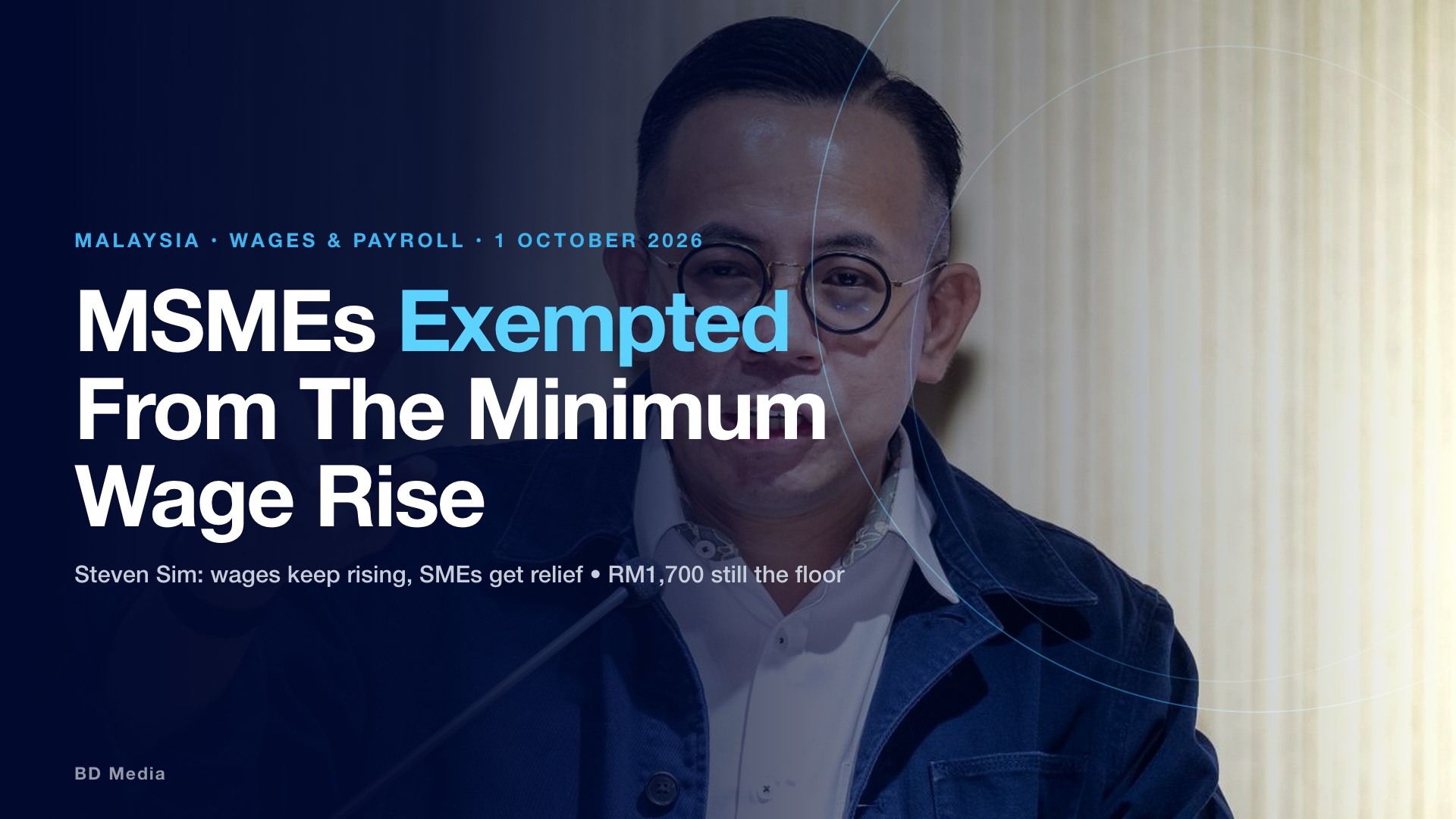
Steven Sim, Entrepreneur Development and Cooperatives Minister, who raised the minimum wage at the 30 September Cabinet meeting. Photo: The Star
What the Cabinet actually decided
Entrepreneur Development and Cooperatives Minister Steven Sim raised the minimum wage at the Cabinet meeting on 30 September. The outcome, in his words: wages should continue to rise, but local businesses – particularly SMEs – are facing operating cost pressure and need protecting.
So instead of pulling SMEs into a statutory increase, the government will lean on wage subsidies under the Progressive Wage Policy, so that pay growth moves with productivity rather than by order.
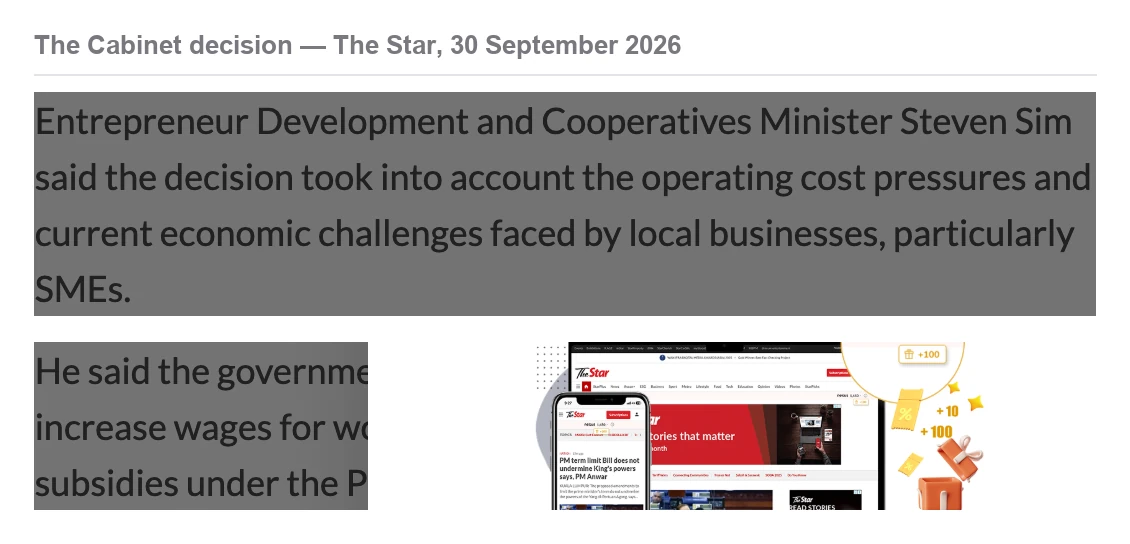
The Cabinet decision as reported. Source: The Star, 30 September 2026
Three questions the announcement does not answer
The relief is real but it is not yet operational. As it stands, nobody can tell you whether your company qualifies, from when, or for how long.
The Federation of Malaysian Manufacturers put the gap plainly. Its president, Jacob Lee Chor Kok, asked the government to specify the eligibility criteria, the commencement date, the duration and the review conditions, and to make clear whether this is a deferment to a later date or an exemption with conditions. Those are different things for a payroll forecast.
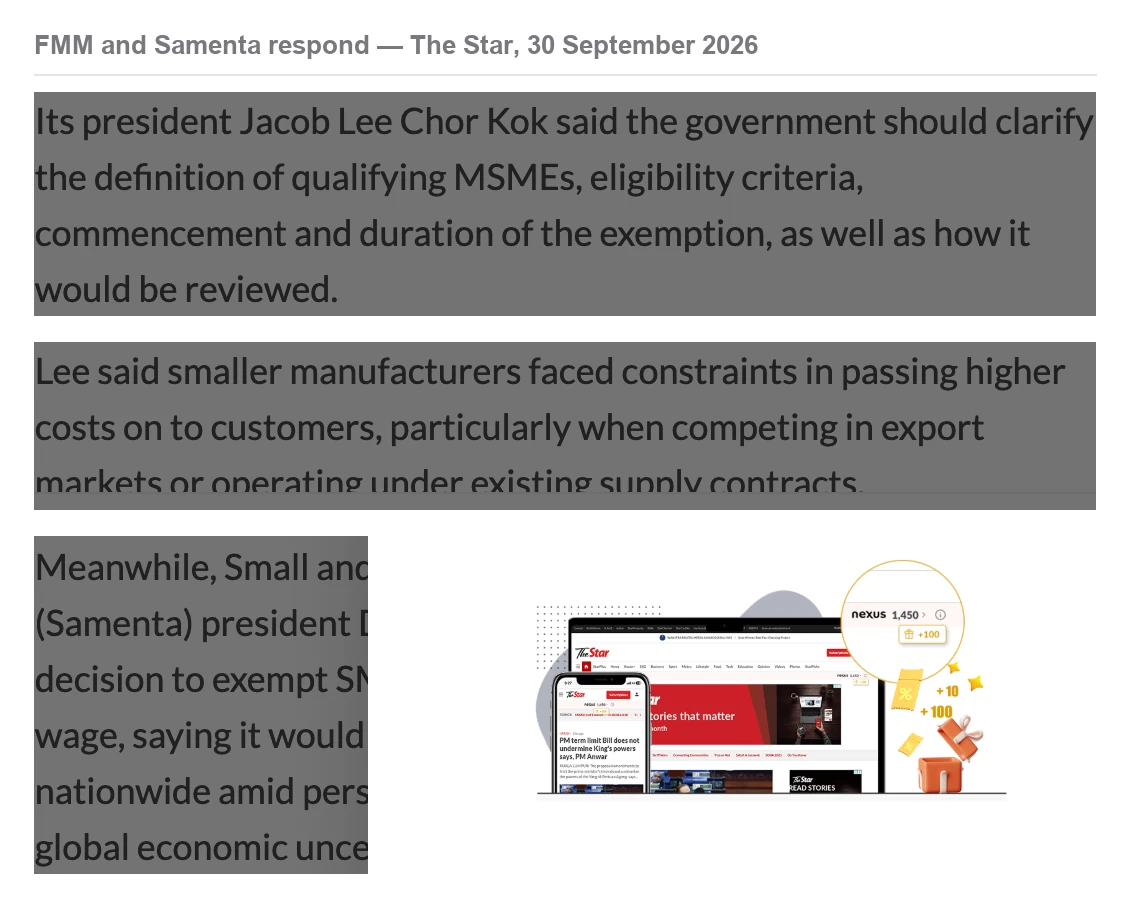
FMM’s open questions and the Samenta response. Source: The Star, 30 September 2026
Two further points from FMM are worth reading carefully. First, it warned that the exemption must not be read as permission to cut existing wages or drop below the statutory floor. Second, it asked the National Wages Consultative Council to look at manufacturers outside the MSME category too, on the basis that company size alone does not determine whether a business can absorb a higher wage bill.
What Samenta said: take the relief, but pay competitively anyway
The Small and Medium Enterprises Association of Malaysia (Samenta) welcomed the decision, saying it protects the livelihood of 1.3 million SMEs nationwide against persistent cost increases, compressed margins and global economic uncertainty. Its president, Datuk William Ng, framed the relief as recognition of the constraints smaller operators actually face.
But he was equally clear that the exemption is not a reason to hold wages down. Samenta urged SMEs that can afford to pay above the floor to do so, arguing that competitive pay is what keeps good staff and builds a loyal, motivated workforce.
His central argument is about where higher pay has to come from:
Sustainable wage growth must be anchored on value creation and productivity gains.— Datuk William Ng, president, Samenta
And on what the government has to fix for that to be possible:
Wage policy cannot be viewed in isolation. To foster capacity for higher pay, the government should continue addressing structural overheads, such as compliance costs, regulatory burdens, and logistics and utility costs, alongside expanding access to low-interest working capital financing.— Datuk William Ng, president, Samenta
Samenta strongly endorsed the government’s move towards the Progressive Wage Policy, and asked it to partner with industry associations to deliver rapid, SME-centric training modules so productivity gains arrive alongside the wage increases rather than after them. The association said it would work with the Entrepreneur Development and Cooperatives Ministry, the Human Resources Ministry and other ministries to help SMEs move into higher-productivity, higher-value work capable of paying competitive, living wages.
Read together, that is a more demanding position than a simple cheer for the exemption. Samenta is saying the relief buys time, and the time has to be spent on productivity – training, overheads and access to financing – not just banked.
What the manufacturers want next
FMM welcomed the relief too, but its emphasis was implementation. It wants the exemption paired with practical help on automation, digitalisation, skills upgrading and process improvement, and has proposed a Smart Manufacturing Support Package, a more competitive tax framework for qualifying SMEs, and industry-led training support in Budget 2027.
It also drew a distinction that matters to any employer thinking about next year’s salary structure: because a statutory floor moves the bottom of the scale, employers trying to preserve meaningful gaps for skills, experience and responsibility often have to move more than just the lowest rung. That is the cost most SMEs underestimate.
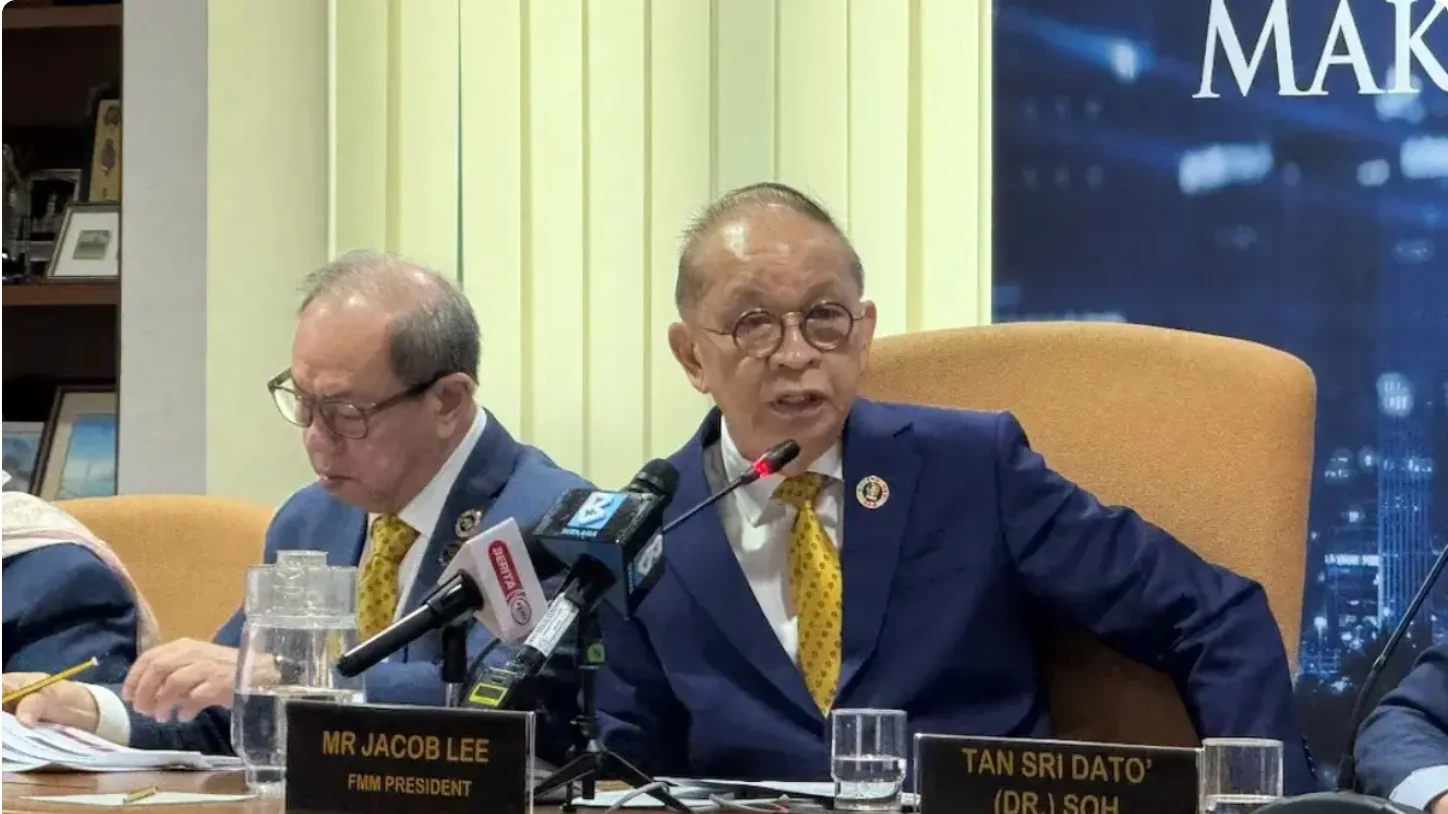
FMM president Jacob Lee Chor Kok, who asked the government to clarify the scope and duration of the MSME relief. Photo: Nikail Rezza/The Edge
What it means for your payroll
The three things that have not changed. RM1,700 is still the statutory floor. It still refers to basic wages only – allowances, bonuses, commissions and overtime cannot be counted toward it. And the exemption is about a future increase, so it is not a licence to reduce anyone’s pay.
What has changed is your planning assumption. If you had budgeted for a rise this quarter, you can hold that number pending the detail. If you are an SME and you had already adjusted pay ahead of an expected order, that decision stands on its own merits – the relief does not undo it, and FMM’s warning makes clear it is not meant to become a reason to reverse it.
The practical risk to watch is the boundary. “MSME” is a defined category, and whether your company falls inside it depends on the official definition applied to this relief – which is exactly what FMM is asking for. Until that is published, treat any assumption about your own eligibility as provisional.
What to do before 9 October
Budget 2027 is tabled on 9 October, and that is where the numbers should land – the exemption details, the Progressive Wage Policy subsidy mechanics, and the rate itself.
- Check your classification. Confirm where your company sits against the official SME definition, and keep the evidence. Your eligibility for the relief runs through this.
- Do not stop paying the floor. RM1,700 basic remains enforceable now.
- Hold, do not cancel, your wage budget. A deferment and an exemption lead to different numbers.
- Model both outcomes. If the rate lands at RM1,800, RM1,900 or RM2,000, know what each does to your monthly payroll before the announcement, not after.
- Look at the Progressive Wage Policy. If subsidies become the mechanism for SME wage growth, the businesses that understand the scheme early will be the ones that use it.
- Watch for the gazette, not the speech. The legal floor changes when a new Minimum Wages Order is published.
We track the rate itself, with the current daily and hourly figures and the history, on our minimum wage Malaysia reference page. If you want the wider Budget context – what SMEs were already expecting before this decision – see what Budget 2027 signals for SMEs.
The practical read
Treat this as a delay with conditions, not a reprieve. The wage floor has not moved, the direction of travel has not reversed, and the government has said out loud that wages should keep rising – it has only changed who moves first and by what mechanism. The businesses that come out of 9 October in good shape will be the ones that spent the intervening days working out their own numbers rather than waiting for the announcement to tell them.
Employers juggling several cost lines at once – payroll, compliance, tooling – can see how the BigDomain LLM Token Hub consolidates AI spend if that is one of them.
Sources
- The Star, “SMEs exempted from new minimum wage hike for now, says cabinet”, 30 September 2026
- The Star, “FMM lauds halt on minimum wage hike for MSMEs, seeks clarity on exemption”, 30 September 2026
- The Edge Malaysia, “FMM want clarity, implementation support on MSME minimum wage relief”, 30 September 2026
- Malaysiakini, “Cabinet exempts MSMEs from new minimum wage hike, for now”, 30 September 2026
- BD Media, Minimum Wage Malaysia 2026: current rates and history
- BD Media, Malaysia Minimum Wage: What Budget 2027 Signals for SMEs