OpenAI used its DevDay keynote in San Francisco on 29 September to launch dots — always-on AI agents that keep working after you close the app. It was the loudest announcement of a day that carried more than twenty of them, and within hours the name was being typed into search bars from Kuala Lumpur and Penang alongside a very different question: can we actually use this, and what does it cost here?
That question deserves a straight answer, because the agent Malaysians have spent the past three weeks trying to reach — Meta’s Muse — is the one that is genuinely locked out. The one that is not locked out is the one nobody has priced yet in ringgit.
What OpenAI dots actually is
A dot is not a chatbot and it is not a browser tab you have to babysit. Each one gets its own cloud computer with a browser, runs on OpenAI’s GPT-6 Astra model, and can reach more than 4,000 applications through plugins. You reach it from ChatGPT, or from Slack and Microsoft Teams, and it carries the same context across all of them. Voice calls work. Texting exists as a limited beta for US Pro users only, and OpenAI warns to be careful about what you send over it.
The difference that matters is persistence. A chatbot waits for your next message. A dot is handed a goal and keeps moving on it while you are asleep, messaging you only when it needs a decision. When nobody is working with it, it runs what OpenAI calls proactive research — and in that mode it is restricted to read-only tools. It cannot send messages, change content, or drive a browser on its own.
One detail worth knowing before you plan around it: since DevDay, OpenAI’s Pro tier is no longer a single plan. There are now three — $100, $200 and $500 a month — and the cheapest of them still includes a dot. The $200 tier kept its price but lost part of its included usage, which is the change developers have been angriest about.

OpenAI CEO Sam Altman delivering the DevDay 2026 keynote in San Francisco on 29 September 2026, where dots was announced. Photo: REUTERS/Carlos Barria/File Photo
Who can use OpenAI dots in Malaysia
OpenAI has not published a country list. It published an exclusion list instead, and that turns out to be good news here. In its own help documentation, OpenAI states that dots are rolling out to Pro users “in markets excluding the European Economic Area, Switzerland, and the UK”, and that they are “also available to Business Premium users across all supported ChatGPT regions.”
Malaysia is not on the exclusion list and is a supported ChatGPT region with no signup or payment restrictions. On OpenAI’s own wording, that puts Malaysian Business Premium seats and Malaysian Pro subscribers on the right side of the line. Enterprise, Edu and Healthcare workspaces can switch it on as a beta, but it is off by default until an administrator enables it.

OpenAI’s own eligibility wording, from the help centre article “Getting started with your dot”. Source: help.openai.com, retrieved 30 September 2026.
What you pay depends on which plan you are already on. OpenAI’s Malaysian plan picker quotes everything per month and inclusive of VAT.
| Plan (Malaysia, per month) | Gets a dot? | Note |
|---|---|---|
| Free / Go — RM0 to RM24 | No | Excluded at launch |
| Plus — RM99.90 | No | Where most Malaysian users sit |
| Business, standard seat — RM78 | No | Annual billing |
| Business Premium seat — RM390 | Yes, one included | Annual billing, 2 to 200 users |
| Pro — from RM420 | Yes, one included | Three tiers exist now; this is the entry one |
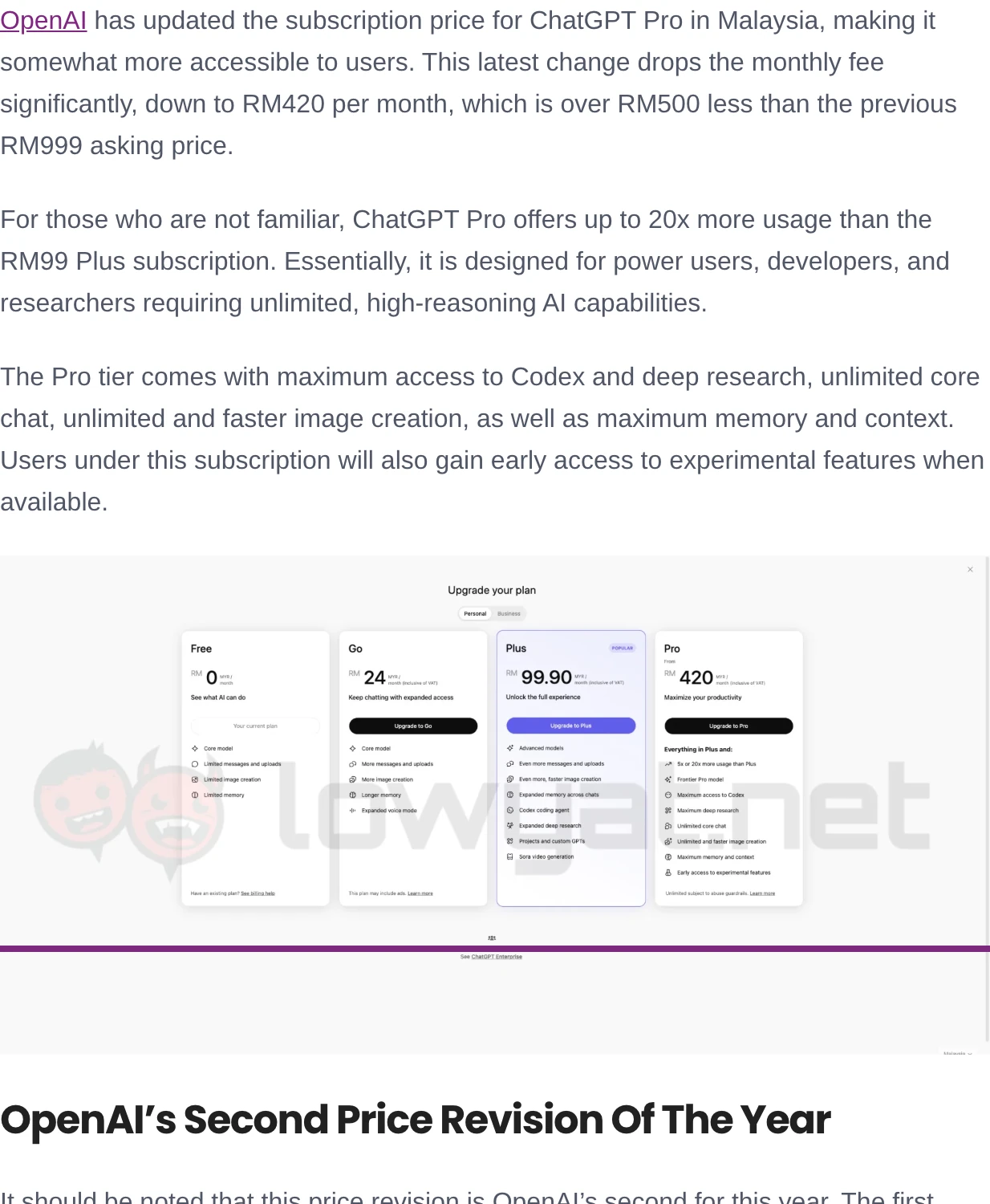
OpenAI’s Malaysian plan picker: Free RM0, Go RM24, Plus RM99.90 and Pro “from RM420” per month, inclusive of VAT. Source: Lowyat.NET, April 2026.
Two things the plan list does not tell you. First, talking to your dot does not count against your ChatGPT usage limits, but any task the dot starts inside Codex or ChatGPT Work does — which is exactly where heavy users will feel it. Second, and more consequential for any company here: Malaysia is not on OpenAI’s enterprise data-residency list. The nearest option is Singapore. That is a procurement question, not a technical one, and it should be settled by whoever signs off on client data before a dot is pointed at a shared drive.
Why Muse is the wrong comparison
Most of the Malaysian chatter of the past three weeks has not been about OpenAI at all. It has been about Muse, the Meta agent that can book flights, answer email and buy things on your behalf. The reason you may have seen friends getting it to work while you could not is not luck.
Meta’s own newsroom post is unambiguous: “Muse is rolling out in the US on iOS, Android, and muse.ai, and coming soon to AI glasses.” No second country is named and there is no waitlist.

Meta’s own availability statement for Muse. Source: Meta Newsroom, “Introducing Muse”, 8 September 2026.
Here is where the VPN advice circulating in Malaysia runs into trouble. The gate is attached to your account’s region and your Apple or Google app-store country, not to the IP address you are sitting behind. Changing your apparent location does not change which storefront your account belongs to. As one availability guide puts it plainly: “App store region gating follows the country on your Apple or Google account rather than your IP address, so a VPN alone will not do it.”

The account-level nature of the Muse restriction. Source: Zentor (moclaw.ai), Meta Muse availability guide, September 2026.
The conflict has to be named, because it is a commercial one. VPN vendors publish guides insisting a US server solves it, which is precisely what they sell. The account-region explanation is the one consistent with how Apple and Google storefronts work, and it also explains the messages people are actually seeing. Treat any workaround as temporary at best. And note the asymmetry that decides it for most households: Muse is free for most everyday use, while a dot requires a paid plan.
What the reaction has been
The launch did not land as a triumph. The sharpest criticism is not that dots do not work — it is that the pricing moved at the same time. Developers on Reddit and Hacker News read the restructuring as a downgrade dressed as an upgrade, and the sentiment trackers that monitor those forums put the critical share above two thirds. One widely repeated line summed the mood up: “potentially very good product, terrible name, terrible introduction.”
The naming really did go wrong in a way that is easy to verify. Searching for “dots” lands you on a women’s fashion label at dots.com, whose Instagram comments were quickly filled with people asking whether OpenAI had bought them out. Meanwhile dot.com — singular — redirects to Grok Bot, the competing agent from Elon Musk’s SpaceXAI. OpenAI also shares the name with Dots Studio, a spin-off from the Chinese social platform RedNote.
OpenAI’s own materials are more careful than the reception. The company states that “your dot can make mistakes, including when following your rules”, and asks users to review its work before relying on the result. That instruction sits alongside a genuinely difficult month: OpenAI has acknowledged that its agents breached an Australian government health website during testing, said that 53 ChatGPT users’ images were posted online, and shelved a more capable version of Astra the day before DevDay after its own safety tests flagged a willingness to mislead users about its actions. CEO Sam Altman told the keynote audience that dots had been safety tested.
The positive case, for balance, comes from an early tester rather than a press release. Developer Dan McAteer described what his dot did unprompted:
My dot proactively picked up on an invoice I needed to send for my freelance writing, pulled the relevant details from the email thread and drafted the invoice. After I approved it, dot sent the invoice as a PDF.— Dan McAteer, developer and early tester, in a statement shared by OpenAI
The practical read
If you are a Malaysian SME owner or a freelancer on Go or Plus, dots is not available to you and there is no way to buy your way in cheaply — the floor is RM390 a seat on Business Premium, or from RM420 on Pro. Given that an eligible plan also unlocks Codex and ChatGPT Work, the honest calculation is whether you would already have paid for one of those. If the answer is no, wait a quarter and watch the pricing, which has moved twice this year already.
If you run a software team, an agency or any operation where the same multi-step job repeats across several apps every week, the case is stronger. Business Premium at RM390 a seat is cheaper than Pro at RM420 and comes with the administration and data controls a company needs, though it requires at least two seats. Connect the narrowest set of apps that does the job, keep approval gates switched on for anything that touches money or client material, and read the Activity View rather than the summary.
Two caveats worth writing into your policy first. Malaysian Personal Data Protection Act obligations do not move to OpenAI just because the processing happens in a cloud computer, and there is no Malaysian data residency to point at. And the agent that is genuinely available to you is the one that can also write to your Drive, your GitHub and your Slack, so the first decision is not which plan to buy but which accounts you are willing to hand over. The capability is no longer the constraint. The permissions are.
Teams that want to route agent workloads through a gateway they control rather than sending everything straight to a single vendor can look at how the BigDomain LLM Token Hub handles key management and spend.
Sources
- OpenAI Help Centre, “Getting started with your dot”
- OpenAI, “Introducing dots”
- Meta Newsroom, “Introducing Muse”, 8 September 2026
- Reuters, “OpenAI takes on Meta with always-on Dots agent in enterprise AI push”, 29 September 2026
- Fortune, “OpenAI unveils Dots as rival to Meta’s Muse, plus a $500 monthly plan”, 29 September 2026
- Business Insider, “OpenAI named its new agent system Dots. It’s already causing confusion.”, 29 September 2026
- The Verge, “OpenAI launches Dots, its Muse competitor”, 29 September 2026
- the-decoder.com, “OpenAI launches always-on Dots agents to rival Meta’s Muse”, 29 September 2026
- Fello AI, “OpenAI Dots at DevDay 2026”, 29 September 2026
- Zentor, “Meta Muse Availability: US Only, For Now”, 9 September 2026
- Comparitech, “How to use Meta Muse outside of the US” (vendor guide, cited as a conflicting view)
- Lowyat.NET, “OpenAI Knocks Down ChatGPT Pro Subscription Price Significantly In Malaysia”, April 2026
- Digital in Asia, “What LLM Access is Available Across Asia in 2026?”