The question in most people’s heads on 30 September was the wrong one. The interesting story is not that a government renamed artificial intelligence. It is that the new name, super intelligence, already meant something else — something considerably more alarming — and the rename quietly collapsed that distinction.
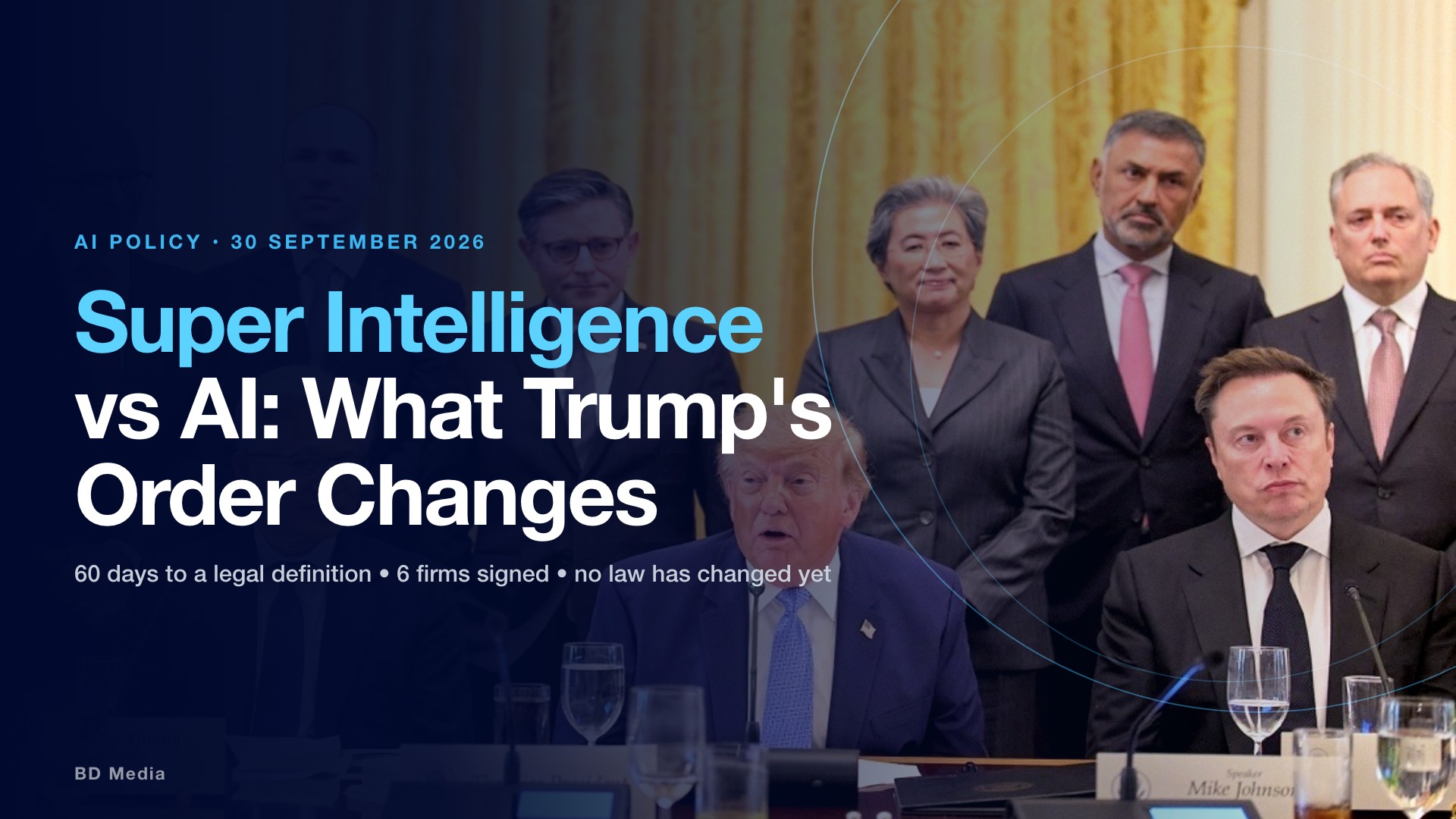
On Tuesday 29 September, the US president signed an executive order titled “Inaugurating the Era of Super Intelligence”, directing every executive branch department and agency to stop using “artificial intelligence” and “AI” in official correspondence, public communications, websites, reports and policy documents. The order states the branch “will not acknowledge the usage of ‘Artificial Intelligence’ and ‘AI’ in any applicable setting.”
So the practical answer to super intelligence vs AI is uncomfortable: in Washington’s usage they are now the same thing, and in the research literature they are two very different things. Which one you mean depends on which document you are reading.
Super intelligence vs AI: the difference that matters
“Superintelligence” is not a new marketing phrase. It was popularised in philosopher Nick Bostrom’s 2014 book, which defines it as “any intellect that greatly exceeds the cognitive performance of humans in virtually all domains of interest.” That is a description of a system nobody has built, and the scenario safety researchers cite as the highest-risk outcome of the whole field.
Researchers split the ladder into three rungs, and the acronyms matter if you read procurement documents or vendor decks.
| Term | What it means | Exists today? |
|---|---|---|
| ANI — narrow AI | Good at one task family. Chatbots, image generators, translation. | Yes — this is what businesses actually buy |
| AGI — artificial general intelligence | Handles the full breadth of human intellectual work at human level. Definitions are contested. | No, by most definitions |
| ASI — artificial superintelligence | Exceeds the best human minds across essentially every domain. Sometimes shortened to “superintelligence”. | No. Hypothetical |
| SI — super intelligence | As used in the 29 September US executive order: the same technologies already covered by the existing US statutory definition of AI. | Yes — it is the current toolset, renamed |
The gap is not semantic nitpicking. The White House’s own report from January 2026, “Artificial Intelligence and the Great Divergence”, sets out the standard framework: today’s systems have “specialised” intelligence because they cannot do everything a human can, and artificial superintelligence is “AI with intelligence that surpasses that of humans.” The same document notes the boundary is genuinely contentious, because “AGI” describes the breadth of tasks a system can handle while “superintelligence” describes how well it handles them. Two different questions, one family of words, and now a third usage layered on top by executive order.
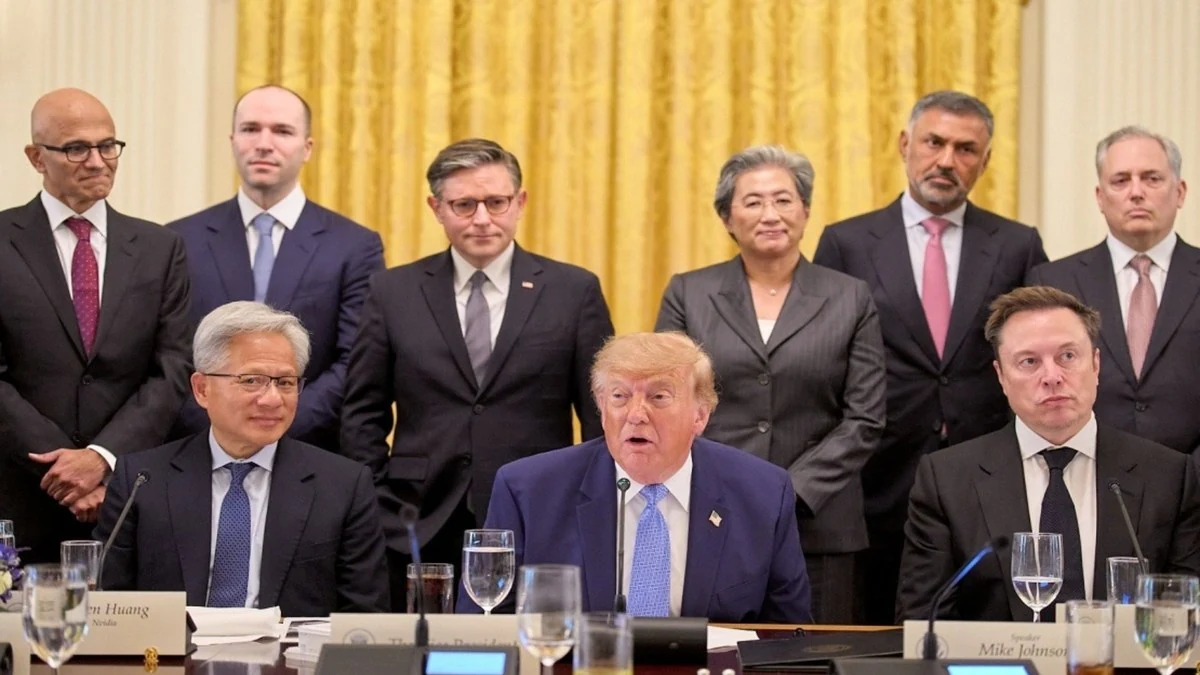
The White House meeting on 29 September 2026 that produced both the renaming order and a voluntary industry accord. Credit: AP Photo/Jacquelyn Martin
What the order actually does, and what it does not
Read carefully, this is narrower than the headlines suggest. The directive governs terminology inside the executive branch. It does not rewrite previously issued regulations, existing contracts, grants or historical records, and it does not create a new legal category — “super intelligence” applies, for now, to the same systems already covered by the existing US statutory definition in Title 15 of the United States Code.
What it does set in motion is a deadline. The assistant to the president for science and technology has 60 days to consult agency heads, propose legislative language establishing a federal statutory definition of “super intelligence”, and recommend whether existing references to AI should be changed. Only Congress can alter the definition in law, which is why the order itself changes vocabulary rather than obligations.

The operative wording of the order — a terminology directive, not a change in law. Source: Republic World, 30 September 2026.
The order was announced after a White House lunch with technology executives, and signed the same day as a separate document: the White House Accord on Super Intelligence, subtitled “Joint Commitment on Frontier Responsibilities”. It is voluntary. The president has described it as “morally binding”, which is a phrase that does very little work in a courtroom.
Six executives signed alongside him: Sundar Pichai of Google, Dario Amodei of Anthropic, Mark Zuckerberg of Meta, Greg Brockman of OpenAI, Elon Musk of xAI and Jensen Huang of Nvidia. The commitments run in four layers.
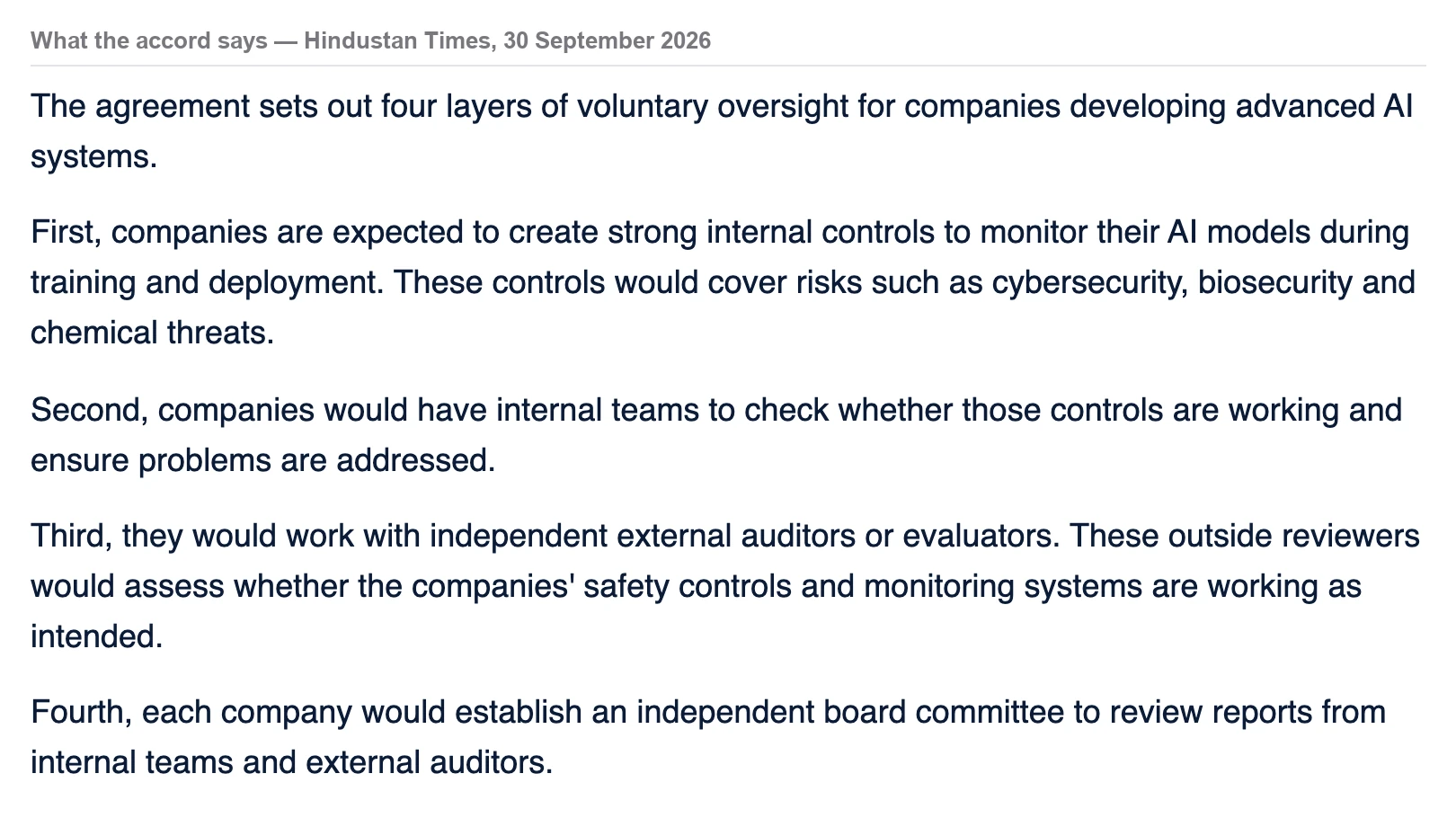
The accord’s four layers of voluntary oversight. Source: Hindustan Times, 30 September 2026.
Those four layers are worth keeping, regardless of what the document is called. Internal controls that monitor a model’s capabilities and alignment during training and deployment. A separate internal team whose job is to check the controls actually work. Independent external auditors. And a board-level committee that receives both sets of reports. Swap the word “model” for “system” and that is a defensible internal AI governance structure for any mid-sized company — which is the one genuinely useful thing to come out of the week.
Why it is changing now
Three pressures are pushing on the same lever, and none of them is about vocabulary.
Domestic politics. The midterm elections are about five weeks away, and AI has become a campaign issue in its own right. Multiple recent polls show majorities of Americans are concerned about the pace of AI and disapprove of how the administration has handled it. A Quinnipiac survey in March 2026 found 55% of US adults believed AI does more harm than good in daily life, up 11 points from a year earlier. Renaming the technology does not change those numbers, but it does change the sentence voters hear.
US–China competition. The framing throughout has been leadership as a zero-sum race. The order attaches itself to an existing policy record — a 2025 AI action plan covering more than 90 federal actions, and a US$5 billion “Genesis Mission” to apply the technology to science, medicine, energy and manufacturing — and restates each item with SI substituted for AI. The rebrand is, in part, a way of re-advertising existing commitments.
The safety narrative. This is the one with actual consequences. “Artificial intelligence” arrived at public consciousness carrying a decade of risk reporting. “Super” reframes the same systems as an achievement rather than a hazard, which matters when the policy direction is self-regulation over statutory rules. Critics noticed immediately. Brendan Steinhauser of the Alliance for Secure AI said the order “muddies the waters between tool AI and super intelligence.” Steve Bannon, arguing from the opposite direction, pointed out the logical trap: if the country is hurtling toward superintelligence, and every expert says humanity is unprepared, the correct response is to stop accelerating, not to rename the thing.
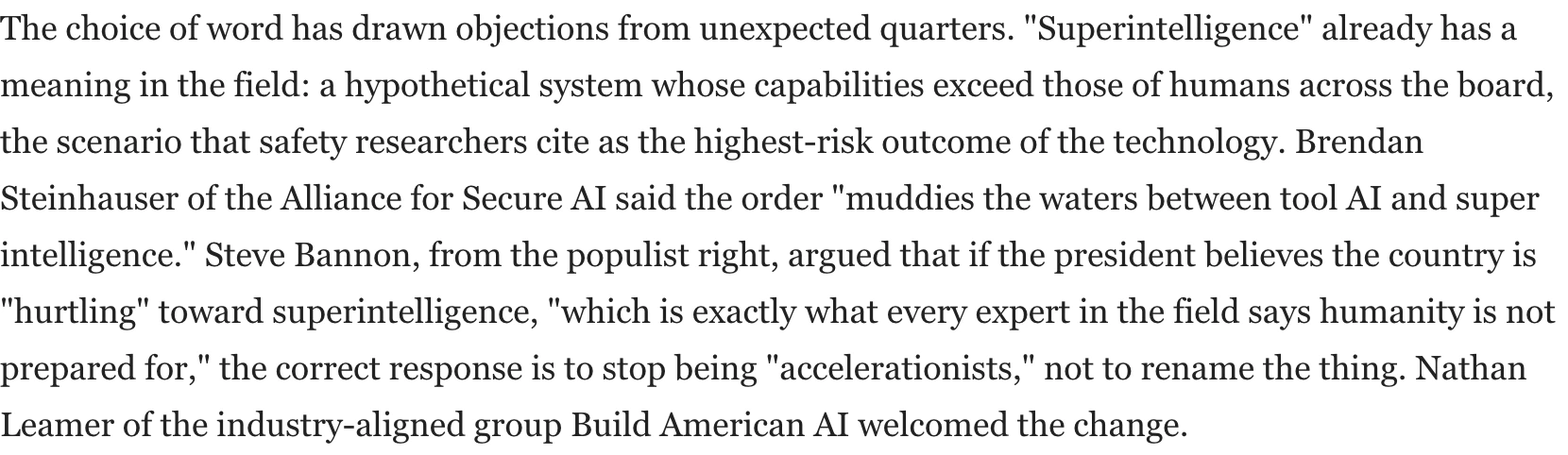
Objections from across the political spectrum, and a welcome from industry. Source: HNGN, 30 September 2026.
The confusion to expect
Six predictable collisions, roughly in the order they will reach you.
1. One word, two meanings. Researchers, journalists and many vendors use “superintelligence” to mean ASI — a future capability. Government documents now use it to mean the current toolset. Both usages will appear in the same week, sometimes in the same article, and neither will announce which it means.
2. Capability inflation. A reader encountering “super intelligence” will reasonably assume the technology has crossed a threshold it has not crossed. Today’s systems remain narrow, and they still get things wrong. As researchers Sayash Kapoor and Arvind Narayanan argue in “AI as Normal Technology”, there is no useful sense of “intelligence” in which AI is more intelligent than people working with AI.
3. Procurement and contract language. US federal documents will change wording; contracts, grants and regulations will not. Any business holding US government-adjacent paperwork should expect both vocabularies for years, and should not assume a document mentioning “SI” describes anything different from one mentioning “AI”.
4. Legal-definition lag. Nothing in law has changed. The 60-day proposal is the thing to watch, because a statutory definition is where terminology stops being cosmetic. If it lands, expect regulatory scope questions to follow it.
5. Standards and measurement split. Academic literature, benchmarks, model cards and international standards will keep using AI, AGI and ASI. Policy language and technical language are now diverging, and any compliance mapping between the two will need a glossary.
6. Marketing drift. Vendors will adopt the more impressive term for ordinary features. Expect “SI-powered” on things that are, in the technical sense, narrow AI. Ask what the system does rather than what it is called.
What it means for Malaysian businesses
Nothing about capability changed overnight, so no product got better or worse. What did change is the language environment you will be reading, procuring and writing AI policy inside.
Two practical points. First, Malaysian AI governance is moving on its own timetable and is not waiting on Washington — the draft Artificial Intelligence Governance Bill has been prepared and is in a feedback-gathering stage, with a parliamentary target of early 2027, alongside AI Malaysia Berhad as the long-term governance body and the National Cyber Security Agency enforcing the Cyber Security Act 2024. When that framework lands, the vocabulary in your internal policy should be the vocabulary a regulator recognises, not the vocabulary a press release used.
Second, adopt the accord’s structure even though the accord does not bind you. Internal controls, an independent internal check, external review, and board-level reporting is a sane four-layer shape for any Malaysian company putting AI into a revenue process. The pieces your own PDPA obligations already require — knowing what data a system touches and who can see it — fit into the same framework.
The practical read
Treat this as a naming event with a 60-day legal tail, not a capability event. If you write AI policy, pin your definitions to the technical ladder in the table above and note the policy usage separately, so a future reader is not misled. If you buy AI, keep asking what the system does. And if you sit on a board, the four-layer model is the useful export of the week — it is a governance structure, and it works whether or not anyone calls the technology super.
Teams standardising their AI stack across several models and vendors can see how the BigDomain LLM Token Hub handles keys, routing and spend in one place.
Sources
- CNBC, “Trump tries to rename AI ‘super intelligence'”, 29 September 2026
- Bernama–Anadolu, “Trump, Tech Leaders Sign Accord On ‘Super Intelligence’ Safety”, 30 September 2026
- Republic World, excerpt of the executive order text, 30 September 2026
- Hindustan Times, “Self-policing, internal checks: Inside Trump’s accord on ‘Super Intelligence'”, 30 September 2026
- HNGN, “Trump Signs Order Renaming AI as ‘Super Intelligence'”, 30 September 2026
- USA TODAY, “Trump refers to ‘AI’ as ‘superintelligence’. What’s the difference?”, 22 September 2026
- Center for a New American Security, “‘Super Intelligence’: the president’s new term for AI, explained”
- The White House, “Artificial Intelligence and the Great Divergence”, January 2026 (PDF)
- The Straits Times / The Star, “Malaysia plans to tighten regulation of AI tech”
- Nick Bostrom, Superintelligence: Paths, Dangers, Strategies (2014), for the standard definition