Budget 2027 Malaysia was tabled in the Dewan Rakyat on Friday 9 October 2026 at 3.35pm, half an hour earlier than the usual 4pm slot, with total spending of RM459.8 billion — 3.6% above the revised 2026 allocation and 19.8% of gross domestic product. It was tabled by Prime Minister Datuk Seri Anwar Ibrahim, who is also Finance Minister. It is the fifth MADANI budget and the second under the 13th Malaysia Plan, and it carries the theme “Malaysia MADANI: Menggapai di Langit, Mengakar di Bumi” (Reaching to the Sky, Rooted in the Earth).
Last updated: 10 October 2026, 8.45am MYT. Measures are added or corrected as they are confirmed, and every figure carries its source and date. Where a report and the ministry’s own documents disagree, we say so rather than pick one silently. The Budget 2027 speech and the tax annex are published in full and this page has been re-read and corrected against them.
This page is our running record of Budget 2027 Malaysia. It leads with what changes for you, then carries the tabled measures themselves and the fiscal architecture underneath them. It is updated through the debate and the committee stage, and every figure carries its source and date.
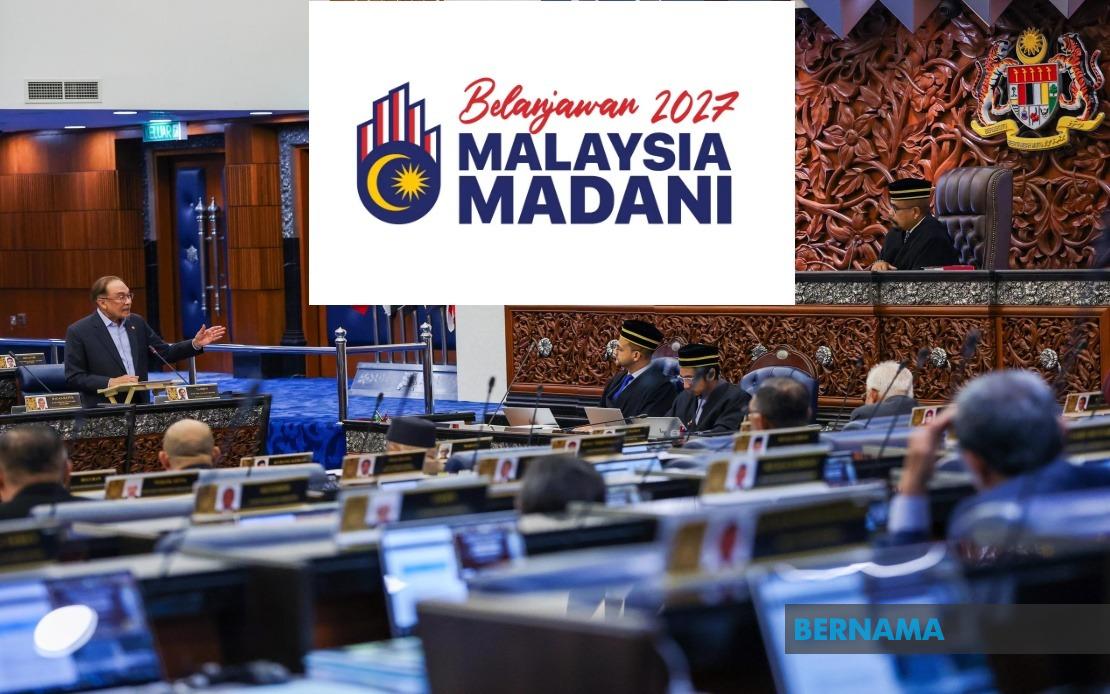
Photo: Bernama. Prime Minister Datuk Seri Anwar Ibrahim at the Dewan Rakyat despatch box, where the national budget is tabled. Image published by Bernama with its Budget 2027 report, 9 October 2026.
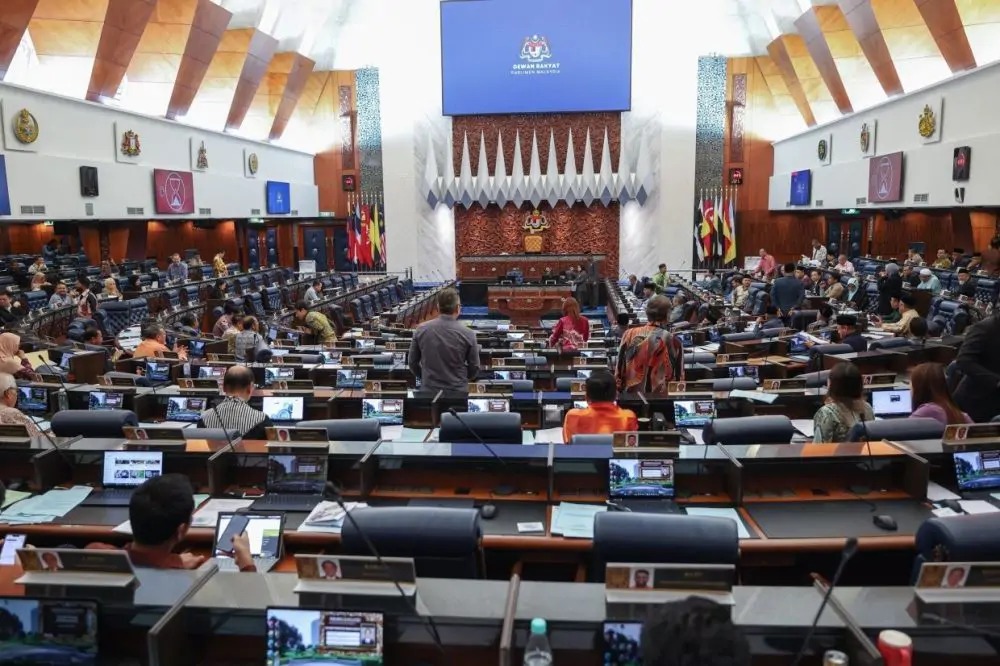
Photo: The Star. The Dewan Rakyat chamber, where Budget 2027 is tabled on 9 October 2026. Read 9 October 2026 at https://www.thestar.com.my/news/nation/2026/10/09/budget-2027-to-be-tabled-in-parliament-today
How to read this page. Two kinds of number appear below and they are labelled differently on purpose. “Tabled” figures are read from the Budget 2027 speech and Ministry of Finance documents. “Expected” figures are the published forecasts or requests of named bodies (economists, associations, unions) and are not government commitments. If a figure is later clarified or corrected, we update it here and date the change. We do not publish a number we have not read at source.
Budget 2027 Malaysia: what changes for you
Budget 2027 in the terms that matter if you draw a wage, run a business or own a home: what the number was, and what it becomes.
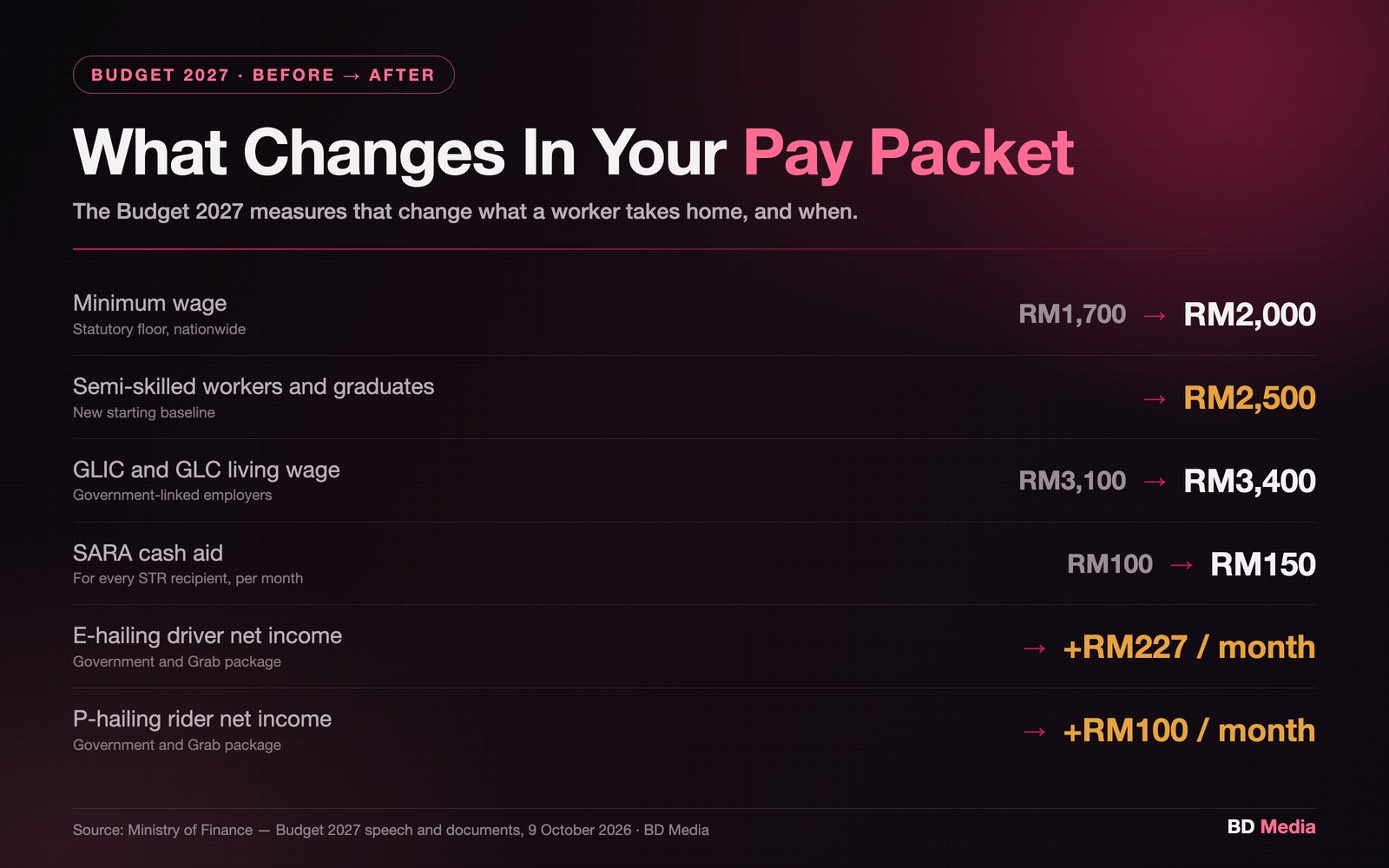
Source: BD Media, from the Ministry of Finance’s Budget 2027 speech and documents, 9 October 2026. Before-and-after values are the position before this budget against the tabled position.
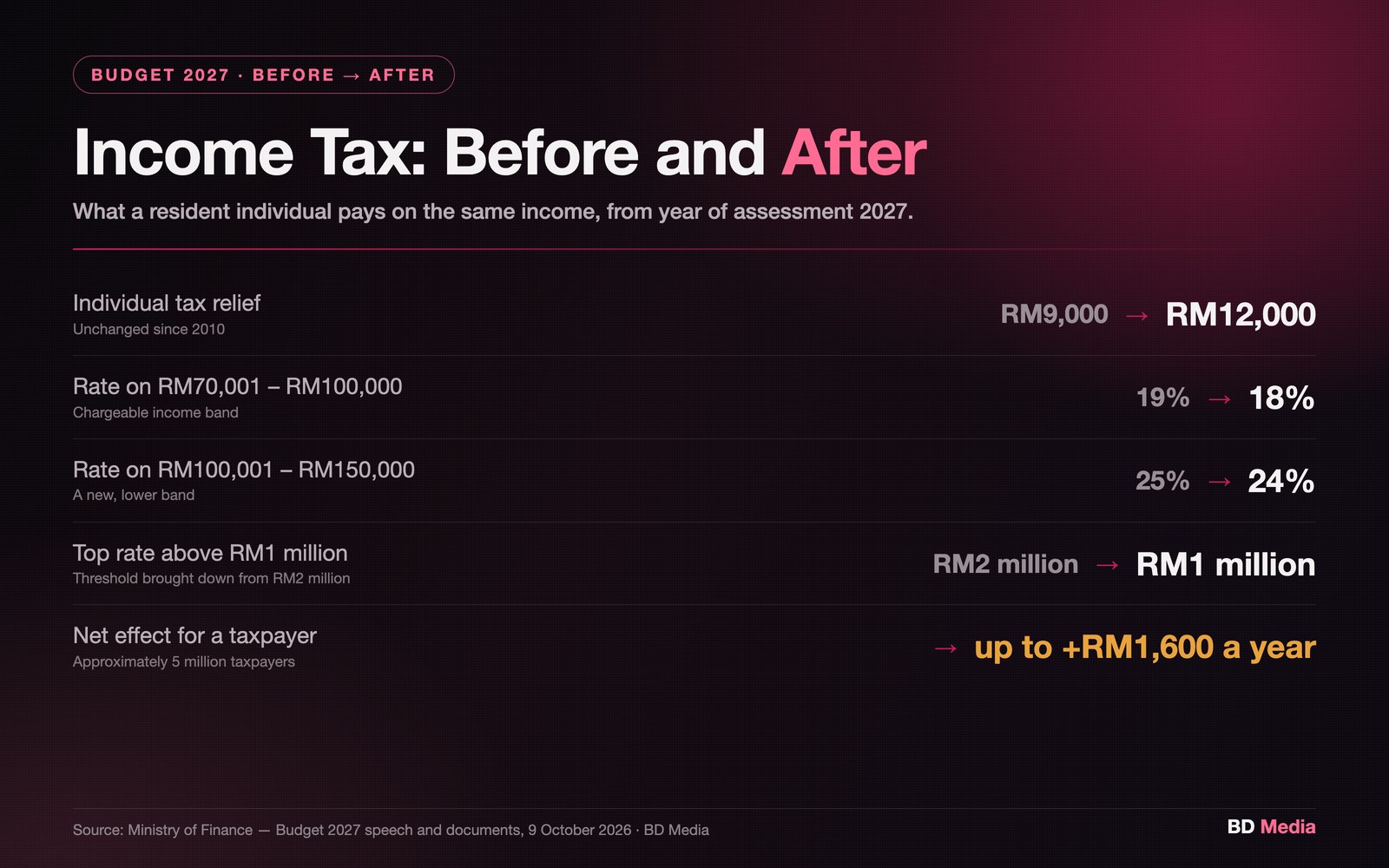
Source: BD Media, from the Ministry of Finance’s Budget 2027 speech and documents, 9 October 2026. Before-and-after values are the position before this budget against the tabled position.
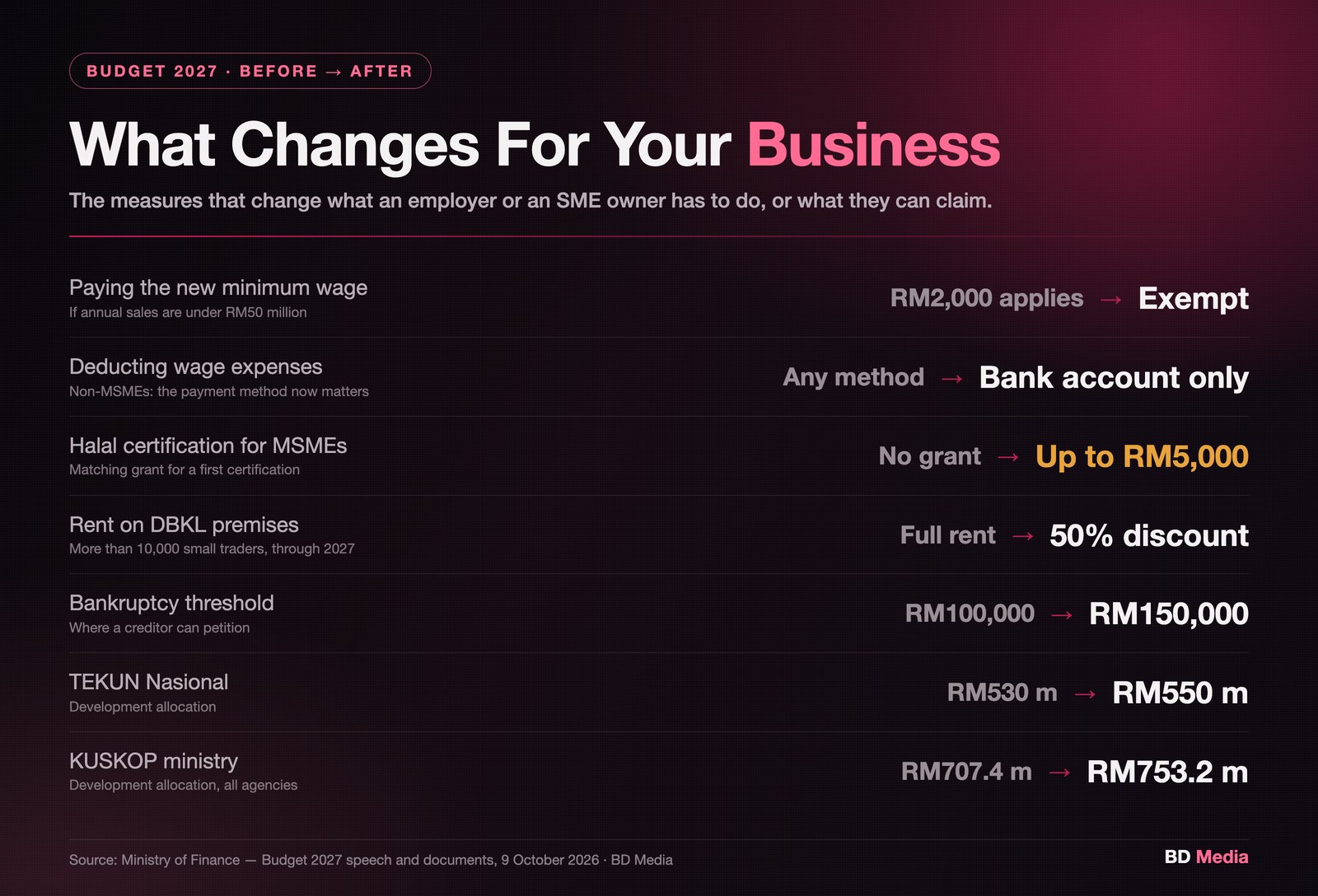
Source: BD Media, from the Ministry of Finance’s Budget 2027 speech and documents, 9 October 2026. Before-and-after values are the position before this budget against the tabled position.
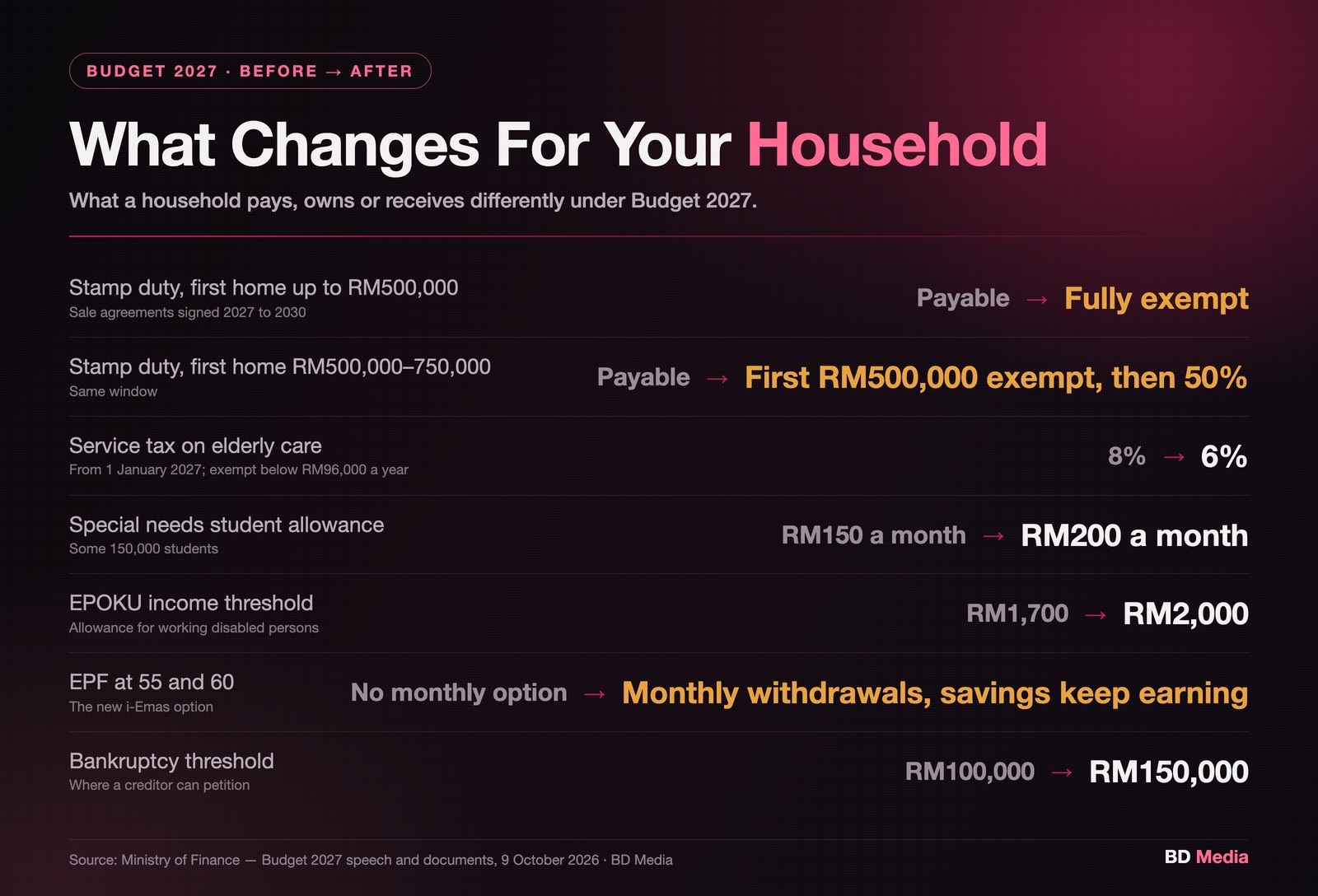
Source: BD Media, from the Ministry of Finance’s Budget 2027 speech and documents, 9 October 2026. Before-and-after values are the position before this budget against the tabled position.
Budget 2027 Malaysia: what is confirmed
| Item | Detail | Source |
|---|---|---|
| Tabled | 9 October 2026, 3.35pm, Dewan Rakyat | Bernama, 9 Oct 2026 |
| Tabled by | PM Datuk Seri Anwar Ibrahim, also Finance Minister | Bernama; The Star, 9 Oct 2026 |
| Theme | “Malaysia MADANI: Menggapai di Langit, Mengakar di Bumi” | Ministry of Finance, Pre-Budget Statement 2027 |
| Which budget | 5th MADANI budget; 2nd under the 13th Malaysia Plan | Bernama, 9 Oct 2026 |
| Three pillars | Raising the growth ceiling · raising the floor of living standards · governance reform | MOF Pre-Budget Statement, 18 Aug 2026 |
| Growth backdrop | H1 2026 actual 5.7%; 2026 full year seen at the upper end of 4.8–5.3%; 2027 forecast 4.2–5.2% | MoF, Economic Outlook 2027; Bernama, 9 Oct 2026 |
| Budget portal | belanjawan.mof.gov.my, opened 18 August 2026 for public submissions | Ministry of Finance |
The tabled measures
These are read from the speech and the Ministry of Finance documents released with it. They are the measures themselves, not forecasts.
| Area | Measure | Effective |
|---|---|---|
| Individual income tax | Individual tax relief raised from RM9,000 to RM12,000 — the first review since 2010 | YA 2027 |
| Individual income tax | Rate cut by one percentage point: 18% on RM70,001–RM100,000; 24% on RM100,001–RM150,000 | YA 2027 |
| Individual income tax | Rate raised to 30% on chargeable income above RM1 million | YA 2027 |
| Individual income tax | Net effect: up to RM1,600 more disposable income for about 5 million taxpayers | YA 2027 |
| Tax relief scope | Expanded to postnatal care; all care expenses for parents and grandparents; sports shoes; all fields of study and children’s tuition; AI subscriptions; vaccination costs; pet adoption from registered centres | YA 2027 |
| Minimum wage | Raised from RM1,700 to RM2,000 a month, covering more than 4 million workers | June 2027 |
| Minimum wage — exemption | MSMEs with annual sales below RM50 million are exempt from the new minimum wage | June 2027 |
| Wage floor | New RM2,500 monthly baseline for semi-skilled workers and graduates | 2027 |
| Living wage | GLIC and GLC living-wage benchmark raised from RM3,100 to RM3,400 — about 230,000 workers | 2027 |
| Wage tax deduction | Non-MSME companies may only deduct wage expenses if wages are paid through bank accounts, on channels permitted under the Employment Act 1955 — aimed at employers of undocumented foreign workers | 2027 |
| Cash transfers | STR and SARA allocation raised from RM15 billion to RM16 billion; all STR recipients now eligible for SARA up to RM150 a month (RM1,800 a year) | 2027 |
| Cash transfers | Malaysians aged 18 and above who are not STR recipients get SARA MADANI RM100 twice — before Aidilfitri, and around the 70th National Day | 2027 |
| SARA network | SARA usable for wet and fresh produce at 216 farmers’ markets / tamu under FAMA; 15,000 participating outlets including 6,800 small grocery shops | 2027 |
| Gig workers | Government and Grab co-fund a RM160 million package: e-hailing net income up to +RM227 a month, p-hailing up to +RM100 a month, for about 600,000 workers | from 2027 |
| Gig workers | PERKESO matching 35%, rising to 50% if platform companies also contribute; 70% matching for more than 200,000 self-employed people across 17 sectors — the non-mandatory sectors under Akta 789; EPF matching up to RM600 a year / RM6,000 lifetime | 2027 |
| Gig workers | BSN and Agrobank provide RM270 million to finance business start-ups and first homes; p-hailing to be regulated under APAD and LPKP | 2027 |
| Retirement protection | PERKESO tax relief extended to Lindung Kendiri mandatory contributions; up to RM150 extra relief for voluntary Lindung 24 Jam and Lindung Kendiri | YA 2027 |
| Cost of living | Jualan RAHMAH MADANI and Jualan Agro MADANI raised from RM630 million to RM750 million; 35,000 sales events (30,000 RAHMAH, 5,000 Agro, with Agro prices up to 30% lower) | 2027 |
| Rural supply | RM250 million to distribute essential goods to rural and remote areas, covering six new locations including Penampang (Sabah) and Pusa (Sarawak) | 2027 |
| MSME income tax | Rate cut by one percentage point: the first RM150,000 of chargeable income from 15% to 14%, and RM150,001–RM600,000 from 17% to 16%; income above RM600,000 unchanged at 24%. Expected to benefit about 300,000 enterprises | YA 2027 |
| MSME capital allowance | Small-asset capital allowance threshold raised from RM2,000 to RM3,000 an asset; the overall annual claim limit for companies other than MSMEs raised from RM20,000 to RM30,000 | YA 2027 |
Source: Budget 2027 speech and the Ministry of Finance’s Fiscal Outlook and Federal Government Revenue Estimates 2027, tabled 9 October 2026, as reported by Bernama, The Star, Sinar Daily, The Vibes and the New Straits Times the same day. Read 9 October 2026.
The fiscal architecture
| Item | 2027 | Comparison |
|---|---|---|
| Total expenditure | RM459.8 billion | +3.6% on the revised 2026 allocation; 19.8% of GDP |
| 2026 allocation, revised | RM444.1 billion | revised up from RM419.2 billion |
| Operating expenditure | RM376.8 billion (81.9%) | RM363.1 billion in 2026 |
| Development expenditure | RM83 billion | RM81 billion in 2026; at least 3% of GDP as required by Act 850 |
| Education, Health, Defence | RM138.85 billion (30.2%) | — |
| Social sector | RM161.6 billion (35.1%) | largest share of expenditure |
| Subsidies and social assistance | RM72.7 billion (19.3% of OE) | down 2.3%; RM74.47 billion in 2026, RM55.27 billion in 2025 |
| Debt service charges | RM61 billion (16.2% of OE) | up 6.5%; 98.4% domestic |
| Emoluments | RM111.6 billion (29.6% of OE) | up 2.9% |
| Revenue | RM380.8 billion | up 4.7% |
| Petronas dividend | RM32 billion | revised up from an initial RM20 billion estimate for 2026 |
| Fiscal deficit | 3.3% of GDP | 3.6% in 2026 and 3.7% in 2025; on the path to 3.0% |
| Federal debt to GDP | 63.7% (2027) | down from 64.0% in 2026 and 65.2% in 2025, as new borrowings are held down; the government targets below 60% |
| Inflation | 1.8–2.8% | 2026 revised to 1.5–2.5% |
| Whole-of-nation envelope | RM510 billion | against RM470 billion for 2026; the speech’s total, comprising RM376.8bn operating + RM83bn development + RM25bn GLIC investment + RM11bn public-private investment + RM14.2bn statutory bodies and MKD companies |
| Development expenditure, certified basis | RM85.00 billion (18.4%) | of the RM461.84 billion certified Federal expenditure estimate — the higher figure includes loans and contingency (see note below) |
Source: Ministry of Finance, Fiscal Outlook and Federal Government Revenue Estimates 2027 and Economic Outlook 2027, released 9 October 2026; reported by Bernama. Deficit revision for 2026 reported by Reuters, 9 October 2026.
Two figures that get mis-quoted, so we state them precisely. Budget 2027 is +3.6% higher than the revised 2026 allocation of RM444.1 billion — not 10% higher than the original RM419.2 billion. And the 2026 fiscal deficit target was revised up from 3.5% to 3.6% of GDP, largely on the fuel subsidy bill, before falling to 3.3% in 2027.
The arithmetic is the check. RM459.8 billion is +3.6% over RM444.1 billion; over RM441.1 billion it would be +4.2%, which is not the figure the Ministry of Finance published. The components agree: 2026 operating expenditure of RM363.1 billion plus development expenditure of RM81 billion is RM444.1 billion — the same total, reached two ways. The discrepancy is not ours to invent: Bernama, the national news agency, published RM441.1 billion (and others picked it up), while The Edge Malaysia’s reading of the same Fiscal Outlook gives RM444.1 billion — which is also what the ministry’s own components add up to. We use RM444.1 billion and flag the disagreement rather than pick a side quietly.
SME and co-operative financing, line by line
Read from the ministry’s own documents, three government-backed financing channels are open to SMEs: the Bank Negara Malaysia SME Stabilisation Relief Facility of RM5 billion for working capital to viable SMEs hit by the West Asia conflict — RM2.8 billion of it already approved to more than 4,900 SME accounts as at August 2026; a further RM5 billion of guarantee capacity under SJPP, with coverage up to 80% and the guarantee period extended to 10 years; and the RM10 billion Bank Negara–CGC guarantee scheme for SME productivity, innovation and resilience. Separately, MITI and the Securities Commission run the CoSIF NIMP Smart Manufacturing Scheme at a 2:1 government-to-private ratio to 2030. Our breakdown of all three channels cites the chapter and page of each figure.
For 2027, the speech puts the total of SME loan facilities and financing guarantees at RM57 billion, up from RM50 billion. Within that total, SJPP and CGC provide guarantee financing of up to RM32 billion, with SJPP coverage widened to mid-tier companies in all sectors and the guarantee limit raised to RM50 million; RM1 billion of SJPP guarantee is earmarked to help local companies expand through mergers and acquisitions. Bank Negara Malaysia, which had opened a RM5 billion facility for SMEs affected by the West Asia conflict (RM2.8 billion approved to more than 4,900 accounts by August 2026), is adding a further RM5 billion to it. Each figure is stated on its own basis; we do not add them into a single total.
The agency-level allocations were published in the Ministry of Finance’s Anggaran Perbelanjaan Persekutuan 2027, released with the speech. These are the development allocations for the bodies that deliver SME and co-operative financing. They sit inside the KUSKOP ministry total, so they should be read as parts of it rather than additions to it.
| Body | 2027 development allocation | Notes |
|---|---|---|
| KUSKOP (the ministry, all agencies) | RM753.2 million | 2026 revised: RM707.4 million. Operating: RM275,248,500 |
| SME Corp Malaysia | RM137.0 million | Of which Program Peningkatan dan Pembangunan PKS RM112.0m; Dana Pembangunan dan Pembiayaan PKS RM22.0m; Pembangunan Perusahaan Mikro RM3.0m. Operating: RM42,756,400 |
| TEKUN Nasional | RM550.0 million | 2026 revised: RM530.0 million. Operating grant: RM3.0 million |
| INSKEN (National Entrepreneurship Institute) | RM9.4 million | Operating: RM12,000,900 |
| Suruhanjaya Koperasi Malaysia (SKM) | RM10.5 million | Co-operative development. Operating: RM91.0 million |
Source: Ministry of Finance, Anggaran Perbelanjaan Persekutuan 2027 (Federal Expenditure Estimates 2027), B.26 / P.26, published 9 October 2026. Read 9 October 2026 at https://belanjawan.mof.gov.my/pdf/belanjawan2027/perbelanjaan/Anggaran_Perbelanjaan_Persekutuan_2027.pdf
What happens next in Parliament
The Supply Bill 2027 was moved for its second reading at 3.35pm on 9 October. Under the Dewan Rakyat calendar the policy-stage debate runs for eight days from Monday 12 October, ministerial winding-up sessions are scheduled for 26–29 October, and the committee stage runs from 2 to 26 November before the Bill is put to the House. Budget estimates can change during the committee stage, so figures on this page are dated.
Source: Bernama, “PM Anwar Tables 2027 Budget, Drives MADANI Agenda”, 9 October 2026.
Live updates
Newest first. Each entry carries its source and the time we read it.
- 10 Oct 2026, 08:45 — re-read at source, no measure changed The tabled measures are unchanged, and the speech and tax annex have been re-read at source; two fiscal-architecture figures are now added. The Ministry of Finance is still serving the full speech and tax annex (95 and 49 pages). The policy-stage debate has not opened — it begins on Monday 12 October — so no measure has moved yet. We have added the Federal debt-to-GDP path (63.7% in 2027) and the Education allocation (~RM69 billion), both read directly from the speech. Source: Ministry of Finance, Budget 2027 speech, paras 93, 101 and 190, read 10 October 2026.
- 9 Oct 2026, 22:00 — the ministry’s documents now carry content The Budget 2027 speech and the tax annex are now published in full, and several measures we had been reporting second-hand are confirmed at source. Earlier today the ministry’s portal served the speech (ub27.pdf) and the tax annex (langkah-cukai.pdf) as single-page cover documents carrying a title and nothing else. They now carry their full text — the speech at 95 pages and the tax annex at 49 pages — and this page has been corrected against them. Source: Ministry of Finance, Ucapan Belanjawan MADANI Kelima Tahun 2027 and Langkah Cukai, published at belanjawan.mof.gov.my, read 9 October 2026.
- 9 Oct 2026, 22:00 — MSME income tax MSME income tax rates are cut by one percentage point: the first RM150,000 of chargeable income from 15% to 14%, and RM150,001 to RM600,000 from 17% to 16%, with income above RM600,000 unchanged at 24%. It takes effect from the 2027 year of assessment and is expected to benefit about 300,000 enterprises. We had earlier carried this as reported-only; it is now confirmed in the ministry’s own tax annex, not only in the speech. Source: Ministry of Finance, Langkah Cukai (tax measures), Annex 11, 9 October 2026.
- 9 Oct 2026, 22:00 — SME financing Total loan facilities and financing guarantees for SMEs rise from RM50 billion to RM57 billion in 2027, with SJPP and CGC providing up to RM32 billion of guarantee financing. SJPP coverage is widened to mid-tier companies in all sectors with the guarantee limit raised to RM50 million, and RM1 billion of SJPP guarantee is earmarked for local companies expanding through mergers and acquisitions. Bank Negara Malaysia adds a further RM5 billion to its RM5 billion post-conflict SME financing facility. Source: Budget 2027 speech, 9 October 2026; reported by Bernama and Media Selangor, 9 October 2026.
- 9 Oct 2026, 16:35 — the tabled budget Budget 2027 commits RM459.8 billion, with the deficit falling to 3.3% of GDP. The 2026 allocation was revised up to RM444.1 billion and the 2026 deficit target revised from 3.5% to 3.6%, largely on the fuel subsidy bill. Operating expenditure takes RM376.8 billion (81.9%) and development expenditure RM83 billion. Education, Health and Defence together receive RM138.85 billion, or 30.2% of the total. Revenue is projected at RM380.8 billion, up 4.7%, including a RM32 billion Petronas dividend. Source: Ministry of Finance, Fiscal Outlook and Federal Government Revenue Estimates 2027, released 9 October 2026; Bernama, 9 October 2026.
- 9 Oct 2026, 16:35 — wages The minimum wage rises from RM1,700 to RM2,000 a month from June 2027, and MSMEs below RM50 million in annual sales are exempt. More than four million workers are covered by the increase. The budget also introduces a RM2,500 monthly baseline for semi-skilled workers and graduates, and raises the GLIC and GLC living-wage benchmark from RM3,100 to RM3,400, affecting about 230,000 workers. Employee compensation is only 33.9% of GDP, which the Prime Minister gave as the reason for moving. Source: Budget 2027 speech, 9 October 2026; Sinar Daily, Media Selangor, The Vibes and SAYS, all 9 October 2026.
- 9 Oct 2026, 16:35 — tax Individual tax relief goes from RM9,000 to RM12,000 and selected rates come down. The rate falls to 18% on chargeable income of RM70,001 to RM100,000 and to 24% on RM100,001 to RM150,000, while income above RM1 million is taxed at 30%. The government puts the combined effect at up to RM1,600 of extra disposable income for about five million taxpayers. Relief has also been widened to AI subscriptions, postnatal care, all care expenses for parents and grandparents, children’s tuition, vaccination and pet adoption from registered centres. Source: Budget 2027 speech, 9 October 2026; Bernama and The Star, 9 October 2026.
- 9 Oct 2026, 16:35 — households and gig workers STR and SARA rise to RM16 billion, and gig workers get a RM160 million package. All STR recipients can now draw SARA of up to RM150 a month, and Malaysians aged 18 and over who are not on STR receive SARA MADANI of RM100 on two occasions. SARA can be used for wet and fresh produce at 216 farmers’ markets and tamu. For the roughly 600,000 e-hailing and p-hailing workers, the government and Grab will co-fund a RM160 million package; PERKESO matching is set at 35%, rising to 50% where platforms also contribute. Source: Bernama and Sinar Daily, 9 October 2026.
- 9 Oct 2026, before the speech Budget 2027 is tabled at 3.30pm. The Dewan Rakyat sitting was scheduled half an hour earlier than the usual 4pm slot. The measures above replace the pre-tabling position this entry previously carried. Source: Bernama and The Star, 9 October 2026.
Also in Budget 2027
Measures that were not on this page when it first published, read from the ministry documents and the day’s reporting.
| Area | Measure |
|---|---|
| Education | Keeps the largest allocation at nearly RM69 billion, against RM66.2 billion in 2026; the Higher Education ministry separately receives RM19.1 billion, including RM800 million to upgrade campuses and replace ageing equipment |
| Health | Allocation rises to RM47.7 billion from RM46.5 billion; more than 9,000 contract doctors offered permanent posts; RM1.2 billion to upgrade and repair public health facilities |
| Sabah and Sarawak | The two states keep the largest federal allocations: Sabah RM18.7 billion and Sarawak RM16.2 billion |
| Elderly care | RM1.3 billion for elderly assistance, reaching nearly 200,000 recipients; more than RM40 million through HRD Corp to train 8,000 elderly-care workers; two National Integrated Care Centres of Excellence in Penang and Sarawak; a Senior Citizens Bill to be drafted |
| Disabled persons | RM1.5 billion total assistance for persons with disabilities; the EPOKU income threshold rises from RM1,700 to RM2,000 |
| MSMEs | Matching grant of up to RM5,000 for a first halal certification |
| Small traders | More than 10,000 small traders renting DBKL premises get a 50% rental discount through 2027; festive bazaar fees from RM400 |
| Rural infrastructure | RM3.3 billion for basic rural infrastructure including clean water and electricity |
| Connectivity | RM5 billion under the Jendela project for internet expansion, targeting Orang Asli villages, roads and rail |
| Housing | About RM1 billion for Rumah Mesra Rakyat and Program Residensi Rakyat, including four new projects in Kulai, Nilai, Paya Rumput and Pertang; at least 2,500 Rumah MADANI units planned at Belfield, Kuala Lumpur |
| Abandoned housing | Full stamp duty exemption for rescue contractors or developers and original buyers, 2027 to 2030, aimed at zero abandoned projects by 2030 |
| Orang Asli | RM445 million for development including replanting and preschool projects |
| Transport | The Elevated Autonomous Rapid Transit system agreed for Johor Bahru; more stage bus routes and frequencies and higher KTM Komuter frequency ahead of the RTS Link |
| Flood mitigation | RM100 million for retention ponds and river maintenance to cut flood risk in the Klang Valley |
| Places of worship | RM80 million for the maintenance of registered non-Muslim houses of worship |
| Chinese New Village | Infrastructure repair allocation raised to more than RM100 million |
| Elderly care | Service tax on elderly-care centres cut from 8% to 6% from 1 January 2027, with full exemption for care fees up to RM96,000 a year per resident at registered centres |
| Stamp duty | Full exemption on opening savings and current accounts from 1 January 2027; a flat RM10 on agreements using bank excess credit and on peer-to-peer financing loan agreements, for instruments executed 2027–2030 |
| Manufacturing | Manufacturers may reclaim sales tax on locally purchased machinery, spare parts and equipment, and on raw materials for pharmaceuticals, animal feed, fertiliser and pesticides |
| SMEs and AI | RM30 million through MDEC to help 4,000 SMEs adopt AI and automate operations |
| Exports | RM60 million for MATRADE to build local companies’ market reach, and RM1 billion of export financing through BPMB for SMEs |
| Taxi and school-bus drivers | A one-off RM1,000 payment to 38,000 taxi and hire-car drivers and 15,000 school-bus drivers nationwide |
| Retirement | Every citizen is automatically registered as an EPF member on reaching age 18, so retirement savings start earlier |
Source: The Edge Malaysia, “Highlights of Budget 2027”, 9 October 2026, at https://theedgemalaysia.com/node/821179; and Bernama, 9 October 2026. Read 9 October 2026.
Related coverage
- Budget 2027 SME Financing: Three Official Channels: the financing channels read from the ministry’s own documents, with chapter and page cited
- Budget 2027 Gig Workers: RM160 Million, And What Creators Can Claim
- Budget 2027 SME Wishlist: SAMENTA’s 15 Asks: the association’s submission to the Ministry of Finance
- Budget 2027 Malaysia: SMEs Want Outcomes, Not Allocations: the SME Association of Malaysia’s submission
- Budget 2027 SST: What Malaysia’s Tax Experts Want Changed
- Labuan Service Tax: SMEs Seek Section 48 Relief
- Malaysia Minimum Wage: What Budget 2027 Signals for SMEs
Sources
Primary documents, read directly
Ministry of Finance, Ucapan Belanjawan MADANI Kelima Tahun 2027 (the Budget 2027 speech), 95 pp, at belanjawan.mof.gov.my/pdf/belanjawan2027/ucapan/ub27.pdf; Langkah Cukai (tax measures annex), 49 pp, at belanjawan.mof.gov.my/pdf/belanjawan2027/ucapan/langkah-cukai.pdf; and the Anggaran Perbelanjaan Persekutuan 2027 with its overview Tinjauan Belanjawan 2027, at belanjawan.mof.gov.my/pdf/belanjawan2027/perbelanjaan/ringkasan.pdf. All read 9 October 2026.
Sources
Ministry of Finance: Budget 2027 speech; Economic Outlook 2027; Fiscal Outlook and Federal Government Revenue Estimates 2027; Pre-Budget Statement, 18 August 2026; and the Budget portal at belanjawan.mof.gov.my.
Bernama, 9 October 2026: “PM Anwar Tables 2027 Budget, Drives MADANI Agenda” (tabling time and parliamentary calendar); “Budget 2027: Growth That Pays Off For Malaysians” (RM459.8 billion, sector shares); “Budget 2027 Estimated At RM459.8 Bln, Up 3.6 Pct Year-on-year” (fiscal architecture); individual tax relief; STR and SARA; growth and revenue outlook; “Budget 2027: KUSKOP Seeks More Funding, Lower Business Costs For SMEs”, 8 October 2026; and the tabling date first announced 27 July 2026.
Corroboration
The Star, 9 October 2026: income tax rates by band; the Prime Minister’s tabling remarks; market reaction.
Sinar Daily, 9 October 2026: minimum wage to RM2,000 from June 2027; the RM160 million gig-worker package.
The Edge Malaysia, 9 October 2026: subsidy and social assistance path, RM72.73 billion.
Reuters, 9 October 2026: 2026 deficit target revised to 3.6%.
New Straits Times, 9 October 2026: pre-tabling expectations and the wage position.
The Vibes and Media Selangor, 9 October 2026: the RM50 million MSME exemption and the RM2,500 graduate baseline.
Astro Awani, 18 August 2026: Ministry of Finance Pre-Budget Statement coverage.
The Edge Malaysia, 2 October 2026: SMEAM Budget 2027 submission.
Oriental Daily, 10 September 2026: Budget 2027 preview, TA Securities note.
Sources and method. This page is now built on the ministry’s own documents, read directly. The Budget 2027 speech (ub27.pdf, 95 pages) and the tax annex (langkah-cukai.pdf, 49 pages) are published at belanjawan.mof.gov.my, alongside the Federal Expenditure Estimates 2027, the budget overview and the revenue and economic-outlook chapters. Where a newspaper and the ministry’s own document disagree, we say so rather than pick a side quietly.
Two things we looked for and did not find. Re-checked in full on 10 October 2026: we searched the speech and the tax annex for any measure on the 2% dividend tax that SAMENTA asked to be reviewed; there is none. We searched the same two documents for a carbon-pricing roadmap; there is none. That is an absence of evidence, not proof the government has ruled either out. Solar and battery storage, by contrast, are addressed: the Green Technology tax incentives are extended to 31 December 2030 and cover solar and Battery Energy Storage Systems, the budget funds a RM1.5 billion central solar park for government buildings, and it accounts for an energy-storage project at KLIA.
Development expenditure, stated with its basis. The speech and the Fiscal Outlook give RM83 billion of Federal development expenditure for 2027. The certified Anggaran Perbelanjaan Persekutuan 2027 carries RM85.00 billion, 18.4% of the RM461.84 billion certified estimate — the higher figure includes loans and contingency. Both are the ministry’s; we keep each on its own basis rather than swap one for the other.
This article is maintained as a live record of Budget 2027 and is updated as measures are tabled, clarified or corrected. It is produced by the BD Media desk. Last updated 10 October 2026, 8.45am MYT.