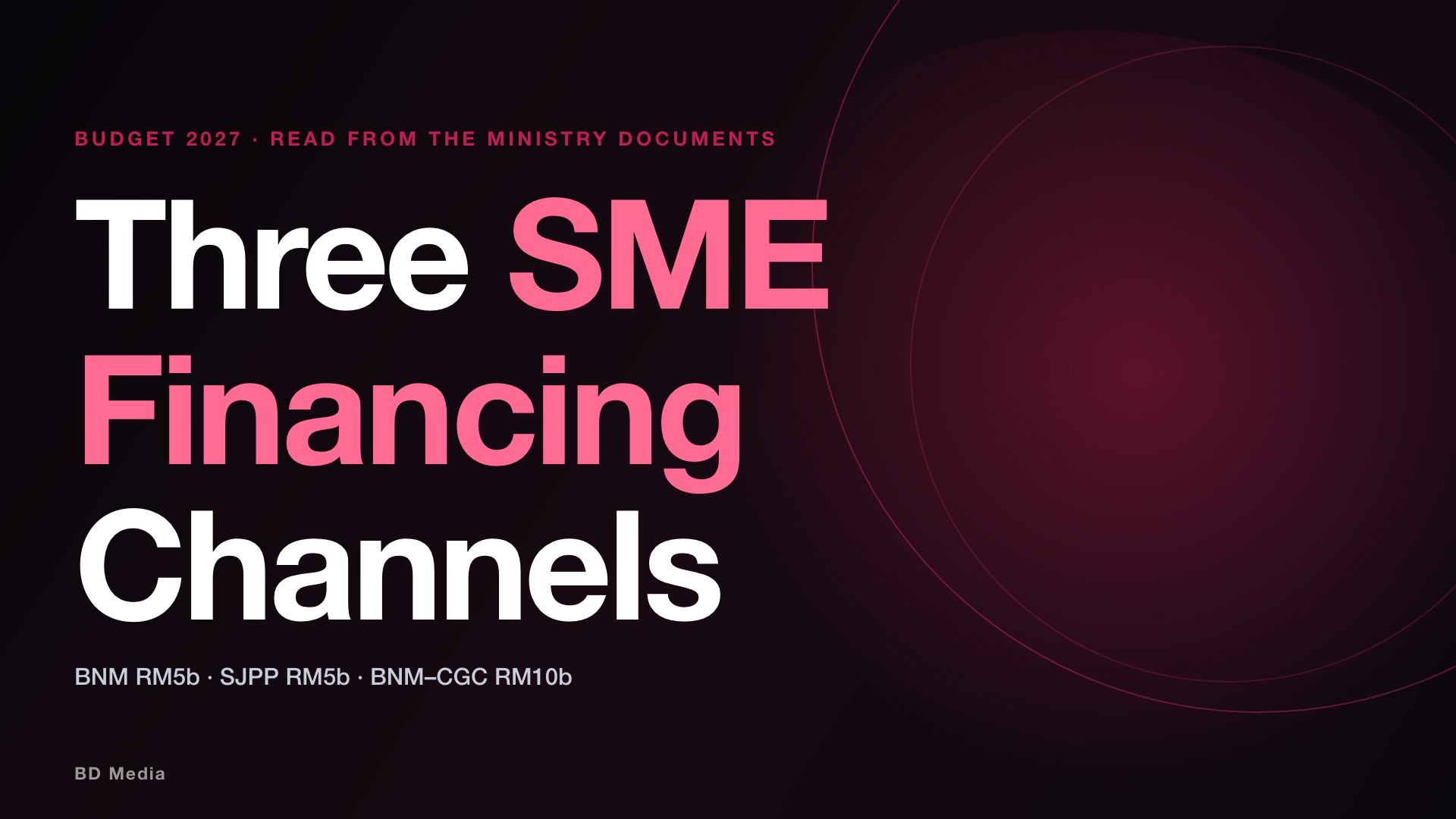
Budget 2027 SME financing runs through three government-backed channels named in the Ministry of Finance’s own Economic Outlook 2027: RM5 billion of working capital through Bank Negara Malaysia, a further RM5 billion added to the SJPP loan guarantee scheme, and a RM10 billion Bank Negara–CGC guarantee facility. Those are the ministry’s figures, read from the published chapter, not from a news summary. The same document says RM2.8 billion of the first facility had already been approved to more than 4,900 SME accounts as at August 2026.
Last updated: 9 October 2026, 6.35pm MYT. Figures on this page are read from the Ministry of Finance documents published with Budget 2027, with the chapter and page cited. Where a figure is our own arithmetic rather than the ministry’s, we say so.
Budget 2027 SME financing: the three official channels
These are the three facilities the Economic Outlook 2027 names for small and medium enterprises. They are three separate schemes, run by different bodies, and they are not interchangeable.
| Channel | What it is | Scale |
|---|---|---|
| BNM SME Stabilisation Relief Facility Bank Negara Malaysia | Working capital financing for SMEs that are viable but affected by the West Asia conflict. As at August 2026, RM2.8 billion had been approved to more than 4,900 SME accounts. | RM5 billion |
| Additional SJPP guarantee Syarikat Jaminan Pembiayaan Perniagaan | Additional guarantee capacity for affected micro, small and medium enterprises. Financing guarantee coverage of up to 80%, and the guarantee period extended to 10 years. | RM5 billion |
| BNM–CGC guarantee scheme Bank Negara Malaysia with Credit Guarantee Corporation | The broader scheme supporting SME productivity, innovation and resilience. | RM10 billion |
Source: Ministry of Finance, Economic Outlook 2027, Chapter 3 “Tinjauan Makroekonomi”, section “Langkah Susulan Kerajaan”, page 99, published with Budget 2027 on 9 October 2026. Read 9 October 2026. These are three separate facilities with their own purposes and administrators; the ministry does not publish a combined figure for them, and we do not add them up.
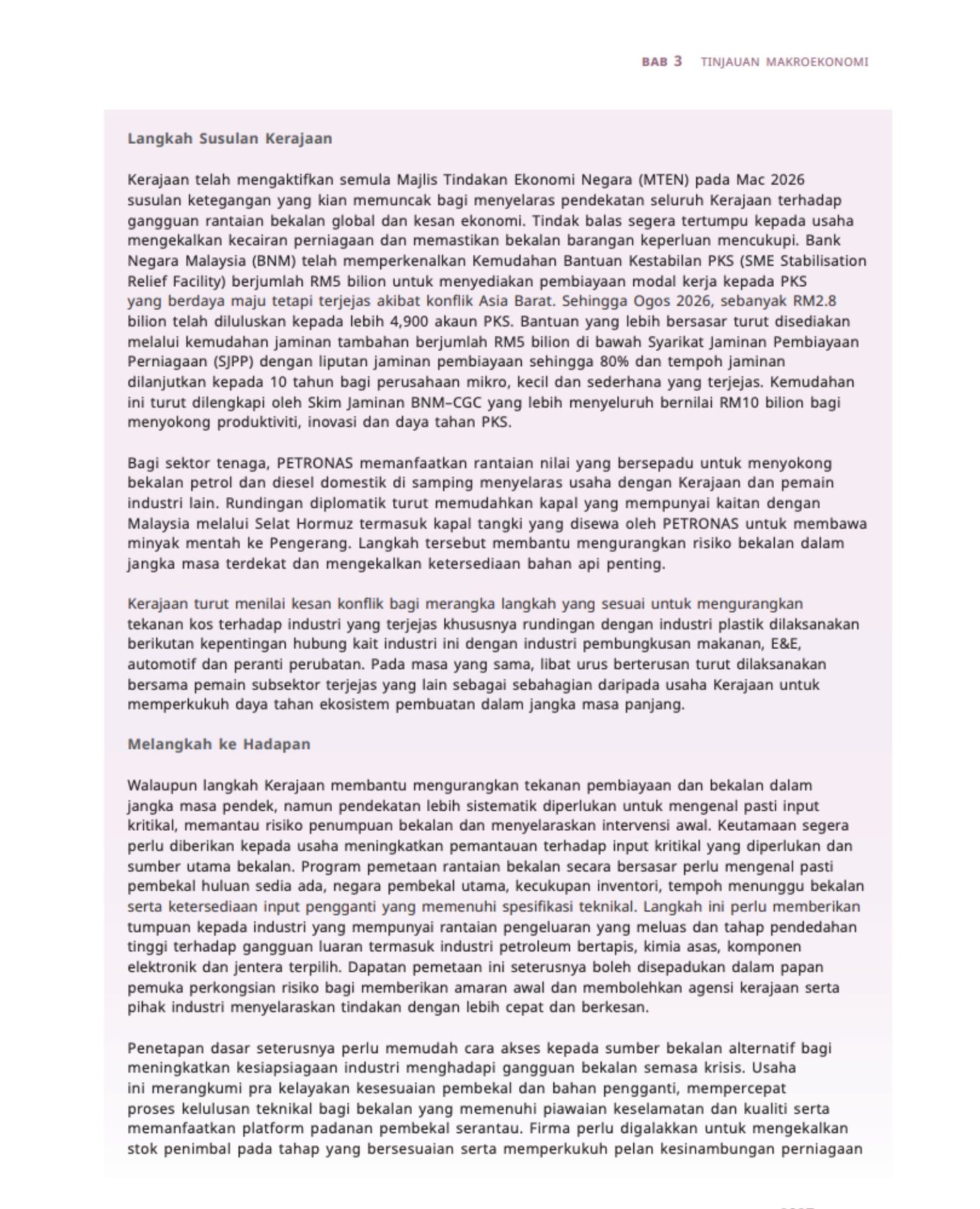
Source: Ministry of Finance. Page 99 of Economic Outlook 2027 (Chapter 3, “Langkah Susulan Kerajaan”) as published with Budget 2027. Read 9 October 2026.
What SMEs are actually borrowing
The same chapter series carries the lending numbers, and they are worth reading carefully because two of them point in opposite directions.
| SME borrowing | 2025 | 2026 | Change |
|---|---|---|---|
| Loan applications | RM205.2 b | RM203.0 b | −1.1% |
| Loan approvals | RM99.6 b | RM107.8 b | +8.2% |
| Loan disbursements | RM318.3 b | RM315.4 b | −0.9% |
| Outstanding loans | RM403.7 b | RM423.4 b | +4.9% |
Source: Ministry of Finance, Economic Outlook 2027, Chapter 4 “Perkembangan Monetari dan Kewangan”, page 165, table of business-sector lending. Read 9 October 2026.
Business lending as a whole disbursed RM899.3 billion, up 5.1%, with SMEs taking 35.1% of it. Growth was strongest in electrical and electronics and in ICT. The odd pair is the first two rows: SME applications fell while approvals rose 8.2%. Fewer businesses asked, and more of those who asked got money — which reads as banks loosening while demand softens, the opposite of the usual pattern.
Who holds what: the agency allocations
Separately from the guarantee and central-bank facilities, the Anggaran Perbelanjaan Persekutuan 2027 sets out the development allocations for the agencies that disburse SME and co-operative financing. These sit inside the KUSKOP ministry total, so read them as parts of it, not as additions.
| Body | 2027 development allocation | 2026 revised |
|---|---|---|
| KUSKOP (all agencies) | RM753.2 m | RM707.4 m |
| SME Corp Malaysia | RM137.0 m | — |
| TEKUN Nasional | RM550.0 m | RM530.0 m |
| INSKEN | RM9.4 m | — |
| Suruhanjaya Koperasi Malaysia (SKM) | RM10.5 m | RM10.8 m |
Source: Ministry of Finance, Anggaran Perbelanjaan Persekutuan 2027 (Federal Expenditure Estimates 2027), B.26 / P.26, published 9 October 2026. Read 9 October 2026.
The automation scheme almost nobody mentioned
One SME measure in the official documents has had very little press: the CoSIF NIMP Smart Manufacturing Scheme, launched by MITI and the Securities Commission to speed up automation and Industry 4.0 adoption among SMEs and mid-tier companies. It offers a government-to-private investment ratio of 2:1 up to 2030 — the government puts in RM2 for every RM1 raised through equity crowdfunding and peer-to-peer platforms.
Worth noting the definition it uses, because it decides who qualifies: a mid-tier company is one with annual revenue between RM50 million and RM500 million in manufacturing, or between RM20 million and RM500 million in services.
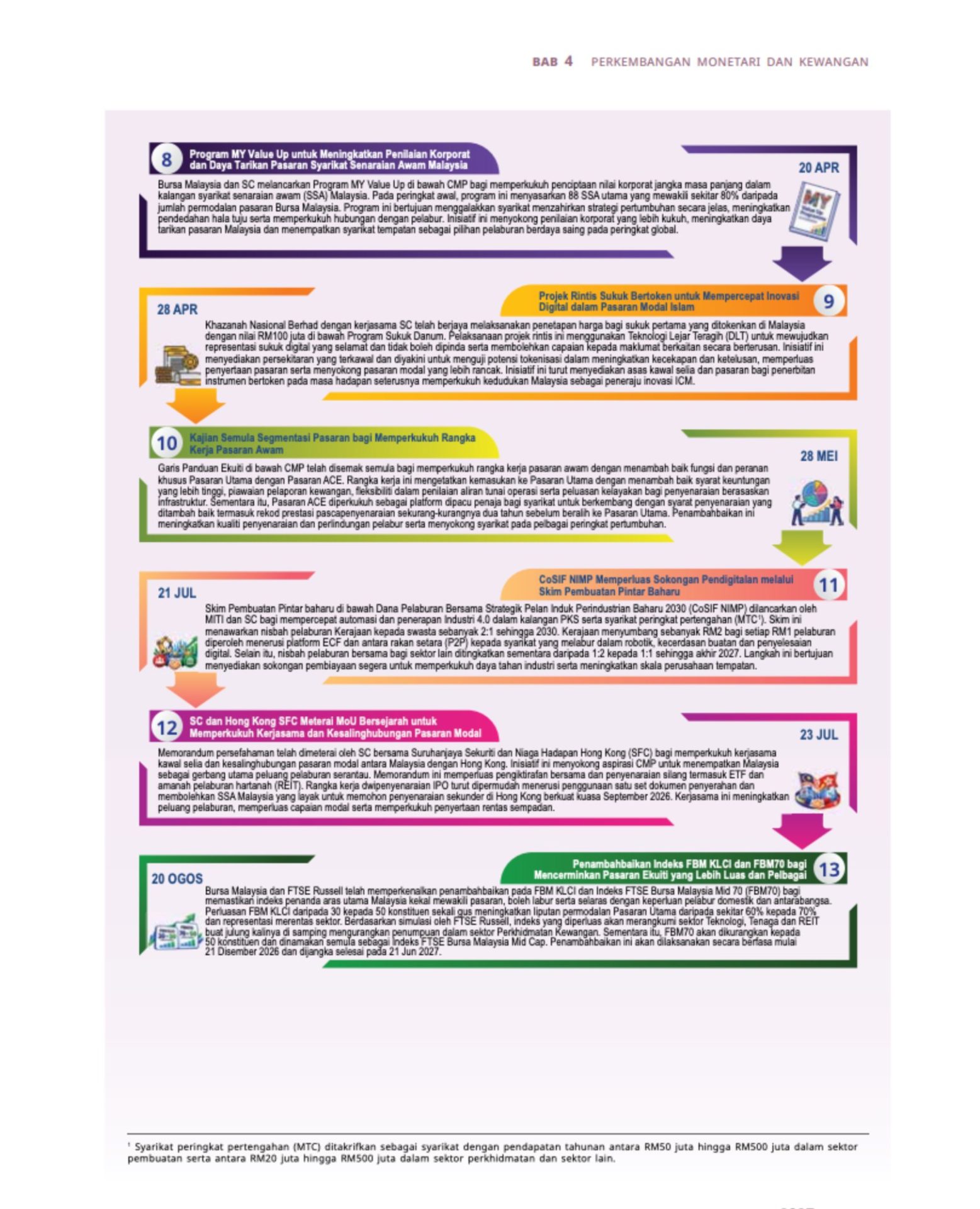
Source: Ministry of Finance. Page 165 of Economic Outlook 2027 (Chapter 4), carrying the CoSIF NIMP Smart Manufacturing Scheme and the mid-tier company definition. Read 9 October 2026.
What is still not confirmed on the tax side
Two things matter here, and both are absences rather than findings.
First, the tax annex is not published. The Budget portal hosts the speech, the tax measures and the budget summary as cover pages only — single-page PDFs carrying a title and nothing else. That was still the case on the evening of 9 October. So the tax detail reported by the press cannot yet be read at source.
Second, the reported MSME income tax cut is still unconfirmed. A reduction of the MSME rate from 15% to 14% on the first RM150,000 of chargeable income, and from 17% to 16% up to RM600,000, has been reported. It is not in any document we can read — and the revenue estimates, which are published in full, do not confirm it either. For scale, those estimates put 2027 Federal Government revenue at RM380.8 billion. We are not presenting the MSME cut as a measure. If it is gazetted, it will be the single most valuable line in this budget for a small company, so it is worth checking against the tax annex when that lands.
Source: Ministry of Finance, Memorandum Perbendaharaan mengenai Anggaran Hasil Kerajaan Persekutuan Tahun 2027, published 9 October 2026 (“Hasil Kerajaan Persekutuan 2027 dianggarkan berjumlah RM380.8 bilion”). Reported in English by Bernama, 9 October 2026. Read 9 October 2026.
How to read the numbers above. The financing figures, the lending figures and the agency allocations all come from ministry documents and are cited to chapter and page. There is deliberately no combined total on this page. The three facilities are separate schemes with different administrators and different purposes, they may overlap, and the ministry does not publish a sum for them — so neither do we. An earlier version of this piece carried an “RM20 billion” total that was our own addition of the three; that was wrong to publish as a figure and has been removed. The MSME tax cut is not on this page as a measure because we could not read it in a government document.
Related coverage
- Budget 2027 Malaysia: Live Updates and Key Announcements: the full budget as tabled
- Budget 2027 SME Wishlist: SAMENTA’s 15 Asks: what the association asked for, including zero-collateral export credit
- Budget 2027 Malaysia: SMEs Want Outcomes, Not Allocations
- Budget 2027 Gig Workers: RM160 Million, And What Creators Can Claim
Sources
Official documents (read at source)
Ministry of Finance, Economic Outlook 2027 (Tinjauan Ekonomi 2027), published with Budget 2027 on 9 October 2026: Chapter 3 “Tinjauan Makroekonomi”, section “Langkah Susulan Kerajaan”, page 99 (the RM5 billion BNM SME Stabilisation Relief Facility, the RM2.8 billion approved to more than 4,900 SME accounts as at August 2026, the additional RM5 billion SJPP guarantee at up to 80% coverage and 10-year tenure, and the RM10 billion BNM–CGC guarantee scheme); Chapter 4 “Perkembangan Monetari dan Kewangan”, page 165 (SME lending table; the CoSIF NIMP Smart Manufacturing Scheme at a 2:1 government-to-private ratio to 2030; the mid-tier company definition). At belanjawan.mof.gov.my/ms/ekonomi.
Ministry of Finance, Anggaran Perbelanjaan Persekutuan 2027 (Federal Expenditure Estimates 2027), B.26 / P.26, published 9 October 2026: agency development allocations for KUSKOP, SME Corp, TEKUN Nasional, INSKEN and the Suruhanjaya Koperasi Malaysia. At belanjawan.mof.gov.my.
Ministry of Finance, Ringkasan Anggaran Hasil Kerajaan Persekutuan 2027 (Summary of Federal Government Revenue Estimates 2027), published 9 October 2026: tax revenue RM297,059,811,000; direct tax RM199,898,172,000; income tax RM184,450,522,000. At belanjawan.mof.gov.my/ms/fiskal.
Not available at source
The Budget 2027 speech (ub27.pdf), the tax measures annex (langkah-cukai.pdf) and the budget summary (touchpoint-budget-bm.pdf) were published as single-page cover documents carrying a title only, as at 9 October 2026. No tax detail could be read from them.
Corroboration
Bernama, 9 October 2026: “Budget 2027 Estimated At RM459.8 Bln, Up 3.6 Pct Year-on-year” — the Federal Government revenue estimate of RM380.8 billion and the operating/development split, which match the ministry’s own memorandum and tables.
The Edge Malaysia, 9 October 2026: “Highlights of Budget 2027” — independent reporting of the same budget lines, used to cross-check the official figures above.
This article is produced by the BD Media desk from the official Budget 2027 documents. Last updated 9 October 2026, 6.35pm MYT.