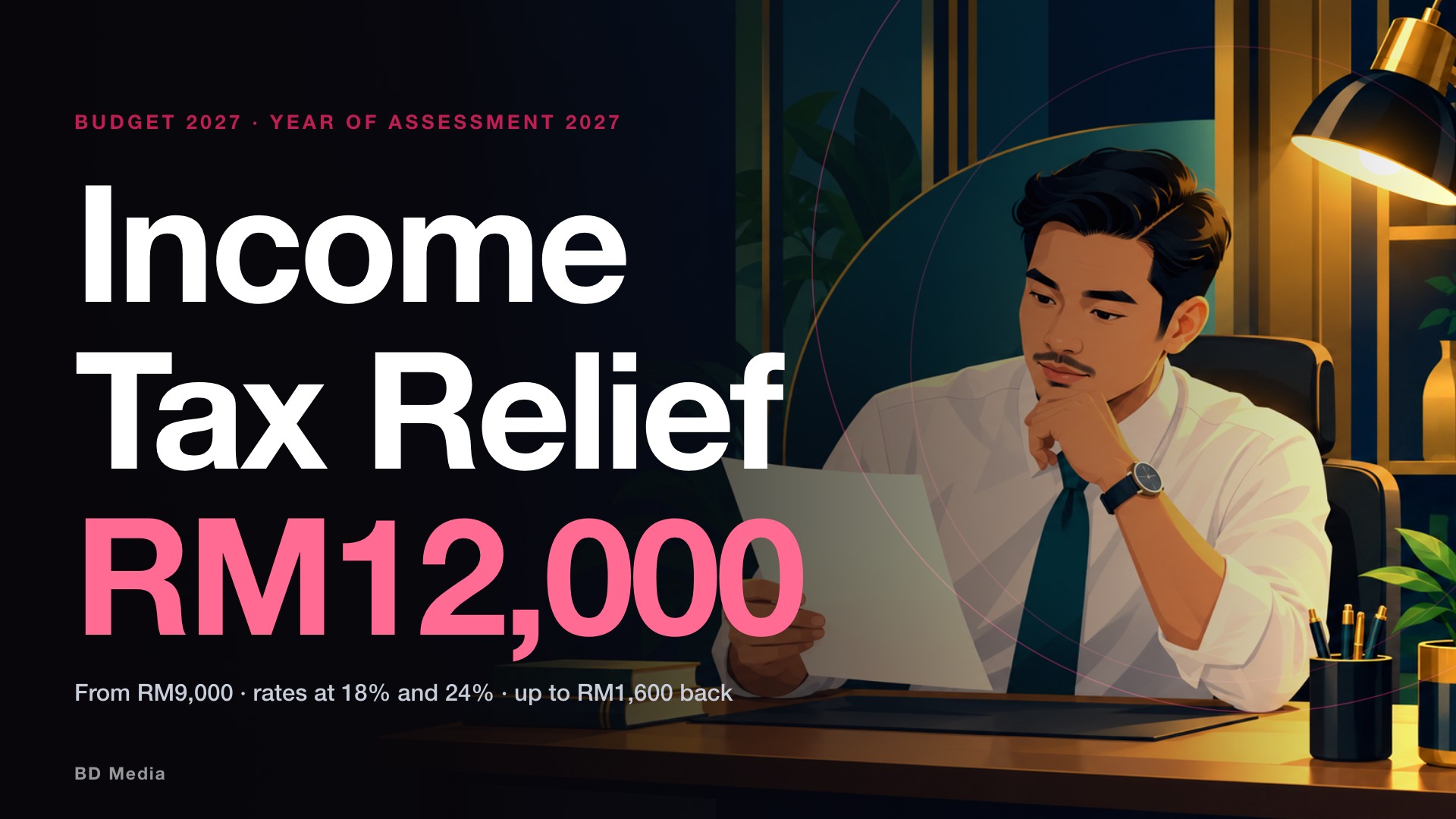
Income Tax Malaysia 2027 changes are real and worth planning around: the individual relief rises from RM9,000 to RM12,000 and two resident rates fall. The government’s headline is “up to RM1,600” of extra disposable income for about five million taxpayers. Nobody has published what that means at your actual income — so we worked it out from the Inland Revenue Board’s own table, and there is one catch nobody is writing about.

The report carrying the RM12,000 relief announcement, over the tabling of Budget 2027 in the Dewan Rakyat on 9 October 2026. Source: Bernama, “Good News For M40, Tax Relief Increased To RM12,000”, 9 October 2026.
Anwar announced three things that matter to an individual taxpayer: the relief limit goes from RM9,000 to RM12,000 for the first time since 2010, the rate on taxable income of RM70,001 to RM100,000 falls to 18 per cent, and the rate on RM100,001 to RM150,000 falls to 24 per cent. To that list he added one change that runs the other way — income above RM1 million is taxed at 30 per cent.
He also framed the whole package against the cost of living, saying the government had heard the concerns of the middle-income group who had remained patient. We have taken him at his word on the intent and gone to the numbers, because the number he gave is the least useful part.
What Income Tax Malaysia 2027 changes, and what we still cannot tell you
Start with what is settled, because it is more than most posts have managed to get right.
- Individual relief: RM9,000 → RM12,000. Unchanged since 2010 until now. This is an automatic reduction in your chargeable income — you get it whether or not you claim anything.
- RM70,001 to RM100,000 of chargeable income: 19% → 18%.
- RM100,001 to RM150,000 of chargeable income: 25% → 24%.
- Above RM1 million: adjusted to 30%.
Those are the announced figures. What is not settled is the one thing most posts are about to assert without checking: which Year of Assessment these attach to.
This means that the increase in tax relief and the reduction in individual tax rates will provide an additional disposable income of up to RM1,600 to approximately five million taxpayers.
— Anwar Ibrahim, Prime Minister and Finance Minister, tabling Budget 2027, Dewan Rakyat, 9 October 2026
Two qualifiers travel with that sentence and both matter. Up to RM1,600 — a ceiling, not a typical benefit. And approximately five million taxpayers — a group, not a per-person figure. No source explains how the RM1,600 is derived, and none of them says which income level produces it.
The gap: nobody has tied this to a tax year
Every outlet reported Budget 2027’s tax changes. Not one of them named a Year of Assessment. The Inland Revenue Board’s own published tables do not close the gap either — as of this writing the most recent tables on both its tax rate page and its tax relief page are headed Year of Assessment 2023, 2024 & 2025, and the relief figure they carry is the current RM9,000.

The Inland Revenue Board’s published resident tax rate table, headed “Year of Assessment 2023, 2024 & 2025”. Band F is 19 per cent on RM70,001–100,000; band G is 25 per cent on RM100,001–400,000. This is the table that has to change. Source: Inland Revenue Board of Malaysia, hasil.gov.my, tax rate page.
This is not a gap in reporting. It is a gap in the announcement, and it looks deliberate in at least one direction. The same Budget 2027 speech does carry an explicit Year of Assessment for the shipping tax exemption — extended to Year of Assessment 2036, according to The Edge’s reading of the speech text. So the ministry knows how to say it, and did not say it here.
Malaysian practice would suggest a budget tabled in October 2026 attaches to the year of assessment beginning in 2027. That is a reasonable expectation, not a statement anyone has made. We are not writing “your YA 2027 tax” and neither should anyone else until LHDN publishes.
There is also a structural change hiding inside the headline
Look at the two published tables side by side.
Anwar’s framing was that resident rates were cut by “one percentage point”. Against LHDN’s table, the 19% to 18% change is indeed one point. The 25% to 24% change is also one point on the headline rate — but LHDN’s 25% band runs from RM100,001 all the way to RM400,000, while the budget names RM100,001 to RM150,000.
So the 24% band is not simply the old band with a lower rate attached. Its upper boundary has moved from RM400,000 to RM150,000. That is a change to the shape of the table, and it changes who is affected, not just what they pay per ringgit. What applies above RM150,000 is not stated in the announcement — it is the single most consequential missing detail for anyone earning more than RM150,000 a year.
What it actually saves you
No outlet published a worked example on 9 October 2026, and no tax consultancy had one out. So here is ours.
How this was calculated, and the assumption you need to check: we applied the ordinary progressive method — each band’s rate to the portion of income inside it — using LHDN’s published resident table for every band below RM150,000 of chargeable income, and the two rates Anwar announced. Because the speech does not state a rate above RM150,000, we assume the narrower reading: the 24% band ends at RM150,000 and the existing 25% resumes above it. The wider reading, where 24% continued to the old RM400,000 ceiling, would give larger savings than shown. Reliefs beyond the RM12,000 individual relief are not included, so a real claim may differ.
| Annual income | Tax now (relief RM9,000) | Tax after (relief RM12,000, new rates) | Saving | Per month |
|---|---|---|---|---|
| RM60,000 | RM1,610 | RM1,380 | RM230 | RM19 |
| RM70,000 | RM2,710 | RM2,380 | RM330 | RM28 |
| RM80,000 | RM3,890 | RM3,480 | RM410 | RM34 |
| RM90,000 | RM5,790 | RM5,140 | RM650 | RM54 |
| RM100,000 | RM7,690 | RM6,940 | RM750 | RM62 |
| RM120,000 | RM12,150 | RM11,020 | RM1,130 | RM94 |
| RM150,000 | RM19,650 | RM18,220 | RM1,430 | RM119 |
| RM200,000 | RM32,150 | RM30,600 | RM1,550 | RM129 |
Calculated by us from LHDN’s published YA 2023–2025 resident table and the two rates announced in Budget 2027. Assumes the 24% band ends at RM150,000. Not a tax return; exclude other reliefs. Source: Inland Revenue Board of Malaysia tax rate table; Budget 2027 speech as reported by Bernama, 9 October 2026.
Read the top of that column and the government’s figure makes sense. Our computed saving reaches about RM1,550 at RM200,000 of annual income — which is what “up to RM1,600” appears to describe. That corroborates the shape of their number. It is not independent confirmation of it, because the working behind theirs has not been published.
Note also what the table says about who benefits least. At RM60,000 the saving is RM230 a year, about RM19 a month. The relief increase alone is worth 3% of the additional RM3,000 for a lower earner and much more at the top of the range. “Up to RM1,600” is genuinely an up-to.
The relief items nobody has costed yet
The scope of the RM12,000 widened well past the RM3,000 increase. Anwar’s list:
- Medical — extended to postnatal care services.
- Care for parents and grandparents — expanded to all care expenses, no longer restricted to medical health. This is the broadest change on the list.
- Sports equipment — now includes sports shoes.
- Education and skills training — all fields of study, plus children’s tuition fees.
- Lifestyle — now includes artificial intelligence subscriptions, vaccination costs, and pet adoptions from registered centres.
Here is the problem with costing any of it: every one of these sits under the RM12,000 aggregate ceiling, and none of the per-category sub-limits have been published. Nobody can compute what a family’s actual claim is worth until LHDN issues them, and nobody can yet say what counts as a “registered centre” for a pet adoption or a qualifying AI subscription.
One ambiguity worth flagging: taxable income or annual income?
The 30% top rate is described two different ways in the same coverage. Bernama and Sinar Daily write about taxable income exceeding RM1 million. NST writes about annual incomes exceeding RM1 million.
Those are different numbers for the same person. Taxable income is what is left after deductions and reliefs; annual income is what you earned. A person with a RM1.3 million salary and RM60,000 of allowable deductions is above one line and below the other. Until the speech text or an LHDN clarification settles it, the threshold’s practical meaning is genuinely unclear.
What to do, and what to wait for
You can act on the RM12,000 figure as a planning number — it is announced, it is the first change since 2010, and on our arithmetic it is worth roughly RM19 a month at RM60,000 of income rising to about RM129 at RM200,000. Plan on the lower end; the RM1,600 is a ceiling, not a promise to you.
You cannot yet file against a year, because no one has said which year. You also cannot price the widened reliefs, because the sub-limits are not published. And if you earn above RM150,000 you are in the part of the table the announcement leaves open.
This page is updated in place when LHDN publishes, with the date of the change noted at the point it changes. We do not publish a number we have not read at source, and where the government has not said, we say that instead of filling the gap.
Sources
Sources — Budget 2027 was tabled in the Dewan Rakyat on 9 October 2026. Every figure in this article is attributed to the Inland Revenue Board’s own published tables, to the speech as reported by the national news agency, or to a Ministry of Finance published document, each with its date.
- Inland Revenue Board of Malaysia, Tax Rate — resident individual table headed “Year of Assessment 2023, 2024 & 2025”: band F, RM70,001–100,000 at 19 per cent; band G, RM100,001–400,000 at 25 per cent. No YA 2026 or YA 2027 table published. Page last updated 26 June 2026.
- Inland Revenue Board of Malaysia, Tax Relief — individual and dependent relatives relief of RM9,000; tables published for YA 2016 to YA 2025 only. Page last updated 26 June 2026.
- Bernama, “Good News For M40, Tax Relief Increased To RM12,000”, 9 October 2026 — quoting Prime Minister Anwar Ibrahim in the Dewan Rakyat. The RM12,000 relief, the 18 and 24 per cent rates, the RM1 million threshold, the “up to RM1,600 to approximately five million taxpayers” statement, and the widened relief scope.
- New Straits Times, “2027 Budget: Income tax rates cut, tax relief expanded”, 9 October 2026 — second reading; and its “annual incomes exceeding RM1 million” phrasing, which differs from Bernama’s “taxable income”.
- Sinar Daily, “First tax relief rise since 2010: What you can claim”, 9 October 2026 — second reading of the relief, the rate bands and the widened scope.
- The Edge Malaysia, Budget 2027 coverage, 9 October 2026 — used only for the shipping tax exemption extended to “the Year of Assessment 2036, according to the text of Prime Minister Datuk Seri Anwar Ibrahim’s Budget 2027 speech”.
Dr Henry Tye & Team