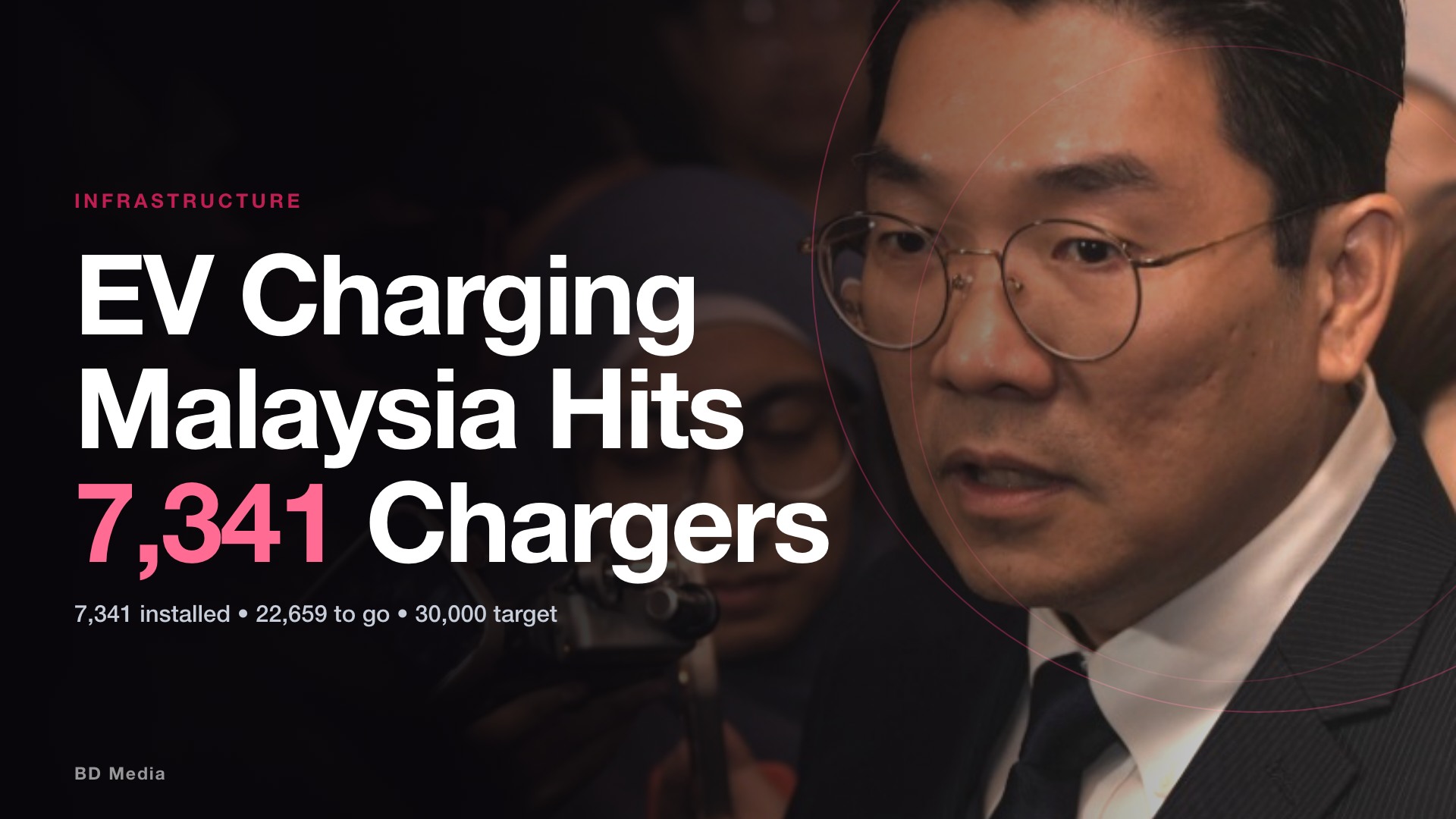
EV charging Malaysia reached 7,341 public charging stations by 30 September 2026, according to a Dewan Rakyat answer delivered on 16 November. The national target is 30,000 charging points by 2030. That leaves 22,659 to install, and the Deputy Investment, Trade and Industry Minister said the pace depends less on charger hardware than on electricity substations and whether local demand can justify the cost.
Published 16 November 2026 · figures as at 30 September 2026 · page will be updated when the levy proposal is decided.
EV charging Malaysia: what the 7,341 figure actually covers
The count is for public chargers only. It breaks into 4,992 alternating current units and 2,349 direct current fast chargers. A further 148 DC chargers are operating at rest and service areas, lay-bys and petrol stations along major highways. Twenty charge point operators are active in the market.
| Measure | Reported figure | Source and date |
|---|---|---|
| Public EV charging stations installed | 7,341 | Bernama and The Edge, 16 Nov 2026; as at 30 Sep 2026 |
| Alternating current chargers | 4,992 | Bernama and The Star, 16 Nov 2026 |
| Direct current fast chargers | 2,349 | Bernama and The Star, 16 Nov 2026 |
| DC chargers on major highways | 148 | Bernama and The Edge, 16 Nov 2026 |
| Active charge point operators | 20 | Bernama and The Edge, 16 Nov 2026 |
| National target | 30,000 by 2030 | Ministry of Investment, Trade and Industry, reported 16 Nov 2026 |
| Arithmetic gap | 22,659 | 30,000 minus 7,341 |

Source: Patrick Goh/The Edge, photograph published with the 16 Nov 2026 Dewan Rakyat report · captured 16 Nov 2026 from theedgemalaysia.com/node/825900
Sim Tze Tzin gave the figures while answering questions on rural coverage and range anxiety. The government’s answer was explicit about the mechanism. Bernama reported him saying: “Without substations, expansion will not be possible. Therefore, we hope TNB (Tenaga Nasional) can assist the government in providing more EV charging stations and ultimately, it’s in terms of benefits against costs.”
That is the constraint that decides where the next tranche of chargers can go. A charger is a small asset compared with the substation behind it. Substation capacity takes planning, construction and utility coordination, none of which can be compressed into a routine installation schedule.
Who pays for the next 22,659 chargers
The ministry’s position is that expansion is driven mainly by private investment through charge point operators. The government encourages participation but does not force operators to install at named locations. An operator choosing a site weighs consumer demand, installation cost and the readiness of the electricity supply. State governments, local authorities, premises owners and utilities are drawn in when a site needs access or a connection.
The Star reported the minister saying: “This target will be achieved by encouraging private sector investment through CPOs, as well as through cooperation with state governments, PBTs and industry players.” The same report said the government wants charging outside the main cities, including toll plazas, federal roads, commercial areas, small towns and tourist destinations, with AC units at business premises, shopping centres and public facilities.
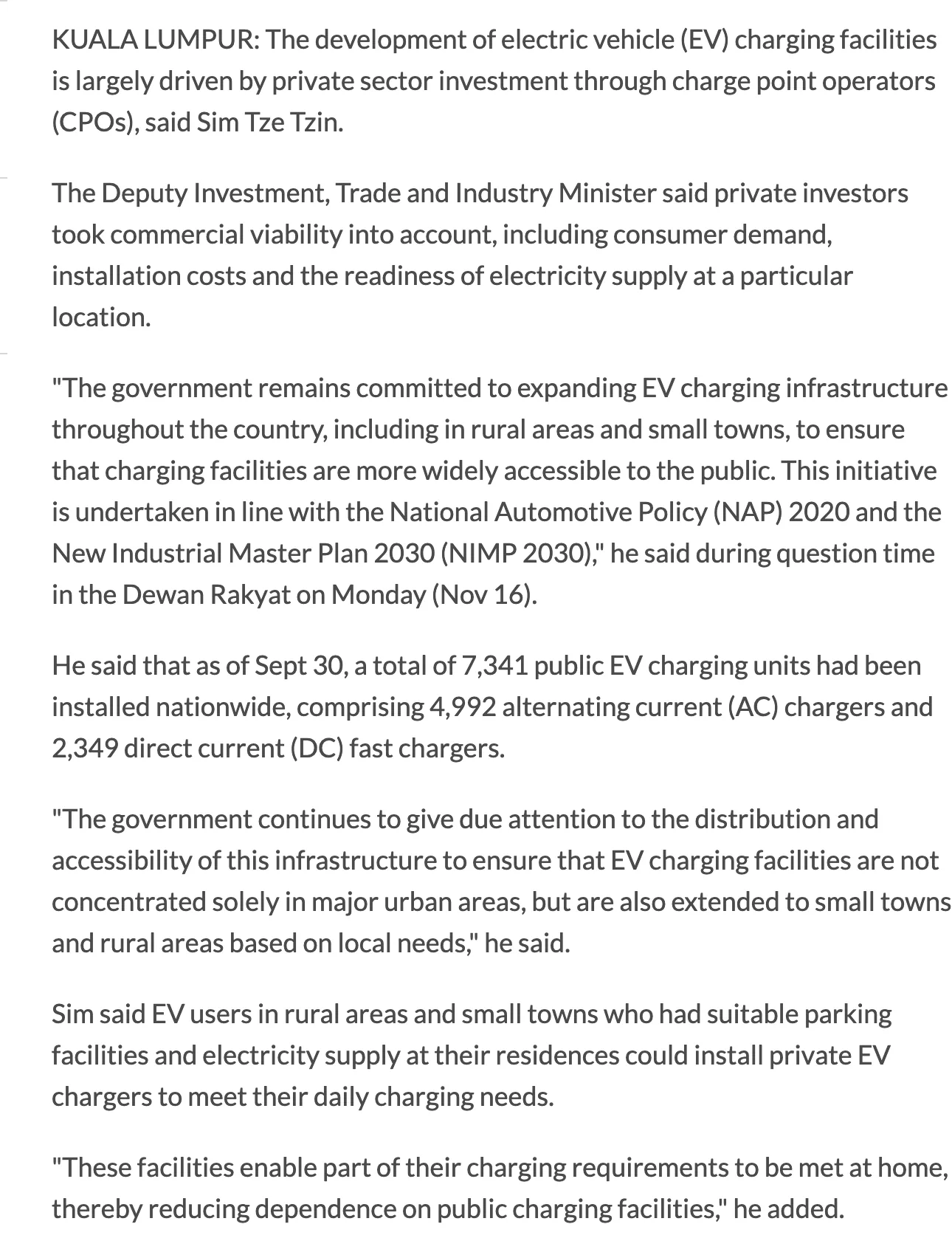
Source: The Star, Private sector drives EV charging expansion as nationwide tally hits 7,341 units, 16 Nov 2026, article body paragraphs on CPO investment and installed chargers · captured 16 Nov 2026 from www.thestar.com.my/news/nation/2026/11/16/private-sector-drives-ev-charging-expansion-as-nationwide-tally-hits-7341-units
For a premises owner, this changes the pitch. Hosting a charger is no longer a simple question of spare parking bays. The operator still has to see enough use to recover the installation, and the site still has to carry the load. A quiet retail lot with an old supply may be less attractive to an operator than a smaller site beside a highway interchange with a reliable connection and steady passing traffic.
Why substations decide where chargers go
The clearest line in the parliamentary answer came after a supplementary question from Kubang Pasu MP Ku Abd Rahman Ku Ismail about reaching the 30,000 target. Sim said substations were expensive and had to be planned by TNB. “It is not possible to request a substation today and have it ready by tomorrow,” he said, according to Bernama. The second half of the test was demand: “We need to ensure that there is sufficient consumer demand to justify the investment costs.”
That sequence matters. Power readiness comes first, then utilisation, then the business case. A site without the first cannot be fixed by a cheaper charger. A site with power but no predictable flow of vehicles will struggle to attract a private operator, because the investment stays with the operator rather than the government.
Lowyat.NET reported the same count and noted it was about 24% of the 2030 target, short of an earlier 2025 target of 10,000 and above the 6,416 figure reported previously. Taken together, those numbers describe a network that is growing but still working through its supply constraints.
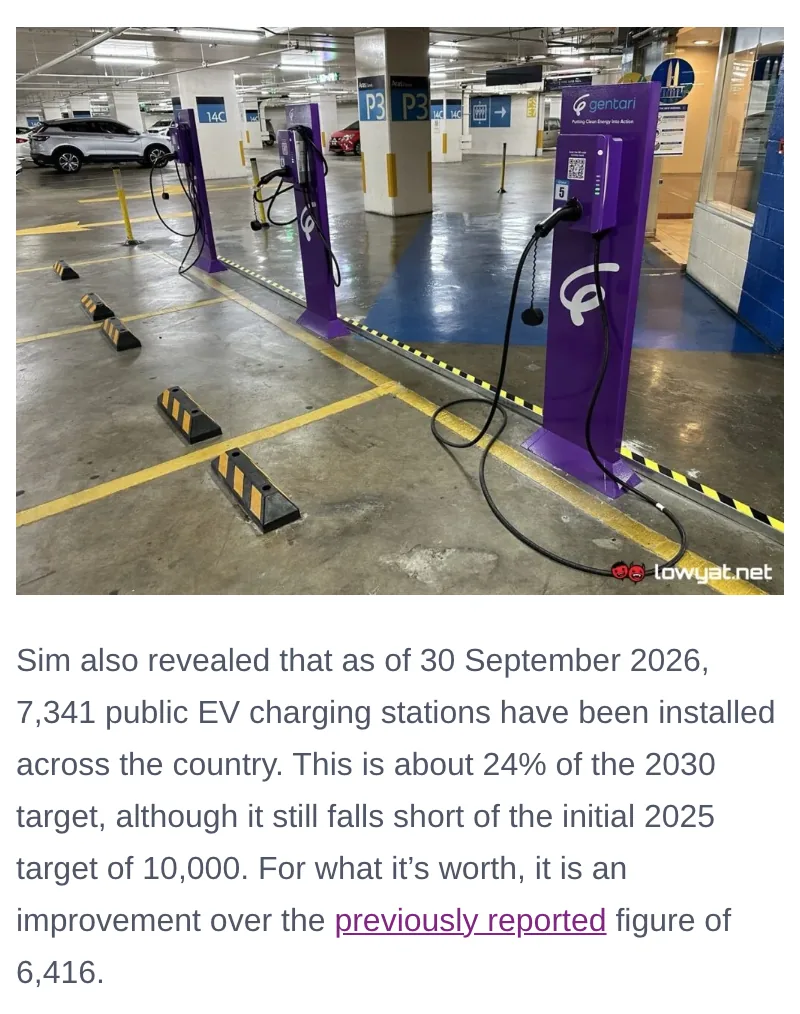
Source: Lowyat, Govt Examining Measures For Accelerating EV Charging Rollout To Meet 2030 Target, 16 Nov 2026, paragraph beginning “Sim also revealed” · captured 16 Nov 2026 from www.lowyat.net/2026/409835/govt-accelerating-ev-charging-rollout
What a business site should check before budgeting
The practical effect is a short due diligence list before any charging project is priced. These checks are deliberately boring, because the expensive mistakes are boring too.
- Confirm the available supply and whether the site needs a new substation or an upgrade. Get the utility timeline in writing before signing an operator agreement.
- Count the vehicles that actually pass through or park at the site on a normal week. Operator interest follows predictable use, not a general claim that EV adoption is rising.
- Compare AC and DC against dwell time. A destination where vehicles stay for hours has a different case from a highway stop where drivers need a fast top-up.
- Ask which party pays for the connection, the civil works and the ongoing maintenance. The ministry’s answer makes clear that private investment leads, but the contract decides where the cost lands.
- For a fleet, check home or depot charging first. The Star reported that rural users with suitable parking and supply can install private chargers, reducing reliance on public points.
None of this turns a business into a charge point operator. It does let a site owner ask better questions when an operator arrives with a proposal, and it explains why a seemingly good location can be passed over.
The proposed levy is still a proposal
The other headline from the Dewan Rakyat answer was a proposed levy on electric vehicles to help fund charging infrastructure. Sim said the idea was still being studied and that several aspects needed examination before anything could be implemented. No rate, start date or collection mechanism was announced.
That limits what can honestly be said about it. A levy could change how the 22,659-unit gap is financed, but until the proposal is published, it should not be treated as a cost line in a vehicle purchase or a site plan. The only firm policy facts from this answer are the installed count, the 2030 target, the 20 active operators, the 148 highway DC chargers and the stated reliance on private investment.
What changes next
The ministry is working with state governments, local authorities, premises owners, utilities and industry players to widen access. The Energy Commission, TNB, local authorities and operators are also expected to coordinate on site access and supply connections. For SMEs, the signal is to plan around power and demand first, then wait for the levy decision before pricing any assumption about public funding.
Readers looking for the older consumer background on road tax and general charging coverage can use BD Media’s 2024 EV owner guide. This page records the 2026 parliamentary update and will be corrected if the ministry publishes a different count or a decided levy.
About BD Media. BD Media is the editorial desk of Big Domain, a Malaysian web hosting and digital services company. We report on the policy, infrastructure and cost decisions that Malaysian businesses have to act on.
Sources
- (T2) Bernama, Govt Looking At Various Ways To Expedite EV Charging Infrastructure Development, 16 Nov 2026. Read 16 Nov 2026. Installed count, AC/DC split, highway chargers, operator count, substation quotes and the proposed levy.
- (T2) The Edge Malaysia, Govt looking at ways to expedite EV charging infrastructure development — deputy minister, 16 Nov 2026. Read 16 Nov 2026. Credit: Patrick Goh/The Edge. Quote on consumer demand, and the count as at 30 Sep 2026.
- (T2) The Star, Private sector drives EV charging expansion as nationwide tally hits 7,341 units, 16 Nov 2026. Read 16 Nov 2026. Private sector framing, target locations and home charging.
- (T2) Lowyat.NET, Govt Examining Measures For Accelerating EV Charging Rollout To Meet 2030 Target, 16 Nov 2026. Read 16 Nov 2026. Progress against target and the earlier 6,416 count.
Verification note. The EV sales levy was described as under study. No rate, implementation date or agency was published in the sources read, so none is stated.