Two money bills were tabled in the Dewan Rakyat on 16 November, and one of them proposes a lower company tax rate for qualifying Malaysian SMEs. The Finance Bill 2026 would cut the rate on the first RM150,000 of chargeable income from 15% to 14%, and the next RM450,000 from 17% to 16%. Both bills are at first reading. No rate has changed yet. The useful response for a company director is to check the two published tests now and wait for the second reading before booking any saving.
Published 17 November 2026 · bills tabled 16 November 2026 · first reading only; this page will be updated when the Bills pass or the rates change.
Finance Bill SME tax: what was actually tabled
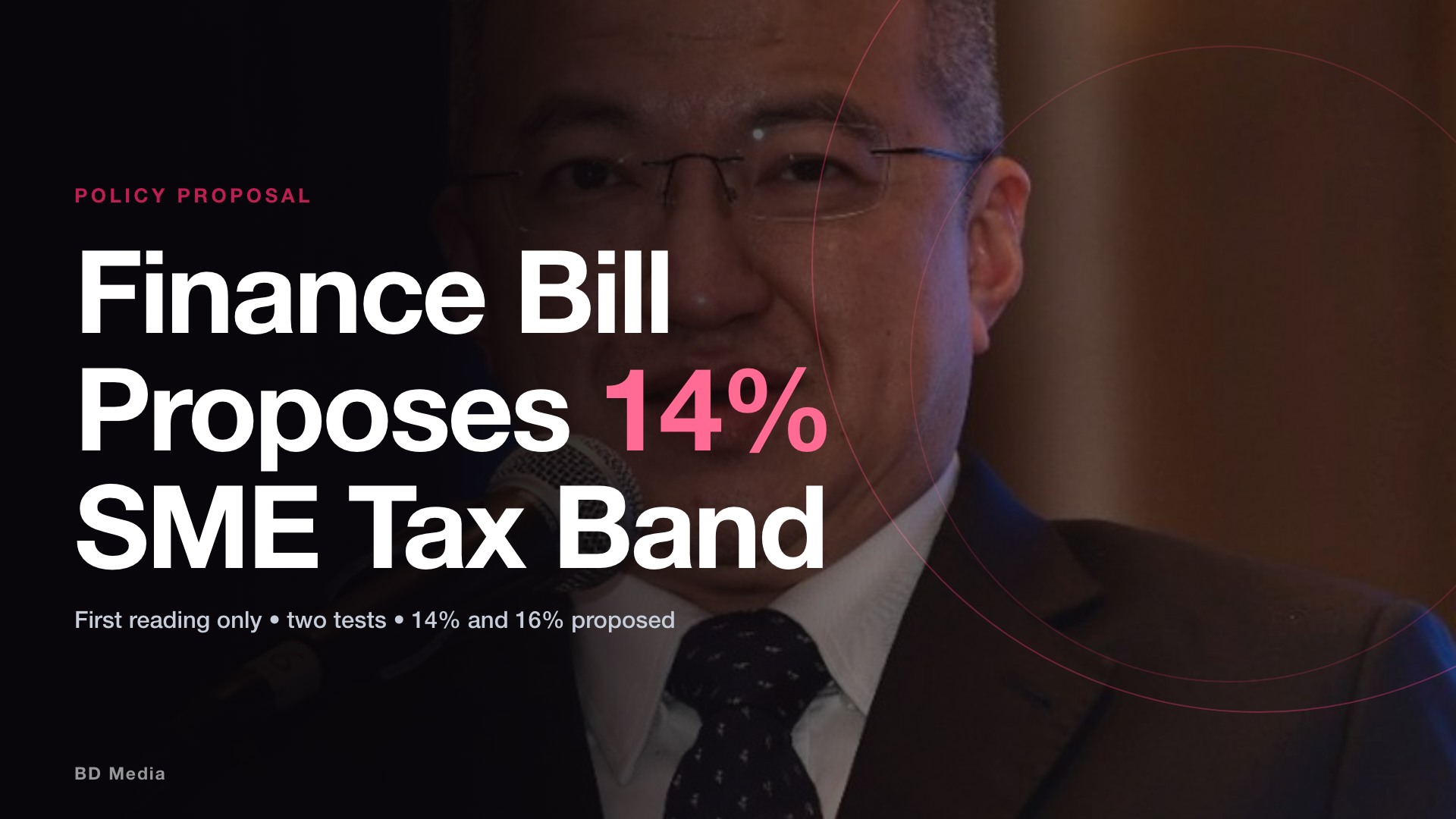
The Finance Bill 2026 and the Tax Collection, Administration and Enforcement Measures Bill 2026 were tabled for first reading on Monday 16 November. Deputy Finance Minister Liew Chin Tong tabled both and said the second reading would be held during the same Dewan Rakyat sitting.
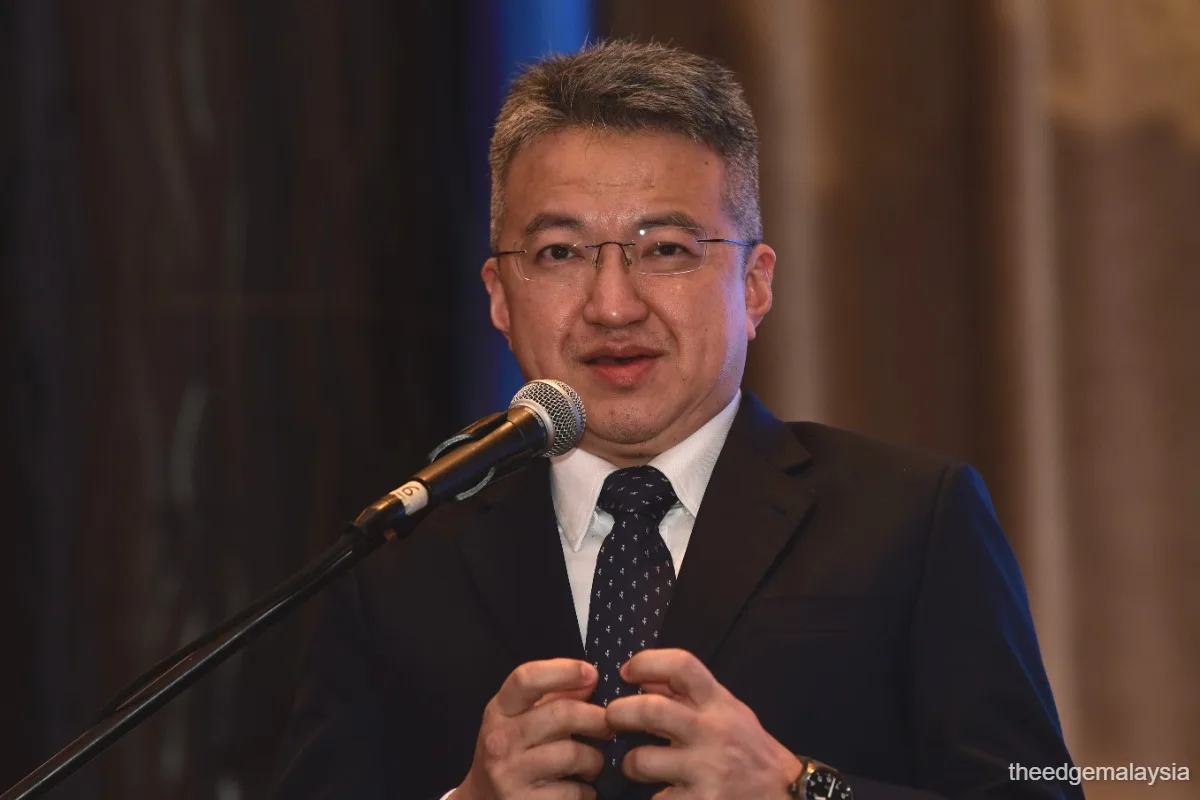
Source: photograph by Patrick Goh/The Edge, published with Two MOF bills tabled for first reading, 16 Nov 2026 · captured 17 Nov 2026 from theedgemalaysia.com/node/825938
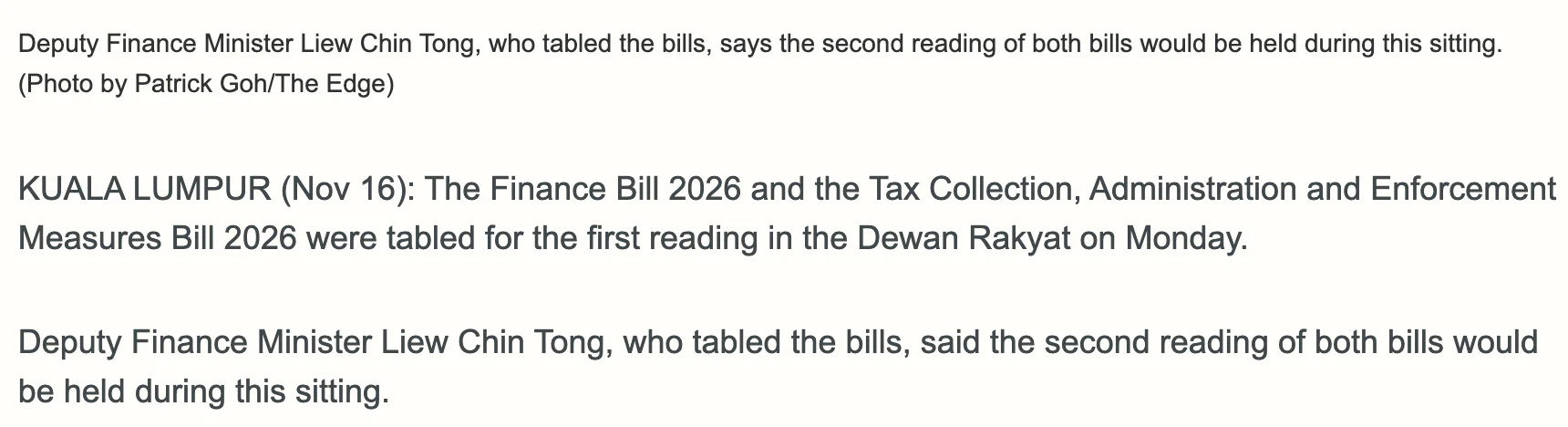
Source: The Edge Malaysia (Bernama), Two MOF bills tabled for first reading, 16 Nov 2026, lead paragraphs · captured 17 Nov 2026 from theedgemalaysia.com/node/825938
The two Bills do different jobs. The Finance Bill 2026 amends the Income Tax Act 1967, the Stamp Act 1949, the Labuan Business Activities Tax Act 1990, the Petroleum (Income Tax) Act 1967 and the Finance Act 2025. The collection Bill amends a wider set including the Customs Act 1967 and the Excise Act 1976. This article covers only the company-rate proposal in the Finance Bill, because that is the part a trading SME can act on.
Scope note: the same reports also describe personal tax relief, a lifestyle deduction for AI software subscriptions, an 8% stamp duty on certain foreign residential purchases and a customs declaration clause. Those affect individuals, property buyers or travellers. They are excluded here rather than padded in.
The two tests that decide whether the 14% band applies
The proposed lower rates are not for every business with “SME” in its description. The Star reported the proposal as applying to Malaysian companies that meet both of the following:
- Paid-up ordinary share capital of RM2.5 million or less; and
- Gross business income not exceeding RM50 million.
Two tests, both met. A company that passes one and fails the other is not described by the reported proposal. Sole proprietors and partnerships are not named in the reported condition either, so nothing here should be read as applying to them. If the structure is a limited liability partnership or a group with several entities, the position needs confirmation from the Bill text or a tax adviser rather than from a headline.
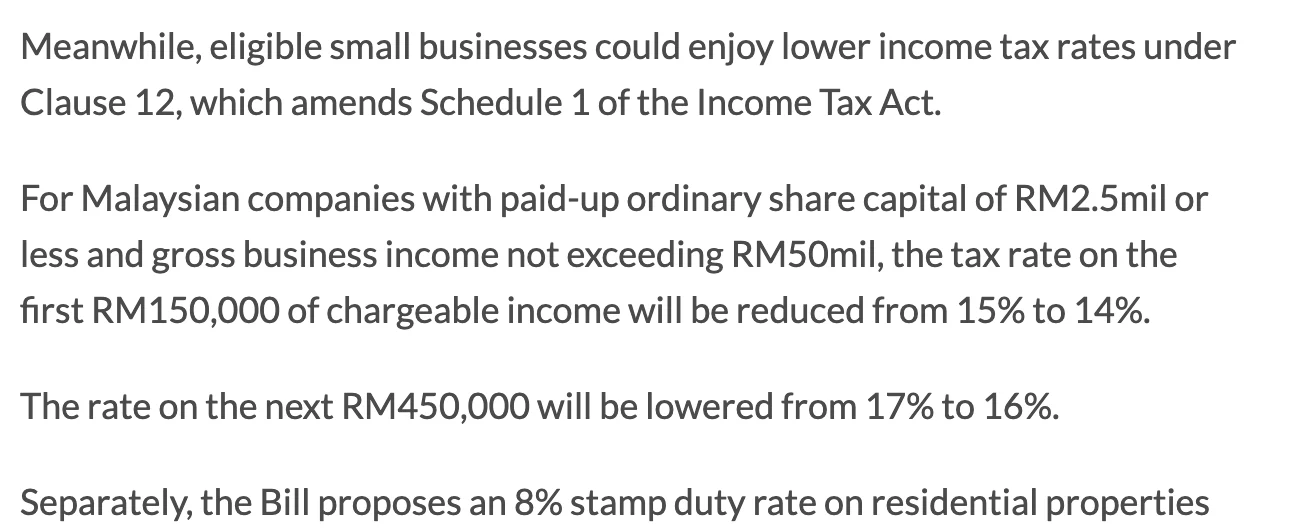
Source: The Star, Finance Bill proposes higher personal tax relief, lower rates for small businesses, 16 Nov 2026, the eligibility and rate paragraphs · captured 17 Nov 2026 from thestar.com.my/news/nation/2026/11/16/finance-bill-proposes-higher-personal-tax-relief-lower-rates-for-small-businesses
What the two bands would change
The proposal keeps the band structure and lowers the rate in each of the first two bands. It does not replace company tax with a flat 14%.
| Chargeable income band | Current rate reported | Proposed rate | Who it is reported for |
|---|---|---|---|
| First RM150,000 | 15% | 14% | Qualifying Malaysian companies meeting both tests |
| Next RM450,000 | 17% | 16% | Qualifying Malaysian companies meeting both tests |
| Above RM600,000 | Not stated in the reports read | Not stated in the reports read | No claim made here |
A company with RM150,000 of chargeable income would see a one-percentage-point difference on that slice if the proposal becomes law and the company qualifies. That is RM1,500 on RM150,000, before any other adjustment. A company with RM600,000 would see the difference on both bands. Nothing in the reported proposal changes how chargeable income is calculated, and nothing here is a tax computation for a specific company.
This article deliberately prints no clause or section numbers. The reports name them, but the Bill document itself was not opened for this piece. House sourcing rules do not allow a clause number taken from a secondary source. The substance above is attributed to the two reports read on 17 November.
What is confirmed, and what is still a proposal
Confirmed: both bills were tabled for first reading on 16 November, the second reading was signalled for the same sitting, and the reports state the same two rate bands. Not confirmed: that the Finance Bill has passed, that the rates have commenced, or that the effective year of assessment for the company-rate change has been separately gazetted.
The Star’s report ties the proposed amendments to measures announced under Budget 2027 and says certain amendments take effect from the 2027 year of assessment. A second reading can change a Bill. Until that happens, a business should treat 14% and 16% as figures to plan around, not figures to file under.
| Question | Answer from the reports | What is not yet known here |
|---|---|---|
| Has the rate changed? | No. The Bill is at first reading. | The passing date and any commencement notice. |
| Does every SME qualify? | No. Two tests are reported for companies. | Treatment of LLPs, sole proprietors and group structures. |
| Is it 14% across the board? | No. 14% is the first band; 16% is the next. | Rates above the first RM600,000 in the reports read. |
| What should be done now? | Check paid-up capital and gross business income against the two tests. | Whether a particular company’s own facts fall inside them — that is company-specific. |
What to check before the second reading
This is preparation, not a filing change. None of the following requires amending a return that has already been submitted.
- Confirm the paid-up ordinary share capital figure from the company’s own records, not from an old incorporation document.
- Confirm gross business income for the relevant period. The reported test says gross business income, not profit after tax.
- Check both tests together. One passed and one failed is not the reported condition.
- If the company sits in a group, ask whether the test is applied at entity level in the Bill as passed. Do not assume the group’s combined figure is the one that counts.
- Keep the current Rate in the tax provision until the Bill passes. A saving that has not commenced is not a saving.
- Re-read the Bill or the Minister’s second-reading statement before changing any 2027 forecast.
The separate collection Bill matters for a different reason. The Star reported that it proposes self-billed invoices for e-commerce platforms and would commence on 1 January 2027 if passed. That is an invoicing question for online sellers, not a company-rate question, and it is covered here only so readers do not confuse the two Bills. BD Media’s earlier e-invoice exemption guide explains the separate RM3 million group test; it should not be read as the test in this Bill.
Sources
- (T2) The Edge Malaysia (Bernama), Two MOF bills tabled for first reading, 16 Nov 2026 16:34. Read 17 Nov 2026. Exact bill names, first-reading stage, second-reading statement, Acts amended, and the credited Patrick Goh photograph.
- (T2) The Star, Finance Bill proposes higher personal tax relief, lower rates for small businesses, 16 Nov 2026 17:04 MYT. Read 17 Nov 2026. The two eligibility tests, both rate bands, and the Budget 2027 framing.
- (T2) The Star, New tax Bill proposes self-billed invoices for e-commerce platforms, says Liew, 16 Nov 2026. Read 17 Nov 2026. Scope of the separate collection Bill and its 1 January 2027 commencement if passed.
Verification limit: the Bill documents were not opened for this round. No clause, section or schedule number is printed. All figures are attributed to the named T2 reports and were re-read on 17 November 2026. This is a dated record of a proposal, not tax advice for a specific company.