Gemini 4 Carbon’s introductory API price of $2 per million input tokens and $10 per million output tokens ends after 30 November 2026. Google’s own price footnote sets the following rate at $4 per million input tokens and $20 per million output tokens. For a Malaysian development team calling the API, that is a doubling of the token rate on a date already fixed.
Google published the announcement on 10 November 2026. The model became available through the paid Gemini API in Google AI Studio and Gemini for business, at the same introductory rate as Gemini 4 Argon. The footnote attached to that sentence carries the change, and it is the only source needed to establish the numbers.
The wording matters. Google wrote that the higher price applies after the introductory period expires on November 30, 2026. It did not publish a 1 December effective-date phrase. This article uses Google’s formulation throughout, and the distinction is recorded again in the section on what could not be confirmed.
Last updated: 17 November 2026. This article reports a published price footnote, the access tiers named in the same announcement, and dollar-denominated scenarios. It does not convert to ringgit or state a tax treatment, because neither was verified.
What changed on 10 November: the Gemini 4 Carbon price
Before 10 November, Carbon had been available to a subset of cyber defenders through the Fairwind Program. Google’s 28 October post described that limited opening: access went first to a subset of defenders, with gradual expansion to additional trusted partners.
The 10 November post widened access and attached a price. Google stated that Carbon is available through the API in Google AI Studio and Gemini for business for all paying developers and enterprises, at the same introductory price as Argon. Google also said the model is rolling out to Google AI Ultra subscribers in Antigravity, the Gemini app and AI Mode in Search.
Two separate facts sit in that announcement: a broader access tier, and a dated price footnote. The footnote is the part a budget has to absorb. CASRAI reported the same change on 13 November and noted that cost estimates built on $2/$10 need re-running at $4/$20.
The price table, from Google’s own footnote
The source is a footnote, not a pricing blog. Google’s exact wording is reproduced here rather than paraphrased:
| Rate | Input, per 1M tokens | Output, per 1M tokens | Status |
|---|---|---|---|
| Introductory | $2 | $10 | Applies during the introductory period |
| After 30 November 2026 | $4 | $20 | Stated in Google’s footnote [1] |
| Change | 2x | 2x | Both token rates double |
Both rates come from Google’s 10 November 2026 announcement and its footnote [1]. Source: Google, Gemini 4 Carbon is now available, 10 November 2026.
Google’s sentence names 30 November as the day the introductory period expires. It does not use a 1 December phrase, and secondary coverage that does should not be mistaken for Google’s own wording. The table above is a restatement of the footnote, not an independent pricing forecast.
Google’s own announcement page, read 17 November 2026. Source: Google blog, “Gemini 4 Carbon is now available”, 10 November 2026.
Who pays more, and who stays on the old price
The footnote limits itself to the Carbon model intended for public access. That qualifier is doing real work. A team calling Argon through the same paid API is not covered by this particular footnote, and neither is a workload on an enterprise seat or a consumer subscription whose price is set elsewhere.
During the introductory period, Carbon and Argon share the same $2/$10 rate. After the period expires, the higher rate applies to Carbon. Google did not publish a revised Argon rate in the same footnote, so no claim about Argon’s future price should be inferred from it.
Access tier also determines which price mechanism is relevant. Paid developers and enterprises pay per token. Google AI Ultra subscribers receive access through Antigravity, the Gemini app and AI Mode in Search, but the announcement gives no Ultra subscription price and no enterprise seat price. Researchers and cyber defenders may enter through selective programmes described in the next section, where the per-token question is not the primary one.
Who can still use it free
Google’s post describes a selective research route, not a general free tier. Scientists and researchers may apply for access to Argon and Carbon through Google Antigravity’s highest usage tier free of charge for six months. Google qualifies that offer with the words “subject to eligibility, capacity, and selection”, and says onboarding happens on a rolling basis.
That programme did not begin with Carbon. Four weeks earlier, Google opened applications for 10,000 scientists to use Argon free for six months; the 10 November post extends the programme to Carbon for current and future participants. The number 10,000 belongs to the earlier Argon cohort and should not be read as a guaranteed Carbon allocation.
Cyber defenders form the other named route. Google says defenders may apply to join the Fairwind Program for Carbon for cyber, also on a rolling basis. A shorter version of the same access path was described on 28 October, when a subset of defenders had the model first.
What a Malaysian team actually pays
The usable calculation is token volume multiplied by the published rate. All figures below are in US dollars, because that is the currency Google publishes. No ringgit conversion, exchange-rate assumption or SST treatment is included, since none was verified for this article. The scenarios are illustrative, not a forecast of any team’s usage.
| Illustrative monthly usage | At $2/$10 | At $4/$20 | Dollar increase |
|---|---|---|---|
| 5M input + 1M output | $20 | $40 | $20 |
| 20M input + 4M output | $80 | $160 | $80 |
| 100M input + 20M output | $400 | $800 | $400 |
Illustrative US-dollar scenarios calculated from Google’s two published token rates. Source: Google, Gemini 4 Carbon is now available, 10 November 2026. No currency conversion or tax treatment is asserted.
The practical step is to take a real month of token counts, apply the higher rate to both input and output, and compare the result with the current line item. Google’s 28 October post also states that cached input tokens are priced at a 95 per cent discount to standard input tokens; that term belongs to the earlier post and should be checked against the account’s own pricing page before it is built into a budget.
For the broader method of comparing rent, buy and per-token options across a Malaysian team, see how Malaysian teams compare AI cost per task. This page changes one input to that comparison, not the method.

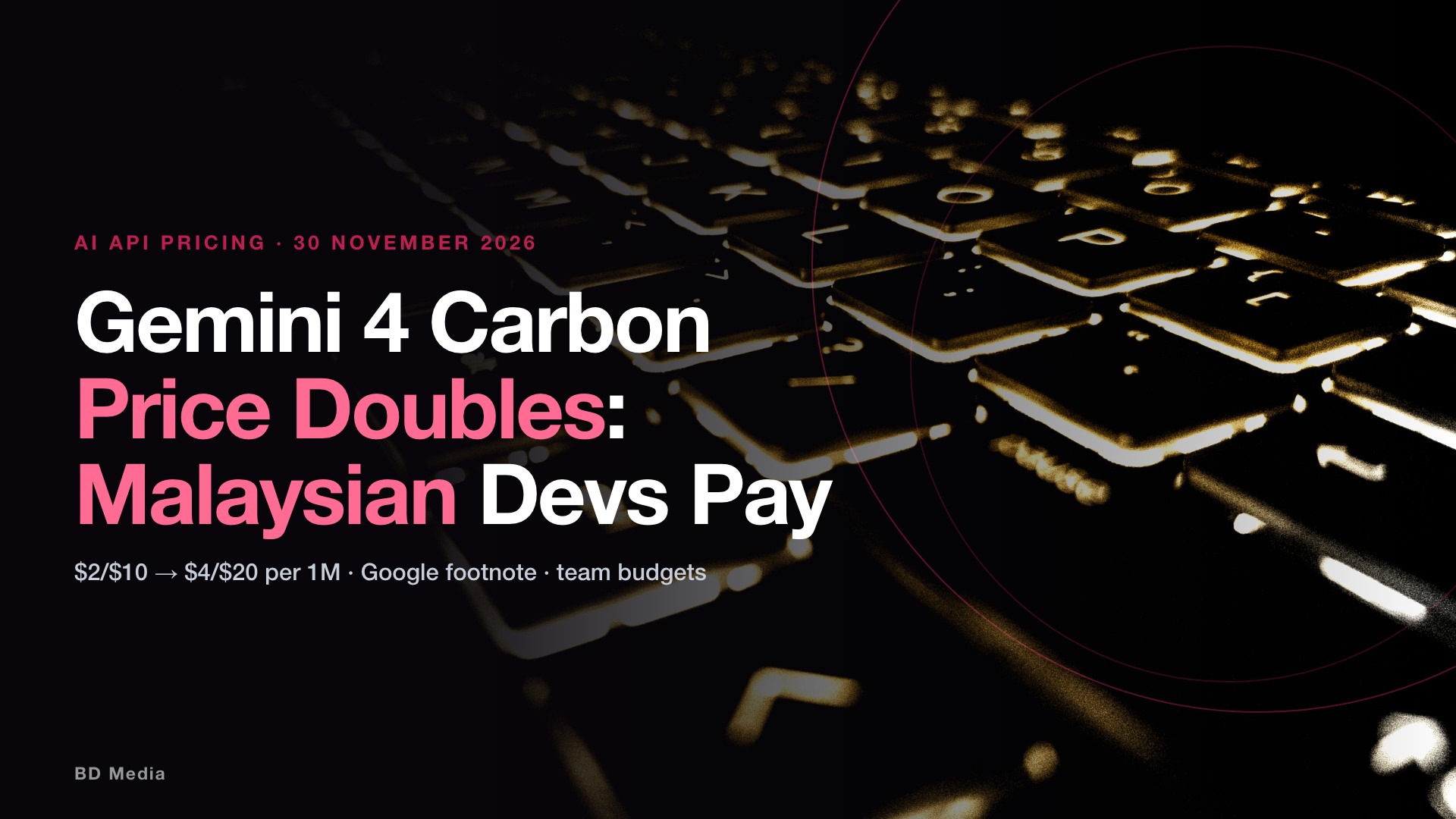
Cost planning happens at the keyboard, not in the pricing footnote alone. Photo: “Keyboard in dark”, Wikimedia Commons, CC BY-SA 4.0. Price figures are from Google’s 10 November 2026 footnote.
Per-token is not per-task
A doubled token rate does not automatically double the cost of finishing a job. Google says Carbon uses more tokens than Argon to reason deeply and run verification loops, which means a lower per-task result can coexist with a higher per-token price. The two measures answer different questions.
Google reports that Carbon ranks first on CursorBench 4.0, Perplexity’s WANDR and Zapier’s AutomationBench, at more than two times lower cost per task than the next best external model. Google also reports a second place on the Multimodal Knowledge Agent benchmark, a benchmark it launched with Artificial Analysis, at more than six times lower average cost per task than the top model. Those are Google’s reported results. The MKA benchmark was co-launched with Artificial Analysis, but the ranking and the cost comparison in the announcement are Google’s statements.
Google reports that Carbon passed 92 per cent of tasks on its own 375-task agentic honesty benchmark, against 70 per cent for Argon. Google reports a 0 per cent prompt-injection success rate on the Gray Swan IPI benchmark, and reports that Trajectory Labs found zero new universal jailbreaks across 132 hours and more than 13,000 requests. Each of these is a result published by Google, including the ones whose underlying benchmark carries an external name. None is presented here as independently verified by this desk.
The lesson for a budget is narrower than the benchmark table. Measure the model against the team’s own tasks, count the tokens those tasks consume, then apply $4/$20. The earlier discussion of what Apple’s AI token budget cut taught Malaysian teams covers the budgeting discipline from the other direction.
Why this is different from x402 and ChatGPT Wallet
Three stories about AI and money are circulating together. They operate at different layers, and confusing them produces the wrong checklist.
| Name | Layer | What changes for a team |
|---|---|---|
| Gemini 4 Carbon pricing | Model call cost | Token rates move from $2/$10 to $4/$20 after 30 November. |
| ChatGPT Wallet | Consumer product | An agent pays at checkout with a network token and per-purchase approval. See how ChatGPT Wallet changes agent payments. |
| x402 | Protocol idea | A proposal around the HTTP 402 status code. See how x402 handles payments at the protocol level. |
Three different layers: API pricing, a consumer payment product, and a payment protocol idea. Source: Google, 10 November 2026; BD Media’s published ChatGPT Wallet and x402 articles.
None of these three is a substitute for another. A developer budget affected by the Carbon footnote is not affected by whether an agent can pay at retail checkout, and a protocol discussion does not change the token rate on an invoice.
What we could not confirm
- Data handling. Google’s Carbon announcement does not set out data retention, training use, logging or deletion terms for Carbon. Those terms sit with the applicable API, Cloud or Workspace agreements and cannot be inferred from the launch post.
- Subscription and seat prices. Google AI Ultra’s subscription price and enterprise seat pricing do not appear in the announcement.
- Free and lower-tier timing. No date was given for free or lower-tier access. The selective research and Fairwind routes are not general availability.
- Independent benchmark verification. Every benchmark figure in the post is reported by Google, including results connected to named external benchmarks. This desk did not reproduce them.
- An exact 1 December wording. Google’s phrase is “after the introductory period expires on November 30, 2026”. Secondary reports that convert this into a 1 December start date are not quoting Google.
- Malaysian search demand. `gemini 4 carbon`, `gemini api pricing` and `ai pricing malaysia` all returned no data in the MY keyword database on 17 November 2026. No data is not zero.
What to watch next
The dated item is the end of the introductory period on 30 November 2026. Any cost model that still uses $2/$10 for Carbon needs re-running at $4/$20 before that date. After the change, the first check is whether invoices reflect the footnote, not whether a secondary report described the change correctly.
Three undated items follow. Google may publish specific data-handling terms for Carbon on the API and workspace tiers. The reported benchmark results may be reproduced by parties outside Google. And the selective access programmes may change shape, though Google gave no timetable. None of these should be treated as scheduled.
For teams looking at other routes into AI tooling while budgets are being reworked, other free AI routes open to Malaysian SMEs are covered separately. The immediate decision here is simpler: recalculate the token budget at the published higher rate.
Sources
- Google, Gemini 4 Carbon is now available, 10 November 2026 (introductory $2/$10 API price; footnote [1] on the 30 November expiry and $4/$20; access tiers; selective research and Fairwind routes; Google-reported benchmarks) — blog.google/innovation-and-ai/models-and-research/gemini-models/gemini-4-carbon-now-available
- Google, Gemini 4 Carbon: our next frontier model, 28 October 2026 (initial subset of cyber defenders via Fairwind; 10,000-scientist Argon programme; cached input note) — blog.google/innovation-and-ai/models-and-research/gemini-models/introducing-gemini-4-carbon
- CASRAI Editorial Board, Google Makes Gemini 4 Carbon Generally Available: Access Tiers, Pricing and What Research Offices Should Check, 13 November 2026 (independent corroboration of the footnote and of the access tiers) — casrai.org/news/google-gemini-4-carbon-release-2026
- RR Tech Pulse, Gemini 4 Carbon is now available to paying developers and AI Ultra subscribers, Ramiz Raja, 10 November 2026 (access summary; explicit note that the reported results are Google’s) — rrtechpulse.com/stories/gemini-4-carbon-now-available-api-ai-ultra
- SE Ranking, DATA_getKeywordsMetrics, source MY, measured 17 November 2026 (three candidates returned no data;
gemini api2,400) — internal SEO record, see meta.jsondemandblock
BD Media is the editorial desk of Big Domain. This article records a published price change and the access tiers named by Google. It is not procurement or tax advice. No currency conversion has been applied and no benchmark result is presented as independently verified.