MAI Code 2 is now selectable in GitHub Copilot. Microsoft released the flagship coding model and a lighter sibling, MAI Code 2 Flash, on 17 November 2026 at Ignite in San Francisco. Both arrived generally available rather than as a preview, which for a Malaysian team on Copilot means the choice sits in the model picker today rather than in a waitlist.
The pitch is arithmetic. Microsoft says MAI Code 2 reaches 98% of OpenAI’s GPT-6.1 Sol on four coding benchmarks at about 40% of the cost per task, and 96% of Anthropic’s Claude Opus 5.5 at 5% of the cost. Those are the company’s own figures, produced on its own evaluation platform, and the cost side is calculated at a promotional rate that Microsoft has already scheduled to end.
Both halves of that sentence matter. The first half is why developers will try the model this month. The second half is why a procurement decision built on it needs a date attached.
Last updated: 19 November 2026. This article uses Microsoft’s announcement and keynote transcript, TechWire Asia’s report of the disclosure footnotes, and GitHub’s Copilot billing documentation. Microsoft’s benchmark results have not been independently reproduced.
MAI Code 2 claims: near-Sol quality at 40% of the cost
Microsoft’s announcement places the two models in a single family with different jobs. Code 2 handles multi-file implementation, deep debugging and repo-wide reasoning. Flash handles the high-volume work around it: explanations, targeted edits, routine fixes, fast iteration.
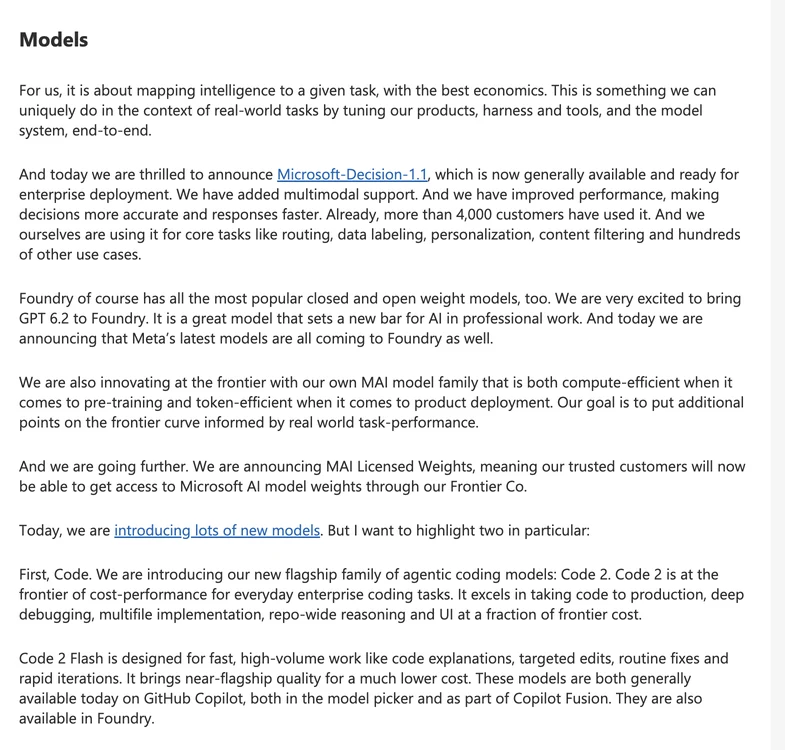
Source: The Official Microsoft Blog, Ignite 2026: Building the frontier ecosystem, 17 November 2026. Captured 19 November 2026 from blogs.microsoft.com/blog/2026/11/17/ignite-2026-building-the-frontier-ecosystem.
The comparison is an average across four suites: DeepSWE 1.1, Terminal Bench 2.1, SWE-Atlas and FrontierCode v1.1. All were run at maximum reasoning effort. Three ran on MSBench, Microsoft’s internal evaluation platform, driven through the GitHub Copilot CLI with subagents disabled. FrontierCode’s scores and costs came from Artificial Analysis, the only outside grader in the set.
| Claim Microsoft makes | Quality | Cost per task | Who measured it |
|---|---|---|---|
| MAI Code 2 against GPT-6.1 Sol | 98% | 40% | Microsoft, four suites |
| MAI Code 2 against Claude Opus 5.5 | 96% | 5% | Microsoft, four suites |
| Code 2 Flash against GPT-6 Luna | comparable | 65% | Microsoft, three suites |
| Code 2 Flash against Claude Haiku 5.5 | comparable | 20% | Microsoft, three suites |
All four cost ratios are computed at Microsoft’s 50% promotional price. Nothing here has an independent reproduction yet.
The catch: the rate doubles on 17 May 2027
TechWire Asia read the footnotes and found the one that governs the whole comparison. Microsoft disclosed that the MAI Code 2 cost figures were calculated using a 50% promotional discount, while the models it is compared against were priced at list. GitHub’s Copilot billing table carries the same story with dates attached: the launch rates hold until 17 May 2027, then double.
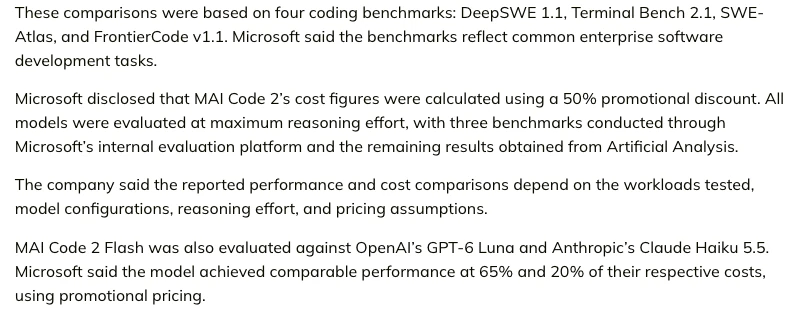
Source: TechWire Asia, Microsoft unveils new AI models for coding and cybersecurity, 18 November 2026. Captured 19 November 2026 from techwireasia.com/2026/11/microsoft-ai-models-coding-cybersecurity/.
Doubling changes the shape of the claim without changing the model. If a team’s token use per task stays flat, the same comparison becomes roughly 80% of GPT-6.1 Sol’s cost and 10% of Opus 5.5’s once the promotional rate lapses. That arithmetic is ours, not Microsoft’s, and it assumes no change in how many tokens a task consumes.
What Microsoft says the models cannot do
The scoping is stated plainly in the launch material. Microsoft says that both models are built for everyday enterprise coding and are “explicitly not yet tuned for harder problems, like fundamental science research and very long horizon agentic work.” The model card adds the operational limits: release optimisation is for English code production, and generated code is expected to pass human review and testing before it reaches production.
Long sessions are named as a weak point too, with instruction drift and unfinished verification reported as known behaviours rather than edge cases. None of this is disqualifying. It tells a team where the model belongs, which is the routine majority of a working week rather than the hard tail of it.
Availability is narrower than the announcement’s tone suggests. Code 2 is in Copilot for Pro, Pro+, Max, Business and Enterprise plans. Flash reaches the Free and Student tiers as well. Flash is also in limited-access preview on Microsoft Foundry. Other channels, including OpenRouter and Vercel, are described as forthcoming rather than live.
MAI Code 2 against the Chinese open-weight models
A Malaysian team comparing this against the alternative has a second reference point: the Chinese families whose weights can be downloaded and run on hardware the team controls. On the two benchmark versions Microsoft chose for its own scorecard, Code 2 sits in the middle of that group rather than at the front of it.
| Model | Terminal-Bench 2.1 | DeepSWE v1.1 | Weights |
|---|---|---|---|
| MAI Code 2 (Microsoft) | 84.6 | 73.2 | not downloadable |
| GLM-5.3 (Z.ai) | 88.2 | 66.9 | 756 GB, MIT-style |
| DeepSeek-V4-Pro-0813 | 87.9 | 62.7 | 1.78 TB, MIT |
| Qwen3.8-Max (2.4T-A95B) | 86.6 | not reported | 2.50 TB, MIT-style |
| Qwen3.8-27B | 73.0 | not reported | 31 GB FP8, Apache 2.0 |
| DeepSeek-V4.1-Flash-1017 | not reported | 77.0 | 511 GB, MIT |
| Kimi K3.1 Pro (Moonshot) | not on 2.1 | 75.5 | 1.56 TB, MIT-style |
Every score is vendor-reported. Microsoft ran its row on MSBench through the Copilot CLI; the Chinese labs used their own harnesses, so the columns are comparable in name more than in method. Weights and sizes read from the Hugging Face cards on 13 November 2026.
One row is worth isolating. DeepSWE v1.1 puts Kimi K3.1 Pro at 75.5 and DeepSeek V4.1 Flash at 77.0, both above Code 2’s 73.2, and DeepSeek V4.1 Flash activates 8B to 16B parameters against Code 2’s 77B. A model that fits on one node scores higher on that suite. The same table shows why a single column cannot settle the question: GLM-5.3 wins Terminal-Bench 2.1 at 88.2 and lands 10 points behind Code 2 on DeepSWE.
The version gap that changes the ranking
Terminal-Bench 4.0 is the newer, harder release, and the Chinese labs report against it. Kimi K3.1 Pro posts 65.7 there, against 66.4 for Claude Opus 5.5. DeepSeek V4.1 Flash posts 42.3 and GLM-5.3 posts 41.8. Microsoft reported Code 2 on 2.1, not 4.0.
A community-compiled table from the same week attempted the comparison anyway: it put Code 2 at 26.3 on Terminal-Bench 4.0 and Code 2 Flash at 2.5, against 48.5 for Qwen4-Max and 42.3 for DeepSeek V4.1 Flash. Its compiler labelled the table uncontrolled and asterisked several rows for harness differences, and the parameters used were estimates. It is an observation, not a result.
What it does establish is narrower and more useful. A score of 84.6 on one generation of a benchmark says nothing about the next generation, and the open-weight labs have already published on the next generation while Microsoft has not. That is not a claim that Code 2 collapses on harder tasks. Nobody outside Microsoft has run it on them yet, and until someone does, the honest position is that the headline figure is scoped to the suite that produced it.
Open weights versus a Copilot seat
The difference that survives benchmark arguments is access. DeepSeek publishes under MIT. Qwen’s 27B release is Apache 2.0. GLM-5.3-Flash is MIT. The flagships from Moonshot, Z.ai and Qwen carry MIT-style licences with revenue clauses that bite only on businesses reselling model access, which is not most Malaysian software houses.
MAI Code 2 has no download at all. Microsoft introduced MAI Licensed Weights at the same event, described as access to model weights for trusted customers through its Frontier programme, and the coding models are served rather than shipped. A team that needs the code to stay on its own hardware has no route to this model, at any price.
Hardware is where the open route narrows. Kimi K3.1 Pro is a 1.56 TB checkpoint, DeepSeek V4 Pro 1.78 TB and Qwen3.8-Max 2.50 TB, each needing an eight-GPU node and often two. Qwen3.8-27B is 31 GB in FP8 and fits a single 80 GB card, which is the only entry on this list a mid-sized Malaysian company could plausibly run in its own rack without buying a node.
One more number belongs beside the scores. The October 2026 LSCBench study of generated code found that Kimi K3 produced code that was both working and secure on 16.4% of tasks, GLM-5.3 on 21.3%, Qwen3.8-Max on 22.0% and DeepSeek V4 Pro on 18.0%. The best closed model reached 25.1%. Cheap code that passes a benchmark and ships a vulnerability is not cheap, in either camp.
What this changes for a development team in Malaysia
Copilot usage is billed in AI credits, with one credit equal to one US cent, and each plan carries an included allowance before usage charges begin. Business and Enterprise administrators decide which models their users can reach through model policies, and new models are enabled automatically under the default policy unless an administrator has turned that behaviour off.
Two consequences follow for a team already paying for seats. Flash reaching the free tier means the cheapest way to evaluate the family costs nothing beyond an existing account. Administrators who want a controlled comparison need to act on policy before the model appears for everyone, not after.
The second consequence is about measurement. A lower token price is not the same as a cheaper finished feature. If a model needs more attempts, or produces patches that take longer to review, the saving on the invoice can be spent again in engineering hours. Microsoft’s own framing, that these models produce changes maintainers would merge, is the right thing to test and the wrong thing to assume.
How a team can check the claim on its own repository
A useful comparison needs three tasks, not thirty. One contained bug with a known cause. One change that touches several files. One interface element built from a mockup, since the models accept images as input.
Both models should receive the same acceptance tests, written before either run starts. Three outcomes are worth recording: whether the patch passes, whether it edits anything nobody asked it to touch, and how much review the change needs before merge. The third is where a cheap model stops being cheap, and it is the number the benchmark suites do not carry.
Running the same three tasks at the post-promotion rate as well as the launch rate takes an afternoon and settles the budget question that the headline comparison leaves open.
Sources
- Microsoft, Ignite 2026: Building the frontier ecosystem, The Official Microsoft Blog, 17 November 2026 — blogs.microsoft.com
- Microsoft AI, Microsoft Ignite 2026: MAI keynote transcript, 17 November 2026 (98% of GPT-6.1 Sol at 40% of the cost; the explicit scope limit on science research and long-horizon agentic work) — microsoft.ai
- TechWire Asia, Microsoft unveils new AI models for coding and cybersecurity, 18 November 2026 (96% of Claude Opus 5.5 at 5% of cost; four benchmark suites; 50% promotional discount disclosure; Foundry preview) — techwireasia.com
- Reuters via CGTN, Microsoft unveils AI models for coding, cybersecurity, 18 November 2026 (Ignite, San Francisco; Mustafa Suleyman interview) — news.cgtn.com
- Wikimedia Commons, Microsoft sign at night at The Bravern Building 1, CC BY 2.0 (cover photograph) — commons.wikimedia.org
BD Media is the editorial desk of Big Domain. This article reports vendor-published benchmark claims and the pricing disclosure attached to them. It does not present Microsoft’s figures as independently verified, and it makes no recommendation on which Copilot plan a business should buy.