Data centre Malaysia growth is now part of Malaysia’s cyber-risk conversation. NACSA’s chief executive told The Vibes on 17 November that 117 projects had been approved and that more than 5,000 cyber incidents were recorded up to September 2026. A separate report gives 5,110 incidents for that period; the incident counts and the scope of the RM385.7 billion figure are both reported below as unresolved source conflicts. The official NC4 portal carries the level directly: “National Cyber Threat Level MODERATE (Last updated: 04 November 2026, 11:42AM)”. It describes that level as “An existence of cyber threats, or known exploits have been identified and has resulted minor impact to the nation.” The wording is important: the official classification is precautionary, not a declaration of a national cyber crisis.
None of this says that small businesses were breached, or that a data centre was attacked. The reported point is about attack surface: more interconnected digital systems mean more places that need protection. For an SME, the useful response is a short check of suppliers, accounts and monitoring, not a new security budget built on a headline.
Last updated: 23 November 2026. This article separates NACSA figures reported by the media from the official threat-level scale published by NC4. It is not security or legal advice.
What did NACSA actually report about data centre Malaysia growth?
The Vibes reported on 17 November that National Cyber Security Agency chief executive Dr Megat Zuhairy Megat Tajuddin linked expanding digital infrastructure to a wider attack surface. The report quotes him directly on the mechanism:
The same report is careful on causation. It says the expansion of data centres did not necessarily make the facilities direct targets. The concern was the growth in interconnected systems around them.
The figures come from that report. No NACSA page opened in this session carries the 117-project or RM385.7 billion numbers, so they are attributed to The Vibes’ reporting of the chief executive’s remarks, not to an official document read directly. That boundary matters and is repeated in the section on what could not be confirmed.
The same report says Malaysia has been strengthening cyber resilience through the Cyber Security Act 2024, particularly the capabilities and preparedness of entities under the National Critical Information Infrastructure framework. The financial sector was described as having taken earlier steps. For a business outside that framework, the practical question is whether a customer or supplier relationship pulls it into someone else’s readiness plan.
Do the 117 projects and RM385.7b mean what readers think?
The Vibes gives a breakdown that is more informative than the headline total. Of the 117 approved projects, 55 are already operational, 19 are under construction, 16 have yet to begin construction and 27 are at various stages of implementation.
| Project stage | Count | What it means |
|---|---|---|
| Operational | 55 | Already running |
| Under construction | 19 | Building in progress |
| Not yet begun | 16 | Approved but not started |
| Other implementation stages | 27 | At various stages, per the report |
| Total approved | 117 | RM385.7 billion in investment, per the report |
Project counts reported by The Vibes, 17 November 2026, citing NACSA’s chief executive. Source: The Vibes. No official project register was opened for this article.
Approval is not operation. A project counted in the 117 may be running, building, stalled at the planning stage or somewhere between. The RM385.7 billion figure is a cumulative data-centre-related investment approval total reported by MIDA from 2021 through the first half of 2026 (as reported by From Inside Asia, 17 November 2026), not a measure of cybersecurity exposure and not a figure for any single operator.
Who is counted in the 5,000 cyber incidents?
The Vibes reported more than 5,000 cyber incidents up to September 2026. The same report gives historical context: 3,076 incidents in 2024 and 5,837 last year. It quotes the NACSA chief expecting the number to keep rising as AI tools give attackers greater capability.
The reporting does not provide a sector breakdown for those incidents. It does not say how many involved SMEs, how many were reports of scams rather than intrusions, or how many were directed at critical infrastructure. A total national count cannot be read as a count of business breaches.
That distinction protects readers from a common mistake. A rise in national incident reporting may reflect more detection and more reporting as well as more attacks. Without a category breakdown, the figure is a signal of trend, not a measure of any one business’s risk.

NC4’s national threat-level indicator, captured 23 November 2026. Source: NC4, Malaysia Cyber Threat Landscape. The page presented MODERATE in one capture and LOW when re-read the same day; the article reports both readings rather than choosing one.
What changed with the 4 November threat level?
Bernama reported on 4 November that NACSA raised the National Cyber Security Threat Level from Low to Medium, according to a National Security Council statement. The statement described the move as a precaution in light of current security developments.
The official NC4 site publishes the scale used for this classification: LOW, MODERATE, CAUTION, HIGH and CRITICAL, and identifies its operator in the site footer as the National Cyber Coordination and Command Centre. The page opened for this article rendered LOW at the time of reading. It did not supply the 4 November change or a timestamp for that change. The 4 November move is therefore attributed to Bernama’s report of the NSC statement, not to the official page.
There is also a wording difference. Bernama’s English report says Medium; the NC4 scale uses MODERATE. Both refer to the second rung of the national scale. The article prints both labels with their sources rather than silently choosing one.
Bernama reported nine preparedness measures for National Critical Information Infrastructure entities, naming 24-hour monitoring, system patching, multi-factor authentication and updated Service Continuity Plans among them. Sector heads must submit weekly threat status reports to NACSA. NC4 issued eight alerts and advisories during October 2026, the statement said.
The statement linked the change to remarks by Prime Minister Anwar Ibrahim in the Dewan Rakyat on 3 November about national preparedness amid geopolitical and regional tension. It also described three continuing NC4 functions: issuing cybersecurity alerts and advisories, strengthening threat detection and assessment, and monitoring NCII entities and government agencies. NACSA’s own FAQ describes its mandate as covering the government, NCII, businesses and the public, which is why a raised national level can matter to a company that is not itself a critical entity.
What should a Malaysian SME check this week?
The measures just described apply to NCII entities. An SME is not automatically one of them. The reason to act is indirect: a business may supply an NCII operator, share systems with a larger client, or depend on a platform whose security posture affects its own operations.
- Confirm the supplier chain. Ask which providers handle authentication, payments or hosted systems for the business, and whether any client classifies the business as a critical supplier.
- Check multi-factor authentication. Cover admin, remote and third-party accounts, not only the owner’s login.
- Look at patching. Compare the business’s update cycle with any advisory that applies to software it uses.
- Test the alert path. Confirm that an overnight security alert reaches a person who can act, not an unmonitored inbox.
- Keep a short evidence log. A dated record of checks is easier to produce if a client asks than a recollection.
None of these steps requires treating the national threat level as a crisis. Bernama’s report of the NSC statement called the change precautionary, and NACSA’s chief executive has made the same point in separate reporting. The checks are proportionate to a raised alert posture, not to a confirmed incident at the business.
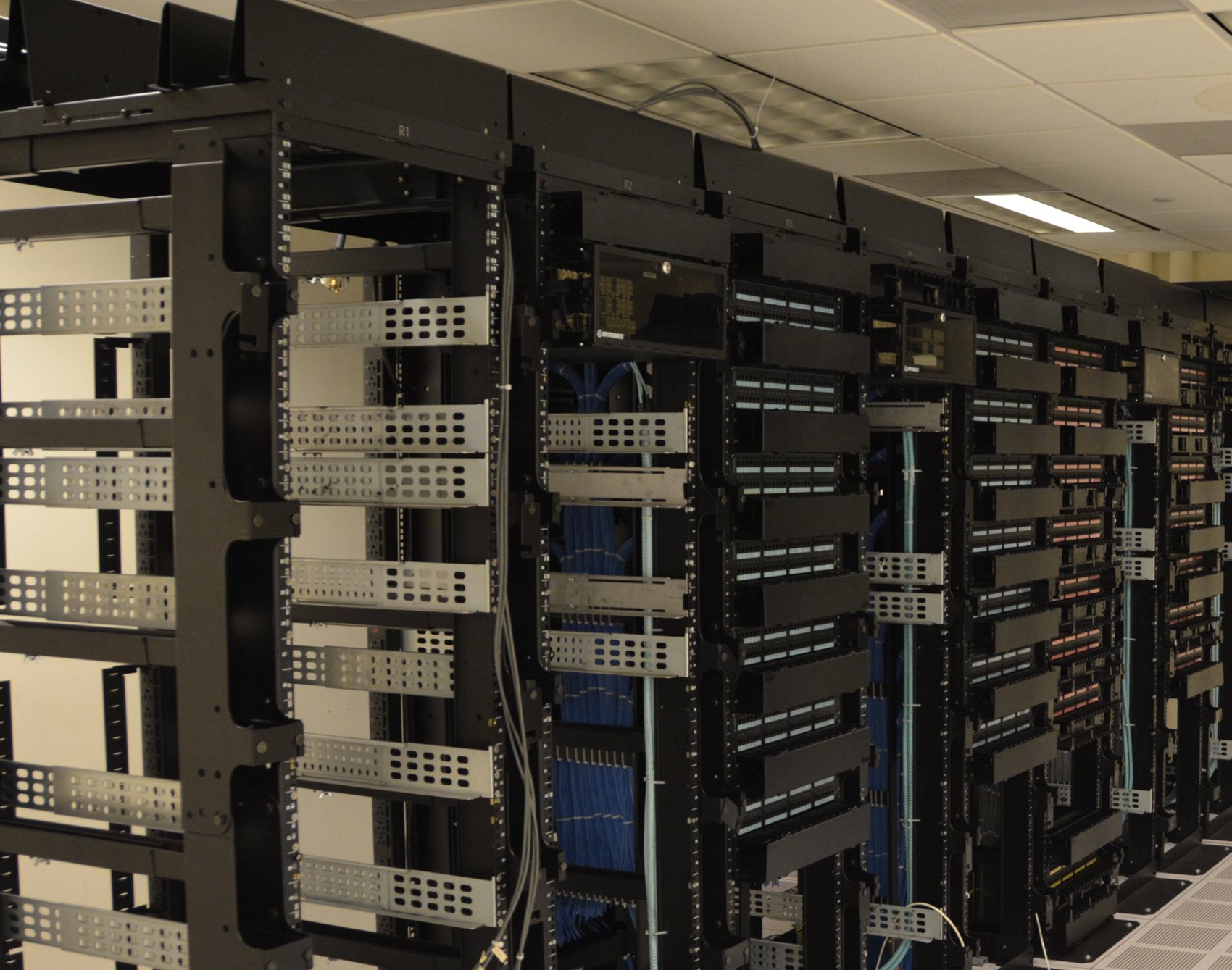
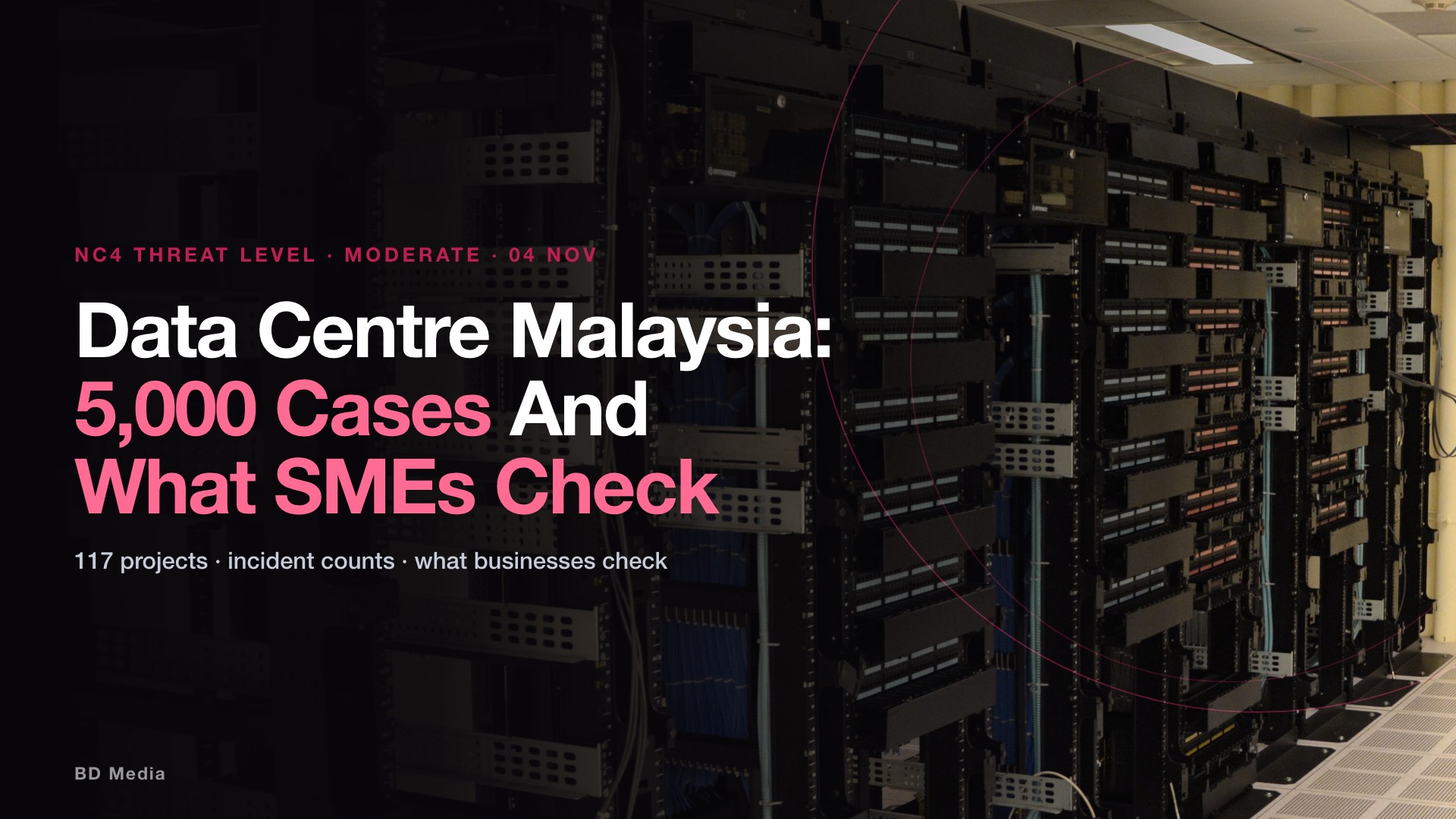
Data centre server racks. Photo: “Datacenter Server Racks”, Carl Lender, Wikimedia Commons, CC BY 2.0. Approval figures are attributed in the text to reporting of government data.
Why is this not the chip-licensing story?
Data centres appear in two separate policy stories this month, and they are being conflated. The earlier article on Malaysia’s US chip licensing rules deals with export controls, licence conditions and the risk of advanced chips reaching restricted destinations. This page deals with NACSA’s cyber-posture figures and the national threat level.
The mechanisms do not overlap. An export licence governs what hardware may be supplied. A cyber threat level governs how prepared operators and service providers should be. A data centre can be relevant to both without the two stories being the same news.
For readers following national infrastructure policy, Malaysia’s sovereign AI cloud plans are a third, related subject. And a different compliance calendar again is covered in Online Safety Act obligations, which concern platform safety plans rather than cyber readiness.
Does data centre growth change local supply chains?
The NACSA remarks reported by The Vibes focus on digital interconnectedness rather than procurement. The article does not give a supplier breakdown, local-content figure or jobs number for the 117 projects. Any claim about how much of RM385.7 billion reaches Malaysian vendors would need a source that was not opened here.
What can be said is narrower. More operational data centres create demand for facilities management, network services, security monitoring, specialist labour and the suppliers that support them. For firms already working in that chain, the relevant question is which security requirements arrive through customer contracts rather than through a new regulation aimed at them. Businesses selling into that chain may inherit the customer’s security requirements through contract. For Malaysian teams weighing the spend side of that relationship, how Malaysian teams compare AI costs per task covers cost comparison from a different angle.
What we could not confirm
- Official source for the investment figures. No NACSA page opened in this session carries the 117-project or RM385.7 billion numbers. They are attributed to The Vibes’ report of the chief executive.
- Category breakdown for the incident count. The report gives a national total and two historical figures, not a split by sector or business size.
- An official timestamp for the 4 November change. The NC4 page rendered LOW when opened and did not show the change. The event is sourced to Bernama’s 4 November report.
- Whether the eight-million-user threshold or other NCII thresholds changed. No source was found for any adjustment.
- Local supply-chain value. No local-content or vendor-spend figure was available from the sources opened.
What to watch next
Three items are worth monitoring. NACSA may publish the incident figures in a form that breaks them down by sector. NC4’s published threat level may move again, and the official page is the place to read the current state. And future reporting may attach a supplier or procurement breakdown to the approved project count.
For a business, the next step is modest and specific: verify whether any customer treats it as part of critical infrastructure, then complete the five checks above with dates and names attached. That is a better use of the raised alert posture than reading the RM385.7 billion figure as a personal risk estimate.
Sources
- The Vibes, Data centre boom exposes Malaysia to wider cybersecurity threats, NACSA warns, 17 November 2026 (117 approved projects; RM385.7 billion; 55 operational, 19 under construction, 16 not begun, 27 at other stages; more than 5,000 incidents to September; 3,076 in 2024; 5,837 last year; attack-surface quote) — thevibes.com, 17 November 2026
- Bernama, NACSA Raises Level of Cyber Security Threat To Medium, 4 November 2026 (Low to Medium; NSC statement; nine preparedness measures; weekly NCII reports; eight October alerts) — Bernama, 4 November 2026
- National Cyber Coordination and Command Centre, National Cyber Threat Level (official scale LOW / MODERATE / CAUTION / HIGH / CRITICAL; footer identifies NC4; page rendered LOW when opened on 23 November and did not display the 4 November change) — nc4.gov.my/news-detail/18295
- NACSA, Frequently Asked Questions (official description of NACSA’s mandate over NCII, businesses and the public; incident reporting route) — NACSA FAQ, accessed 23 November 2026
- SE Ranking, DATA_getKeywordsMetrics, source MY, measured 23 November 2026 (`data centre malaysia` 10 / difficulty 34; two narrow candidates no data) — internal SEO record, see meta.json
demandblock
BD Media is the editorial desk of Big Domain. This article reports NACSA figures carried by named media and the official threat-level scale published by NC4. It is not security or legal advice. Readers should check the official NC4 page for the current threat level.