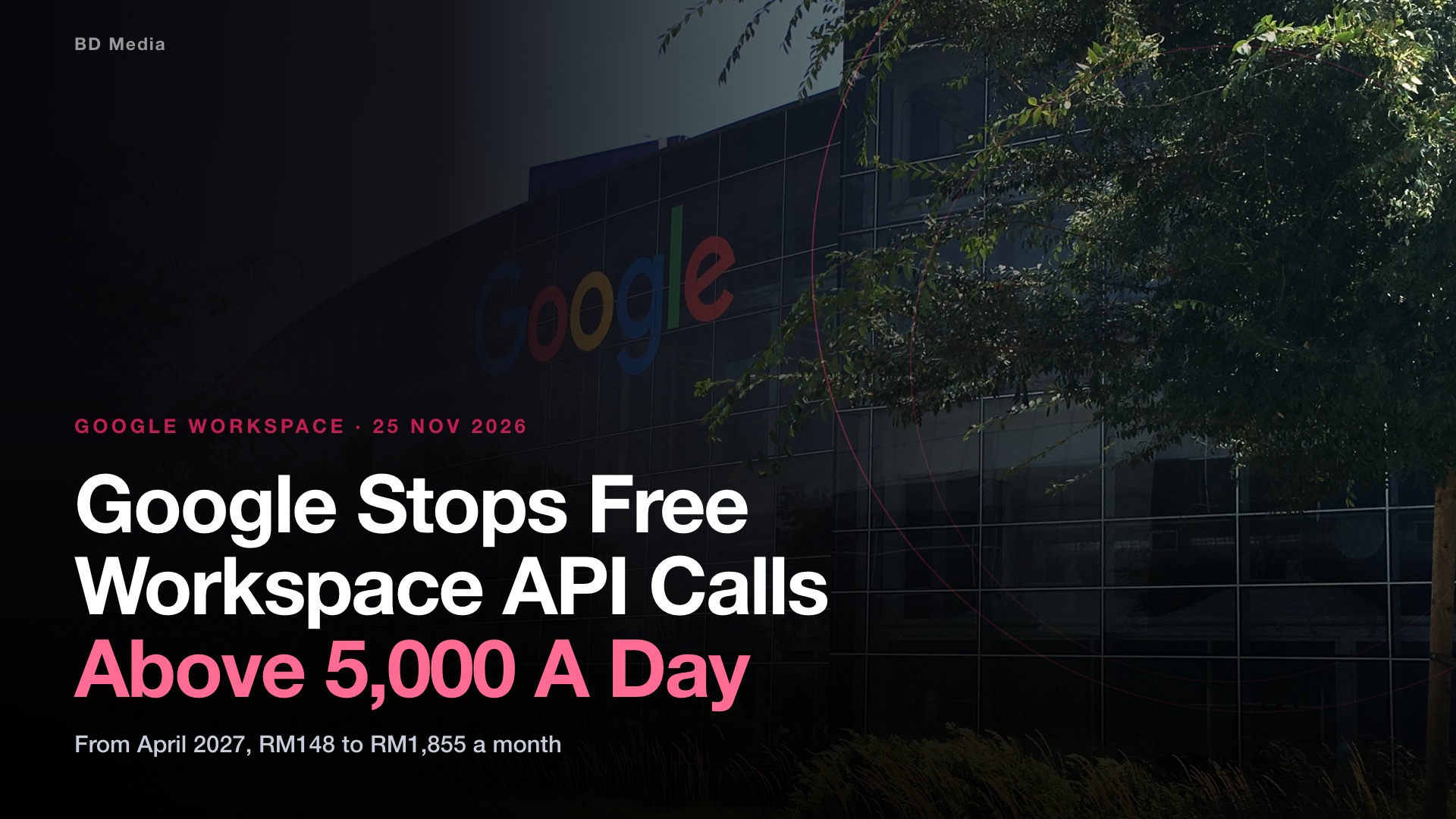
KUALA LUMPUR, 25 November 2026 — The Google Workspace API now has a price list on the door that AI agents use to reach Gmail, Google Drive and Google Calendar. The company made its Workspace Model Context Protocol servers and the official Workspace command-line tool generally available on 24 November and split the Workspace APIs behind them into two usage tiers: Standard, free at published rate limits, and Scaled, which is metered from 1 April 2027. A project that wants more than Standard allows must be switched to Scaled by then, or it is throttled back to Standard limits on that date.
The sentence that decides who this concerns is in the launch post itself. Google states that over 99 per cent of active developers sit inside Standard and will keep using these APIs at no cost. The exposure therefore falls on the small share of projects running agents against Workspace data all day — and on the tool vendors who sell those agents to everyone else, which is how the bill reaches a Malaysian SME.
What Does Google Workspace API Cost Now?
Four billing buckets, priced per 1,000 requests, and each API draws from a fixed set of them. Drive uses all four. Gmail uses three, without Plus. Every Calendar request is priced in Plus.
| Billing bucket | Ringgit per 1,000 requests |
|---|---|
| Light — metadata reads | RM0.41 |
| Medium — mail reads, standard changes | RM0.82 |
| Plus — list operations, all Calendar calls | RM1.03 |
| Premium — bulk sync, batch, binary downloads | RM2.06 |
Google publishes these rates in US dollars — 0.10, 0.20, 0.25 and 0.50 per 1,000 requests. The ringgit column is this desk’s conversion at RM4.1228 to the dollar. Source: Google Workspace developer documentation, per-1,000-request pricing, https://developers.google.com/workspace/guides/quota-pricing, page updated 24 November 2026; reference rate published by ExchangeRate-API on 24 November 2026.
Read as a rate, the change to the Google Workspace API is trivial. A thousand requests a day for a month in the Plus bucket comes to about RM31. That is not a cost story, and any headline built on the per-request price is describing the wrong thing. The published volume discounts only begin above 20,000 US dollars of monthly usage — roughly RM82,000 — which no Malaysian SME running one internal agent will approach.
The cost is in the shape of the tier, not the size of the tariff, and it takes two published rules to see it.
Why Does A 5,000-Request Ceiling Matter More Than The Rate?
On the Standard tier, the generally available Workspace MCP servers are free up to 5,000 requests per project, per product, per day, on top of a per-minute rate limit. That figure is a ceiling, and two details on Google’s own pages turn it into a cliff.
The first is that some composite MCP tools make several API calls per invocation and are counted as several requests. A tool that summarises a mail thread is not one unit of work at the counter; it is whatever the tool needs. The multiplier per tool is not published, so an agent’s real daily consumption is higher than the number of times it was asked to do something, by an amount nobody outside Google can predict in advance.
The second is that the daily free allowance which softens the Scaled tier for REST users does not exist for MCP. Google’s billing documentation is explicit: in the Scaled tier, the Gmail, Calendar and Drive MCP servers are billed from the first successful request. There is no allowance to exceed. One request over the free ceiling, and the project is either throttled or metered on everything it sends for the whole day.
| Agent requests a day | RM a month, Medium | RM a month, Premium |
|---|---|---|
| 5,000 — the free ceiling | RM0 | RM0 |
| 6,000 | RM148 | RM371 |
| 10,000 | RM247 | RM618 |
| 30,000 | RM742 | RM1,855 |
This desk’s arithmetic: 30-day month, one request per call, no volume discount. Medium and Premium bracket the two ends of ordinary agent traffic. Source: Google Workspace developer documentation, pricing and billing tiers, https://developers.google.com/workspace/guides/quota-pricing, read 25 November 2026; converted at RM4.1228, the reference rate published by ExchangeRate-API on 24 November 2026.
What Does This Cost A Malaysian SME In Ringgit?
For Google Workspace Malaysia, the four levels price out like this. Take a 20-person sales team running one internal agent that summarises mail and answers questions about files. Twenty-five runs a day each, ten MCP calls a run, is 5,000 requests a day: inside the free ceiling, with nothing to spare. One more user, or one tool that loops on a long thread, and the project is at 5,250 requests — and the whole 5,250 is billable, not the extra 250.
That is the decision the numbers support: a project either sits comfortably under the ceiling or it should be budgeted as a subscription. The middle ground does not exist, because the allowance is not proportional and the MCP side has no allowance at all. At 6,000 requests a day the line item is RM148 a month at the Medium rate and RM371 at Premium; at 30,000 it is RM742 or RM1,855. A business can plan around those figures. It cannot plan around “usage above the free allowance”, which is what the summary emails say and what almost every report of this announcement has repeated.
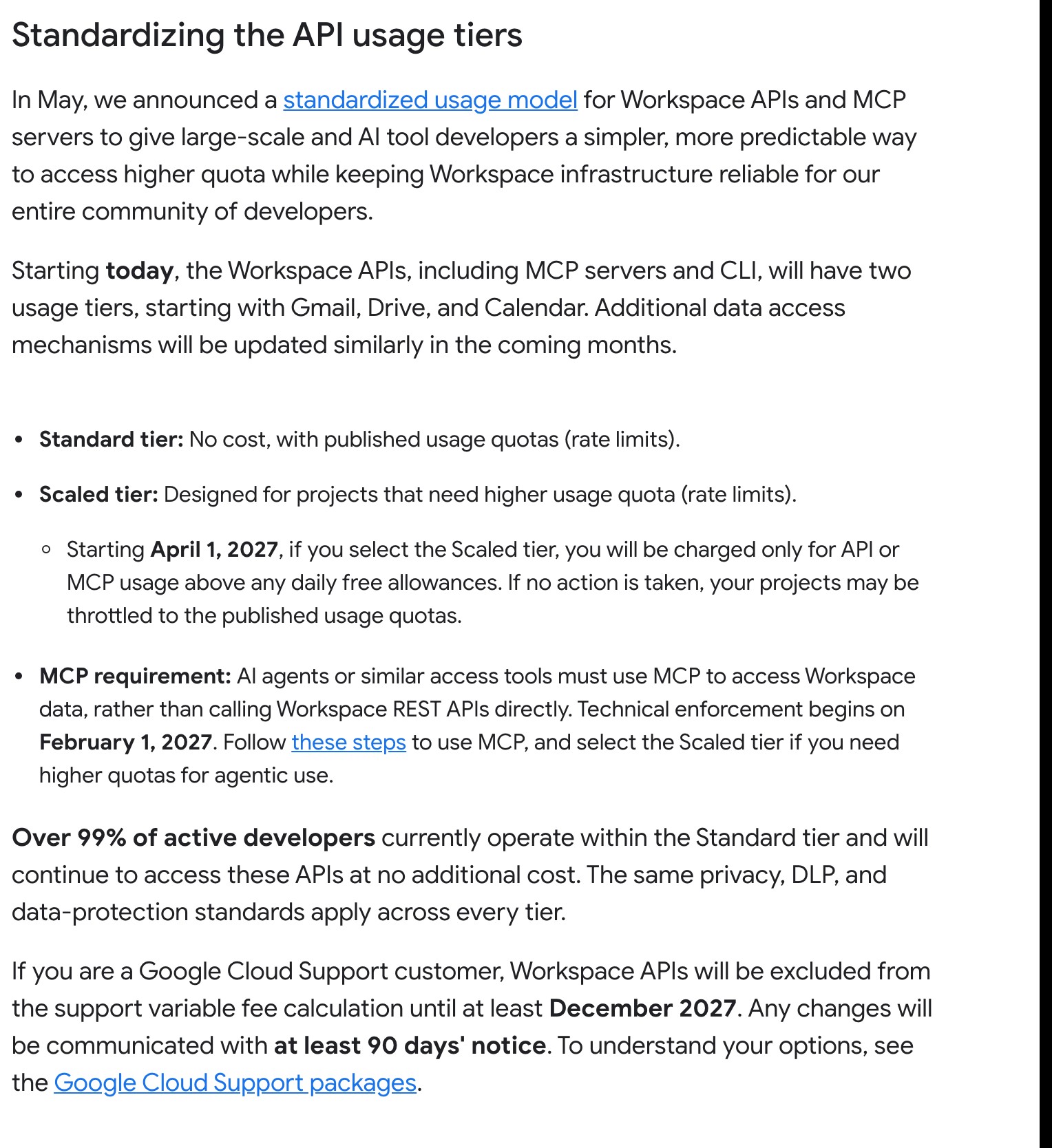
The two tiers in Google’s own words, published 24 November 2026: Standard at no cost with published quotas, Scaled metered from 1 April 2027, and MCP required for agent access with enforcement from 1 February 2027. Source: Google Workspace Updates, https://workspaceupdates.googleblog.com/2026/11/mcp-servers-cli-standardized-usage-tiers-now-available.html, captured 25 November 2026.
Two caveats belong on the number. Google bills in US dollars, so a card payment carries the bank’s rate and any foreign-exchange loading, and the sales and service tax position is the payer’s, not Google’s. Every conversion here uses the 4.122789 rate published by ExchangeRate-API on 24 November 2026. And the one-unit-per-call assumption is the floor: composite tools count for more, so a real bill lands at or above these figures, never below.
Who Should Do Nothing?
Most Malaysian businesses, and it is worth saying so before anyone spends a morning on it. The tiers attach to Google Cloud projects that call Workspace APIs. They do not attach to a Workspace subscription.
- No Cloud project. A company that buys Workspace mailboxes and nothing else has no project to meter. This is not for that business.
- No third-party tool reading mail or files. If the only software touching Gmail is the browser and the phone app, there is nothing to audit and nothing to bill.
- Agents that stay under 5,000 requests a day per product. Under the ceiling in Standard, the cost is zero and the action is to leave it alone.
- Businesses using a vendor’s AI tool. The API bill is the vendor’s; the decision is a contract question, not an engineering one, and it belongs in the section below.
Do not apply for the Scaled tier to be safe. It is a billing relationship with a card attached, it removes the free MCP quota, and it is only worth entering when a project has been measured above the ceiling for a month.
What Changes On 1 February 2027?
Agents must reach Workspace data through the MCP servers or the command-line tool rather than calling the REST APIs directly, and technical enforcement of that rule begins on 1 February 2027. The practical instruction from Google is to flag each agent’s OAuth client with the AI-powered agent option in the Cloud console, on a client separate from the one the company’s ordinary integrations use. Agent traffic still arriving over REST after that date is held to Standard quota, which for a busy agent means throttling rather than a bill.
The rollout is staged. Gmail, Drive and Calendar are first; Docs, Sheets, Slides, Chat and Tasks are named as supported by the MCP servers, with Keep listed as coming, and Google says the remaining data access mechanisms will move to the same model over the coming months. A business that automates a Google Sheet today has one quarter more than a business that automates an inbox.
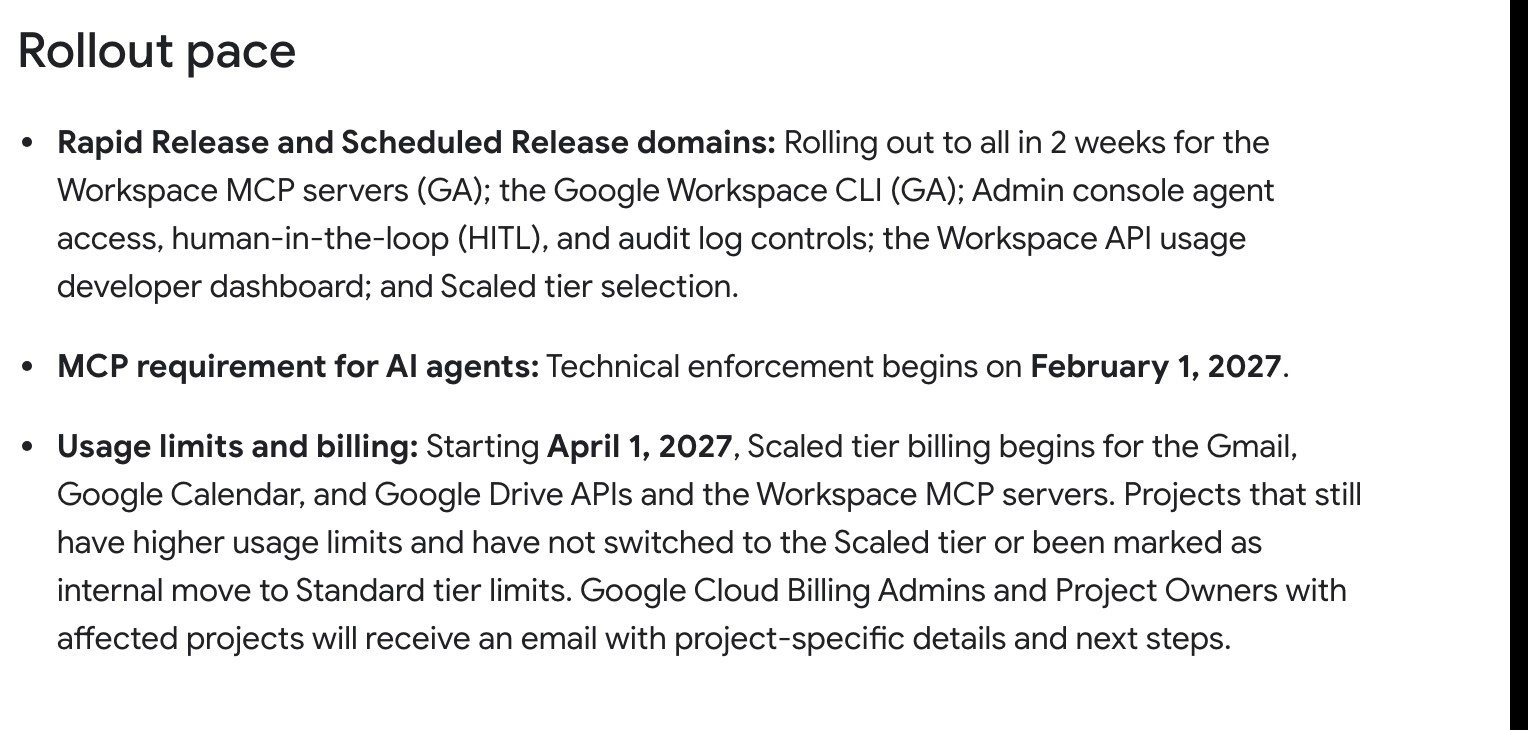
The rollout pace section: enforcement from 1 February 2027, billing from 1 April 2027, and the notice that billing administrators and project owners are emailed with project-specific details. Source: Google Workspace Updates, https://workspaceupdates.googleblog.com/2026/11/mcp-servers-cli-standardized-usage-tiers-now-available.html, captured 25 November 2026.
Independent coverage of the launch repeats both dates and the 99 per cent figure without disagreement: Aipolix pairs the MCP deadline with Google’s Agent Gateway, and Adaptd reads it as an admin-console problem rather than a billing one. Neither prices it for a small business, because the billing detail sits three pages deep in developer documentation rather than in the announcement.
The Bill Arrives Through The Vendor, Not From Google
A Malaysian SME with no Cloud project will never see this invoice, and will still feel it. The tools it buys — the AI assistant that drafts replies from the inbox, the one that files quotations into Drive, the one that reads the shared calendar — run on somebody’s Cloud project, and that somebody is now looking at a metered line that did not exist in its unit economics last week. The pass-through happens at renewal, and it arrives as a price change, not an explanation.
One contradiction is worth resolving before any budget is set. The launch post says a project used only inside one Workspace organisation can be marked internal, so that higher limits remain included in the subscription. Google’s Calendar API quota page describes the same exception more narrowly: it raises the per-project REST quota without switching to Scaled, and states that MCP server quota is not covered by it. Both pages were read on 25 November 2026 and they do not agree. If the narrow reading holds, an internal agent has a free ceiling at 5,000 requests a day and no exemption above it, which changes the arithmetic for every company running its own assistant.
Then put one question to each vendor in writing: how is Workspace API usage billed from April 2027, and is that cost already inside the subscription or passed through at renewal. A vendor that has not yet worked this out will discover it in the same quarter as its customers, which is a reason to ask now rather than in March.
Last updated: 25 November 2026. Tier definitions, the 1 February 2027 enforcement date, the 1 April 2027 billing date, the 99 per cent figure and the internal-use provision from Google Workspace Updates, 24 November 2026. Per-1,000-request rates, the 5,000-request MCP ceiling, the absence of a daily MCP allowance and the volume-discount schedule from Google Workspace developer documentation, pages updated 24 November 2026. The narrower internal-use reading from the Calendar API quota page. Ringgit figures are this desk’s conversion at RM4.1228, the reference rate published on 24 November 2026; Google bills in US dollars and the bank’s rate applies. Full source register with the cannot-verify list held as SOURCES.md.
Googleplex, Mountain View. Cover photograph: Wikimedia Commons, CC BY-SA 4.0.